 Iranco Magazine Team
From product selection and sorting to MRL control, export packaging, cold chain and buyer market intelligence
Export guide · Lime · Quality · Packaging
Iran Lime Export: Target Markets, Quality Standards and Packaging
From product selection and sorting through pesticide residue control, export packaging, cold chain and understanding buyer markets for Iranian lime — a guide for professional importers.
Introduction
Iranian lime for export is not judged on taste and freshness alone. A professional buyer looks at cultivar, diameter, peel colour, juice percentage, visual soundness, pesticide residues, shipment uniformity, packaging and transport conditions.
Iranian lime export becomes a sustainable business when fruit is chosen in the orchard to match the destination market from the start. Lime suited to quick sale in a nearby market is not necessarily suitable for several weeks of transport and distribution in a European market or Gulf retail chains.
Southern Iran is among the well-known tropical and subtropical citrus production areas; Hormozgan, Fars and southern Kerman play an important role in the lime supply chain. Iran’s advantage is not only proximity to Iraq, Oman, Kuwait and Qatar — harvest in warm southern regions, overland and sea access, and regional familiarity with Iranian citrus have built a commercial base.
Competition with Turkey, Egypt, South Africa, Mexico, Brazil and Spain shows that Iranian exporters cannot enter markets on price alone. Export must be a controlled chain from orchard, harvest, sorting, testing, packaging, pre-cooling, transport and delivery.
1. Iran lime in the market and supply chain characteristics
Lime in Iran is linked mainly to warm southern regions. Hormozgan is one of the best-known areas, and southern Kerman and parts of Fars also participate in the tropical citrus chain.
Orchard origin affects availability timing, fruit size, intensity of green or yellow peel, peel thickness, juice content, aroma and acidity, transport sensitivity, ability to supply large volumes, and distance to sorting and cold storage.
- Buying on the generic name “lime” alone is a common mistake — botanical identity and commercial standards differ.
- Exact product name, botanical name, production region and agreed specifications should be recorded on the technical sheet.
- Orchard fruit should be split from the start into fresh consumption and processing/industrial paths; mixing in export sorting lowers average quality.
2. Commercial lime types and what they mean for buyers
| Product group | General characteristics | Commercial use | Export note |
|---|---|---|---|
| Mexican lime | Usually smaller, aromatic and acidic | Fresh consumption and food use | Control size and juice percentage precisely |
| Persian lime (Tahiti) | Larger, suited to long-distance trade | Professional green lime | Maintaining green colour is highly important |
| Lemon | Usually yellow and more elongated | Retail and food industry | Do not treat as identical to green lime |
| Industrial grade | Not fresh retail appearance; sound internal flesh | Juicing and processing | Outside fresh export packs |
Mexican lime (Citrus aurantiifolia) has a minimum of 40% juice under CXS 217-1999. Persian lime (Citrus latifolia) has a minimum of 42% juice under the European marketing standard.
- In a professional request, record: product name, botanical name, origin, colour, diameter or count per pack, minimum juice, quality class, defects, seeds, packaging and transport conditions.
3. Export lime quality standards
Export lime must be sound, firm and able to withstand transport. International standards emphasise full soundness, absence of decay, clean surface, no serious pest damage, suitable firmness, no chilling injury, no abnormal moisture or odour, and proper maturity for shipping.
Juice percentage must be measured by an agreed sampling method — the word “juicy” in a contract is not enough. In green lime, ethylene reduces greenness; in the EU, Persian lime allows up to 30% yellow spots and Mexican lime up to 20% acceptable surface.
| Size code | Fruit diameter |
|---|---|
| 1 | Over 45 mm |
| 2 | 40.1 to 45 mm |
| 3 | 35.1 to 40 mm |
| 4 | 30.1 to 35 mm |
| 5 | 25 to 30 mm |
4. Technical specifications the buyer should put in the order
| Parameter | Option or contract criterion | Importance |
|---|---|---|
| Product type | Exact name and botanical name | Avoid wrong delivery |
| Origin | Province and region | Season and product traits |
| Diameter | Millimetre range | Pack uniformity |
| Count per carton | Agreed by both parties | Control actual size |
| Colour | Green or visual standard | Fit destination market |
| Juice percentage | Specified minimum | Eating quality |
| Firmness | No softness or shrivelling | Shelf life |
| Skin defects | Agreed ceiling | Retail appearance |
| Decay | Not accepted | Prevent spoilage |
| Pesticide residues | Per destination | Legal entry |
| Net weight | Weight per pack | Commercial control |
| Packaging | Material, dimensions, ventilation | Less pressure and spoilage |
| Loading temperature | Per cold chain | Shelf life |
Serious defects: shrivelling, softness, brown spots, mould, open wounds, crushing, cracks, pressure damage, oil spotting and chilling injury. The contract should define acceptance criteria for the whole shipment — random sampling from several pallets gives a more realistic picture.
5. Testing, product safety and market entry requirements
MRL control matters for professional sensitive markets — in the EU under Regulation (EC) No 396/2005 and current amendments through 2026. Testing should list substances, methods and results for each active ingredient; “pesticide-free” is not enough for a contract.
- Practical tests: juice, appearance, diameter and weight, firmness, acidity, Brix if requested, MRL, heavy metals if required, quarantine pests, decay and mould, net pack weight.
- Phytosanitary certificate and quarantine requirements should be checked before purchase — final destination after a transit country may differ.
- EU Regulation 2023/2429: lemon 20%, Persian lime 42%, Mexican lime 40% minimum juice.
- Six-digit HS code for fresh or dried lemon and lime: 080550 (older statistical versions may show 080530).
6. Target markets for Iranian lime export
2024 importer data in the lemon and lime group: Iraq about 777 tonnes, Uzbekistan about 499 tonnes, Oman about 157 tonnes; the EU collectively over 109 tonnes from Iran.
| Market | Demand structure | Buyer priority | Supplier strategy |
|---|---|---|---|
| Iraq | Wholesale, retail and food service | Price, freshness, speed | Road transport and commercial sort |
| Oman | Wholesale, retail, food industry | Appearance, durability, pack | Colour control and cold chain |
| Kuwait | Importers and retail | Uniformity and appearance | Smaller packs and precise sorting |
| Central Asia | Wholesale and distribution | Shelf life and delivered price | Fruit more resistant to the route |
| Germany and Europe | Specialist importers | Standards, MRL, traceability | Orchard control, testing, standard packs |
Iraq: intense price competition — separate wholesale and retail channels. Gulf: heat makes cold chain critical. Europe: competition with Spain, Mexico, Turkey and South Africa — needs farm control, pesticides, traceability and regular delivery.
7. Suitable packaging for export lime
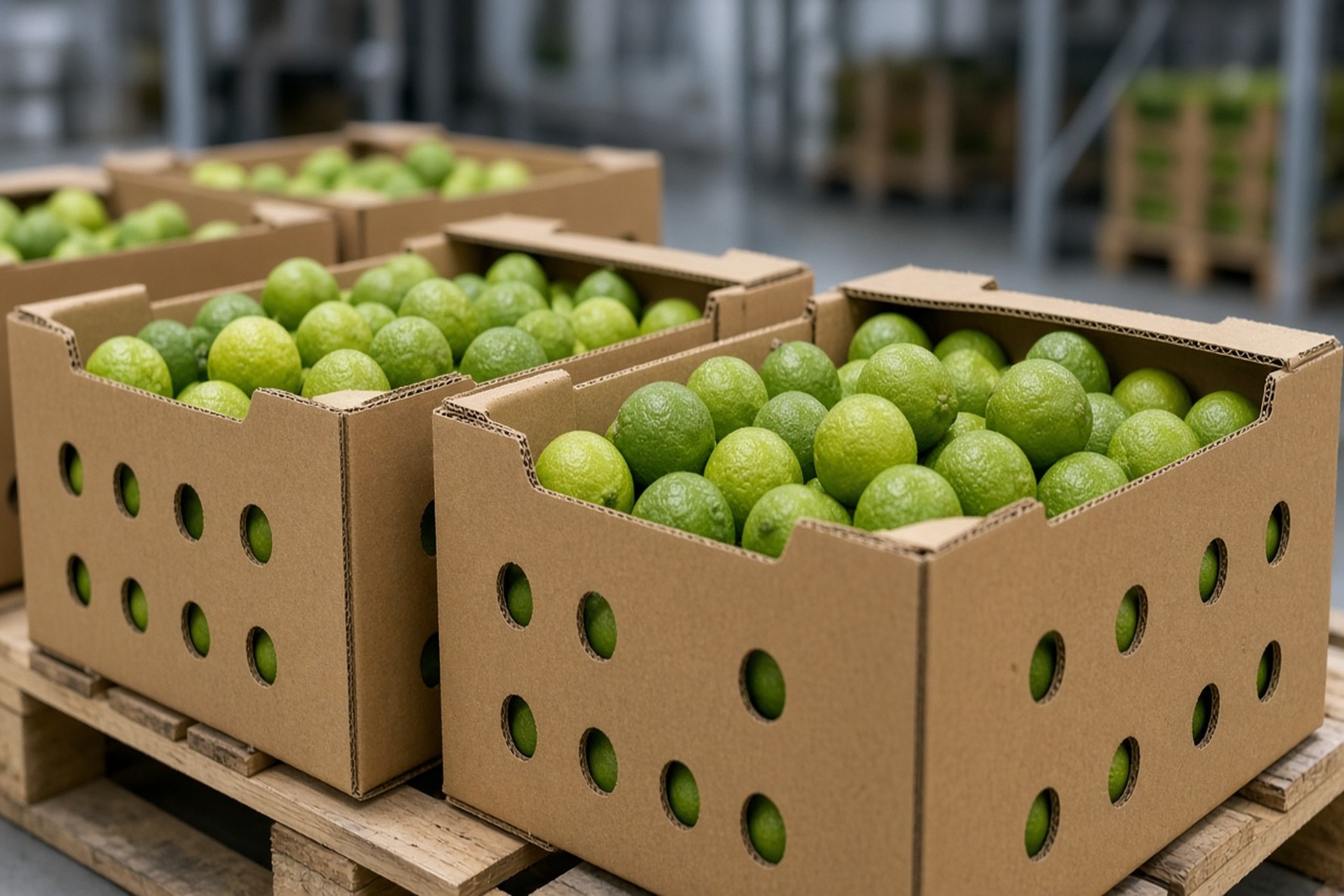
Packaging must combine mechanical protection, ventilation and appearance. For Persian lime, cartons of about 4.5, 9.1 and 18.2 kg are common — choice depends on the market.
| Supply format | Advantage | Limitation | Use |
|---|---|---|---|
| ~4.5 kg carton | Less pressure, better presentation | Higher pack cost | Retail and premium |
| Medium carton | Balance of cost and protection | Needs proper stacking | Professional wholesale |
| Heavy carton | Lower cost per kilo | More pressure and damage | Short route and bulk |
| Consumer pack in master carton | Retail-ready | Labour and material cost | Chain retail |
- Cartons: strength in cold and humid conditions, adequate ventilation, safe edges, net weight, alignment with pallet and container.
- Uniformity inside the pack by origin, grade and size — inspect several pallet layers.
8. Pre-cooling, storage and export transport
The cold chain starts with removing field heat. A range of 10 to 13°C and 90–95% humidity suits many commercial limes; temperatures that are too low cause chilling injury. Ethylene reduces greenness — separation from ethylene-producing fruit is essential.
| Defect | Likely cause | Preventive action |
|---|---|---|
| Shrivelling | Moisture loss and delay | Suitable RH and shorter time |
| Crushing | Pack and pallet pressure | Reduce pressure and strong cartons |
| Brown spots | Chilling or impact | Temperature control and gentle handling |
| Mould | Wounds and poor conditions | Remove wounded fruit and hygiene |
| Yellowing | Ripening and ethylene | Time management and separation |
| Softening | Over-ripeness or wrong temperature | Harvest at the right stage |
Road transport (Iraq and region): load in cool hours, no long stops in direct sun, stable pallets, airflow between packs. Sea freight: align harvest, packing, pre-cooling and container booking.
9. Export pricing and Iran’s competition with foreign suppliers
Delivered price depends on season, supply, region, size, exportable share after sorting, colour, juice, appearance, testing, cartons, cold storage, pallets, domestic and international freight, customs and Incoterms. Price per kilo of deliverable product is a better benchmark than orchard price.
| Competitor | Main advantage | Challenge for Iran |
|---|---|---|
| Turkey | Regional and EU access | Competition in nearby markets |
| Spain | Export infrastructure to EU | Sort and pack standards |
| Mexico | Large scale in lime | Global market experience |
| South Africa | Professional fresh fruit export | Strong cold chain |
| Brazil | Presence in Persian lime | Uniformity and market access |
Iran should focus on markets where distance, lead time and familiarity with Iranian product create a real advantage — not full imitation of global supply chains.
10. Importer checklist before placing an order
- Exact product name: Specify whether Mexican, Persian or another product is required.
- Production origin: Orchard region affects traits and availability timing.
- Required diameter: Avoid vague “small” and “large”.
- Fruit count per pack: Makes comparing offers easier.
- Minimum juice percentage: Internal quality should be measurable.
- Expected colour: Define with images and written criteria.
- Sample before contract: Receive and evaluate.
- Check beyond appearance: Weight, diameter, juice, firmness and taste.
- Test list: Finalise before final harvest.
- MRL alignment: With the orchard spray programme.
- Carton net weight: Specified and contractual.
- Carton material and dimensions: Confirm.
- Palletisation: Obtain cartons per pallet.
- Loading temperature: Record.
- Harvest to loading time: Review.
- Defect tolerance: Write in the contract.
- Shipment sampling: Define the method.
- Quarantine and commercial documents: Check before movement.
- Damage liability: Based on delivery terms.
- Trial shipment: Evaluate before repeat orders.
11. What information should be sent for an accurate price?
- Exact product name and botanical name if needed
- Colour, diameter or size, approximate count per carton, quality grade
- Minimum juice percentage and maximum acceptable defects
- Order quantity, net weight per pack, carton type
- Need for private label, language and print specifications
- Pallet type, required tests
- Destination country, delivery city/border/port, transport mode and schedule
- Preferred commercial terms (Incoterms)
Incomplete request: “Quote export lime price.” Professional request: specified cultivar, defined diameter, minimum juice, carton with stated net weight, known volume, MRL testing and delivery to a named destination.
12. Sourcing export lime from Iran through Iranco
For overseas buyers, matching supplier capability to purchase specifications is the main challenge. Iranco is a platform to submit purchase requests, define specifications and review supply options.
In your lime request, specify cultivar, size, colour, volume, destination market, pack format and tests from the start. Samples, specifications, pack approval and destination requirements before loading matter more than the initial price.
Summary
Iranian lime export has potential in nearby markets and some farther ones, but success depends on standardisation. Mexican, Persian and lemon are not one product — diameter, uniformity, peel, firmness, juice and MRL must be numeric.
Choose packaging by route and sales channel; pre-cooling, 10–13°C and ethylene management preserve colour and shelf life. Iraq and Oman benefit from distance; Europe needs MRL, traceability and precise documentation. Competition is about shipments that meet promised specifications on delivery.
Frequently asked questions
Do all green limes have the same export requirements?
No. Mexican and Persian differ in size, appearance and standards. Exact name, botanical name, diameter, juice and colour must be specified.
What is the tariff code for fresh lime?
Six-digit HS 080550 for fresh or dried lemon and lime. National subheadings for the exporting and importing country should be chosen in the final declaration.
What is the most important export lime quality criterion?
Soundness, firmness, no decay, uniform size, suitable colour, juice and destination MRL together define quality.
What juice percentage is appropriate?
Mexican minimum 40% (CXS 217-1999); Persian minimum 42% under EU marketing standards.
What transport temperature suits green lime?
About 10 to 13°C at 90–95% humidity; temperatures that are too low cause chilling injury and brown peel.
Why does lime turn yellow in transit?
Ripening, long storage and ethylene reduce greenness — fast cold chain and separation from ethylene-producing fruit.
Which packaging is better for export?
Strong ventilated corrugated cartons, pallet dimensions and weight suited to the route; 4.5 kg is common in international lime trade.
Is pesticide residue testing necessary?
For strict markets and professional buyers, MRL is essential — each active substance has its own EU limit and should be checked before loading.
How is export lime price set?
Season, region, size, colour, sort, pack, cold storage, volume and delivery — orchard price without sort-out is not a fair comparison.
What is the export difference between Mexican and Persian lime?
Mexican is usually smaller with at least 40% juice; Persian is larger, for long-distance green lime with at least 42% juice in the EU — size, allowed colour and packaging should be defined separately in the contract.
Is a sample enough for a bulk order?
A sample is necessary but not sufficient — specifications should become a written contract and shipments checked with random sampling.
Featured Products









Related Articles



