 Iranco Magazine Team
Expert guide to grade selection, moisture and texture control, packaging by distance and sales channel, quality control and shipping planning
Date Export · Khasoei · Moisture · Packaging
Iranian Khasoei Date Export: Expert Guide to Grade Selection, Moisture & Texture Control, Packaging Design
A specialist guide to grade selection, moisture and texture control, packaging design by distance and sales channel, quality control and shipping planning for buyers of Iranian Khasoei dates.
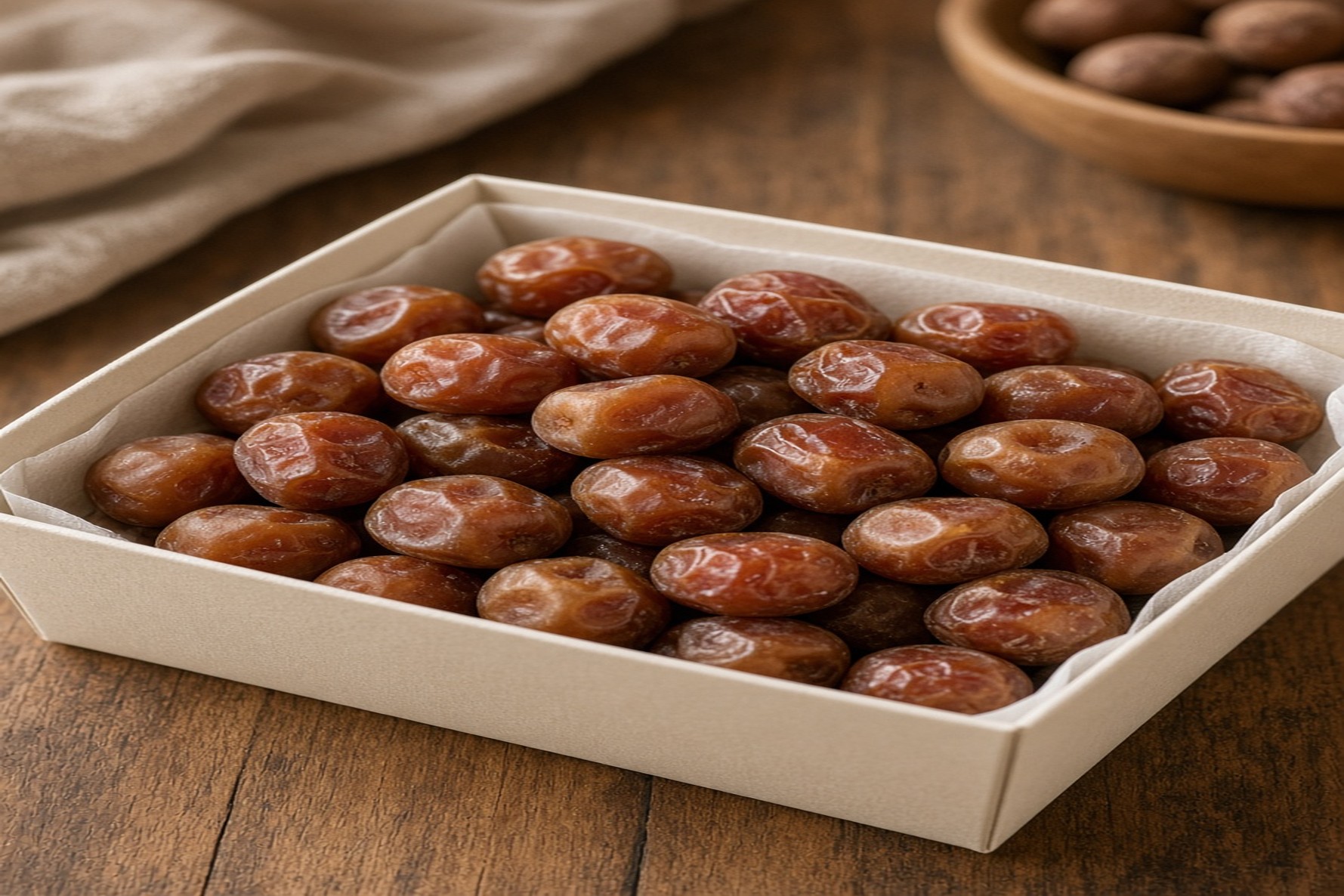
Khasoei is a small, distinctive Iranian date variety valued for its noticeable sweetness, soft texture and brown-to-reddish colour. With more limited supply than major commercial cultivars, it can carve out a niche in specialist markets. In export, the challenge is not only finding buyers — product moisture, texture resistance, in-pack pressure, stacking, transit time and retail presentation all directly affect the quality received at destination.
| Indicator | Value | Importance |
|---|---|---|
| International tariff code | HS 080410 | Basis for date trade classification |
| Min weight with stone | 4.75 g | Codex size and compliance benchmark |
| Maximum moisture | 30% | CXS 143-1985 reference |
| Storage relative humidity | 70–75% | Limits unwanted moisture gain or loss |
Khasoei export should not be managed like high-volume cultivars such as Mazafati or Piarom. Small size, soft texture and pronounced sweetness require tighter product definition in bulk trade. Production region, ripeness stage, moisture, size, colour uniformity and processing type must be recorded alongside the variety name. Successful export depends on aligning four factors: real product specs, controllable moisture, route-appropriate packaging and temperature management to the final market.
1. Khasoei's Position in Iran's Export Basket
Khasoei is a lower-volume, more specialist product than Iran's major commercial dates. Middle Eastern food stores, premium distributors and specialist dried-fruit retailers seek distinctive varieties they can sell outside direct commodity competition. Research classifies Khasoei among soft, small cultivars with light brown to reddish colour; production is reported in Bushehr, Khuzestan, Fars and Hormozgan.
Core advantage in niche markets
Small size is part of this variety's identity, not a defect. Khasoei suits daily small packs, hospitality service, Iranian diaspora stores, native-variety assortments, multi-variety date packs, specialist nut shops and some processing uses where sweetness and softness matter.
- Small daily-consumption and hospitality packs
- Iranian and Middle Eastern retail channels
- Native Iranian date variety baskets
- Gift packs with appropriate visual sorting
HS code 080410 covers all date varieties; Iran's aggregate export statistics must not be presented as Khasoei-specific data. A large market for Iranian dates does not automatically mean ready demand for Khasoei.
2. Commercial Specifications: What Must the Buyer Define?
The variety name is the first line of the purchase spec, not the last. Two Khasoei lots can differ greatly in moisture, softness, colour, surface syrup, uniformity and transport resistance.
| Parameter | Define in order | Importance |
|---|---|---|
| Variety | Khasoei, no unintended mixing | Product identity |
| Ripeness stage | Rutab or tamar | Texture and shelf life |
| Size | Count per specified weight | Avoids "small" vs "large" disputes |
| Colour | Acceptable colour range | Shelf uniformity |
| Texture | Soft to semi-soft | Packaging and transport choice |
| Moisture | Lot test result | Stability and stickiness control |
| Pack type | Container, film, carton | Matched to route and channel |
Small size must not be defined as a defect. Professional sizing uses average fruit weight, weight range, count per 500 g, or percentage outside the agreed size band.
3. Evaluating Export-Grade Khasoei Quality
Target quality combines health, uniformity and preservation of natural variety traits. Severe grade mixing, crushing, fermentation, mould and uncontrolled syrup leakage are real defects.
| Observation | Likely cause | Buyer action |
|---|---|---|
| Wide softness variation | Moisture or ripeness mixing | Request tighter sorting |
| Free syrup at container base | Pressure or high temperature | Check moisture and transit test |
| Crushed fruit at bottom | Excessive pack height | Revise pack dimensions |
| Sour or alcoholic odour | Possible fermentation | Reject sample |
| Excessive stickiness | High moisture or surface syrup | Review transport conditions |
4. Moisture: The Hidden Critical Variable
Moisture affects texture, microbial activity, stickiness, syrup migration and in-pack behaviour. Codex CXS 143-1985 sets a 30% maximum for invert-sugar date groups and 26% for predominant sucrose groups.
| Indicator | Explanation |
|---|---|
| Moisture content | Total water in the product |
| Water activity (aw) | Water available for microbial growth |
| Surface syrup | Sign of pressure, heat or excess softness |
| Packing temperature | Affects stability in transit |
5. Quality Control and Pre-Export Testing
The test scope must match destination market and product risk level.
- Physical control: net weight, size, damaged fruit, insect contamination, colour uniformity, compression damage
- Physicochemical: moisture, water activity, sugar profile
- Microbiological: yeast and mould in softer product
- Safety: pesticide residues and aflatoxin per destination (EU: B1 max 2 µg/kg)
6. Export Packaging by Distance
Packaging must protect against pressure, unwanted moisture exchange, contamination and temperature fluctuation.
| Scenario | Dominant risk | Pack feature |
|---|---|---|
| Short route | Pressure and contamination | Simple but robust container |
| Road transport | Vibration and temperature swing | Strong carton and secure stacking |
| Sea freight | Time, humidity, condensation | Moisture barrier and strong carton |
| Air freight | Weight cost | Light yet sturdy pack |
7. Pressure and Stacking Effects
Small fruit is not necessarily more crush-resistant. When fruit is soft and sticky, upper-layer weight can deform product, release syrup and cause fruit to adhere together.
- Pack height: shallower containers for premium grade
- Container strength: withstand warehouse pressure without deformation
- Headspace: balance between fruit movement and internal pressure
- Palletisation: carton corners must not overhang the pallet
8. Temperature and Humidity in Transit and Storage
No packaging fully compensates for poor thermal management. Ripe dates are generally stored at 70–75% relative humidity. Higher temperature accelerates softening, syrup migration and yeast activity. Dew-point condensation when cold packs enter warm humid environments must be planned for in transfer schedules.
9. Pack Selection by Sales Channel
- Retail: shallow containers, accurate net weight, stickiness and syrup tests
- Premium specialist stores: visual sorting and smaller display packs
- Wholesale: price per kg and product stability
- Food service: net weight and ingredient uniformity
- E-commerce: resistance to drop, inversion and courier pressure
10. Potential Markets and Destination Logic
| Market | Signal | Opportunity | Entry note |
|---|---|---|---|
| India | High Iranian date imports | Large market | Define channel and target price |
| European Union | Significant imports | Specialist product | Food safety and labelling compliance |
| Turkey | Iranian date buyer | Wholesale | Compare with competing cultivars |
| Kazakhstan | Iranian date imports | Regional retail | Road-route stability |
11. Standards, Tariff Code and Documentation
Six-digit HS 080410 covers fresh or dried dates and does not separate Khasoei. Codex CXS 143-1985 covers ripeness, sorting, moisture, minimum size and labelling. UNECE DDP-08 defines Extra, Class I and Class II and requires product to withstand transport.
- Commercial invoice, packing list and certificate of origin
- Certificate of Analysis (COA) and shipping documents
- Labelling: product name, net weight, country of origin, production date
12. Comparing Khasoei Export Prices
Price must not be compared on per-kg quotes alone. Sellable product cost = total delivered cost ÷ quantity actually saleable after quality inspection.
| Factor | Impact |
|---|---|
| Size and uniformity | Retail value |
| Moisture and texture | Shelf life and transport risk |
| Packaging and volume | Final landed cost |
| Tests and destination | Market requirements |
13. Importer Pre-Order Checklist (18 Items)
- Confirm variety identity on sample, proforma and product spec
- Ask production region and harvest year
- Obtain a representative lot sample — not a hand-picked show sample
- Define size numerically; avoid vague terms
- Specify moisture by test, not description alone
- Check texture within the sample
- Set colour range with an approved reference image
- Write defect tolerances explicitly
- Assess microbiological risk appropriately
- Design pesticide residue testing for the destination
- Test consumer pack for pressure and syrup leakage
- Test master carton at actual loaded weight
- Specify pallet height
- Record loading temperature
- Align transport mode with product specification
- Define destination acceptance criteria
- Verify net weight
- Approve destination labels before mass printing
14. Export Supply of Khasoei Dates
The first sourcing step is converting market need into a clear purchase specification: size, colour, texture, moisture, order volume, packaging, destination, transit time and acceptance criteria. Differences between suppliers' samples in texture, colour, moisture and uniformity can be substantial in Khasoei; sample evaluation before final commitment is especially important.
Conclusion
Khasoei export makes most sense when the variety is treated as a specialist product. Three decisions matter most: measurable numeric specifications, route-based packaging, and channel-appropriate pack design. Moisture and pressure are the two critical variables; soft sweet fruit in the wrong pack can lose visual value before reaching the shelf.
Frequently Asked Questions
Is Khasoei suitable for export?
Yes, but its natural place is niche markets. Success depends more on sorting, moisture, packaging and sales channel than on the variety name alone.
What colour should export Khasoei have?
Colour ranges from light brown to reddish brown. Define an acceptable band with an approved reference image rather than a single fixed colour.
What pack suits soft Khasoei?
A shallow container that absorbs external pressure without transferring it directly to the fruit. For long routes, moisture barrier and master-carton strength also matter.
Can ordinary container shipping work?
It depends on moisture, texture, season, transit time and pack type. Softer lots on long routes are more sensitive to temperature rise and benefit from thermal control.
What is the most important Khasoei test?
Moisture is a primary indicator; depending on destination, water activity, yeast and mould, and aflatoxin may also be required.
What drives export price?
Size, uniformity, colour, texture, moisture, defects, pack, volume, tests, transport and delivery terms. Prices are comparable only on identical specifications.
How can I source directly from Iran?
Write your purchase specification, obtain and evaluate samples. Buyers can submit requests through Iranco.
Is small size a sign of low quality?
No. Small size is a recognised trait of this variety. What matters is size uniformity within grade, proper ripeness, health and desired texture.
Featured Products






Related Articles



