 Iranco Magazine Team
From South Khorasan jujube selection and export grade definition to China entry requirements, competition with domestic Chinese jujube, food and TCM uses, contaminant control, packaging and purchase contracts
Jujube Export · South Khorasan · China · Traditional Chinese Medicine
Exporting Premium Iranian Jujube to China: Comparison with Chinese Jujube, Traditional Medicine Uses and Quality Standards
China market analysis for Iranian jujube, comparison with Chinese jujube, food and traditional Chinese medicine (TCM) pathways, premium grade parameters, quality control, entry requirements, tariff codes, packaging, logistics and importer checklist.
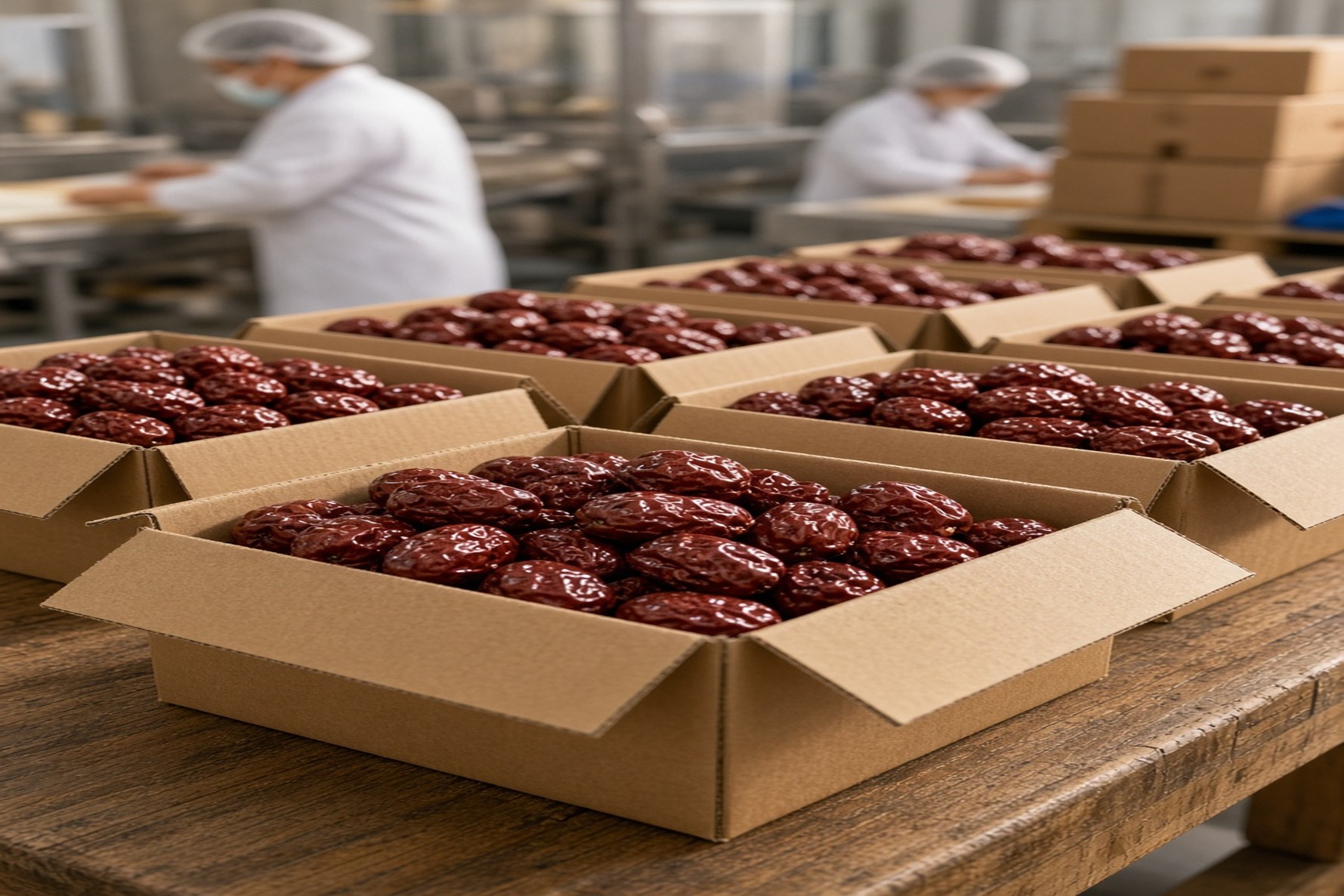
Iranian jujube — especially product from South Khorasan — is not a generic dried fruit in the China market. It can be supplied both in food channels (snacks, cooking, beverages) and in traditional Chinese medicine (TCM) as Jujubae Fructus (大枣/红枣). China is the world's largest jujube producer and consumer; entering this market without quality differentiation, technical specifications and familiarity with entry standards is high risk. Success for the Iranian exporter depends on three pillars: product differentiation from Chinese jujube, precise premium grading and compliance with China's food import rules and medicinal/raw-material market requirements.
| Indicator | Value / reference |
|---|---|
| Main production centre in Iran | About 97% of output in South Khorasan |
| Premium fruit length (Jujubae Fructus) | 2 to 3.5 cm |
| Premium fruit diameter | 1.5 to 2.5 cm |
| International standard | ISO 24063:2026 |
The China jujube market has two layers. The first is intermediate/retail food consumption with intense competition on price, appearance and uniformity. The second is traditional medicine, herbal pharmaceutical and functional food formulation, with higher sensitivity to physical specifications, purity, moisture and documentation. Iranian jujube has greater differentiation opportunity in the second layer — if offered with premium grade, quality control and suitable packaging — because some professional buyers seek alternative or supplementary supply outside China's domestic jujube chain.
However, the Chinese importer expects imported product to be "better than Chinese jujube" — not merely "Iranian jujube". Differentiation must be measurable: size, colour, flesh texture, moisture, stone percentage, uniformity, contamination level, pesticide residues and compliance with GB and ISO standards. This article examines premium Iranian jujube export to China from that angle: market opportunity and comparison with Chinese jujube, the TCM pathway, quality control, entry regulations, packaging, logistics and a practical importer checklist.
Analytical Introduction
The China market for Iranian jujube should not be assessed like a country with limited domestic production. The Chinese buyer first asks what advantage this imported product has that cannot be obtained from China's vast domestic chain. The correct answer is not broad phrases such as "higher quality" or "premium product". Advantage must be converted into measurable indicators: size, uniformity, colour, skin condition, flesh-to-stone ratio, moisture, pesticide residues, foreign matter, fungal contamination, drying method, traceability, packaging type or suitability for a defined application.
China has not only a developed food jujube market but also recognises dried jujube in its official pharmacopoeia as Dazao or Jujubae Fructus (大枣). The 2025 edition of the Chinese Pharmacopoeia defines Jujubae Fructus as the ripe, dried fruit of Ziziphus jujuba Mill. and sets appearance specifications and identification methods. This edition became mandatory from 1 October 2025.
On the other side, publication of ISO 24063:2026 for jujube used as a traditional medicine raw material has special commercial importance. This standard covers minimum requirements and test methods in areas such as identification, foreign matter, moisture, ash, polysaccharides, heavy metals, sulphur dioxide, pesticide residues and aflatoxins.
For the Iranian exporter the conclusion is clear: successful jujube sales to China do not begin with sending an attractive sample; they begin with defining the final application and the product's technical file.
1. China Market Opportunity for Premium Iranian Jujube
China has a deep domestic chain in jujube production and consumption. Chinese product is present in fresh fruit, dried fruit, herbal tea, beverages, paste and food processing, and also as a traditional medicine raw material. This breadth means Iranian jujube in China does not face an unknown competitor; it competes with a product Chinese consumers already know and whose supply chain is well developed.
International standard ISO 24063:2026 also references jujube use in products such as candied jujube, black jujube, cake, jujube paste, jam, juice, tea, vinegar and other foods and beverages. This scope shows the China market cannot be reviewed only from the angle of dried-fruit retail.
Bulk market or specialist market?
Entry into China's general jujube bulk market is not simple for a foreign supplier. The Chinese producer benefits from scale, market knowledge, domestic distribution routes and access to many product types. In contrast, the Iranian exporter can focus on more specialist segments; for example:
- Premium jujube with defined origin and traceability
- Uniform product for higher-level packaging
- Raw material with complete laboratory control
- Jujube required by herbal tea and botanical product manufacturers
- Product with agreed specifications for processing
- Orders based on a defined combination of appearance and laboratory criteria
- Markets where a different origin has marketing value
In such markets, "being Iranian" alone is not a commercial advantage. Origin creates value when accompanied by product story, repeatable quality and technical documentation.
Iran's supply capacity
South Khorasan is the main jujube production centre in Iran, and official agricultural reports place the counties of Khusf, Birjand and Sarbisheh among the important production areas. Two well-known local cultivars, Sivijan and Mojan, are also cited in provincial reports.
In export trade, cultivar name is only part of the specification. Two lots with the same local name can differ greatly in size, moisture, ripeness, colour, wrinkle level, flesh-to-stone ratio and uniformity. The professional buyer must define grade based on measurable characteristics.
2. Iranian Jujube vs Chinese Jujube: A Comparison That Matters to the Buyer
The question "Is Iranian jujube better than Chinese jujube?" is not precise for a commercial contract. Quality must be compared at shipment level, not only by country of origin.
China has a large domestic market covering economic product through premium grade and traditional medicine raw material. Iran cannot be compared with China on production scale, but a different position can be created in orders where South Khorasan origin, product selection, precise sorting and laboratory control matter.
| Criterion | Iranian jujube | Chinese jujube | Note for buyer |
|---|---|---|---|
| Supply scale | More limited, concentrated in South Khorasan | Very extensive | Iranian orders need a defined supply plan |
| Commercial diversity | Mainly local cultivars and post-harvest sorting | Wide range of cultivars and grades | Product name alone is not enough for comparison |
| Chinese consumer recognition | More limited | Very high | Iranian product needs clear positioning |
| TCM use in China | Possible if legal pathway and specs align | Established domestic chain | Food and medicinal paths must not be confused |
| Differentiation potential | Iran origin, South Khorasan, selection and sorting | Cultivar, region and domestic brand | Differentiation must be provable |
| Packaging and processing scale | Developing | Highly developed | Pack quality is decisive for China |
| Price competition | Depends on season, grade and export logistics | Domestic production advantage | Pure price competition is usually difficult |
Large size is not always a better grade
In retail, large uniform appearance can have higher value; but in processing raw material or traditional medicine, the requirement mix is different. Shape, botanical identification, moisture, contamination and pharmacopoeia characteristics may matter more.
Exporters should not label all large jujube as "premium". Premium must be defined for a specific application.
Colour and skin
Expected colour must be fixed in a reference sample. For dried product, excessive darkening, abnormal spots, signs of moisture contact, deep cracking, surface contamination and severe non-uniformity can reduce shipment value.
The Chinese Pharmacopoeia for Jujubae Fructus refers to a dark red surface with slight lustre and irregular wrinkling. This is a medicinal definition and should not be applied to all food jujube without review.
Size on the traditional medicine pathway
The China Pharmacopoeia 2025, in its appearance description of Jujubae Fructus, cites length of about 2 to 3.5 cm and diameter of about 1.5 to 2.5 cm. These figures matter for exporters targeting the pharmaceutical chain; but final commercial acceptance also depends on purchase specifications and entry regulations.
3. What Does "Premium" Jujube Mean for the Chinese Buyer?
Premium grade is better defined by a set of criteria than by a word on a proforma invoice. In a professional purchase request, minimum size, uniformity, moisture, skin condition, foreign matter, percentage of damaged fruit, insect contamination, pesticide residue specifications and packaging must all be clear.
| Parameter | Order specification | Importance for China buyer |
|---|---|---|
| Product type | Dried jujube (Ziziphus jujuba), South Khorasan origin | Origin differentiation and traceability |
| Fruit length | 2 to 3.5 cm (Jujubae Fructus) | TCM compliance and uniformity |
| Fruit diameter | 1.5 to 2.5 cm | Grading and appearance |
| Colour | Uniform red to golden yellow (per cultivar and reference sample) | Visual market acceptance |
| Flesh texture | Fleshy, dense, no widespread crushing | Eating and processing quality |
| Moisture | Per agreed specification and test report | Shelf life and safety |
| Size uniformity | Maximum permitted deviation from mean length/diameter | Packaging and TCM |
| Stone | Pitted or with stone (per order) | Food or medicinal application |
| Visual defects | Maximum permitted percentage of damaged, cracked or dark fruit | Shipment acceptance |
| Contamination | No foreign matter, stones, leaves or stems | Safety and TCM |
| Pests | No live insects or severe infestation signs | Clearance and QC |
| Mould | No visible mould accepted | Health and shelf life |
| Pesticide residues | Per destination regulations and test list | Clearance and safety |
| Heavy metals | Per relevant standard | Safety requirements |
| Sulphur dioxide | Where relevant to processing method | Compliance and labelling |
| Aflatoxin | On pathways where testing is mandatory | Fungal risk control |
| Net weight | Per pack unit | Commercial and financial control |
| Packaging | Material, dimensions, weight and master carton | Protection and distribution |
An important point is that the phrase "export standard compliant" in a contract is not enough. Destination standard, test method and acceptance limit must be specified.
Reference sample: the basis of every contract
Before bulk production, an approved physical sample must be the comparison baseline. Ideally an approved image, written technical specification and signed/stamped physical sample are kept together in the purchase file. In the China market, quality change without buyer notification — even if the product remains "acceptable" — leads to shipment rejection or termination of cooperation.
4. Food Pathway vs Traditional Chinese Medicine (TCM) Pathway
Imported jujube entering China can follow two main market paths. Path selection determines QC requirements, packaging, labelling and documentation. Exporter and importer must define the target path before negotiation.
| Subject | Food pathway | TCM / herbal pathway |
|---|---|---|
| Product name in China | 红枣 / 大枣 (dried jujube) | Jujubae Fructus (大枣) |
| Target buyer | Food importer, wholesaler, retailer, snack brand | TCM importer, herbal pharmaceutical, formulator |
| QC priority | Appearance, taste, moisture, GB 7718 labelling | Size, purity, moisture, pesticide residues, uniformity |
| Key regulations | GACC Decree 248, GB 2762, GB 2763, GB 7718 | Same food rules + buyer TCM/medicinal requirements |
| Packaging | Retail pack, master carton, brand | Industrial bag, drum, bulk pack with technical label |
| Typical tests | Moisture, pesticide residues, heavy metals, microbiology | All food tests + purity, size, sometimes stricter heavy metals |
| Price sensitivity | Medium to high (competition with Chinese jujube) | Lower than snack path; quality matters more |
| Iran differentiation potential | Premium imported product | Alternative supply source with Jujubae Fructus grade |
Many Chinese importers initially prefer the food pathway because approval and distribution cycles are simpler. The TCM pathway offers greater differentiation for the Iranian exporter with strong QC and uniformity — provided size specifications (2–3.5 cm length) and complete documentation are supplied.
5. Positioning in Traditional Chinese Medicine (TCM)
In traditional Chinese medicine, dried jujube as Jujubae Fructus (大枣) is one of the oldest food-medicine homology materials. Common uses include Qi tonification, calming formulations, decoctions and combinations with other botanicals (such as ginger and liquorice). The TCM market is sensitive to size, purity, moisture and uniformity — not merely retail pack appearance.
Why does Iranian jujube have TCM opportunity?
- Source diversity: some formulators seek supply outside China's domestic production
- Premium grade: length 2–3.5 cm and diameter 1.5–2.5 cm align with Jujubae Fructus reference
- Recognised origin: South Khorasan can be marketed in B2B as a credible source region
- ISO 24063:2026: international dried jujube standard creates common language with professional buyers
Additional TCM pathway requirements
TCM importers usually request, in addition to GACC food regulations: a Certificate of Analysis (COA) with full parameters; pesticide residue report per GB 2763; heavy metals report per GB 2762; size specifications with a repeatable measurement method; and sometimes a purity (foreign matter) report. The Iranian exporter should design QC for this level from the outset — not after the first shipment is rejected.
6. Pre-Loading Quality Control
In jujube export to China, many commercial disputes appear only after the shipment reaches customs or the importer's warehouse. Pre-loading control must be precise enough to minimise rejection risk at destination.
| QC area | Action | Acceptance criterion |
|---|---|---|
| Size | Random sample length and diameter measurement | 2–3.5 cm length, 1.5–2.5 cm diameter (premium) |
| Moisture | Moisture test by agreed method | Contract range (usually 15–25% by grade) |
| Uniformity | Visual check and measurement of 100–200 fruits | Permitted deviation from mean |
| Visual defects | Sort sound / damaged / reject fruit | Maximum permitted percentage in contract |
| Foreign contamination | Screening and manual inspection | No stones, leaves, stems or extraneous matter |
| Pests | Inspection and trapping where needed | No live insects |
| Mould | Visual and odour inspection | No visible mould accepted |
| Pesticide residues | Accredited laboratory test | GB 2763 compliance |
| Heavy metals | Pb, Cd, Hg, As testing | GB 2762 compliance |
| Microbiology | Where requested by buyer | Agreed range |
| Sampling | From several batches and pack points | Per agreed sampling plan |
| COA | Issue batch analysis report | Accompany shipment |
A laboratory report must not replace visual control. Product may pass laboratory tests yet still be unsuitable for TCM or premium snack sale because of size non-uniformity or excessive defect percentage.
7. Entry Standards for Jujube in China
Food entry into China is overseen by the General Administration of Customs China (GACC). Exporter and importer must be familiar with the regulatory framework below:
GACC Decree 248 (safe food import)
GACC Decree 248 defines the framework for foreign supplier registration, import declaration, border inspection and product traceability. The foreign supplier (exporter/factory) must be registered in the GACC system and the Chinese importer is responsible for coordinating registration and declaration. Without correct registration, the shipment faces problems at the border.
GB 2762 — contaminants in food
National standard GB 2762 sets maximum limits for heavy metals (lead, cadmium, mercury, arsenic) and other contaminants in food. Dried jujube as dried fruit falls under these limits. Pre-shipment test reports must demonstrate GB 2762 compliance.
GB 2763 — agricultural pesticide residues
GB 2763 defines maximum permitted pesticide residues in food. Jujube orchards may receive crop protection treatments; multi-residue pesticide testing before export is therefore essential for professional importers.
GB 7718 — general prepackaged food labelling
At the time of writing, GB 7718-2011 is the current labelling standard before mandatory application of the new edition. GB 7718-2025 has been published and will replace the 2011 edition from 16 March 2027. The Chinese government has asked producers and market operators to prepare for label changes during the transition period.
For products manufactured after the new standard takes effect, GB 7718-2025 requirements become directly relevant. This standard sets mandatory information and display methods for prepackaged food. New food labelling supervision regulations also take effect from 16 March 2027.
For exported prepackaged product, the final Chinese label design must be reviewed by the importer or compliance specialist before bulk carton or wrapper printing. Labels must be in Simplified Chinese and include product name, net weight, required dates, importer name and address, country of origin and batch number.
ISO 24063:2026 — international dried jujube standard
ISO 24063:2026 (replacing ISO/TS 24063) is the international standard for dried jujube and defines quality specifications, grading and test methods. Referencing this standard in the contract creates common language between the Iranian exporter and Chinese buyer — especially for premium grade and B2B export.
- Foreign supplier GACC registration (Decree 248)
- GB 2762 compliance (heavy metals and contaminants)
- GB 2763 compliance (pesticide residues)
- GB 7718 labelling for retail packs
- ISO 24063:2026 reference in contract technical specifications
8. Tariff Code HS 081340
Dried jujube is classified internationally under HS 081340: "Other fruit, dried, other than that of headings 0801 to 0806; mixtures of nuts or dried fruits of Chapter 8" — which includes dried jujube (Ziziphus jujuba). China's customs system may have further domestic sub-lines.
The final declared code must match actual shipment characteristics (dried jujube, with or without stone, grade, packaging) and be confirmed with the importer and Chinese customs broker. Incorrect declaration can affect customs valuation, duty and inspection process. For the TCM pathway, some importers may require a different code or goods description — this must be coordinated with the Chinese customs broker before loading.
9. Export Packaging Suited to the China Market
Jujube packaging has two jobs: physical protection against moisture, pressure and contamination; and preparation for the sales channel (wholesale, retail or TCM bulk). Pack selection must align with the market path defined in Section 4.
| Pack type | Application | Technical notes |
|---|---|---|
| Vacuum / MAP bag | Premium retail, snack | Moisture control; shelf-life test before large order |
| Plastic container / tin | Retail brand, gifting | Crush resistance; GB 7718 label |
| Master carton (bulk) | Wholesale, TCM, processing | Inner moisture-barrier bag; 10–25 kg weight |
| Drum / industrial bag | TCM bulk, formulation | Technical batch label; COA included |
| Buyer private label | China private label | Approve print file before production; Simplified Chinese text |
Master cartons and pallets
- Adequate crush resistance for multi-layer stacking
- Inner bag with moisture barrier
- Shipping label with batch, net weight, country of origin
- Palletisation per export standard (usually 40–48 cartons)
10. Logistics, Moisture and Shelf Life
Dried jujube is less cold-chain sensitive than soft dates, but ambient moisture and temperature still affect shelf life, mould risk and texture. Rising ambient humidity or temperature swings can accelerate water uptake, softening, mould and spoilage.
Reference storage conditions
- Cool, stable ambient temperature (usually 15–25°C)
- Low relative humidity (below 65%, preferably 50–60%)
- Away from direct light and strong odours
- Moisture-barrier packaging after final drying
Sea freight to China
Common routes from Iran to China include transshipment from Gulf ports or land/rail corridor routes. Dried jujube is usually shipped in a dry container (not reefer) — provided product moisture is within the contract range before loading and packaging has a moisture barrier. Desiccants in cartons are recommended for long transits.
Moisture risk in transit
A dry container on a sea route can experience condensation — especially during climate change. Inner packaging must protect product from ambient container moisture. Rapid discharge and transfer to a dry, cool warehouse in China is an essential part of the supply chain.
11. How Export Jujube Pricing for China Is Formed
A jujube shipment price cannot be compared without its specifications. Two offers both labelled "premium export jujube" may differ greatly in size, moisture, uniformity and QC.
| Factor | Impact |
|---|---|
| Grade and size | 2–3.5 cm length and high uniformity cost more to sort |
| Moisture and shelf life | Controlled moisture and uniform drying |
| Defect percentage | 95%+ sound fruit vs 85%+ sound fruit |
| Tests and COA | GB 2762/2763, ISO 24063 |
| Pack type | Vacuum, private label, bulk |
| Order volume | FCL vs LCL |
| Transport route | Origin/destination port, transshipment |
| Incoterms | FOB, CIF, DAP — not directly comparable |
| Season and supply | Post-harvest (autumn) usually higher supply |
The Chinese buyer should price all suppliers against one identical specification sheet — covering grade, size, moisture, tests and Incoterms.
12. Importer Pre-Order Checklist (20 Items)
- Define market path: food, TCM or both
- Specify product precisely: South Khorasan dried jujube, premium grade
- Set length range (2–3.5 cm) and diameter range (1.5–2.5 cm)
- Agree acceptable moisture range
- Obtain a representative production sample
- Retain an approved reference sample
- Define maximum permitted visual defect percentage
- Specify mould, pest and contamination acceptance criteria
- Define required GB 2762 and GB 2763 tests before loading
- Reference ISO 24063:2026 in technical specifications
- Confirm foreign supplier GACC registration (Decree 248)
- Confirm pack type (bulk, retail, TCM)
- Confirm net weight and GB 7718 label (for retail)
- Confirm tariff code HS 081340 with Chinese customs broker
- Define Incoterms and destination port (Shanghai, Qingdao, Guangzhou, etc.)
- Define sampling plan and COA requirements
- Review need for third-party pre-shipment inspection
- Allow time for GACC clearance and inspection at destination
- Define post-clearance storage conditions (dry warehouse)
- Define written criteria for destination quality disputes
13. Information Required for an Accurate Price Quote
- Product name: premium dried jujube, South Khorasan origin
- Target path: food, TCM or both
- Grade: length 2–3.5 cm, diameter 1.5–2.5 cm, maximum defects
- Moisture range and with/without stone
- Pack type: bulk, vacuum, private label; net weight
- Required tests: GB 2762, GB 2763, ISO 24063
- Order volume (kg or FCL) and Incoterms
- Destination port/city in China and required delivery timing
- Need for COA, inspection and reference sample
Without these details, comparing two prices is almost meaningless. Buyers can enter the same information in an Iranco purchase request so supply options are reviewed on a single specification basis.
14. Three Entry Strategies for Iranian Jujube in the China Market
Importer or exporter can choose one of the three strategies below — or a combination:
| Strategy | Description | Suitable for |
|---|---|---|
| 1. Premium Food / Snack | Retail pack, imported brand, e-commerce and specialty store channel | Chinese brands offering "premium Iranian" product |
| 2. TCM / Herbal B2B | Bulk with Jujubae Fructus grade, full COA, pharmaceutical/formulator customer | TCM importers with strict QC |
| 3. Industrial / Ingredient | Large bulk for processing (beverage, confectionery, functional food) | Processing plants with fixed specifications |
Strategy 2 (TCM) offers greater differentiation potential for Iranian jujube with strong QC and size uniformity. Strategy 1 requires more investment in packaging and brand. Strategy 3 is volume-based with lower unit price — and harder competition with Chinese jujube.
15. Common Exporter Mistakes When Negotiating with Chinese Buyers
Calling every product "premium grade"
If all grades are called premium, the term loses meaning. At least several commercial grades with numerical specifications must be defined.
Sending a non-repeatable sample
A sample hand-picked from one hundred kilograms but representing a multi-tonne order is not a suitable baseline. The sample must reflect the actual sorting process.
Focusing only on size
Large size is only one quality factor. Large fruit with unsuitable moisture, contamination, weak colour or high variation between fruits cannot be placed at a higher level solely because of size.
No pesticide residue plan
Post-harvest testing does not replace orchard spray management. For strict markets, the plan must start from orchard records and input use.
Confusing the medicinal market with dried fruit
The exporter must not present food product as "medicinal" simply because jujube is used in traditional medicine. Legal pathway, standard and buyer differ between the two markets.
Printing packaging too early
For China, label text and requirements must be approved before high-volume printing. GB 7718-2025 also becomes mandatory from 16 March 2027 and importers must plan for the transition.
Relying on a general tariff code for market assessment
HS 081340 covers "other dried fruit" and total imports under this group cannot all be attributed to jujube. For a realistic market assessment, shipment description and more precise codes must be reviewed.
Export Supply of Premium Iranian Jujube Based on Buyer Specifications
In international jujube sourcing, the difference between two offers is not only price per kg. Size grade, moisture, uniformity, COA, pack type, GACC registration and delivery timing can change the outcome of the deal. Sourcing should start with a written technical specification sheet; samples are then received and approved, QC and final packaging defined, and the main order produced against the same criteria.
Iranco enables Chinese buyers and importers to submit premium jujube purchase requests with their required details: grade (2–3.5 cm), TCM or food pathway, GB and ISO 24063 tests, pack type, FCL volume, destination port and Incoterms. Specifications can be entered in the request so available supply in Iran (South Khorasan) is reviewed on that basis.
For the China market it is best to state in the same request whether the product is intended for dried fruit, food industry, herbal tea or traditional medicine raw-material chain — because this choice can change the technical and commercial requirements of the entire order.
Conclusion
Premium Iranian jujube export to China is attractive when the exporter manages it not as a generic dried fruit but as a product with defined grade (Jujubae Fructus, length 2–3.5 cm, diameter 1.5–2.5 cm), origin differentiation (South Khorasan) and compliance with China's standards (GACC 248, GB 2762/2763/7718, ISO 24063:2026). China is the world's largest jujube market and competing with low-cost domestic product on price alone is not a practical path for Iranian supply.
The most important starting point is defining the application. Premium food jujube, factory raw material and Jujubae Fructus for the traditional medicine chain are three markets with different criteria. After that, size, uniformity, colour, skin condition, moisture, foreign matter, pesticide residues, heavy metals and other relevant indicators must be converted into contract specifications.
For the traditional medicine market, the China Pharmacopoeia 2025 and ISO 24063:2026 have special importance. For the food market, foreign facility registration, safety standard compliance and labelling requirements must be reviewed from the first project stages. Iran's jujube advantage lies above all in the concentrated South Khorasan origin and the ability to build a defined sorting and supply chain — but this advantage becomes export value only when the buyer receives in the commercial shipment the same quality seen in the sample.
For the China market, "premium" must be a technical specification, not a marketing adjective. Tariff code HS 081340, moisture control in logistics and the 20-item importer checklist are operational success elements. A professional Chinese buyer should compare offers on one identical spec sheet; when grade, tests, packaging and Incoterms are all defined, price comparison becomes meaningful.
Frequently Asked Questions
Does China need imported jujube?
China is the dominant jujube producer, but demand exists in premium food, TCM and diversified supply segments for imported jujube with premium grade, full COA and origin differentiation — not in the general economic market.
What is the main difference between Iranian and Chinese jujube?
Both are Ziziphus jujuba, but origin (South Khorasan vs Chinese provinces), cultivar, drying method and market position differ. Iranian jujube should differentiate in premium grade and TCM, not in volume competition with domestic Chinese product.
What is the standard premium jujube size for export to China?
For premium grade and Jujubae Fructus reference: length 2 to 3.5 cm and diameter 1.5 to 2.5 cm. This range should be stated in the contract and COA.
Can Iranian jujube be exported for TCM use in China?
Yes, if size grade, purity, moisture and COA (including GB 2762/2763) meet TCM importer requirements. The TCM pathway has higher QC sensitivity than the snack market.
What tests are required before export to China?
Typically: moisture, pesticide residues (GB 2763), heavy metals (GB 2762), and microbiological tests where requested by the buyer. Batch COA must accompany the shipment.
What is the tariff code for dried jujube to China?
Internationally HS 081340 (dried fruit). The precise China customs code must be aligned with the broker, importer and shipment characteristics.
What packaging is suitable for jujube export to China?
By pathway: bulk (carton + moisture-barrier inner bag) for TCM; vacuum or container for premium snack; GB 7718 label for retail. Desiccants in dry containers are recommended.
Why does a reference sample matter?
Without an approved physical sample before bulk production, size, colour and texture differences at destination in China lead to rejection or dispute. The reference sample must be kept in the contract file.
What information is needed for an accurate price quote?
Grade (length/diameter), moisture, TCM or food pathway, pack type, volume (kg/FCL), Incoterms, China destination port, required tests and COA/inspection need. These details can be submitted in an Iranco purchase request.
Featured Products






Related Articles



