 Iranco Magazine Team
From precise size, colour and firmness specs to grade cards, packaging, MRL control, supply capacity, export documents and cold chain
Export Guide · Greenhouse Produce · UNECE FFV-36
Building an International Product Page for Iranian Greenhouse Tomatoes
From precise size, colour and firmness to grades, packaging, MRL, supply capacity, export docs and cold chain — how to turn a product page into a real international sales tool for professional buyers and procurement managers.
An export greenhouse tomato page should not be a few photos and the phrase “export quality”. Professional buyers need measurable specifications, real grade photos, packaging details, supply schedules, pesticide residue control, cold-chain conditions and a clear path to samples and pricing.
Before deciding on price, a fresh tomato importer is effectively assessing purchase risk. Will the delivered grade match what was shown? What is the exact size? What colour stage at loading? Is firmness suitable for the route? Will cartons withstand pallet pressure? Is carton ventilation compatible with the reefer system? How are residues controlled — and can a sample or lab report be obtained before the commercial order?
This matters even more for greenhouse tomatoes. Fresh tomatoes are living, respiring product — sensitive to ripeness, temperature, humidity, pressure, impact and time. Two loads that look similar at packing can perform very differently after a few days in transit. “Export tomato” is not a technical specification; the buyer must know exactly what product, grade and conditions are being offered.
Iran supplies fresh tomatoes to several regional markets. 2024 trade data records imports of fresh or chilled tomatoes of Iranian origin into Iraq, Oman, Pakistan, Armenia and Qatar under HS 0702. These statistics do not separate greenhouse from field production — so total tomato trade figures must not be presented as greenhouse-specific production data on a greenhouse sales page.
A strong international product page is not a shop window. It should do part of the pre-purchase work: reduce ambiguity, make the product comparable and give the buyer what they need for quotes, sampling and contracts.
Optimal storage temperature depends on ripeness stage. For pink/green tomatoes, 12.5–15°C and 90–95% RH are recognised post-harvest conditions. UNECE FFV-36 defines a measurable size-code system for tomatoes based on diameter.
1. What international buyers want from a greenhouse tomato page
The main goal is to shorten the gap between “viewing the product” and “submitting an actionable purchase request”. Importers do not only need to know that Iran produces tomatoes — they must judge whether the offer fits their buying programme, sales channel and transit time.
The page should answer at least seven questions quickly:
- What type of tomato is offered?
- What grade and size range apply?
- How are colour stage and firmness defined at loading?
- What packaging and net weight per unit are used?
- What is supply capacity and season window?
- What quality and residue controls are performed?
- How can the buyer obtain a sample or destination-specific quote?
“Export quality” is not enough
A common weakness is using terms like “grade one”, “premium” or “export” without measurable criteria. For professional buyers, quality only matters when it becomes verifiable specification — for example:
- Diameter or weight per fruit
- Size uniformity
- Colour stage
- Firmness level
- Cracking percentage
- Soft fruit percentage
- Surface defect level
- Calyx present or absent
- Pack arrangement
- Net weight
- Grade tolerance
- Inspection acceptance criteria
Codex for fresh tomatoes emphasises sound, whole, clean product free of decay affecting edibility. UNECE FFV-36 provides commercial quality classes, sizing and tolerances. A professional page should state that product is graded to order specifications — then list the selectable parameters — rather than “export grade one greenhouse tomato”.
2. Product specifications block — the most important sales section
The specification table should sit in the upper half of the page. Buyers should not have to search marketing copy for size, pack type or country of origin.
| Parameter | Information to display | Why it matters |
|---|---|---|
| Product type | Round, elongated, cherry, cluster or offered form | Defines sales channel |
| Production method | Greenhouse | Product differentiation |
| Origin | Iran | Import docs and regulations |
| Variety | If fixed and guaranteed | Post-harvest behaviour and market appeal |
| Size | Diameter, weight or count per pack | Pricing and retail display |
| Colour stage | Visual or agreed definition | Transit time and destination ripeness |
| Firmness | Measurement method or agreed criterion | Transit tolerance |
| Grade | Standard-based or contract spec | Offer comparison |
| Pack format | Loose, with calyx, cluster | Market application |
| Packaging | Carton, crate or consumer pack | Logistics and retail |
| Net weight | Actual product weight per unit | Price calculation |
| Cold chain | Pre-cooling method and agreed temperature | Shelf life |
| Testing | Residue or other required tests | Destination market compliance |
| MOQ | If a defined policy exists | Buying programme |
| Destinations | Markets actually assessed for supply | Route evaluation |
3. How to display size and grade
Sizing is one of the most important parts of a tomato product page. Terms like “small”, “medium” and “large” without numeric ranges are too vague for international trade.
UNECE FFV-36 allows tomato sizing by diameter, weight or count. For diameter-based sizing it defines codes including:
| Size code | Diameter |
|---|---|
| 4 | >35 to 40 mm |
| 5 | >40 to 47 mm |
| 6 | >47 to 57 mm |
| 7 | >57 to 67 mm |
| 8 | >67 to 82 mm |
| 9 | >82 to 102 mm |
| 10 | >102 mm |
This table does not mean all Iranian export tomatoes are sold under these exact codes. It shows that size can be defined in a standard, measurable way.
Offered grades are best shown as separate cards — for example:
Grade A
- Diameter: 57–67 mm
- Loading colour: per buyer request
- Shape: round and uniform
- Packaging: ventilated carton
- Suggested use: wholesale and retail
Grade B
- Diameter: 47–57 mm
- Other specs: per contract
- Packaging: per agreed format
- Suggested use: wholesale and processing
These numbers belong on a live page only when the supplier actually offers those ranges.
Uniformity matters more than average diameter. Two loads can share a 60 mm average yet one be highly uniform and the other a mix of small and large fruit.
The page should explain sorting method and negotiable tolerance — not only the size range.
4. Grade photos — images as product evidence, not decoration
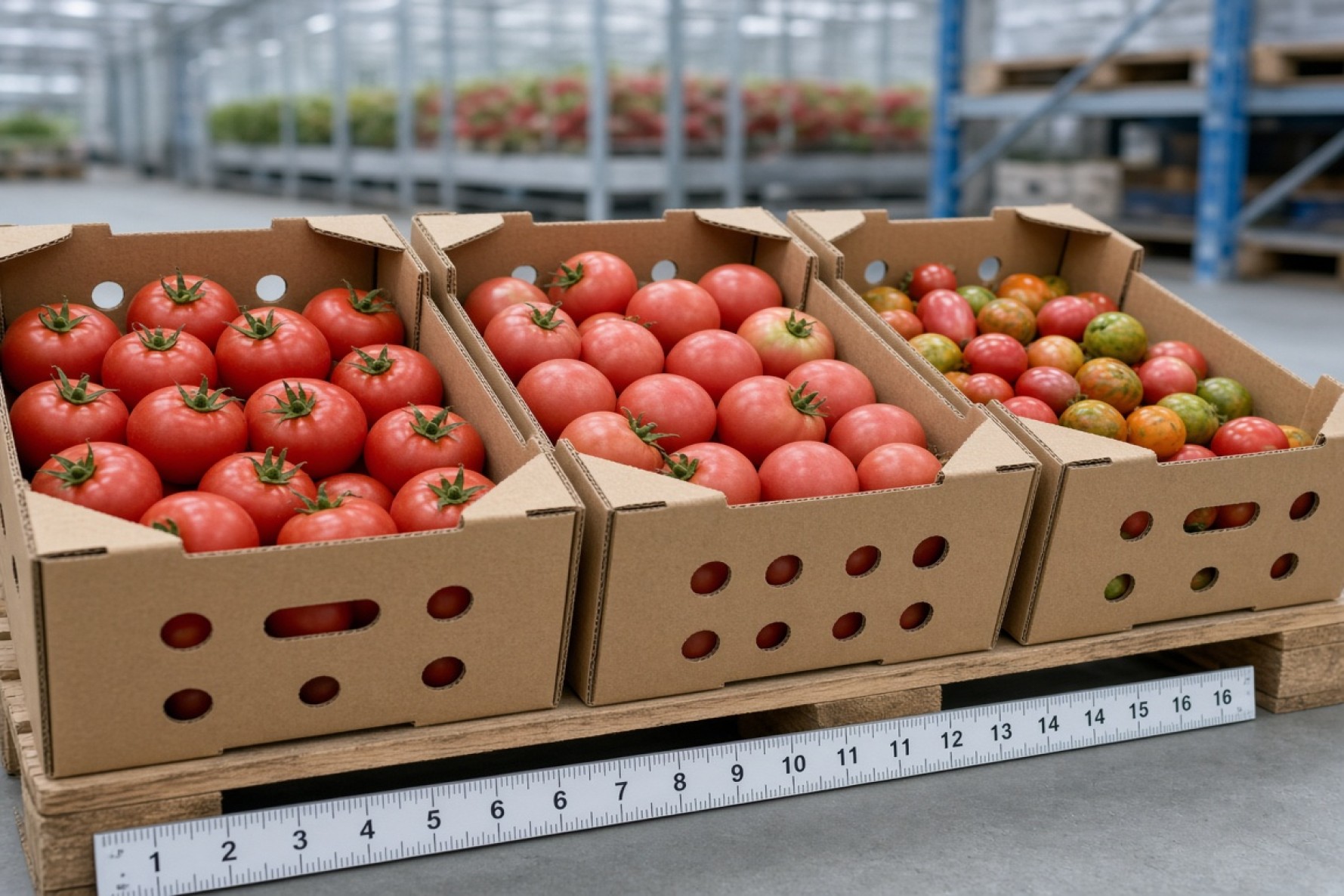
In fresh produce trade, photos are part of technical information — not just aesthetics. A page with only a glossy close-up of red tomatoes leaves many buyer questions unanswered.
For each grade, the recommended photo set includes:
- Close-up of skin and colour
- Several fruits together to show uniformity
- Product beside a ruler or size reference
- Tomatoes inside the actual pack
- Open carton view
- Closed carton view
- Ventilation hole detail
- Carton label
- Pallet ready for loading
- Full cluster image, if cluster product is offered
If two sizes or quality levels are offered, their images must not share one gallery without clear labels. Each image should state type/grade, size range, colour stage at photography, pack type and sample date or period where relevant — so an old shipment is not mistaken for all production.
Page photos must not replace an approved reference sample. After initial agreement, buyer and seller can base approval on images, physical samples or specifications of a defined batch. International buyers reviewing Iranian greenhouse supply can structure comparison by submitting size, grade, packaging and destination requests through Iranco.
5. Colour and firmness — translate into commercial language
For tomatoes that will travel hours or days, more red at harvest is not automatically the better choice. Harvest stage must align with transit duration, cold-chain temperature, distribution time and shelf timing at destination.
Tomatoes picked at advanced ripeness may suit a very near market but can arrive too soft on a longer route. Phrases like “good red” or “export colour” are not controllable criteria.
A better page will:
- Show sample colour stages
- State which stages can be ordered for loading
- Explain that final colour is chosen against route length and buyer programme
Firmness is a key factor in resistance to pressure and handling. University of California post-harvest research identifies firmness and absence of over-ripeness softness among tomato quality indicators. In sensitive contracts, firmness should be assessed by an agreed method. If a fixed instrument or numeric method exists in the supply chain, unit and test procedure must be stated. If not, do not publish a non-repeatable numeric value on the page.
6. MRL and pesticide residues — “pesticide-free” does not replace testing
Residue management is one of the most important trust elements for exported fresh produce. A professional sales page should not claim “completely pesticide-free” unless that claim is technically and documentarily provable. The commercial issue is compliance with destination-market limits.
What is MRL?
MRL is the legal maximum residue of a specific active substance in a food product. Limits differ by substance and market. In the European Union, Regulation (EC) No 396/2005 sets the framework for pesticide MRLs; the consolidated version remains in force in 2026 and values for each active substance must be checked against current regulation and the official database for that market. Where no specific limit is set, EU rules may apply a default of 0.01 mg/kg unless another default applies to the substance in question.
A fixed “tomato residue limit table” for all countries is therefore incorrect.
The product page should clarify:
- Whether residue testing is available
- Whether testing relates to pre-loading samples or general production history
- How the laboratory is selected
- How the tested substance list is matched to the destination market
- Whether the buyer can specify active substances to be tested
- Which batch or shipment the report belongs to
A lab sheet without clear shipment linkage is insufficient. At minimum, traceability should cover sample number, sampling date, product, batch/shipment, test method, result and measurement unit. For sensitive markets, explain the testing process against buyer requirements rather than a generic promise of “testing available”.
7. Packaging and ventilation — what buyers need before price
Tomato packaging is part of the quality system. Poor cartons can turn good fruit into high-waste cargo before arrival. Codex requires tomato containers to be suitable in quality, hygiene, ventilation and strength for handling, transport and product protection. FAO technical guidance also emphasises carton strength, airflow and pack coolability.
| Feature | Required information |
|---|---|
| Pack type | Carton, box or consumer pack |
| Net weight | Product weight excluding pack |
| Dimensions | Length × width × height |
| Arrangement | Controlled bulk, layered or tray |
| Layer count | If fixed |
| Ventilation | Location and hole design |
| Carton strength | Suitable for pallet stack and humidity |
| Dividers | If used |
| Pallet type | If palletised supply |
| Units per pallet | Based on actual stack pattern |
| Label | Product and traceability information |
FAO fresh-produce packaging guidance recommends adequate carton vent area for airflow; one document cites at least 5% of box surface as a ventilation guide — but real export design must match pack type, carton strength, pallet pattern and cooling method. A fixed percentage must not be applied to every pack.
Ventilation is not only holes in the carton. Even well-ventilated cartons underperform if pallet stacking blocks air paths. FAO stresses that air must pass through the whole stack arrangement — critical for forced-air cooling and refrigerated transport. A real pallet photo is more informative than a 3D render of an empty carton.
8. Cold chain by ripeness stage
One dangerous product-page error is stating a single “storage temperature” without reference to ripeness. Suitable tomato temperature depends on maturity and colour.
| Product stage | Recommended temperature |
|---|---|
| Pink / green-ripe | 12.5–15°C |
| Light red | 10–12.5°C |
| Ripe and firm | 7–10°C for short holding |
Suitable relative humidity is about 90–95%. Tomatoes — especially at pink/green stage — held too cold for too long risk chilling injury and ripening disruption.
Instead of “transport temperature: 8°C”, state: “Temperature and loading colour stage are set according to product ripeness, route duration and buyer delivery programme” — then record the agreed temperature on the order specification sheet.
Post-harvest heat must be managed. Forced-air cooling can remove heat from inside packs and pallets more uniformly and quickly than room cooling alone. Vent design and pallet arrangement directly affect performance.
If a controlled cold chain exists, the page should explain:
- At which stage product enters packing
- How pre-cooling is performed
- Where temperature is monitored
- Under what conditions refrigerated transport is offered
- Whether in-load temperature recorders can be requested
The phrase “standard cold chain” adds little without these details.
9. Capacity, supply season and target markets
Wholesale buyers care about repeatable supply — not only one excellent load. A supplier may prepare one outstanding shipment yet lack stable weekly or monthly capacity. Capacity is therefore critical page information — but only when the figure is provable and current.
Define capacity at three levels:
- Per load: volume available in one shipment
- Periodic: volume realistically available per week or month in a production window
- Availability window: months or periods when the target grade can be supplied
If capacity is not fixed, state “capacity confirmed per production period and order specification” rather than leaving a number on the page that expires in a few months.
2024 trade data records fresh or chilled tomato imports from Iran into Iraq, Oman, Pakistan, Armenia and Qatar. Iraq alone registered about 19.1 million kg of Iranian-origin tomatoes that year. These figures cover all HS 0702 trade and do not specify cultivation type.
| Recorded market | Practical note for product page |
|---|---|
| Iraq | Regional route; distribution speed coordination matters |
| Oman | Packaging and heat management are critical |
| Pakistan | Recorded market for Iranian fresh tomatoes |
| Armenia | Regional route requiring precise timing |
| Qatar | Import market where appearance and packaging can carry high weight |
This table does not replace study of regulations, demand season and buyer-specific specs. It shows real recorded markets for Iranian fresh tomatoes — not a promise to export everywhere.
Do not write “exportable to all countries”. Destination markets differ on residue lists, phytosanitary rules, labelling, packaging standards, certificates, preferred size, colour stage, transit tolerance and retail structure. List countries whose supply routes have actually been assessed; offer separate feasibility for other destinations.
10. Documents, standards and verifiable trust
A professional wholesale page differs from advertising by having a clear “documents and quality control” section — separating documents actually available from items only “reviewable on request”.
Product standards
Codex CXS 293-2008 is the recognised international standard for fresh tomatoes, covering round, ribbed, elongated and cherry/cocktail types plus quality, uniformity, packaging and marking requirements. UNECE FFV-36 is a key commercial quality and sizing standard for fresh tomato trade.
Use “compliant with standard” only when product is actually graded and controlled to that standard. Otherwise present the standard as a framework for defining the order.
Export pack information
Codex for non-retail packs expects commercial pack information such as exporter/packer identification, product type, country of origin, class and — where sized — size range. A strong international page shows a real label sample with confidential customer data removed.
European Union market
Entry of many plants and plant products from non-EU countries is governed by EU phytosanitary rules covering plant health certificates and document, identity and pest-status checks. Exact requirements must be verified against current regulation and origin status.
The page should distinguish three concepts:
- Commercial quality standard
- Food safety and MRL
- Quarantine and phytosanitary requirements
These are not the same thing.
11. Sample, pre-shipment inspection and acceptance criteria
A product page builds more trust when it explains what happens after an enquiry is sent. A practical workflow:
- Buyer sends initial specifications
- Feasibility of those specs is assessed
- Grade images or samples are offered
- Final packaging specification is agreed
- Agreed tests are performed if required
- Pre-loading acceptance criteria are recorded
- Shipment sampling or inspection is carried out
- Documents and loading are completed per agreement
Samples must represent the order. Sending the best fruit from a greenhouse as a sample then delivering a commercially wide quality spread is a major source of fresh-produce disputes.
Buyers should agree upfront:
- Which batch the sample came from
- Whether the sample represents the commercial grade
- Shipment size range
- Which defects are not acceptable
- Maximum tolerance and how it is measured
- Colour stage at loading
- Sampling method at inspection
UNECE commercial classes include defined tolerances — for example, in Class I up to 10% by number or weight may fail class requirements within standard limits. “Zero defects” should not be used without contractual definition.
12. Importer checklist before placing a greenhouse tomato order
Before requesting a proforma, a professional buyer should define or verify at least the following:
- Define required tomato type: round, elongated, cherry, cluster or other
- Require a specific variety only if it truly matters for your market
- Define size by diameter, weight or count
- Specify required colour stage at loading
- Define acceptable firmness or ripeness criterion
- Record defect percentage or tolerance in contract
- Include cracking, bruising, decay and mechanical damage in acceptance criteria
- State whether calyx or stem is required
- Set net weight per pack
- Confirm carton or crate type and dimensions
- Obtain photos of final pack design and label
- Review units per pallet and pallet stack pattern
- Ensure ventilation paths remain open on the pallet
- Set temperature conditions by ripeness stage and transit time
- Review pre-cooling method and harvest-to-cool time
- List destination-market tests required
- Base pesticide residue review on destination substance list and limits
- Verify lab report linkage to the commercial batch
- Match phytosanitary and import documents before loading
- Assess weekly or periodic capacity separately from single-load capacity
- Record order preparation lead time
- Define transport mode and delivery point
- Agree contract handling of destination quality discrepancies
- Evaluate a sample or trial load before the first large order where possible
This checklist materially reduces the gap between “approved sample” and “commercial shipment”.
13. Information needed for an accurate price quote
Greenhouse tomato price is not comparable without product specification. Two sellers may quote very different prices for “one tonne of tomatoes” while one offers uniform size, stronger packs, testing and cold chain and the other a completely different product.
- Tomato type
- Variety, if mandatory
- Grade
- Target diameter or weight
- Colour stage at loading
- Firmness criterion
- Calyx required or not
- Approximate order volume
- Order frequency
- Packaging type
- Net weight per pack
- Consumer pack needed or bulk carton only
- Private-label requirement
- Label language and required information
- Pesticide residue testing
- Other contractual tests
- Destination country
- Delivery city, border or port
- Transport mode
- Commercial delivery terms
- Approximate timing for first shipment
Buyers can submit these details in an Iranco purchase request so available Iranian greenhouse tomato supply options are reviewed against real order specs — avoiding price comparisons between different grades.
14. Page architecture — turning structure into a sales tool
A good page should not bury everything in one long text block. Architecture should let the buyer extract essentials in minutes, then drill into detail.
| Order | Page section | Purpose |
|---|---|---|
| 1 | Precise product title | Identify product type |
| 2 | Real photos | Initial visual assessment |
| 3 | Specification table | Quick comparison |
| 4 | Grade and size selection | Define the order |
| 5 | Packaging | Logistics assessment |
| 6 | QC and testing | Risk reduction |
| 7 | Cold-chain conditions | Transit feasibility |
| 8 | Capacity and supply window | Buying programme |
| 9 | Available documents | Compliance review |
| 10 | Markets or destination conditions | Export feasibility |
| 11 | FAQ | Remove common doubts |
| 12 | Quote / sample request form | Convert visit to enquiry |
A form that only collects name, phone and free text loses critical buying data. A fresh tomato form should include product type, size range, colour stage, order volume, pack weight and type, destination, testing needs and sample/batch image requests — so the supplier response is much more precise.
15. Common mistakes on export tomato product pages
- Using non-representative or stock images on a sales page
- Stating a size without tolerance — “size 60” does not say whether that is average, minimum or sort class
- Quoting very high capacity without time period — “1,000 tonnes” without day/week/month/season context
- Publishing per-kg price without grade, size, net weight, pack, testing and delivery point
- One fixed temperature for all ripeness stages
- Using one old lab report for every shipment
- Mixing quality standard with import regulations
- Promising export to any destination without route and compliance review
16. Questions the page should answer before the buyer contacts you
Professional buyers repeat the same questions. Answering them on the page makes first discussions faster and more technical.
Can tomatoes be loaded at multiple colour stages?
The page should explain whether ripeness stage can be selected according to route duration and distribution programme.
Is size fixed?
Size range and tolerance must be stated — not only a marketing size label.
Is buyer-branded packaging available?
If yes, minimum volume, artwork and preparation time should be clarified at enquiry stage.
For which markets can MRL reports be prepared?
Answer by destination country and controlled substance list — not with one generic report.
Can samples be provided?
Sample process, possible cost and relationship to the final batch should be clear before the first order.
17. Supply path for Iranian greenhouse tomatoes via Iranco
In international fresh tomato buying, the difference between two offers is not only per-kilo price. Grade, size range, colour stage, firmness, defect percentage, net weight, carton type, ventilation quality, cold-chain conditions, residue testing and destination can make two quotes entirely different in real value.
Supply should start from a technical specification request — not simply “what is the tomato price today?”. Iranco allows importers to submit purchase requests by product type, size, grade, order volume, packaging, destination, transport conditions and required tests so available supply options in Iran are reviewed on that basis.
For sample evaluation, packaging comparison or multi-option review, define acceptance criteria from the start — especially on a first order, when images, tests and grade definition can create a shared baseline before the main shipment.
To review Iranian greenhouse tomato supply, specify size, colour stage, approximate volume, carton type and destination in the purchase request so feasibility can be assessed against that need.
18. Conclusion
An international greenhouse tomato page earns trust when it lets the buyer evaluate the product substantially before first contact. Good photos help — but size range, colour stage, firmness, grade, defect tolerance, net weight, packaging, ventilation, capacity and cold chain matter more for the purchase decision.
The key shift is from adjectives to specifications. “Grade one”, “premium” and “export” should give way to defined diameter, stated grade, real photos, acceptance criteria, carton type and testing conditions.
In fresh tomatoes, logistics is part of quality. Product that leaves the greenhouse in good condition can lose commercial value at destination if harvested at the wrong stage, field heat is poorly managed, pack vents are blocked on the pallet or transport temperature does not match colour stage.
On food safety, generic claims are not enough. Buyers must be able to review MRL control against destination regulation, the batch in the deal and a traceable report. The best page for Iranian greenhouse tomatoes is not the one with the most claims — it is the one that removes the most commercial ambiguity.
19. FAQ
For tomato export, is the reddest product the best choice?
No. Suitable colour stage depends on transit time, route temperature, distribution schedule and when the product must reach the consumer. Shorter routes may allow riper fruit; longer routes may require earlier harvest. Colour stage should be set together with firmness and cold-chain plan — not by appearance at harvest alone.
How is export tomato size determined?
Size may be defined by diameter, weight or count. UNECE FFV-36 provides diameter codes — for example code 7 covers >57 to 67 mm. In commercial deals, the measurement method and accepted tolerance recorded in the order specification matter most.
Should greenhouse tomatoes always be shipped at very low temperature?
No. Tomatoes are chilling-sensitive and suitable temperature depends on ripeness. Pink/green fruit is commonly held at 12.5–15°C; riper stages may use lower ranges for shorter periods. Temperature must be set with colour stage and route duration.
What testing is required for pesticide residue control?
Testing must be designed for the destination market. MRL applies to a specific active substance and product; country or trade-bloc rules differ. Specify destination, substances to test and regulatory version used; the report must trace to the commercial sample or batch.
Is one lab report enough for the whole production season?
For confirming a specific shipment, the report must link clearly to the sample and batch in the deal. An old report may show supplier QC history but does not necessarily prove a new load. On sensitive orders, agree sampling method, test timing and batch identification in the purchase terms.
What is the best packaging for export tomatoes?
There is no single answer for all markets. The pack must resist pressure and handling, allow air exchange and heat removal, and match pallet arrangement and cold chain. Pack weight, product layers, route length and sales channel all influence carton or consumer-pack choice.
What information is needed for an Iranian greenhouse tomato price quote?
At minimum: product type, size or diameter range, colour stage, order volume, pack weight and type, destination and transport mode. For precise orders add firmness criterion, defect tolerance, residue testing, private label and delivery terms. Without this, price comparison between offers is unreliable.
How can greenhouse tomatoes be sourced from Iran?
Start by defining product type, grade, size, colour stage, packaging, order volume and destination. Then review supply option, grade sample or images, testing conditions and loading schedule. International buyers can submit these details through Iranco so available options are assessed against their requirement.
What best reduces the gap between sample and commercial shipment?
Recording acceptance criteria is the most important step. A sample photo alone is not enough. Define size range, colour stage, firmness, defect tolerance, net weight, pack type and pre-loading sampling method. The more numeric and auditable the criteria, the lower the risk of buyer–seller mismatch.
Featured Products




Related Articles



