 Iranco Magazine Team
From product category and HS codes to Brix control, destination standards, packaging, labelling, logistics and export order setup
Juice & beverage export · HS 2009/2202 · Brix & labelling
Iran Fruit Juice & Beverage Export: Target Markets and Export Requirements
From juice vs nectar vs fruit drinks to Brix, destination standards, packaging, labels, logistics and professional ordering.
Introduction
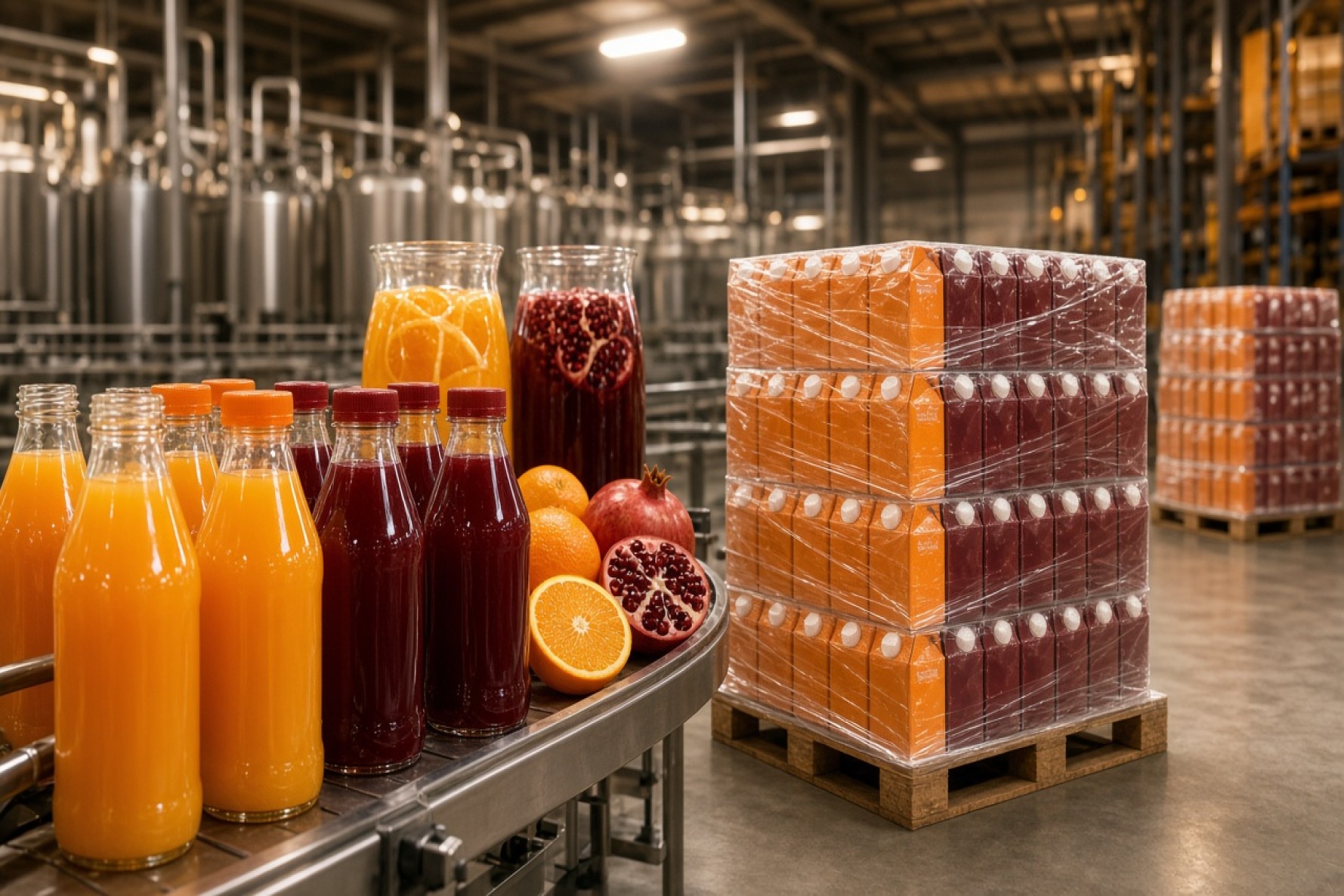
Iranian juice and beverage export is not a price-only game. Product category drives HS codes, standards, labels, testing and market fit. In 2022, HS 2009 trade was about USD 69.2 million and over 100.7 million kg; Turkey, Pakistan, Russia, Iraq and Afghanistan were leading destinations. For HS 2202 beverages, Kazakhstan, Oman and Uzbekistan recorded significant 2024 volumes. Iran combines diverse fruit and industrial capacity for CSD, flavoured and malt-style lines — success requires aligning product, market and technical rules at once.
1. What do Iranian export juices and beverages include?
“Juice”, “nectar” and “fruit drink” are not interchangeable in law or trade. Codex defines juice as unfermented but fermentable fruit liquid; nectar has a prescribed minimum fruit share plus water and permitted ingredients.
Two similar bottles can differ in juice %, formula, HS code and standard — technical definition beats marketing name.
| Product group | Main trait | Top buyer concern |
|---|---|---|
| Direct juice | Fresh extraction | Authenticity, Brix, flavour |
| Reconstituted juice | From concentrate | Final Brix and COA |
| Fruit nectar | Defined fruit share | Fruit % and sugars |
| Fruit drink | Compound formula | Actual juice content |
| Carbonated drink | Contains CO₂ | Pressure and flavour stability |
| Juice concentrate | Industrial input | Brix, aseptic pack |
2. Iran’s export position and real markets
2022 HS 2009 flows include Turkey ~38.3M kg, Russia ~17.1M, Pakistan ~14.6M, Iraq ~9.8M, Afghanistan ~6.5M. 2024 HS 220210: Kazakhstan >11M L, Oman >6.4M, Uzbekistan ~3.9M.
Juice trade patterns differ from non-alcoholic beverage lines — pick the market to match the exact product class.
| Market | Stronger product fit | Commercial note |
|---|---|---|
| Russia / EAEU | Juice and CSD | Technical and label alignment |
| Kazakhstan | HS 2202 lines | Non-alcoholic beverage volume |
| Oman | 2202 and some juice | Arabic label and heat |
| Iraq | Mass-market drinks | Delivered price and pack |
| Turkey | Juice | Strong domestic industry |
| UAE | Packaged retail | Registration and standards |
3. Technical specs buyers must fix before ordering
“Export quality” without numbers has little contract value. Quality must become measurable parameters.
Single-strength juice buyers focus on Brix; Codex minima differ by fruit — e.g. reconstituted pomegranate 12° and grape 16° — do not apply those figures to nectars or fruit drinks.
| Parameter | Must be defined | Why it matters |
|---|---|---|
| Product class | Juice / nectar / CSD | Tariff and standard |
| Juice content | Actual % in finished goods | Label and contract |
| Brix | Agreed value | Soluble solids |
| pH & acidity | Method and result | Taste and stability |
| Additives | Sugar, preservative, colour | Destination compliance |
| Process | Pasteurised / aseptic | Storage and freight |
4. How export juice quality is assessed
Batch-to-batch stability matters more than one attractive lab sample. Flavour must not show oxidation, fermentation or cooked notes; colour must match fruit and process.
Uncontrolled sediment, leaking packs, swelling or sample-vs-shipment gaps need numeric and sensory criteria in the contract.
5. Tests and QC before export
Brix, pH and acidity are core for juice and nectar; colour control matters on pigmented lines.
Yeast and mould are critical on acidic products. Additives must match the destination positive list — legal in Iran can still be rejected abroad.
6. Destination standards and requirements
Codex CXS 247-2005 defines juice, nectar and minimum Brix. GCC markets reference GSO 9:2022 and GSO 1820; EAEU uses TR CU 023/2011 for juice products.
Design for the destination up front — relabelling after production is not a substitute for correct formulation and pack.
7. HS codes for juice and beverages
HS 2009: non-fermented fruit and vegetable juices without added alcohol. HS 2202: sweetened/flavoured waters and other non-alcoholic beverages.
Classification must follow the real formula, not the front-of-pack name — HS errors inflate duty, documents and delays.
8. Packaging for export
Packaging is part of the preservation system. Aseptic cartons suit ambient shelf-stable juice; PET suits many fruit drinks and CSD; glass for premium; cans for carbonated and malt-style products.
Master cartons for export need higher crush strength than domestic retail — container and border warehouse handling is harsh.
| Pack | Main advantage | Export limitation | Best for |
|---|---|---|---|
| Aseptic carton | Light, efficient | Seal/corner damage | Juice and nectar |
| PET bottle | Light, tough | Heat and O₂ sensitivity | Fruit drinks & CSD |
| Glass | Premium look | Weight and breakage | Specialty lines |
| Can | Gas retention | Seam and lining QC | CSD and malt |
9. What export labels must contain
Approve before bulk print: legal name, ingredients, allergens, net volume, origin, dates, batch, storage, nutrition and importer where required.
Product name must match composition; fruit imagery must match the formula — especially sensitive in EAEU markets. For Arabic countries, design Arabic copy from the start, not a sticker overlay.
10. Transport and logistics
Beverages are bulky; freight is a large share of delivered cost. Iraq, Turkey and Afghanistan are mainly road; Oman and UAE often sea from southern Iran.
Ambient-stable lines usually need no reefer if validated — but long hot container dwell time affects colour, gas pressure and appearance.
11. How export pricing is built
Drivers include juice %, concentrate or purée cost, sweeteners, process, pack type and size, print, tests, palletisation and Incoterms.
Comparing 100% juice with a low-juice drink in the same 1 L bottle is meaningless — quote to the buyer’s delivery point.
12. Iran vs regional producers
Iran’s edge shows on pomegranate, sour cherry, grape, apple and native concentrates; on mainstream CSD, brand and logistics weigh more.
Batch consistency, COAs, traceability and contract execution beat factory price alone.
| Rival | Strength | Challenge for Iran |
|---|---|---|
| Turkey | Mature juice industry | Brand and shelf presence |
| Saudi Arabia | Regional beverages | Gulf distribution |
| UAE | Re-export hub | Global brands access |
| Europe | High standards | Premium positioning |
Importer checklist before placing an order
Document these 18 points in writing before you order:
- Confirm whether the product is juice, nectar, fruit drink or carbonated beverage.
- State exact juice or purée percentage in the purchase spec.
- Obtain the full formula and ingredient list.
- Set Brix, pH and acidity appropriate to the product type.
- Receive a sample in the same export formula and pack.
- Review the spec sheet and lab results for the sample batch.
- Match additives, preservatives, colours and sweeteners to the destination.
- Approve final label text before mass printing.
- Define how nutrition information is prepared and verified.
- Contract shelf life and minimum remaining life at delivery.
- Record pack material, nominal volume, closure and units per case.
- Confirm master-carton strength and pallet pattern.
- Verify HS code against the final formula.
- Set accept/reject criteria before production starts.
- Agree in writing on allowed deviation from the approved sample.
- List export documents, origin, health certificates and tests per destination.
- Clarify freight mode and delivery point on the proforma.
- Check the plant’s real capacity for repeat supply.
Information for an accurate price quote
Product name and class, flavour, juice %, Brix if relevant, added sugar, preservative/colour rules, pack size and material, units per case, total volume, brand or private label, label language, destination and delivery point, required tests and delivery terms.
For concentrate: Brix, fruit, acidity, aseptic pack, net weight and industrial use. Iranco accepts purchase requests with this detail to match Iranian suppliers.
FAQ
What is the difference between juice, nectar and fruit drink?
Juice is fruit liquid per the technical definition; nectar has a minimum fruit share with water and permitted ingredients; fruit drinks contain less juice — affecting price, label and HS code.
Top export markets for Iranian juice?
2022 HS 2009: Turkey, Pakistan, Russia, Iraq and Afghanistan; Turkey leads recorded weight and value.
Are beverage markets the same as juice markets?
No — 2024 HS 220210 shows Kazakhstan, Oman, Uzbekistan and others strong on non-alcoholic drinks; match market to product class.
Why does Brix matter when buying juice?
Brix measures soluble solids; Codex minima differ by fruit — e.g. 12 for reconstituted pomegranate and 16 for grape juice.
Best packaging for export juice?
Aseptic cartons for ambient juice; PET for wide use; glass for premium; choice depends on process, shelf life and distribution.
Do export beverages need a reefer container?
Ambient-stable validated products usually do not; chilled fresh juice needs a cold chain — follow the producer’s storage statement.
Why is Arabic labelling important?
In Saudi Arabia consumer information must be in Arabic and match any other language; ingredients and nutrition must meet GSO rules.
Key lab tests for export juice?
Brix, pH, acidity and microbiology; plus additives, MRLs, metals or authenticity depending on product and destination.
What drives export beverage price?
Juice %, raw materials, formula, pack, volume, print, tests, pallet and freight — delivered price matters more than factory FOB on bulky lines.
Is private label export viable?
Yes for importers with distribution — clarify artwork ownership, MOQ, print cost, label approval and destination registration before production.
Summary
Iranian juice and beverage export creates real advantage when product, market and technical rules are planned together. After choosing a destination, contract specs — juice %, Brix, formula, pack and shelf life — decide success. Professional buyers issue one purchase spec and ask every supplier for price and samples on the same basis, turning visual sampling into measurable trade.
Featured Products
Related Articles



