 Iranco Magazine Team
Professional guide to timing fresh Iranian grape purchases — harvest window, cultivar, berry size, Brix, colour, firmness, shatter, decay, packaging, cold chain and regional/EU export planning
Buying Guide · Fresh Grapes · Export
Iran Fresh Grape Buying Season: Timing for Quality, Price and Availability
A professional guide to timing purchases of fresh Iranian grapes — harvest windows, variety, berry size, Brix, colour, firmness, shatter, decay, packaging, cold chain and regional/EU export planning.
Analytical introduction
For wholesale buyers, Iran’s fresh-grape buying season is not a fixed few-week window. Diverse climates, early/mid/late varieties and vineyard elevation spread commercial supply from early summer well into autumn. Research on Iranian cultivars shows harvest spread from mid-July through mid-October; late cultivar Sahibi can reach ~18° Brix in early October. FAO-based 2022 data put total Iranian grape production at ~2.24 million tonnes — not all table grapes for export.
The precise buyer question is: when can you secure the right cultivar, sufficient Brix, firm berries, healthy clusters, reliable commercial volume and export packing capacity at the same time? The answer usually lies between season opening and late season — not at the very first or very last fruit.
1. How Iran’s fresh-grape buying season is shaped
For commercial buying, summer through mid-autumn is the main access period, but cultivar and origin must be checked before calendar month. Early varieties enter first, mid-season drives volume, and late cultivars extend supply into autumn.
| Phase | Market | Buyer opportunity | Main risk |
|---|---|---|---|
| Season start | Early cultivars | Fast market entry | Immaturity, low Brix |
| Rising supply | More farms & varieties | Supplier comparison | Between-farm inconsistency |
| Commercial peak | Maximum choice | Large consolidated orders | Harvest pressure, weak sorting |
| Late season | Late cultivars & stored fruit | Storage-suitable varieties | Shatter, shelf-life risk |
2. Best timing for quality, price and availability
Grapes are non-climacteric — they do not ripen meaningfully after harvest. Under-ripe Brix or incomplete colour will not be fixed in cold storage; storage only slows decline. Peak supply improves choice and price comparison, but not every lot is export-grade. Late buying suits tough-skinned late cultivars if harvest date and cold-room history are transparent.
3. Cultivar, berry size and colour
Size must be judged with uniformity, firmness, skin thickness, cracking, pedicel attachment and Brix — large but soft berries are poor for long haul. Colour must match cultivar expectations; EU standards do not automatically classify sun colouration as a defect, though sunburn and skin damage are graded.
4. Brix, firmness and berry attachment
UNECE FFV-19 (2025) uses 16° Brix as the base maturity benchmark. EU marketing rules set different minima by group: 12° for Alphonse Lavallée, Cardinal and Victoria; 13° for other seeded; 14° for seedless. Contract specs must match the destination market — not a single global number.
5. Separating strong export lots from weak ones
- Rachis & stem: browning rachis signals quality loss; fresh green stems indicate better hydration.
- Shatter: count loose berries at box bottom; check attachment on apparently sound clusters.
- Decay: grey mould (Botrytis cinerea) is a major post-harvest loss driver.
- Free moisture: droplets may indicate warm packing, condensation or broken cold chain.
- Sampling: pre-loading inspection must cover multiple pallets and random points — not one seller-prepared sample box.
6. Cold chain
Post-harvest quality cannot be upgraded — only decline slowed. UC post-harvest guidance recommends about -1 to 0°C for mature grapes; reported freezing point is around -2.7°C depending on soluble solids. Warm fruit loaded directly into a truck will not pull down quickly — pre-cooling is mandatory. Data loggers add value on long routes.
7. Packaging for regional and EU markets
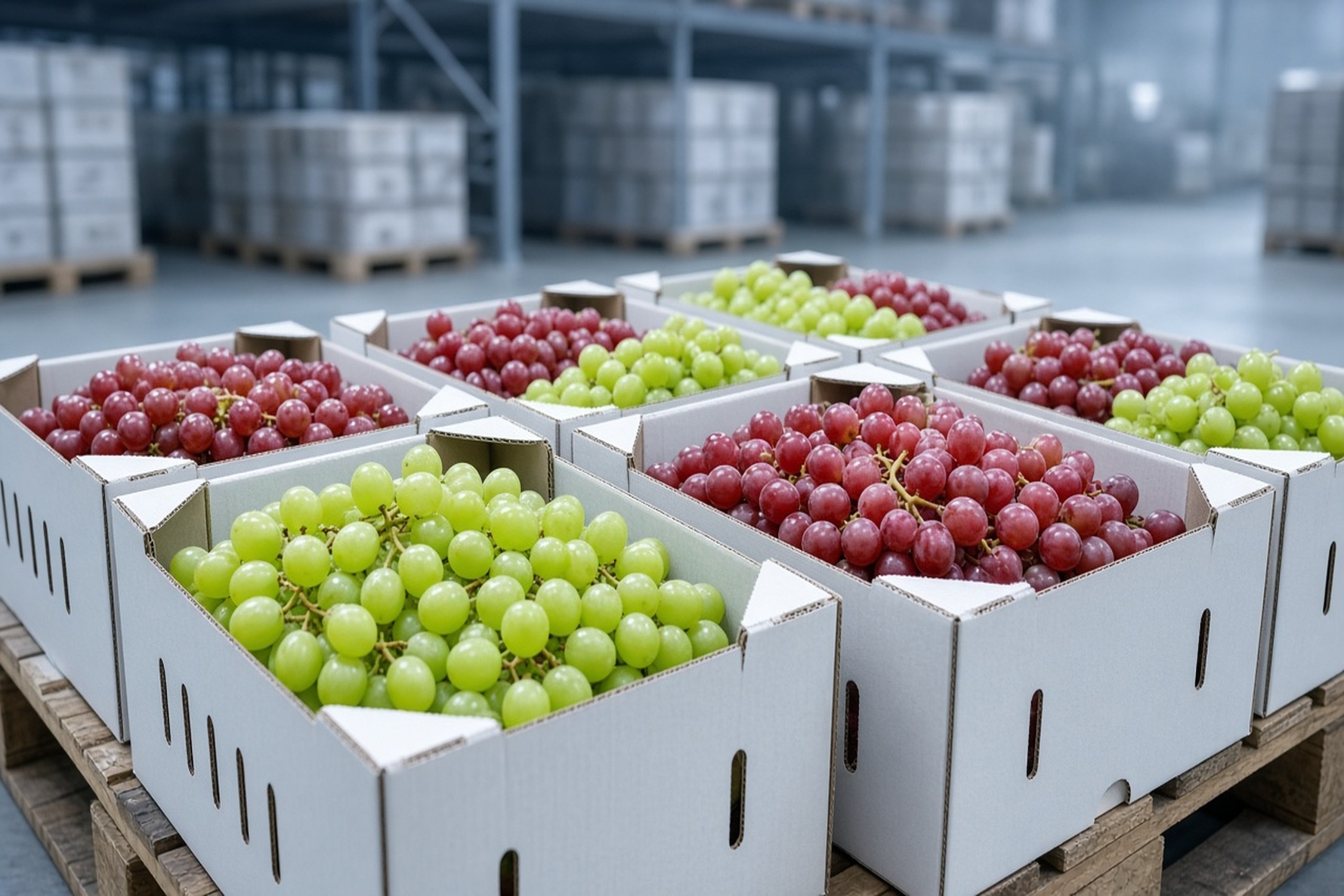
Carton vent area must align with pallet airflow. Short regional routes prioritise speed and carton strength; long cold routes need moisture control and cluster stability. SO₂ generator pads are used in some global chains but must comply with destination MRLs and residue rules.
8. Regional and EU export
Short land routes benefit from time compression only if harvest-to-cool timing is controlled. EU table-grape marketing standards cover health, cleanliness, pests, maturity, class and labelling. Grapes are not among the five EU phytosanitary certificate exemptions. EU MRLs are active-substance × product specific — farm planning must start before harvest.
9. Price drivers
Comparable pricing requires aligned cultivar, harvest timing, Brix, size, sort tolerance, pack weight, Incoterms and destination. Ex-cold-store price must not be compared with delivered city price without freight, documents and border costs.
10. Annual buying programme
Successful programmes start before the first grape reaches market: define destination, cultivar, Brix, size, pack, shatter/decay tolerances, lab tests and transport. At peak harvest, reserve sorting lines, cartons, pre-coolers and reefers — not just fruit volume. Staged orders reduce risk.
FAQ
Which month is best to buy Iranian fresh grapes?
There is no single month for all cultivars. Confirm dates per cultivar and production region when supply is stable but fruit is still field-fresh.
What Brix is suitable for export grapes?
UNECE FFV-19 uses 16° Brix as base; EU minima vary by cultivar group. State your market minimum explicitly in the contract.
What transport temperature is appropriate?
Near 0°C with 90–95% RH. Product must reach target temperature before loading — a reefer cannot replace pre-cooling warm fruit.
Summary
The best buying window is a commercial interval aligned with cultivar, origin, maturity and destination — not a calendar month. Professional buyers ask what cultivar, Brix, size, sort class, pack and delivery terms a price represents.
Featured Products










Related Articles



