 Iranco Magazine Team
From market selection and supply calendars to cold chain, phytosanitary documents, pricing and the first shipment
Export guide · Fresh fruit · Cold chain
Complete guide to exporting Iran’s fresh fruit — from apples and citrus to melons and watermelon
From market selection and supply calendars to packing, cold chain, phytosanitary documents, pricing and the first shipment — a practical Iranco path for Iranian fresh-fruit export.
Iran’s fresh-fruit export journey starts at orchard and farm selection. Fruit grown for foreign markets must combine good flavour and appearance with the strength to survive transport, border formalities, destination warehousing and distribution. Buyers want on-time arrival, match to the agreed sample, and enough shelf life after delivery. Real shipment value is quality, shelf life and reliability together.
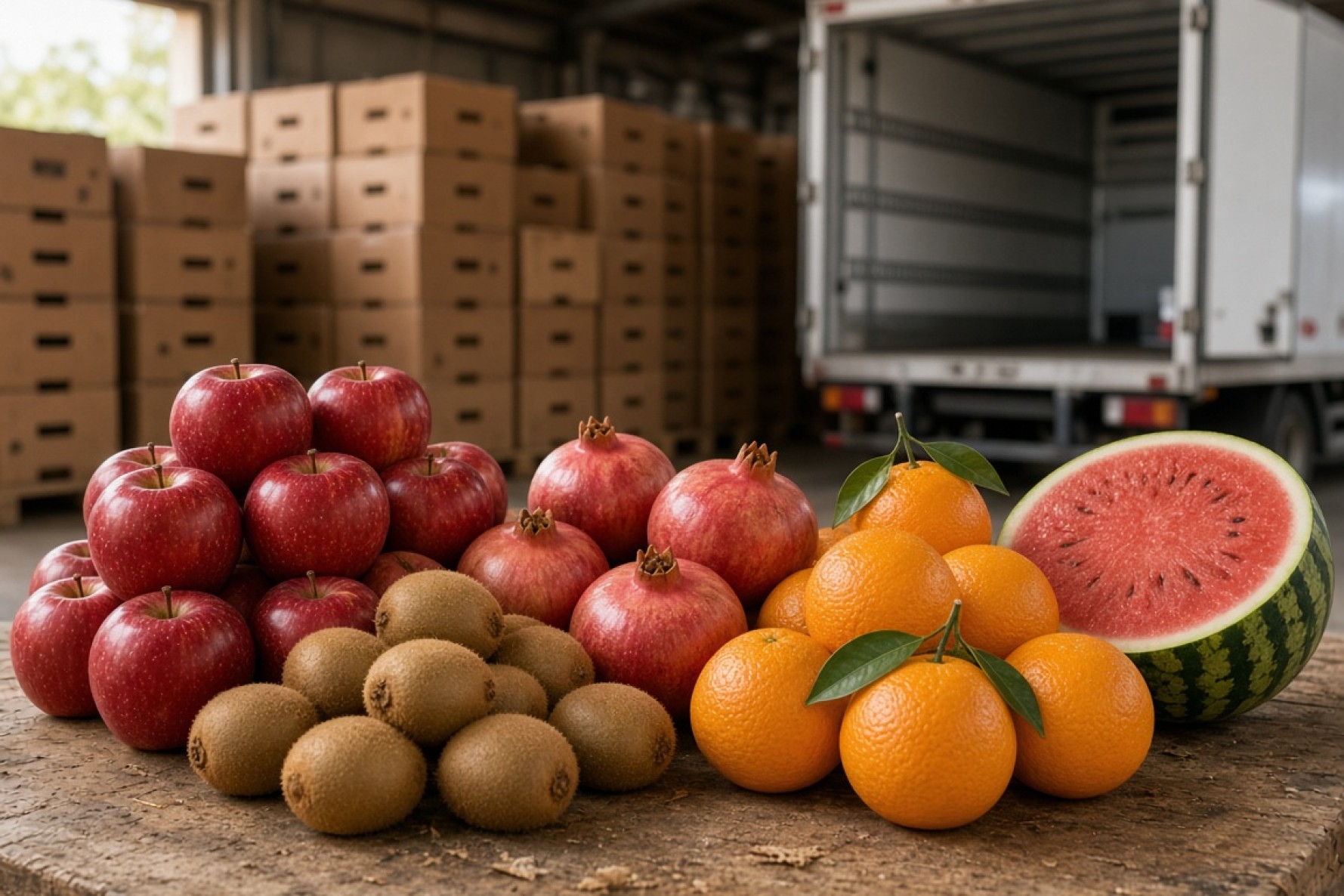
Iran’s climate diversity supports supply across seasons and regions: cold-area apples, northern kiwi, central pomegranates, northern and southern citrus, grapes and summer stone fruit, plus watermelons and melons from warm and temperate zones. Commercial use of this capacity needs coordinated harvest, grading, packing and transport plans. Abundance alone does not create a durable export contract.
For exporters the core question is: which fruit, at what quality, when, by which transport mode, to which buyer? This guide covers tree fruits, citrus, melons and watermelon from market selection through payment and post-shipment review. Grapes and strawberries are included as complementary fresh-fruit trades.
1. How fresh-fruit export differs from domestic wholesale
Domestic sales offer shorter distances and more room to correct mistakes. In export, once the load leaves the packing centre it enters a chain of companies, unloading points and sometimes multiple borders. Small errors in maturity grade, carton ventilation or document details can cut useful selling time. Export quality must therefore be defined for the full route.
A peach that sells well in a nearby market may not suit a long journey. A large, colourful apple with a poor storage history may lose firmness on arrival. Export assessment covers appearance, production history, harvest timing, internal condition and performance after several days of holding.
Professional exporters align sales and quality control—even in a small team. Sales must state real load specs; QC must confirm those specs can be delivered. Commercial commitments rest on available, repeatable product.
2. Choose the market: buyer first, then product
Market choice starts with customer type. Wholesale market traders, supermarket suppliers, hotel and restaurant distributors and specialised importers do not buy the same way. Wholesalers focus on fast turnover and price; retail chains on uniformity, labelling, pack weight and delivery programmes; foodservice on usable size, yield and supply stability.
Build a commercial file for each market: delivered price, freight, real transit time, entry conditions, payment terms and absorption capacity. A higher destination price is attractive only if access cost and quality-loss risk do not erase it. Geographic distance alone is not decisive—a reliable route with fast unloading can beat a short but stop-heavy path.
The table below lists commercial review options. Final product–country combinations depend on confirmed entry feasibility and importer agreement. It is not a statistical ranking of destinations or quarantine clearance for every item.
| Market group | Suitable review approach | Key negotiation focus |
|---|---|---|
| Iraq | Bulk orders and land routes | Delivery time, commercial grade, detention cost, settlement |
| Russia & Eurasia | Apple, kiwi, citrus and seasonal fruit | Supply regularity, transit tolerance, traceability, arrival quality |
| United Arab Emirates | Separate domestic, retail and re-export demand | Buyer identity, packing, unloading plan, final destination |
| Oman, Qatar & Kuwait | Orders matched to distribution channels | Absorbable volume, freshness, pack size, delivery continuity |
| India | Product-specific and logistics planning | Entry rules, product permits, landed cost, transit time |
| Armenia, Azerbaijan & Georgia | Seasonal opportunities and regional haulage | Competitor calendars, border status, distribution speed |
| European markets | Specialised buyers and differentiated product | Compliance, pesticide residues, traceability, buyer requirements |
3. Supply calendar: fresh harvest vs cold-store supply
Export plans must separate harvest season from commercial supply windows. Apples exported in winter may be autumn-harvested fruit; quality then depends on cold-store history, handling frequency and out-of-store conditions. Sensitive fruits must reach markets close to harvest and cannot be held for months.
Spring emphasises early fruit, late citrus and warm-region production; summer stone fruit, grapes and melons; autumn apples, pomegranates, kiwi and early citrus; winter citrus, cold-stored stock and southern production. Set a weekly calendar with orchard, cultivar, volume, export-grade share, packing capacity and transport—aligned with destination selling windows.
4. Write product name, cultivar and origin precisely
In fruit trade, cultivar names, region names and commercial titles are often mixed. “Red apple” is a colour description; “Red Delicious” is a cultivar; a city name shows geographic origin. The same distinction matters for Moghan nectarine, Mashhad cherry, Natanz pear or Jahrom lemon.
Contracts should state fruit type, confirmed cultivar, production area and lot code. Vague labels such as “premium” or “export grade one” without weight, size, allowed defects and maturity create no clear acceptance basis.
5. Red and yellow apples — a base for regular supply programmes
Apples support precise grading, size diversity and storage, making them central to export planning. Red apples need colour and shape uniformity, sound skin and no bruising; yellow apples show stains, russet, scratches and colour change more clearly. Both need firmness, internal soundness and storage history checks. Ranges such as 70–90 mm diameter can define an order; link diameter, unit weight, count per carton and net weight. Strong cartons, suitable trays and movement control reduce transit damage. Food-grade wax is a technical operation with defined conditions—not a mandatory claim for every export apple.
6. Hayward kiwi — manage maturity and keep lots separate
Export kiwi needs sound appearance plus proper maturity. Early-picked fruit may look fine yet disappoint consumers. Soluble solids, firmness, dry matter and maturity uniformity guide decisions; a single Brix reading is not a full assessment. Contracts must define measurement stage, sampling method and acceptance limits. Kiwi is ethylene-sensitive—keep it away from ethylene producers. Track each lot by orchard code and harvest date.
7. Saveh Malas and Neyriz Rabab pomegranate — check inside the fruit
Attractive skin and a sound crown help differentiation, but commercial value is not skin colour alone. Aril colour, taste, sweet–tart balance, internal soundness and absence of browning or rot matter. Cut samples from several points in the load. Weight over 300 g suits some orders but not all markets. Skin cracks, severe sunburn and crown damage are critical control points.
8. Thomson and Valencia oranges — score appearance, juice and taste together
Skin colour is only one buying criterion. Juice content, taste, soluble solids to acidity ratio, firmness and skin health also drive buyer satisfaction. Offer Thomson and Valencia with independent specs. Washing, drying and coating must run on a controlled line. Skin degreening does not replace internal maturity or sweetness.
9. Clementine, Unshiu and Siaho mandarins — prevent hidden bruising
Mandarins attract seasonal demand for easy eating and flavour diversity. Control size, colour uniformity, peel–flesh attachment, seed count and compression damage. Thin peel aids eating but needs gentler handling and tighter packing. Grade with light pressure and avoid overfilling. Compression injury may only show later as quality loss.
10. Sweet lemon, stone lemon and small lemon — three products, three specs
Sweet lemon and sour lemon differ in taste, use and buyer expectation. “Lemon” alone on a proforma is not precise identification. Set size and colour ranges to the order. Use food-contact cartons, washable crates or small retail packs as channel requires.
11. White seedless, red and Yaghouti grapes — cluster health matters
Buyers see the whole cluster: berry size and colour, berry–stem attachment, stem health and no leakage. Fresh-export grapes must be selected for that use from the start. SO₂ pads, where used, must fit cultivar, pack, transit time and destination rules.
12. Peach, nectarine, apricot and plum — pick for arrival timing
Stone fruit is sensitive to impact and maturity shift. Too early weakens taste; too late raises bruising risk. Offer each cultivar with its own specs. Clarify whether “gheysi” means fresh or dried. Shallow cartons and suitable trays reduce pressure; finalise route and clearance before harvest.
13. Sweet cherry and sour cherry — higher value needs tighter execution
For sweet cherry, diameter, firmness, colour, stem health and absence of cracking matter. 28–32 mm may define a premium order—not every buyer wants it. Cool quickly with minimal pressure. Fresh sour cherry is a different market from industrial sour cherry.
14. Persimmon and pear — firm look is not ready-to-eat proof
Persimmon cultivars differ in astringency and ripening behaviour. Firm colourful fruit needs cultivar identity and de-astringency status. For pears, harvest maturity and ripening programmes matter. Agree consumption timing so “firm for transit” is not confused with “ready to eat”.
15. Export watermelon — profit is healthy delivered load, not farm weight
High load weight does not equal high profit. Price per kilo, freight, vehicle weight limits, breakage and sales loss all interact. Harvest at proper maturity—sweetness does not improve much after cutting. Watermelon is chill-sensitive; do not co-load with incompatible temperature regimes. Cheap farm lots pay only when a high share arrives sound and saleable.
16. Melon, cantaloupe and Dastanbu — score aroma, sugar and transit tolerance separately
Mashhadi, Eyvanki and Suski melons differ. Local names need weight, shape, skin, flesh colour, aroma and maturity indices. Brix above 13 may be a sweet-order target, not a universal rule. Postharvest behaviour varies; highly aromatic fruit for distant buyers needs proven transit tolerance.
17. Strawberry — complementary, highly time-sensitive
Strawberry is a specialised fresh-fruit export item. Cultivar, fruit health, calyx freshness, colour and firmness must match delivery timing. Greenhouse or hydroponic growing alone does not guarantee residue safety. Keep harvest–cooling–delivery short and predictable.
18. Technical specification sheet — shared language for seller and buyer
Prepare a short, precise sheet for every order: fruit type, cultivar, origin, size, weight, colour grade, maturity index, allowed defects and packing. Use photos from the same production period. “Ten percent tolerance” is meaningless without defining whether it covers count, weight, size or defects.
| Topic | Required information |
|---|---|
| Product identity | Type, cultivar, production area, lot code |
| Grading | Diameter or weight range, count per pack, colour uniformity |
| Maturity | Measurement method, timing, agreed acceptance limit |
| Defects | Defect definition, sampling method, acceptance limits |
| Packing | Material, dimensions, net weight, count, packing pattern |
| Holding | Temperature plan, ventilation, product-specific conditions |
| Delivery | Exact place, time, documents, quality assessment method |
19. Buying from orchard and farm — build export fruit before harvest
Direct producer links improve quality control. Visit before harvest; record cultivar, crop status, nutrition and plant-protection history. Separate total volume from exportable volume. Contracts must assign harvest responsibility, tools, field crates, transfer and waste separation. Keep several assessed suppliers, but never mix lots without traceability.
20. Harvest and pre-cooling — manage the first hours
Ideal harvest timing differs by fruit. Keep harvested fruit in shade, clean containers and with minimal drop height. Pre-cooling removes field heat with a method suited to the product. Measure pulp temperature—cold room air does not mean every carton is evenly cooled. Load only when the product has reached the agreed condition.
21. Sorting, washing and packing — make quality repeatable
Grading lines must separate fruit to contract criteria. Complete visual grading with internal sampling. Washing is not universal; water quality, contamination control and surface drying matter. Cartons are part of protection and ventilation. Quality must hold on the bottom pallet row, not only in the photo carton.
22. Cold chain — one temperature does not fit all fruit
The cold chain runs from harvest through cooling, storage, loading, transport and distribution. Kiwi is usually held near 0°C; watermelon reference ranges are about 10–15°C. Humidity, ventilation and ethylene also matter. Place temperature loggers at representative points and record their IDs.
23. Choosing road, sea and air freight
Transport choice starts from product selling life and the buyer’s programme. Road is flexible for regional routes; sea adds capacity but needs sailing, power and unloading discipline; air speeds the main leg at higher cost per kilo. Time the door-to-door journey, not only the main haul. Compare carriers on fruit experience, breakdown contingency, monitoring and detention liability—not freight alone.
24. Entry requirements — clarify the administrative path before buying
Before purchase commitment, confirm that the same Iranian-origin fruit can enter the target country. A phytosanitary certificate differs from residue reports or commercial quality certificates. If the destination requires orchard registration, packing-house listing, extra declarations or specific treatments, build those into the plan before harvest.
25. Residues, traceability and product hygiene
Residue control starts in the production programme. Test samples must represent the export lot. Traceability means a carton code can reach grower, harvest date, packing line and transport lot. Staff, surfaces, water and containers hygiene is part of the same control.
26. Export documents and labels — every detail must confirm the others
Finalise the document list with broker and importer for that deal. Seller, buyer, product description, pack count, weight and lot ID must be consistent across documents. Labels must match destination rules and the contract.
26 (continued). Common shipment file documents
| Document / information | Main use in the file |
|---|---|
| Proforma invoice | Offer, specs, price and initial terms |
| Commercial invoice | Value and description of goods traded |
| Packing list | Pack count, type, weight and load layout |
| Transport document | Movement details and related parties |
| Certificate of origin | Goods origin per applicable formalities |
| Phytosanitary certificate | Quarantine requirements coverage |
| Test or inspection report | Results required by contract or destination |
| Insurance & entry documents | Coverage and formalities for the deal |
27. Pricing — farm purchase cost per kilo is not saleable cost per kilo
Base calculations on destination saleable weight. Sum orchard purchase, harvest, domestic haulage, grading, packing, cooling, storage, tests, documents, foreign freight and destination services by contractual responsibility, then add waste, weight loss, commission and financing effects.
Educational example: buy 20,000 kg at 50,000 tomans/kg — purchase cost 1 billion tomans. Select 18,000 kg for export; the other 2,000 kg of another grade earns 60 million tomans. Net purchase attributed to the export load is therefore 940 million tomans.
If other costs total 320 million, the export shipment costs 1.26 billion tomans. With 3% post-packing loss, saleable weight is 17,460 kg — about 72,165 tomans per saleable kilo. These figures are a calculation example, not market prices.
28. Contract, delivery terms and collecting payment
Contracts must state exact delivery place, risk-transfer timing, who pays which costs, and required documents. Risk transfer, ownership transfer and payment timing are separate topics. For fresh fruit, claim deadlines, sampling, photo evidence and independent inspection matter. Vet new buyers for legal identity, track record and payment capacity.
29. First-shipment execution plan
Design the first export around one product, one clear grade and one defined buyer. Put harvest, sampling, cooling and documentation on one shared calendar with a single coordinator. After delivery, review saleable weight, defect rate, logged temperatures and settlement time. Scale volume only when quality and payment are repeatable.
30. Marketing and building credit for Iranian fruit
In fruit trade, brand is built by delivery experience. Product introductions need real photos, technical specs, supply calendar, MOQ, pack type and lead time. Tailor offers by customer group. Show in samples only quality you can repeat.
31. Reducing waste and resource use — a direct profit lever
Waste reduction starts with choosing the right destination. Separate grades to use product better. Lighter packs without losing strength, better pallet cube use and shorter waiting times cut cost and energy. Every percentage of waste cut turns more produced fruit into revenue.
32. Metrics to review after every shipment
Record export-grade share of purchases, weight loss, arrival damage rate, transit time and days to payment. Compare by grower, product, packing and route. Also track buyer reorder rate, payment discipline and cooperation quality.
33. Practical FAQs on Iranian fresh-fruit export
Which fruit is best to start with?
Choose a fruit where you control supply, have a suitable packing centre and a defined buyer. Apples or some citrus often allow more planning room than highly sensitive fruit.
Does larger fruit always fetch a higher export price?
Desired size is set by customer and channel. Uniformity and order match beat unplanned large size.
Do all fruits need the same documents?
Commercial cores are similar, but quarantine, tests, labels and entry rules differ by product and country.
Will a reefer truck cool a warm load on the road?
Transport mainly maintains defined conditions. Product should reach the right state before loading.
How do we prevent quality disputes?
Agree specification sheet, representative sample, traceability code, loading records and arrival inspection method from the start.
Is more expensive packing always more economical?
Packing pays when it cuts damage or creates saleable value the buyer accepts.
When should we increase export volume?
After supply, delivery quality and payment collection are repeatable across several orders.
34. From seasonal selling to sustainable fruit trade
Sustainable Iranian fruit export rests on accessible markets, product fit for that market, correct harvest timing, quality kept on the route, and deals with clear responsibilities. Apples and kiwi need inventory and maturity management; citrus needs skin and internal quality control; stone fruit needs speed and tissue protection; watermelon and melon need freight-cost balance and sound delivery.
Start with one clear order and finalise every component before harvest. Iranian fruit becomes recurring revenue when buyers can rely on every carton and every delivery time.
Featured Products












Related Articles



