 Iranco Magazine Team
Pistachio, dates, walnut, fresh fruit, fruit products and saffron in Turkey — real demand, competitors, standards, tariffs, packaging, logistics and buyer selection
Export Guide · Turkey · Food Market
Iran Food Exports to Turkey: Which Iranian Products Can Compete?
Pistachio, dates, walnut, fresh fruit, fruit products and saffron in Turkey — real demand, competitors, standards, tariffs, packaging, logistics and buyer selection.
Turkey is a major regional food producer and exporter, so geography alone does not guarantee success for Iranian goods. This report shows which Iranian foods face real import demand in Turkey, where Iran’s competitive edge lies, and what exporters must manage on quality, documents, packaging, border control and negotiation with Turkish buyers.
Introduction
Turkey looks attractive at first sight: shared land border, short hauls, truck options, a large consumer market and a developed food industry. Yet Turkey is also a powerful agricultural and food producer and a serious exporter to Europe, Russia and the Middle East in many of the same categories Iran ships.
In 2024 Turkey produced about 33.6 million tonnes of vegetables and nearly 28 million tonnes of fruit, beverages and spices. Close to 60,000 food and beverage manufacturing units were active, and imported foods hold only a limited share on retail shelves.
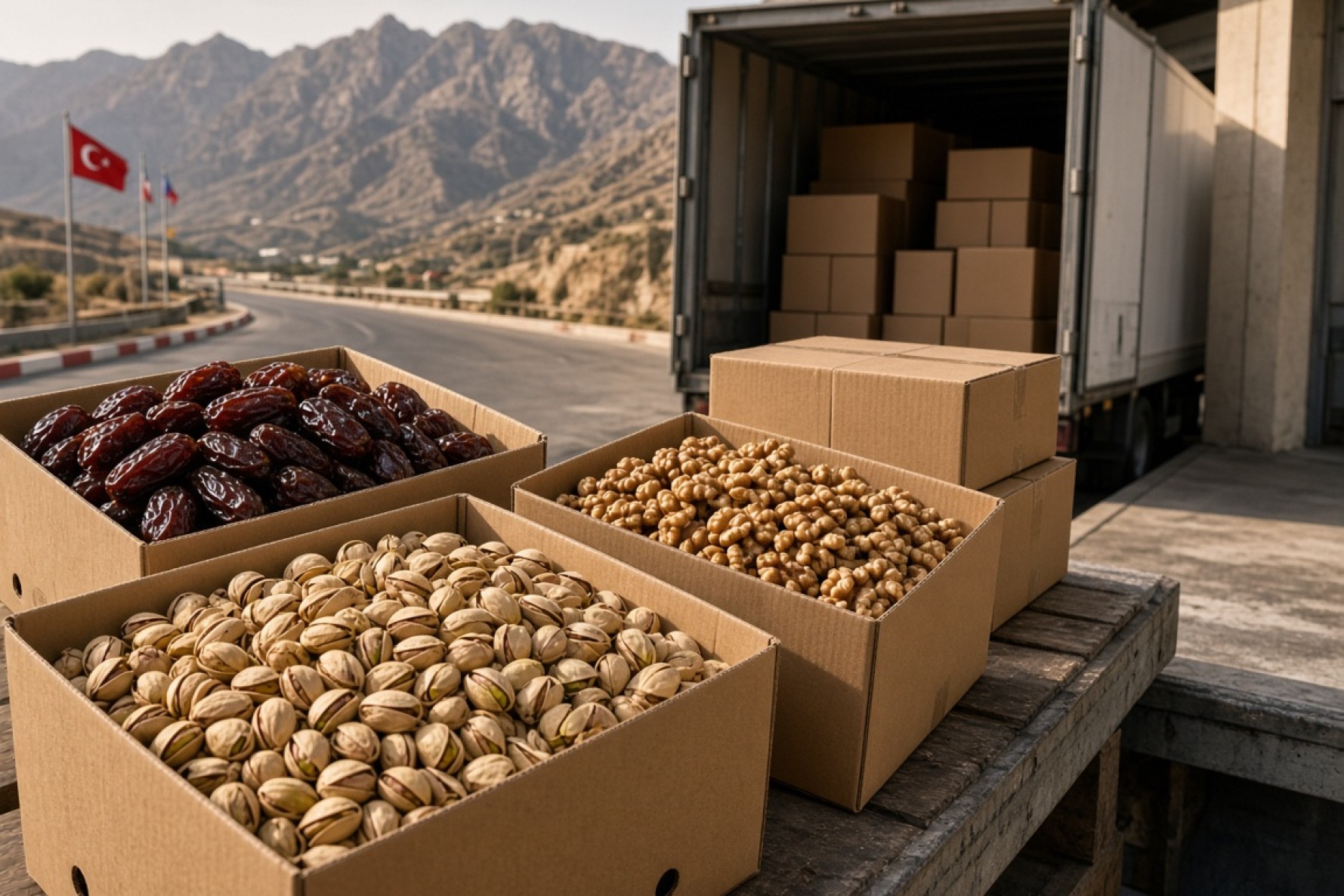
The professional answer is not a list of everything Iran exports. Focus on goods where Turkey is a genuine importer, Iran has a production edge, supply windows match domestic shortages, technical specs suit Turkish food plants, or land freight from Iran beats distant suppliers. Trade data highlight pistachio, dates, walnut, seasonal fresh fruit, fruit preparations and juice inputs, and on a smaller scale saffron.
1. How to assess Turkey for food exports
- Structural supply gaps: dates are the clearest example, with Iran, Egypt, Tunisia, Saudi Arabia and Palestine competing.
- Industrial raw materials: pistachio, tree nuts, concentrates and fruit preparations for confectionery, chocolate, ice cream and beverages.
- Seasonal windows: watermelon and some produce when domestic supply is thin.
- Quality or origin differentiation: saffron, selected date types and pistachio where origin and sensory traits matter.
Farm-gate cheapness alone rarely survives packaging, transit loss, border checks, duties, testing, distribution margin and delay risk.
2. Products with stronger competitive odds
| Product | Demand in Turkey | Iran edge | Main challenge |
|---|---|---|---|
| Pistachio | Significant imports | Volume, grades, land route | USA, domestic crop |
| Dates | Large import market | Supply, types, short haul | Egypt, Tunisia, GCC |
| Walnut | High imports | Proximity, in-shell & kernel | USA, China, Chile |
| Melon & watermelon | Seasonal | Border speed | Perishability, local crop |
| Fruit preparations | Industrial | Raw fruit, bulk industry packs | Specs & price |
| Juice inputs | Factory use | Concentrate & semi-processed | China, domestic plants |
| Saffron | Small, high unit value | Quality range | Volume, authenticity |
2024 trade: about USD 129.6M pistachio, USD 14.6M dates, over USD 5.5M walnut and about USD 2.9M melons and watermelons from Iran.
3. Product-by-product reality
Pistachio
Turkey imported about USD 342.2M pistachio in 2024; roughly USD 129.6M from Iran. The USA led; Iran was the next key supplier. Industrial buyers need in-shell vs kernel, size, open shell %, moisture, defects, kernel colour, splits and aflatoxin limits in contract.
Dates
Over 70,000 t imported in 2024; ~27,000 t from Iran. Retail, Ramadan, bulk and confectionery segments differ. Quote by cultivar, moisture, softness, sort and pack — not generic “Iranian dates”.
Walnut
In-shell imports exceeded 83,000 t; Iran supplied over 4,300 t. Kernel imports ~17,000 t with 1,300+ t from Iran. Shorter land routes help oxidation control; buyers benchmark China, USA and Chile on colour, halves and breakage.
Melons & watermelon
Iran supplied most of Turkey’s 2024 import tonnage in this group — a seasonal, not year-round, opportunity. Arrival timing beats farm price.
Fruit products & juice
HS 200899: 23,000+ t (~USD 28.4M) from Iran; single-strength juice (200980) 14,000+ t (~USD 8.7M). Brix, acidity, micro specs and industrial pack type drive deals.
Saffron
~488 kg imports; 311 kg from Iran. Niche market — ISO 3632, moisture, colour strength and authenticity tests matter more than discounting.
4. Specs Turkish buyers should demand
Define tolerances and convert “export carton” into net weight, inner bag, pallet pattern and strength. Buyers comparing several Iranian suppliers can lodge one structured request on Iranco.
5. Quality control
Approved samples must link to shipment acceptance rules. Nuts: moisture, insects, mould, splits, aflatoxin, oxidation. Dates: moisture, fermentation, softness. Fresh produce: MRLs vs Turkish codex. Industrial fruit: COA per batch, not an old factory reference.
6. Who buys Iranian food in Turkey?
- Nut and spice importers / wholesalers
- Confectionery, chocolate and industrial bakery (broken kernels)
- Juice and fruit processing (stable concentrate specs)
- Retail: local importer/repacker route is usually easier than direct shelf entry
7. Entry requirements
Plant products fall under Turkish Ministry of Agriculture controls (Law 5996 and import inspection communiqués). Pre-notification, then document, identity and physical checks. Consumer packs need Turkish-label compliance under the Turkish Food Codex; 2026 labelling updates allow transition to year-end 2026 for some items.
8. HS codes & preferential trade
Examples: dates 080410; walnut in-shell/kernel 080231/080232; pistachio 080251/080252; watermelon 080711; saffron 091020; other prepared fruit 200899. The Iran–Turkey PTA (from January 2015) covers ~140 Iranian agricultural lines — match code, preference list and rules of origin.
9. Packaging & logistics
Bazargan–Gürbulak is the main truck corridor; Kapıköy–Razi and Sero–Baskale are alternatives. Moisture barriers for nuts; pressure-resistant packs for soft dates; ventilated cartons and cold chain for fresh fruit.
10. Pricing
Landed quotes compare grade, season, defect allowances, tests, pack, volume, freight, Incoterms, duty preference, payment and continuity — not kg price alone.
11. Importer checklist (summary)
- Product form (fresh, dried, kernel, concentrate)
- Measurable grade & acceptance tolerances
- Production sample & agreed COA
- HS code, PTA eligibility, origin proof
- Real manufacturer, capacity, Turkish label proof
- Transport, delivery point, dispute rules
12. Sourcing via Iranco
Register one purchase request with technical specs, volume, pack, destination and quality rules so Turkish importers compare like-for-like Iranian supply options.
Summary
Success means measured specs, full Turkish regulatory fit and predictable delivery — not “cheap neighbour exports”. Pistachio and dates lead defensible opportunities; walnut merits study; fresh fruit is seasonal; fruit ingredients suit industry; saffron stays niche but high value.
FAQ
Does Turkey import Iranian pistachio despite domestic production?
Yes — over 13,000 t in 2024, much for industry and snacking. Grade, size, kernel colour and aflatoxin define value.
Which Iranian foods have the most room?
Pistachio and dates by trade value; walnut, fruit products and seasonal produce also merit review.
Is there a market for Iranian dates?
Yes — 27,000+ t and ~USD 14.6M in 2024 alongside regional competitors.
Is a Turkish label required?
Mandatory Turkish information for consumer-facing packs under codex rules.
Does PTA cover all foods?
No — only listed lines; verify HS code and origin.
Key pistachio test?
Aflatoxin plus moisture, defects and splits; COA for the shipped lot.
Why can Iranian walnut compete?
Shorter land route; compare delivered price vs colour and halves.
Is fresh fruit always economic?
No — windows matter more than small farm price gaps.
How to request accurate prices?
Specify product, grade, volume, pack, Turkish destination and delivery terms — including via Iranco.
Pistachio, dates, walnut and Iranian food ingredients for Turkey
Contact Irancoinfo@iranco.com · WhatsApp: +98 913 104 4182 · Telegram: @irancofood
Featured Products










Related Articles



