 Iranco Magazine Team
From dates, tomato paste and fresh produce to milk powder, raisins and pistachios — market analysis, EAEU rules, packaging, land transport and Armenian buyer requirements
Export Guide · Armenia · Food Market
Iran Food Exports to Armenia: Market Opportunities for Iranian Products
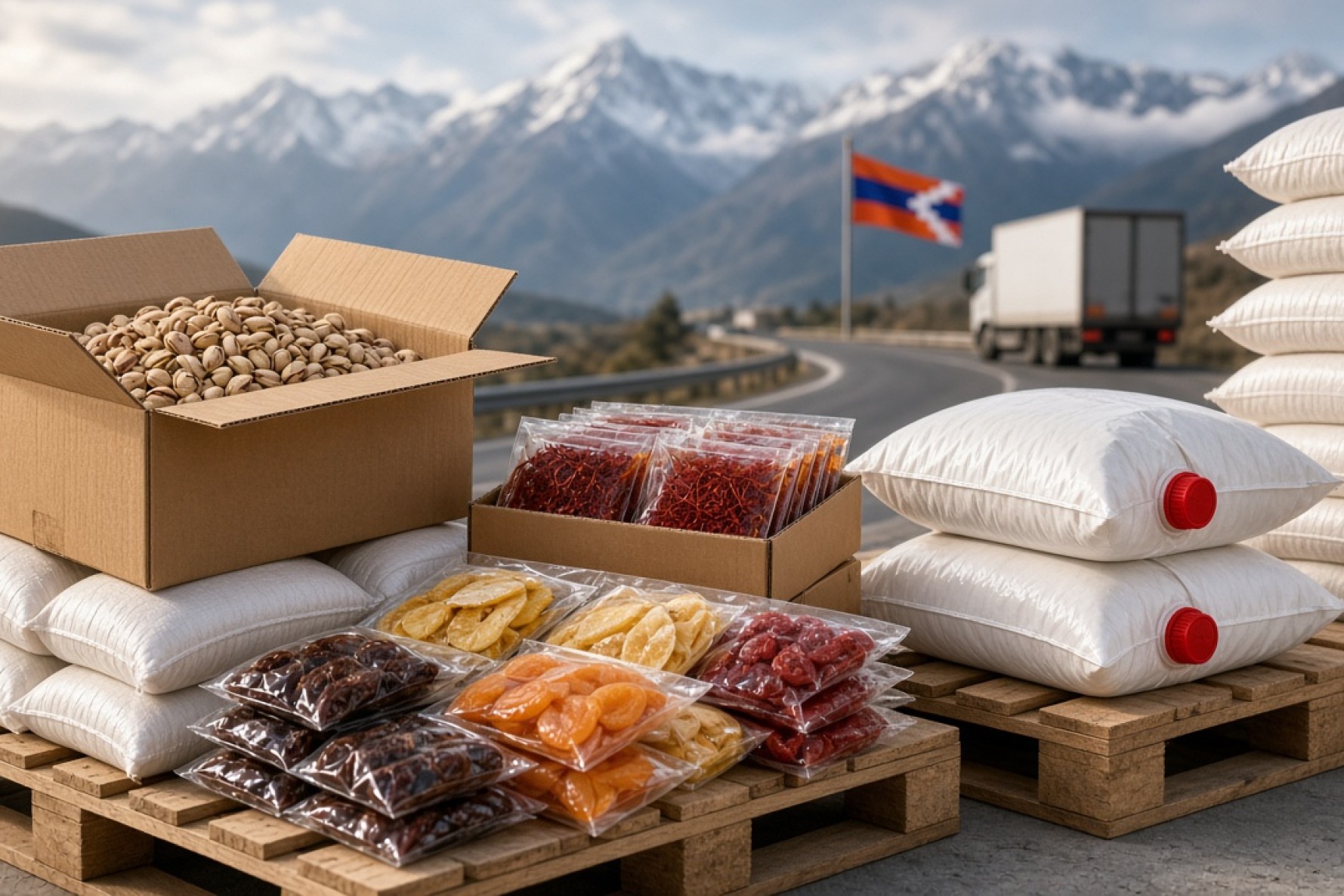
From dates, tomato paste and fresh vegetables to milk powder, raisins and pistachios — market analysis, EAEU regulations, packaging, land transport and Armenian buyer requirements.
Armenia is more than a neighbouring market for Iranian food exporters. Trade data show Iran holds a significant share of Armenian imports in several food groups, from dates and cucumbers to fresh tomatoes and tomato products. This report identifies which Iranian products already have demand, where room remains to grow, and what exporters must observe on labelling, quality control, tariffs, packaging and customs entry.
Introduction
Armenia’s population cannot be compared with markets such as Russia or Iraq, but the country offers Iranian exporters three structural advantages: a direct land border with Iran, a visible presence of Iranian goods in several food categories, and EAEU membership. Together, Armenia is both a standalone sales market and a practical gateway to learn Eurasian technical and trade rules.
Official statistics show bilateral trade rose from about USD 737 million in 2024 to USD 768 million in 2025, with Armenian imports from Iran at roughly USD 680 million in 2025. In the first half of 2026, imports from Iran reached about USD 336.9 million, roughly 12% above the same period a year earlier.
The comprehensive free trade agreement between Iran and the EAEU took effect on 15 May 2025, creating duty-free treatment for nearly 90% of tariff lines and covering more than 95% of reciprocal trade. Preferential access still depends on the tariff code, origin of goods and compliance with rules of origin.
Food trade figures confirm Iran’s position is not theoretical. In 2024, more than 94% of Armenia’s date import value, about 93% of watermelon and melon imports in the relevant group, about 89% of fresh cucumber and gherkin imports, about 68% of fresh tomato imports and more than 97% of preserved tomato imports (excluding vinegar) came from Iran. Iran is also present in raisins, pistachios, milk powder and some juices, but faces stronger competition there.
Exporters should not use one strategy for every food product. For dates the focus is defending market share, stable quality and consumer packaging; for milk powder the challenge is Belarus and Russia; for pistachios it is US competition. Professional exporters must simultaneously understand Armenian national rules, EAEU technical requirements and buyer specifications.
1. Armenia’s Role in Iran’s Food Trade
Armenia offers a major logistics advantage: the two countries share a land border and commercial trucks enter from Iran through the Agarak crossing in southern Armenia. Wholesale distribution and warehousing are concentrated mainly in Yerevan.
In 2025 Armenia imported about USD 680 million of goods of Iranian origin. That figure covers all merchandise, not food alone, but it shows an active, established trade network. Bilateral trade reached USD 768 million.
Direct border advantage
Some of Iran’s competitors rely on transit through Georgia. Iran enjoys direct land access. For bulky low-unit-value goods and for perishables, fewer handovers and better route control materially affect delivered cost.
Yerevan as distribution hub
Real cost to the buyer includes inland Armenian transport, unloading, warehousing, quality checks, required relabelling and distribution to retail or industrial customers. For consumer goods, importer distribution capacity matters; for industrial inputs, direct supply to the factory can be more effective than general wholesale.
2. Which Iranian Foods Have Real Opportunity in Armenia?
Opportunity must be measured with import data, not cultural or geographic proximity alone. 2024 statistics show several Iranian food groups already hold serious positions in Armenia.
| Product / group | Imports from Iran (2024) | Iran’s position | Commercial takeaway |
|---|---|---|---|
| Dates HS 080410 | ~3.06M kg · $7.08M | ~95% of value | Established market |
| Preserved tomato HS 200290 | ~8.53M kg · $8M | >97% of value | Strongest Iranian position |
| Cucumbers HS 070700 | ~5.18M kg · $4.30M | ~89% of value | Fresh-market edge |
| Fresh tomatoes HS 070200 | ~4.22M kg · $5.87M | ~68% of value | Turkey key rival |
| Melons & watermelons | ~8.38M kg · $3.86M | ~93% of value | Large seasonal market |
| Raisins HS 080620 | ~736K kg · $1.24M | ~39% of value | Competitive; room to grow |
| Pistachios HS 080250 | ~145K kg · $845K | ~37% of value | US main rival |
| Skim milk powder HS 040210 | ~1.86M kg · $3.79M | ~20% of value | Belarus & Russia competition |
Dates — Iran’s established market
Armenia imported about 3.13 million kg of dates in 2024, over 3.06 million kg from Iran. Growth in such a market often comes from consumer packaging, stable size and texture, moisture control and proper labelling rather than bulk volume alone.
Tomato paste and preserved tomato products
HS 200290 covers preserved tomatoes other than by vinegar. Armenia imported about 8.68 million kg in this group in 2024, roughly 8.53 million kg from Iran. Industrial orders should specify concentration, Brix, colour, salt, pack type and net weight.
Fresh vegetables
Trade data show strong Iranian presence in tomatoes, cucumbers, carrots and other fresh items. Distance is an advantage, but phytosanitary rules, size uniformity, mechanical damage and shelf life sensitivity are critical.
Raisins, pistachios and milk powder
For raisins, colour, moisture, foreign matter and packaging drive buyer choice. Iranian pistachios have a market, but sellers must compete on size, open-shell percentage, moisture, aflatoxin and pack quality. Milk powder requires chemical and microbiological control aligned with end use.
3. What Specifications Should the Armenian Buyer Define?
Labels such as “export-grade dates” or “premium paste” do not create contract criteria. Professional deals require measurable specifications.
| Product group | Key specs in the purchase request | Why it matters |
|---|---|---|
| Fresh fruit & vegetables | Type, size, ripeness, defects, carton, net weight | Sales and shelf life |
| Dates | Variety, moisture, texture, damage %, pack | Quality and price level |
| Pistachios | Size, open shell %, moisture, aflatoxin | Grade and safety |
| Raisins | Colour, moisture, stem, foreign matter | Retail or industrial use |
| Tomato paste | Brix, salt, colour, pack, net weight | Comparable offers |
| Milk powder | Fat, protein, moisture, microbiological load | Industrial processing |
For fresh produce, buyers should set acceptance limits for surface damage, bruising, over-ripeness and size variation. For industrial inputs, accepted numerical limits must appear on the spec sheet and contract — not only “as per sample”.
4. Quality Control and Testing
QC must match the product. Fresh fruit and vegetables require visual integrity, uniformity, ripeness, pest signs and mechanical damage checks. Official plant exports also face quarantine rules.
The EAEU applies common quarantine requirements. High-risk consignments need phytosanitary certificates from the competent authority in the exporting country and are inspected on entry.
Aflatoxin testing is critical for pistachios. Tomato paste requires Brix, salt, pH, colour and relevant microbiological indicators. Laboratory certificates must refer to the same batch being loaded — not an old production run or display sample.
5. Standards, Food Safety and Labelling in Armenia
As an EAEU member, Armenia applies a large share of food technical regulation through the union’s TR CU / TR EAEU instruments.
- TR CU 021/2011 — food safety
- TR CU 022/2011 — food labelling
- TR CU 005/2011 — packaging safety
- TR CU 029/2012 — additives and flavourings
- TR CU 033/2013 — milk and dairy products
Armenian-language labels
Current Armenian food safety law requires labelling in Armenian with minimum 3 mm legible character height. Required information includes product name, ingredients, allergens, net weight or volume, production and expiry dates, storage conditions, manufacturer and importer details, country of origin, nutrition information and batch ID.
Animal-origin products such as milk powder and cheese face veterinary and health documentation requirements that must be confirmed with Armenian authorities before contracting.
6. Tariffs, HS Codes and the Iran–EAEU FTA
The Iran–EAEU comprehensive FTA has applied since 15 May 2025. Iranian origin alone does not automatically mean duty-free entry: exact tariff code, inclusion on the preference list and proof of origin must each be verified. Form CT-3 is foreseen for preferential origin.
| Product | HS Code |
|---|---|
| Fresh or dried dates | 080410 |
| Pistachios | 080250 |
| Raisins | 080620 |
| Fresh tomatoes | 070200 |
| Fresh cucumbers | 070700 |
| Carrots and turnips | 070610 |
| Skim milk powder | 040210 |
| Preserved tomato (non-vinegar) | 200290 |
7. Packaging for the Armenian Market
Export packaging should follow the sales channel. Fresh tomatoes, cucumbers and fruit need cartons with adequate compression strength and ventilation where required. Dates and nuts need moisture barriers and stable consumer packs.
| Channel | Pack type | Buyer priority |
|---|---|---|
| Retail | Consumer unit with Armenian label | Appearance, weight, shelf life |
| Produce wholesale | Strong shipping carton | Low waste |
| Bulk nuts | Bag or carton with liner | Moisture and contamination |
| Food factory | Industrial pack | Unit cost and handling |
8. Land Transport from Iran to Armenia
Goods enter Armenia through Agarak and move from Syunik onto the national road network. Southern Armenian roads are mountainous and winter conditions can affect truck movement.
- Time from harvest to loading
- Product temperature at loading
- Ventilation or product-specific conditions
- Carton and pallet stacking
- Border dwell and destination unloading time
A refrigerated truck does not guarantee quality without proper loading discipline. For dry and processed goods, check truck floor and walls, odour, humidity and load securing before departure.
9. Competition in Armenia
| Product | Iran position | Main rivals (2024 trade) |
|---|---|---|
| Dates | Dominant | Russia, Israel, Tunisia |
| Fresh cucumbers | Dominant | Turkey |
| Fresh tomatoes | Leading supplier | Turkey |
| HS 200290 | Dominant | Russia, Italy, China |
| Pistachios | Major supplier | United States |
| Raisins | Strong but not dominant | Chile, Russia, Uzbekistan |
| Skim milk powder | Important player | Belarus, Russia |
In dates and tomato products, competition often shifts from “Iran vs other countries” to “Iranian supplier vs Iranian supplier”. In skim milk powder, Belarus and Russia supplied larger volumes than Iran in 2024.
10. Sales Channels and Market Entry
Distribution is relatively centralised; Yerevan dominates warehousing and wholesale.
Importer and distributor sales
For dates, nuts, juice, sauces, paste and snacks, importers with retail networks are usually the right partner. Agree label language, pack size, barcode and remaining shelf life before production.
Bulk fresh produce
Speed of turnover matters more than brand. Export offers should state size, pack, net weight and delivery schedule.
Direct industrial supply
Milk powder, industrial paste, industrial raisins and concentrates can go straight to factories; lab samples and technical specs outweigh pack appearance.
11. Importer Checklist Before Placing an Order
- Define exact product name and processing form.
- Verify proposed HS code with Armenian broker or declarant.
- Check preferential tariff status under the Iran–EAEU FTA.
- Confirm CT-3 certificate requirements.
- Receive and approve a real product sample.
- Attach a technical specification sheet to the contract.
- Define tests required for each batch.
- Set acceptance limits for visual and technical defects.
- Fix net weight and weight tolerance.
- Review Armenian label text before printing.
- Calculate remaining shelf life at entry.
- Confirm health, quarantine or veterinary documents before loading.
- Clarify transport terms and each party’s liability.
- Plan pre-shipment inspection for sensitive orders.
What Information Is Needed for an Accurate Price?
- Exact product name, grade and key technical specs
- Unit size or weight, order quantity and pack type
- Private-label needs, required tests and certificates
- Destination and delivery point in Armenia, transport mode and schedule
- Payment terms
For fresh produce add harvest timing, size and ripeness. For paste and industrial inputs define Brix, industrial pack type and chemical/microbiological tests.
12. Supply Path for Iranian Food to Armenia
Comparing two offers on price per kilogram alone is rarely accurate. Buyers should first fix product group and end use, then quantity, technical specs, packaging, destination and required documents before comparing quotes on identical terms.
Iranco can receive purchase requests to review supply options from Iranian producers and suppliers. For Armenian market sourcing, include product specifications, approximate volume, packaging and delivery city from the start.
Summary
Iranian food exports to Armenia are a real trade flow in several categories, not only a theoretical neighbour market. Dates, tomato products, cucumbers, fresh tomatoes and melons show strong 2024 import shares for Iran; raisins, pistachios and milk powder are competitive segments.
Iran’s structural advantage is the direct land border. The main complexity is complying with both Armenian national rules and EAEU regulation. The FTA in force since May 2025 improves tariff conditions for a wide range of goods, but correct classification and origin proof remain mandatory.
Success depends on proven demand, precise specifications, correct documents and labels, and logistics managed to destination — decisions should rest on market data, product specs and true delivered cost.
Frequently Asked Questions
Is Armenia a suitable market for Iranian food?
For some groups, yes. 2024 data show strong Iranian shares in dates, cucumbers, fresh tomatoes, melons and preserved tomatoes. Pistachios, raisins and milk powder have demand but tougher competition — evaluate product by product.
Which Iranian products are most present in Armenia?
Dates, tomato products, cucumbers, fresh tomatoes and melons stand out. Iran held very high shares in dates and HS 200290 in 2024.
Is Iranian food export to Armenia duty-free?
The FTA from 15 May 2025 covers nearly 90% of lines with duty-free treatment, but each product must qualify via tariff code, schedule commitment and origin proof including CT-3 where applicable.
Is Persian labelling enough for retail in Armenia?
No. Armenian-language labelling is mandatory with required fields for name, ingredients, allergens, weight, dates, storage, parties, origin and nutrition.
Which documents matter for fresh fruit and vegetable export?
Quarantine-controlled plant products must meet EAEU phytosanitary rules. High-risk loads need phytosanitary certificates and are inspected on entry.
What minimum shelf life is required at entry?
Less than 30 days remaining shelf life is prohibited. If total life is under 120 days, at least one quarter must remain at import.
What is the best transport mode from Iran to Armenia?
Land transport via Agarak is the natural route for most trade. Fresh or temperature-sensitive goods need reefer trucks and temperature management; dry goods need moisture and pack integrity control.
How is export pricing to Armenia determined?
From exact product, quality, packaging, volume, testing and certificate cost, delivery terms, freight and FTA preference eligibility — not factory price alone.
How can buyers source food from Iranian producers for Armenia?
Define product, specs, quantity, pack, destination and documents; compare sample-backed quotes on identical terms. International buyers can submit a purchase request through Iranco.
For Armenia food export advisory and purchase requests from Iranian suppliers
Contact Irancoinfo@iranco.com · WhatsApp: +98 913 104 4182 · Telegram: @irancofood
Featured Products








Related Articles



