 Iranco Magazine Team
Comprehensive analysis of technical, quality, logistics and contractual errors in Iranian food export and strategies to retain international buyers
Quality Control · MRL · Cold Chain · Incoterms · Export Packaging
Common Mistakes by Iranian Food Exporters That Cause Loss of Foreign Buyers
Analysis of critical failures in standards compliance, quality control, cold-chain logistics, commercial contracts, and export packaging principles
A review of Iran’s food-industry export challenges shows that most commercial failures do not stem from inherently poor product quality, but from structural errors in customs compliance, failure to meet residue limits, packaging collapse in the cold chain, and misaligned trade documentation. This specialist report dissects export processes, examines costly mistakes that lead to cancelled contracts, returned consignments, and loss of trust among international buyers, and presents practical measures to stabilize cross-border trade.
International trade in agricultural products and industrial foods rests on engineering calculations, strict sanitary compliance, and consistent quality across the supply chain. Iranian exporters—leveraging climatic advantages, distinctive product flavor, and access to a wide range of horticultural and processed goods such as pistachio, saffron, dates, fresh fruit, and dried nuts—have long held a place in regional and global markets. Yet the shift of world trade from traditional bargaining models to structured supply chains requires a full redefinition of operational processes at origin. Every year, a substantial volume of Iranian food consignments is stopped, destroyed, or returned at entry points in countries such as Russia, EU member states, India, and the Gulf Cooperation Council states because of entirely preventable errors.
These crises largely arise from a deep information gap between domestic producers and the legal and technical expectations of international buyers. A professional buyer in destination markets prefers reliable delivery of goods matching contract specifications over a lower price; even minor swings in quality indicators, chemical contaminants, carton failure inside the container, or clearance delays expose destination distribution networks and retail chains to heavy penalties and revoked health permits. An exporter who surprises a foreign buyer at destination—through ignorance of Incoterms 2020, packaging that cannot withstand cold-store humidity, or disregard for pesticide pre-harvest intervals—not only loses a valuable customer but also places the company’s and the origin country’s brand on special-inspection lists at international customs. Systematic analysis of these errors and implementation of risk controls are the only path to protecting Iran’s export value added and sustainably growing market share in target economies.
1. Mismatch between commercial samples and the main shipment, and missing technical metrics in the contract
The most foundational error that ends international cooperation immediately is failure of the final container load to match the initial sample on which the buyer opened a letter of credit or paid an advance. In traditional trade, hand-selecting and shipping the best available lot as a sample is common; in international purchasing protocols, the sample is treated as a definitive representation of the entire production batch, and any deviation is an open breach of contract.
Inconsistency in appearance indicators and physical grading
For dried-nut consignments such as pistachio, raisins, and figs, as well as dates and fresh fruit, foreign buyers decide on clear technical parameters. These include count (ounce size), dimensional caliber, natural split percentage, share of damaged fruit, color uniformity, and texture indicators. When an exporter submits a sample of 28–30 count pistachio at 98% natural split, but loads a container mix of mixed counts below 90% split with stained kernels, the buyer faces a sharp drop in commercial value at destination. That deviation stops automatic lines in destination sorting and packing plants, raises waste, and cuts processed yield—ending in claims and a full break in future trade.
No defined tolerance range in the contract and proforma invoice
The absence of clear technical and legal language in the proforma and sales documents creates deep commercial disputes. In international trade, labels such as “Grade One” or “Premium” without recorded numerical data have no legal force. A professional exporter states in the contract what the statistical mean of the goods is and what maximum allowed deviation (Tolerance) applies to each indicator. If the contract does not state the maximum percentage for breakage, free moisture, or dimensional error, the foreign buyer can cite even the smallest nonconformity as breach, stop final payment, and terminate the deal. Recording allowed deviation limits against Codex Alimentarius or destination national standards clarifies both parties’ obligations.
| Key technical parameter | Common tolerance in export contracts | Consequence of mismatch for the foreign buyer |
|---|---|---|
| Size and dimensional calibration | Maximum ±5% mix with the adjacent size | Disruption of factory automatic sorting and packing lines |
| Free moisture of dried-nut consignments | Maximum 0.5% above the laboratory certificate | Microbial activity, mold formation, and shorter shelf life |
| Share of insect-damaged and stained kernels | Less than 1% of the commercial consignment | Full rejection by border safety and health inspectors |
| Brix of fruit concentrate and puree | ±0.5 degrees Brix versus the contract | Disruption of industrial formulations in juice and dairy plants |
| Net weight of each consumer pack | Zero negative tolerance; up to 1% positive | Seizure in retail networks for weights-and-measures violations |
2. Ignoring health standards, contaminant limits, and maximum residue levels (MRL)
Returned pistachio consignments from the European Union and horticultural products sent back from Eurasia and India show that disregard for destination laboratory and health requirements is among exporters’ costliest mistakes. The error not only puts the consignment at risk of destruction but also tightens customs inspection procedures for other Iranian traders.
The gap between origin national standards and destination market rules
Many exporters obtain a certificate of analysis (COA) against acceptance limits of the National Standards Organization of Iran and wrongly assume that certificate is enough for clearance at every foreign customs office. That approach sharply raises rejection risk. For example, while some countries accept total aflatoxin at 15 or 20 ppb for certain uses, the European Commission under Regulation 2023/915 caps aflatoxin B1 for direct human consumption of pistachio at 8 ppb and total aflatoxin at 10 ppb. An exporter who ships without testing in accredited laboratories equipped with high-performance liquid chromatography (HPLC) or mass spectrometry will face definite hold of the consignment under EU Implementing Regulation 2019/1793.
Unregistered pesticides and breached pre-harvest intervals in horticulture
The case of bell peppers returned from the Russian Federation showed that health requirements are not limited to contaminant dose; they also cover which active substances are used. In that file, rejection stemmed from four pesticides that, although permitted in Iran, were absent from the registered active-substance lists of the Russian Federation and the Eurasian Economic Union. Under Eurasian plant-health rules, unregistered pesticides have no MRL and their residue threshold is treated as zero or a very low 0.01 mg/kg (ppm). In addition, failure to observe the pre-harvest interval (the standard time between the last spray and harvest) leaves chemical formulations in the fruit flesh and renders the consignment unfit for consumption. To manage these requirements and monitor consignments before shipment, Iranco provides traders with a framework to review documentation and align export-product laboratory results with destination-country standards.
Health-chain control and issuance of the phytosanitary certificate
The standard supervisory process for horticultural exports requires the exporter first to obtain the list of permitted pesticides and maximum residue levels (MRL) from official authorities of the target country. Next, the producer must register greenhouse or orchard data in a production-identity system such as Iran’s Samak system and monitor spray pre-harvest intervals. Random sampling then follows standard statistical methods, and compounds are measured in partner laboratories holding ISO 17025 accreditation. Only after full alignment of results with destination rules is the export phytosanitary certificate issued and loading authorized.
| Destination market | Sensitive health indicator | Permitted limit at destination | Consequence of noncompliance at destination customs |
|---|---|---|---|
| European Union | Aflatoxin B1 in edible pistachio kernels | Maximum 8 micrograms per kilogram (ppb) | Official alert in the RASFF system and seizure of the load |
| Russian Federation | Pesticides not registered in the Eurasian national protocol | 0.01 mg/kg (zero threshold) | Container return and suspension of exporter registration |
| Gulf Cooperation Council | Residues of organophosphate insecticides | Aligned with specialized GSO standards | Destruction at the port, fines, and blacklisting |
| India | Contamination with quarantine pests and mites | No live pests of any kind (absolute zero) | Cancellation of the export quota and halt of imports from Iran origin |
| China | Microbial contamination and GB standards | Aligned with CIFER customs-system rules | Revocation of the plant’s access code in China’s customs system |
3. Export packaging engineering failures and damage in the cold chain
Export packaging design is an engineering discipline grounded in transport physics. However excellent the initial product quality, if packaging cannot neutralize mechanical stress, route vibration, and saturated humidity, goods will arrive looking crushed and unsaleable.
Weakening of carton strength under saturated humidity in reefer containers
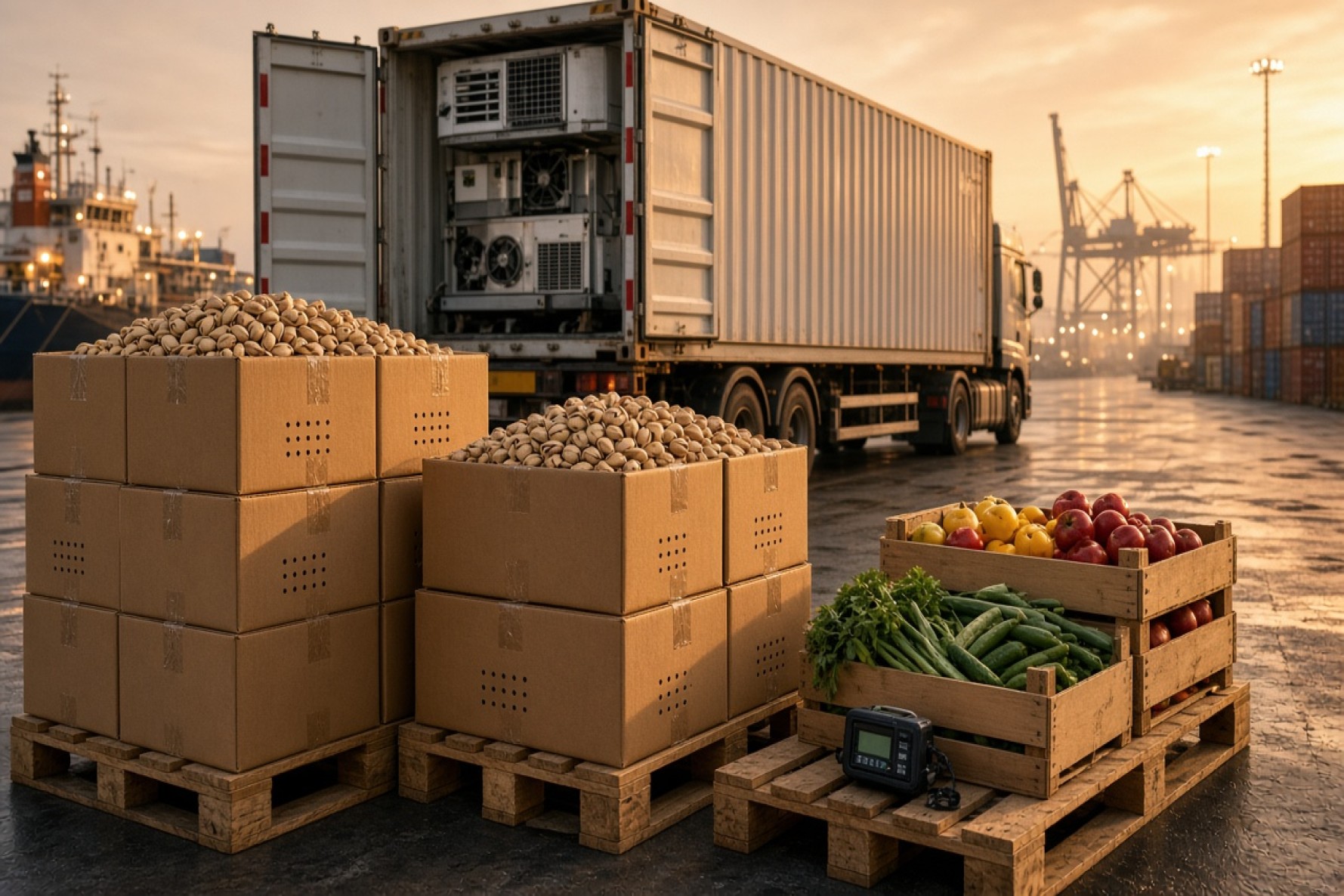
Fresh fruit, vegetables, and dairy are stored and carried in reefer containers at 85–95% relative humidity. Ordinary cartons made from recycled paper with water-based starch adhesives lose up to 80% of their vertical compression strength (Box Compression Test — BCT) under continuous exposure to that humidity. In pallet stacks taller than two meters, lower-tier cartons then crush and collapse. As packs settle, weight bears directly on fruit tissue and causes cellular bruising. That mechanical damage triggers juice leakage and secondary fungal spoilage, destroying the entire container load. Five-ply board of heavy kraft paper, waterproof resin adhesives, and moisture-resistant coating is the fundamental fix.
Blocked air-circulation paths and product suffocation
In reefer containers, cold air is blown upward under fan pressure from the T-bar floor. If carton vent holes are not aligned when stacked on pallets, air circulation is blocked. That failure prevents escape of metabolic heat and ethylene from fruit respiration. Trapped ethylene causes product suffocation: fruit yellows, over-ripens, and ferments in the tissue—even when the reefer system shows an optimal near-zero temperature.
Disregard for the international wood-pallet standard (ISPM 15)
Exporting on traditional wood pallets without the International Standards for Phytosanitary Measures (ISPM 15) remains a recurring exporter error. Wood pallets used in foreign transit must undergo heat treatment in dedicated kilns, with core wood held at least 30 minutes at 56°C so all wood-boring larvae and beetles are destroyed. Approved pallets carry an official burned stamp with country code and facility identifier. Shipping on unstamped pallets leads to quarantine hold at destination ports, heavy unloading costs, and ultimately container return.
| Packaging component | Common Iranian exporter error | Engineering packaging practice |
|---|---|---|
| Board and carton structure | Recycled testliner paper with starch adhesive | Five-ply board with virgin kraft liner and moisture-resistant adhesive |
| Compression-strength indicator | Relying on board grammage instead of edge crush test (ECT) | Design box strength for dynamic stacking load at 90% humidity |
| Air-circulation vent design | Scattered vents that are covered in columnar stacking | Align vents for at least 4–6% of wall area |
| Pallet stabilization | Strapping cartons without protective corner posts | Compressed carton corner posts, polypropylene strap, and breathable stretch film |
| Transport pallets | Assorted used pallets without identifiers | Standard 120×100 cm pallet with official ISPM 15 heat-treatment certificate |
4. Legal and operational mistakes in applying Incoterms 2020
Incoterms rules of the International Chamber of Commerce are the official language for allocating obligations, costs, and risk between buyer and seller. Unfortunately, some Iranian exporters—unaware of concepts revised in the 2020 edition—sign contracts on unsuitable terms that, when unexpected events occur, impose crushing costs on the company.
Incorrect use of Free On Board (FOB) for container carriage
The most common trader error in container sea trades is using FOB. Under ICC rules, Free On Board applies only to traditional maritime carriage and non-container bulk cargo. In container transport, the exporter hands the consignment to the shipping line at the port container yard (CY) and thereafter has no physical access to the container. If the container suffers an incident at the shore terminal before vessel loading, catches fire, or loses its cold chain due to yard power fluctuation, under FOB all risk and financial loss remain with the exporter. The correct term for container loads is Free Carrier at origin (FCA): once the container enters the terminal yard and a delivery receipt is recorded, risk transfer to the buyer is complete.
Severe consequences of Ex Works (EXW) and foreign-exchange obligations
Some operators, seeking to avoid carriage risk, sell under Ex Works (EXW). In that method, export customs formalities and the export declaration formally fall to the foreign buyer. Because under Iran’s foreign-exchange system the export permit is registered in the name of the commercial-card holder, and the exporter must repatriate proceeds (discharge the FX obligation), handing customs formalities to the foreign buyer creates irreparable legal risk. If the foreign buyer delays the quota declaration or misstates goods value, the Iranian exporter is treated as noncompliant by tax authorities and the Central Bank, facing commercial-card suspension and heavy FX penalties. For exports from Iran origin, FCA at the seller’s warehouse—with the seller retaining export customs declaration—is therefore the most rational option.
Equating the “risk” transfer point with the “cost” payment point
Under Group C rules such as CFR (Cost and Freight) and CPT (Carriage Paid To), the exporter pays freight to the destination port or terminal. But the “risk” transfer point is the moment goods are handed to the first carrier at origin. Failure to explain this to the foreign buyer means that if the vessel’s refrigeration unit fails on the open sea and a food consignment is ruined, the buyer may refuse remaining payment and blame the exporter. Clear contractual language on this distinction, and steering the buyer toward comprehensive cargo insurance, prevents collapse of commercial ties after maritime incidents.
| Incoterms 2020 rule | Common error in applying the rule | Sound practice in the food industry |
|---|---|---|
| FOB (Free On Board) | Use in container carriage, leaving exporter risk at the port terminal | Replace with FCA for definite risk transfer at the origin container terminal |
| EXW (Ex Works) | Loss of control over the customs declaration and breach of legal FX obligations | Use FCA at the seller’s warehouse with export formalities performed by the seller |
| CFR / CIF | Implicit acceptance of liability for cargo loss during the sea voyage | State in writing that risk transfers to the buyer at origin loading |
| CPT / CIP | No agreement on Clause A insurance cover for high-value consignments | Contract the highest international insurance cover for perishable goods |
| DAP (Delivered at Place) | Entering unknown tax and clearance processes at final destination | Limit obligations to the entry border and avoid destination clearance |
5. Critical errors in labeling, packaging language, and destination market rules
Food-product labels define the legal and health identity of goods in the destination market. Any mismatch between pack data and the buyer country’s supervisory rules leads to immediate seizure of the consignment and heavy fines on the importer.
Labeling requirements in Gulf markets
The Gulf Standardization Organization has set strict requirements under GSO 9:2022; ignoring its details returns consignments from ports such as Jebel Ali or Hamad. Under that standard, all key information must appear in Arabic on the pack. Fine fonts, poor contrast between text and pack background, and secondary paper stickers on consumer packs without prior system approval are fully prohibited. In addition, GSO 2233 makes a nutrition table mandatory, with precise breakdown of calories, trans fats, added sugars, and sodium against daily intake share.
International additive codes and allergen warnings
Generic phrases such as “permitted color” or “permitted preservative” have no standing on export packaging. The exporter must record the exact additive under the international numbering system (E-numbers). For example, edible turmeric yellow must appear as E100 and sodium benzoate preservative as E211. Presence of allergens (wheat gluten, soy, peanut, lactose, egg derivatives) must also be declared—even when goods were processed on shared factory lines. Concealing these items exposes the foreign buyer to civil and health claims from consumers.
Date format and remaining shelf-life rules
Dating with the Solar Hijri calendar is unacceptable in food trade; production and expiry dates must use the Gregorian calendar in day/month/year format (DD/MM/YYYY) via indelible inkjet. Under Gulf food shelf-life standard GSO 150-2, month and year alone are allowed only for goods with more than three months’ life, and in that case expiry is treated as the end of that month. Another common error is shipping goods that have already spent a large share of shelf life by clearance; foreign distributors and retail chains usually refuse products that have exceeded 30% of their permitted storage period.
| Target market | Official label language | Nutrition and additive requirements | Expiry-date format |
|---|---|---|---|
| Gulf region (GSO) | Arabic and English (Arabic mandatory) | GSO 2233 nutrition table and E-numbers | Gregorian (day/month/year) with indelible print |
| Eurasian Economic Union | Russian plus the member-country language | Allergen data and nutrition contribution | Gregorian with precise humidity and temperature conditions |
| European Union | Official language of the destination country of discharge | Full allergen declaration and industrial processing footprint | Gregorian with standard “best before / use by” wording |
| People’s Republic of China | Simplified Chinese on the primary pack | Compliance with national standard GB 7718 | Gregorian with exact factory processing date |
| Iraq market | Arabic mandatory (English optional) | IQS/230 standard stating country of origin | Legible Gregorian with day, month, and year |
6. Failures in logistics management, cold chain, and temperature data logging
Carriage of perishable agricultural products is a biological process in which living tissue continues physiological respiration. A break in the cold chain confronts the exporter at destination with rot, wilting, and microbial spoilage.
Inadequate pre-cooling before container loading
The largest cold-chain error is loading fruit and vegetables into a reefer container immediately after field harvest. Reefer refrigeration systems are designed only to “hold optimal temperature” and lack the capacity for “rapid pull-down of a warm core load.” If products such as kiwi, grapes, peaches, or tomatoes are loaded without rapid pre-cooling tunnels, with internal temperatures above 20°C, the container compressor is overwhelmed by product heat and severe tissue sweating occurs inside packs. That free moisture fuels fungi such as Botrytis and destroys the load within days.
Incorrect fresh-air vent settings in transit
Each food category needs a defined fresh-air venting rate in cubic meters per hour. For high-respiration fruit such as apples or kiwi, controlled venting is essential to remove carbon dioxide and ethylene; for frozen products such as seafood, meat, or frozen puree at −18°C, vents must be fully closed (zero percent). Leaving vents open by mistake on frozen loads draws ambient humidity into the chamber, builds thick frost on the evaporator, and disrupts container refrigeration.
No independent temperature data integrity
Relying solely on the reefer’s onboard system report is a major legal defense error. If the buyer claims quality loss from temperature fluctuation at discharge, the exporter without independent data-logger records cannot pursue a legal claim. Placing at least two temperature loggers at critical points in the container (especially mid-row and rear of the chamber) records precise temperature and humidity swings at set intervals. These electronic records prove the exporter’s position against shipping-line or road-transit driver negligence in international courts and before insurers.
| Product group | Optimal transit temperature | Optimal relative humidity | Fresh-air vent status |
|---|---|---|---|
| Fresh apples | −0.5 to +1.0°C | 90–95% | Open (15–25 m³/h) |
| Long-storage kiwi | −0.5 to 0.0°C | 90–95% | Open (with ethylene-absorbing filters on the pallet) |
| Pistachio and dried tree nuts | 10–15°C | 55–65% | Fully closed (cool, dry environment) |
| Frozen seafood and vegetables | −18°C or lower | Not applicable | Fully closed (zero fresh air) |
| Cabbage, broccoli, and leafy vegetables | 0.0 to +2.0°C | 95% | Open (maximum 20 m³/h) |
7. Contractual ambiguity, mismatched trade documents, and payment traps
Global trade rests on flawless exchange of paper and digital documents. Mismatch in document data stops clearance at entry ports and drives commercial relations into deadlock.
Mismatch among the five core clearance documents
Holds at foreign customs often arise from mismatched details among five foundational export documents: the bill of lading, commercial invoice, packing list, certificate of origin, and health and quarantine certificates. The slightest difference in the international product identifier (HS Code), the buyer company’s exact legal name, net and gross weights, or container numbers triggers mandatory physical inspection and referral to destination customs violation commissions. For food loads, that customs suspension ends useful shelf life and imposes heavy demurrage.
Errors in natural moisture loss and short weight
Agricultural products and dried-nut goods lose weight during long carriage through cellular respiration and gradual water evaporation (weight loss). An exporter who packs a 10 kg fruit carton at exactly 10 kg net will face 9.7 kg cartons at discharge. Under weights-and-measures and consumer-protection laws in many countries, that is treated as commercial fraud and can seize the entire container. Allowing 2–4% overfill in primary packing to offset evaporative short weight is a technical must for perishable exports.
The consignment-sale trap and delivery without bank security
Shipping on consignment—especially in Dubai fruit-and-vegetable markets and some regional countries—is among the most damaging export methods. The exporter hands the load to brokers and middlemen without advance payment, bank guarantee, or letter of credit, to settle after daily sales. Temporary market slowdown, heavy supply, or middleman default then forces the exporter to liquidate at large loss or face total capital loss from nonpayment. Insisting on definite payment methods or reliable documentary credits is a condition of survival in these markets.
8. Weak commercial communication, invalid price quotes, and incomplete inquiry processes
Many deal opportunities are lost not because of product defects, but because the exporter cannot present clear financial proposals and negotiate professionally.
Vague inquiries and nonstandard price quotes
Short messages with figures and no legal or logistics detail are seen as highly unprofessional. In modern trade, a price inquiry must be answered as a formal quotation sheet or proforma invoice. Exact Incoterms 2020 term, packaging type and quality, minimum order quantity (MOQ), delivery timeline, and—most importantly—quote validity period are inseparable parts of an export offer. A price without an expiry date, amid FX and ocean-freight volatility, exposes the exporter to financial loss or unintended breach.
Missing standard technical data sheets and quality documentation
Industrial buyers, pharmaceutical companies, confectionery and chocolate manufacturers, and supermarket chains need a full product technical file for import. That documentation includes the technical data sheet (TDS), food-safety management certificates (ISO 22000 or HACCP), and laboratory results on non-GMO status and contaminant residues. Inability to supply these documents quickly in English or Russian pushes the buyer toward organized international competitors. Defining these requirements from origin is critical in export; on Iranco, buyers and exporters can register and exchange supply requests with all necessary technical and laboratory detail so supplier evaluation rests on a reliable basis.
| Communication and operational failure | Damaging commercial consequence | Corrective professional practice |
|---|---|---|
| Sending a lump price without an Incoterm | Ambiguity over freight and demurrage cost liability | State the term and exact place clearly (e.g. FCA Tehran or CFR Jebel Ali) |
| No validity period on the price offer | Financial loss from freight spikes and FX moves | Include the formal line: “This offer is valid until [date]” |
| Irregular, delayed replies on communication channels | Buyer withdrawal and contracts with regional competitors | Staff a trade sales team with definite replies within 24 hours |
| Use of generic public email addresses | Buyer distrust of the company’s legal identity | Conduct all correspondence on a dedicated domain and corporate email |
| Missing TDS and health certificates | Rejection from the foreign buyer’s vendor list | Complete a technical catalog, TDS sheet, and ISO approvals |
9. Importer checklist before placing a food order from Iran
Importers, international purchasing managers, and trading companies should finalize the operational checklist below before remitting the advance payment, to secure the supply chain and avoid legal claims:
- ☐ Quantitative and cultivar conformity of the product: Define exact botanical species, variety, caliber, count, split percentage, color, and physical tolerance penalties in the purchase contract.
- ☐ MRL conformity inquiry: Formally send the destination country’s list of banned pesticide compounds and permitted residue limits to the seller.
- ☐ Require a valid laboratory certificate (COA): Oblige the seller to test mycotoxins (aflatoxin B1 and total), microbial load, and heavy metals in an ISO 17025 partner laboratory.
- ☐ Graphic and text approval of the pack label: Review packaging print artwork for language rules, Gregorian date format, allergen declaration, and destination nutrition table.
- ☐ Define carton and packaging engineering specs: Approve five-ply carton resistance to cold-store humidity (BCT/ECT), vacuum film type, and waterproof wax coatings.
- ☐ Formal ISPM 15 pallet commitment: Require the burned heat-treatment stamp on all wood pallets used in the container.
- ☐ Pre-shipment inspection (PSI) by a third party: Appoint an international inspection company at origin to supervise sorting, random sampling, and loading.
- ☐ Precise Incoterms 2020 selection: Use Free Carrier (FCA) instead of FOB for container loads and avoid high-risk Ex Works terms.
- ☐ Require temperature data loggers: State in the carriage contract that two digital temperature and humidity recorders must be installed mid-container and at the rear.
- ☐ Conformity of the five clearance documents: Check draft bill of lading, invoice, packing list, certificate of origin, and phytosanitary certificate against HS code and export quota.
10. What information must be sent to receive an accurate price?
Competitive, accurate quoting in food export requires a clear set of technical and commercial variables. Importers should complete and send the price-inquiry form with the specific information below:
- Exact product type and commercial grade: Scientific and trade names (e.g. natural-split Kaleh Ghouchi pistachio, premium Piarom dates, or tomato paste at 28–30 Brix).
- Calibration and dimensional specs: Count size for dried nuts (e.g. 20–22 count), physical dimensions, allowed split or breakage percentage, and sensory indicators.
- Biochemical and laboratory parameters: Maximum allowed moisture, total acidity, pH, aflatoxin level, and destination-country standards required.
- Final packaging form and material: Consumer or industrial pack (carton, tin, glass, pail, aseptic bag, vacuum pack) with net weight per unit.
- Total order volume and loading tonnage: Number of containers requested (20 ft or 40 ft refrigerated FCL) and delivery schedule.
- Exact delivery place and Incoterm: Precise destination port or land border under Incoterms 2020 (e.g. CIF Mersin, CFR Nhava Sheva, or FCA Tehran).
- Buyer private-label packaging needs: State whether private label or the origin factory’s registered brand will be used.
- Mandatory destination customs documents and tests: State buyer-country customs requirements for phytosanitary certificates, Halal certificates, or registration in origin supervisory systems such as Eurasian registry or China’s CIFER.
11. Direct sourcing of this product from Iran with Iranco
Success in international food trade rests not only on access to quality products, but on continuous alignment with technical rules, laboratory standardization, and protection of the consignment across the logistics chain. Technical packaging mistakes, short pesticide pre-harvest intervals, and careless trade documents can destroy both parties’ capital and reputation.
Iranco provides a specialized, structured platform connecting foreign buyers, importers, and trade managers with leading Iranian food producers and factories. Drawing on technical oversight and international standards, the platform manages quality-priority assessment, biochemical indicator conformity, authentic representative samples, cold-chain-ready industrial packaging, and clearance-document alignment. For buyers who intend to source food products and horticultural goods at a stable standard matching destination health rules, Iranco enables review of selected producers’ offers, specialized order placement, and transparent supply-chain management.
12. Conclusion
Sustainable export of agricultural products and foods depends on precise understanding of the international trade environment and aligning the supply chain with destination-market requirements. Failure to retain foreign customers is rarely caused by inherent defects in Iranian export goods; it arises from structural compliance-management gaps. Disregard for maximum residue levels (MRL), weak packaging against reefer humidity, operational mistakes in reading Incoterms 2020, and labeling failures are key drivers of long-term commercial damage.
The outstanding exporter in modern markets defines quality with numerical data, ships the final consignment exactly matching the approved sample, and runs health tests against the buyer country’s rules. Entering durable distribution chains and achieving stable profitability requires moving beyond traditional brokerage and adopting structured, engineered export models.
13. Frequently asked questions
What is the main reason Iranian fresh agricultural products are returned from Russia and Eurasia?
The fundamental cause is use of pesticides that, although licensed in Iran, are absent from the official registered list of the Eurasian Economic Union. Under Eurasian rules, unregistered pesticides are assessed at a strict zero threshold or a maximum of 0.01 mg/kg, which leads to seizure of the load.
Why should FOB not be used for container sea exports?
Because in container carriage, delivery to the shipping line occurs at the container yard (CY), not on the vessel’s deck. Choosing FOB leaves the Iranian exporter exposed to incidents, fire, and reefer power failure at the shore terminal. The matching term for this method is FCA.
How can bruising and fruit-carton collapse in reefer containers be prevented?
Use five-ply board with virgin waterproof kraft papers and a box compression test (BCT) rated for pallet weight. In addition, precise alignment of carton vent holes in columnar pallet stacking prevents humidity and ethylene buildup and carton failure.
What is the aflatoxin limit for pistachio exports to the European Union?
Under European Commission Regulation 2023/915, the maximum for aflatoxin B1 in pistachio for direct human consumption is 8 micrograms per kilogram (ppb), and for total aflatoxins (B1+B2+G1+G2) the limit is 10 ppb.
What does GSO 9:2022 require for food labeling of exports to the Gulf?
The standard mandates full information in Arabic, a nutrition table breaking out added sugars and trans fat under GSO 2233, indelible Gregorian dates, and international additive codes (E-numbers) on consumer packs.
Why do agricultural consignments show short weight at the buyer’s port?
Living agricultural products lose weight naturally during carriage through tissue respiration and surface evaporation. The exporter should allow 2–4% overfill in primary packing to avoid short weight and destination customs penalties.
What is the ISPM 15 wood-pallet heat-treatment certificate and why is it required?
Under the International Plant Protection Convention, all wood packaging and pallets used in trade must be heated to 56°C for 30 minutes to destroy wood-boring pests, and carry the official HT mark; loads without that mark are stopped at destination.
What information should be provided to receive an accurate food price from Iran?
The buyer should state exact product type, grade, dimensional caliber, biochemical and sensory specs, packaging type and weight, order tonnage, Incoterms 2020 term, and discharge port. Registering these data on Iranco enables precise comparison of available options and a valid quote.
How can Iranian food-industry products be sourced with quality-conformity assurance?
International buyers can register their technical specs and health standards as a formal request on Iranco so sample coordination, laboratory validation, and supplier introduction follow the requirements of that same market.
Featured Products








Related Articles



