 Iranco Magazine Team
Best-selling product basket, EAEU regulatory standards, digital traceability and cold-chain logistics on Iran–Russia export corridors
Export Guide · Russia · EAEU · Cold Chain · Rosselkhoznadzor
Iran Food Exports to Russia: High-Demand Products, Standards and Logistics
Best-selling basket, EAEU regulatory standards, digital traceability and cold-chain management on Iran–Russia export corridors
Food exports to the Russian Federation require market metrics, Rosselkhoznadzor compliance, EAEU customs rules and an integrated cold chain. This report is a roadmap for importers and food businesses pursuing sustainable Iran–Russia trade.
1. Trade structure and EAEU FTA
Iran’s free trade with five EAEU members sharply cuts duties on vegetables, fruit, seafood, tomato paste and nuts. The bilateral agri-food target is about USD 2 billion; Iran’s edge combines tariff relief, climate diversity and winter greenhouse supply when Russian open-field production stops.
2. High-demand product basket
Five pillars: greenhouse veg (pepper, tomato, lettuce, cucumber), fresh fruit (kiwi, apple, citrus), nuts and dates, seafood (frozen rainbow trout, vannamei shrimp), processed (aseptic paste, dairy). Over 60% of Iran’s export bell peppers go to Russia.
3. Technical specs and grading
Uniform calibre (5–10% tolerance), kiwi Brix 12–14% at destination, pepper 180–250 g, Mazafati moisture 20–24%, paste Brix 36–38% — contractual baselines for X5 and Magnit buyers.
4. Quality control and defects
Cosmetic defects capped at 3–5%; critical defects (mould, live pests, freeze damage) at zero. Contract on numeric specs, not hand-picked samples; third-party inspection at packing recommended.
5. Rosselkhoznadzor, TR CU and digital systems
TR CU 021/2011 and 022/2011; Cerberus plant registration; Mercury veterinary e-certificates; Argus-Fito phytosanitary; Chestny ZNAK Data Matrix on dairy. Quarantine focus: ToBRFV, Tuta absoluta, western flower thrips.
6. Distribution channels
Food City Moscow for traditional wholesale; X5 (Pyaterochka, Perekrestok) and Magnit for modern retail with long-term contracts; processors in Moscow/Kazan for bulk paste and raisins; HoReCa for premium seafood and nuts.
7. HS codes and customs documents
Pistachios 080251/080252, peppers 070960, tomatoes 070200, kiwi 081050, dates 080410, paste 200290, frozen trout 030314, shrimp 030617 — plus CT-3 origin for zero FTA duty.
8. Export packaging
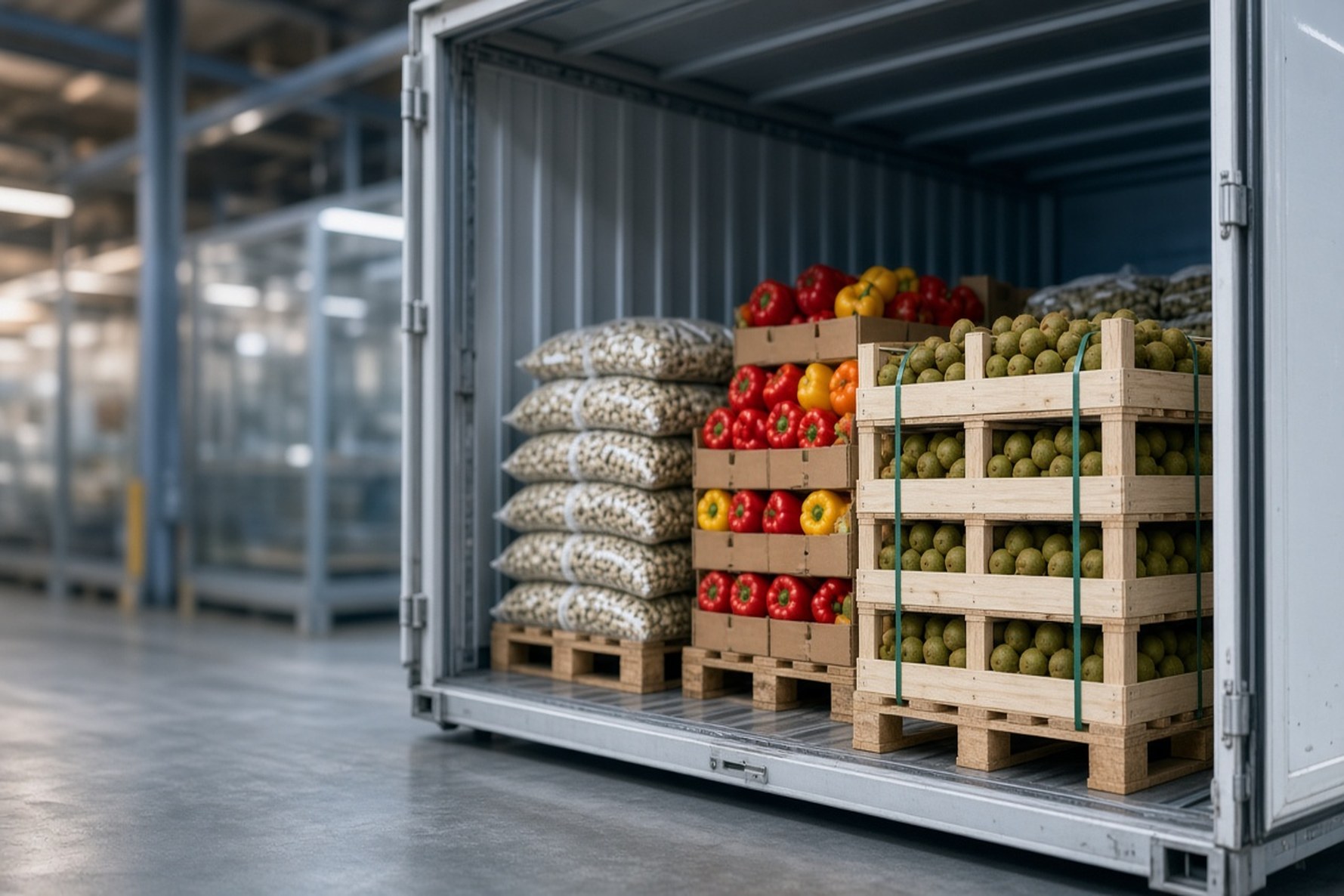
5–7 ply hydrophobic kraft cartons, MAP for lettuce and peppers, ethylene pads, EUR 120×80 or 120×100 pallets, max stack ~2.2 m, vented stretch film.
9. Transport corridors
Western Astara–Samur 5–8 days for fresh veg; Caspian sea 7–12 days for paste and dry goods; eastern Turkmenistan–Kazakhstan 10–14 days; air for samples and saffron.
10. Competitors
Turkey (packaging, speed, no zero tariff), Azerbaijan (proximity), Egypt (cheap citrus), Uzbekistan (sweet fruit), China (scale). Iran wins on greenhouse energy costs plus FTA.
11. Pricing and settlement
Incoterms 2020, 2–5% transit moisture loss on greens, Rosselkhoznadzor inspection fees, seasonal peak Dec–Mar; RUB–IRR settlement and staged prepayment.
12. Importer checklist
Written specs, TR CU 021 lab proof, negative ToBRFV PCR, Cerberus approval, 5-ply cartons, Russian TR CU 022 labels, Chestny ZNAK if applicable, Argus-Fito, CT-3, thermographs.
13. RFQ information
Variety, calibre, Brix/moisture, pack type, tonnage and containers, Incoterms (Astara truck, CFR Astrakhan, Moscow cold store), inspection and label rules.
14. Supply via Iranco
Iranco reviews B2B purchase requests with technical specs, grade, volume and Russian destination against Iranian producers and EAEU compliance.
15. Conclusion
Combining 87% FTA coverage, winter supply windows and Rosselkhoznadzor plus cold-chain discipline opens a durable path into X5, Magnit and industrial buyers.
High-demand product basket
| Category | Key products | Peak demand | Russia edge |
|---|---|---|---|
| Greenhouse veg | Pepper, tomato, lettuce, cucumber | Nov–May | Winter supply |
| Fresh fruit | Kiwi, apple, citrus | Oct–Apr | Texture & price |
| Nuts & dates | Pistachio, raisin, dates | Year-round | Shelf life |
| Seafood | Frozen trout, shrimp | Oct–Mar | EU substitute |
| Processed | Aseptic paste, dairy | Year-round | Industrial pack |
Key technical indices
| Product | Index | Acceptance |
|---|---|---|
| Pepper | Weight & wall | 180–250 g; >6 mm |
| Kiwi | Brix & weight | Brix ≥12; 75–110 g |
| Dates | Moisture | 20–24% Mazafati |
| Paste | Brix | 36–38% |
| Frozen trout | SalmoFan | ≥24 |
HS codes and documents
| Product | HS | FTA duty | Documents |
|---|---|---|---|
| Pistachio | 080251/080252 | 0% | CT-3, aflatoxin |
| Pepper | 070960 | 0% | Argus-Fito |
| Tomato | 070200 | 0% | ToBRFV, phyto |
| Kiwi | 081050 | 0% | Phyto, CT-3 |
| Aseptic paste | 200290 | 0% | Brix, metals |
| Frozen shrimp | 030617 | 0% | Mercury, Cerberus |
Transit corridors
| Corridor | Transit | Cost | Best for |
|---|---|---|---|
| Astara–Samur | 5–8 days | High | Fresh veg |
| Caspian sea | 7–12 days | Medium | Paste, dry goods |
| Eastern land | 10–14 days | Lower | Apples, onions |
| Air | 1–2 days | Very high | Samples, saffron |
International competitors
| Country | Edge | Weakness | Lines |
|---|---|---|---|
| Turkey | Packaging | No zero FTA | Tomato, citrus |
| Azerbaijan | Proximity | Limited volume | Tomato, hazelnut |
| Egypt | Low cost | Long transit | Oranges |
| Uzbekistan | Sweet fruit | Long rail | Grapes, dried fruit |
| China | Scale | Distance | Garlic, canned |
Importer checklist (10 items)
- Written specs and grade in contract
- TR CU 021/2011 lab proof
- Negative ToBRFV PCR
- Cerberus approval for seafood/dairy plants
- 5-ply hydrophobic cartons
- Russian TR CU 022 labels
- Chestny ZNAK if applicable
- Argus-Fito registration
- CT-3 certificate of origin
- Thermographs in reefer
What to send for an accurate quote?
- Variety and calibre
- Brix/moisture
- Pack type and tonnage
- Incoterms and delivery city
- Inspection and label rules
Export supply via Iranco
Iranco reviews B2B purchase requests with technical specs, volume and Russian destination against Iranian producers and EAEU rules. Complete the purchase request form on Iranco.
Frequently asked questions
What does the EAEU FTA do to duties?
Over 87% of lines are zero-rated; CT-3 origin is required at clearance.
Top quarantine risks?
ToBRFV, Tuta absoluta and western flower thrips — PCR at origin.
What is Chestny ZNAK?
Russia’s Data Matrix traceability for dairy and listed packs.
Winter veg packaging?
5-ply cartons, MAP and ethylene pads.
Astara vs Caspian?
Astara 5–8 days for fresh; Caspian cheaper for paste and dry goods.
Reefer temperatures?
Pepper +8…+10 °C, tomato +10…+12 °C, fruit 0…+1 °C, seafood −18 °C.
Avoid sample vs shipment disputes?
Numeric specs in contract plus pre-loading inspection.
Source via Iranco?
Submit a purchase request with specs and Russian destination.
For Russia food export advice and B2B sourcing from Iranian suppliers
Contact Irancoinfo@iranco.com · WhatsApp: +98 913 104 4182 · Telegram: @irancofood
Featured Products












Related Articles



