 Iranco Magazine Team
Market potential, competitive advantages, GSO/SFDA requirements, reefer logistics and a practical commercial entry roadmap
Export Guide · GCC · GSO · Cold Chain
Opportunities for Exporting Iranian Food to Persian Gulf Countries
Market potential, competitive product advantages, standards compliance, reefer logistics and a practical roadmap for traders, procurement managers and producers.
GCC states depend heavily on food imports due to arid climate and limited freshwater. Iran offers biodiversity, year-round cropping and strong processing. Short Gulf crossings deliver fresh cargo in hours versus weeks from distant origins. Trade is now governed by GSO, SFDA, SABER, ZAD and cold-chain rules.
1. GCC market structure and geo-economics
High per-capita income, expatriate communities and tourism define demand. Indoor farming covers only a fraction of needs; governments diversify origins, long-term supply contracts and strategic cold storage. Iranian southern ports cut container freight to the UAE to roughly one-quarter of routes via Turkey or Egypt, with 6–36 hour sailings enabling better harvest maturity.
2. Leading product groups
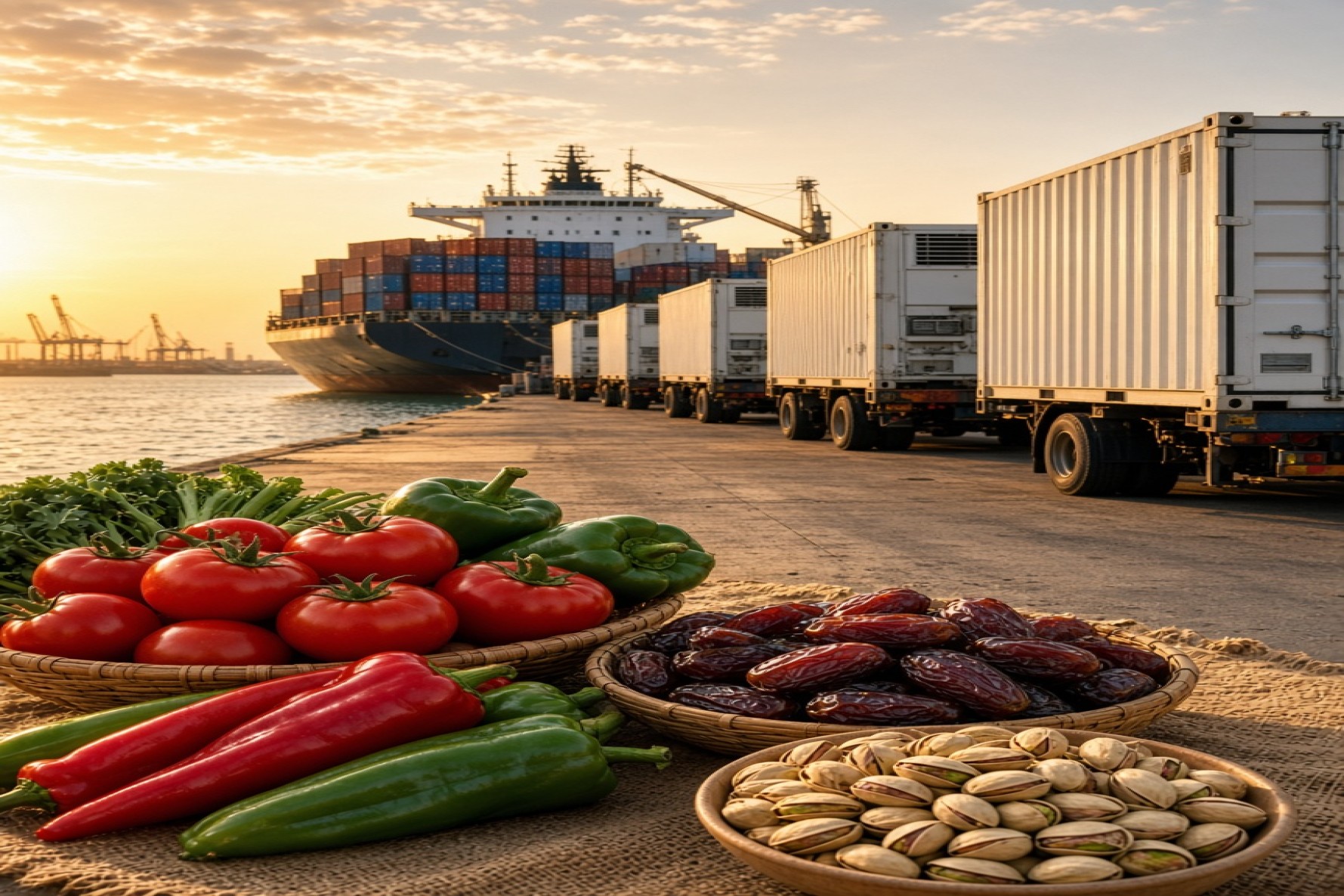
- Greenhouse produce: cluster tomato, bell pepper, eggplant, broccoli — off-season from Hormozgan through March.
- Pistachio & nuts: Akbari, Ahmad Aghaei, Kaleh-Ghouchi, Fandoghi; golden raisins, walnuts, almond kernels.
- Dates: Piarom, Mazafati Bam, Kabkab, Zahedi; paste, syrup and date sugar powder.
- Tomato paste & concentrates: 36–38°Brix aseptic; apple, sour cherry, grape and pomegranate bases.
- Dairy: skim milk powder, feta, strained yogurt, industrial ice cream (UHT lines).
- Saffron, honey & bakery: high-crocin negin; mountain honey; biscuits and filled chocolate.
| Group | HS | Iran origin | GCC markets | Edge |
|---|---|---|---|---|
| Greenhouse veg | 0702 / 0709 | Hormozgan, Bushehr | UAE, Qatar, Oman | Ultra-fast transit |
| Pistachio | 080251/252 | Kerman, Khorasan | UAE, Kuwait, Qatar | Flavor & natural fat |
| Dates | 080410 | Fars, Kerman | UAE, Oman, Kuwait | Texture variety |
| Paste/concentrate | 200290 / 200979 | Fars, Golestan | UAE, Oman | Brix & natural color |
| Dairy | 040610 / 040210 | Mazandaran, Isfahan | UAE, Bahrain | Halal & cost |
| Saffron | 091020 | Khorasan | UAE, Qatar | Crocin >240 |
3. GSO standards and clearance systems
GSO 9:2022: Arabic mandatory on retail packs; ingredients, “Made in Iran”, dates, storage, allergens and nutrition per 100 g.
GSO 150-2 & MRSL: Saudi Arabia requires ≥50% remaining shelf life at customs; UAE ≥one-third or 3 full months.
GSO 1016 & GSO 2055-1: microbiological limits and halal for additives and food-contact packaging.
Saudi SFDA/SABER: FIRS registration, annual PCoC and shipment SCoC. UAE ZAD: pre-arrival food registration. Qatar/Kuwait: phytosanitary, veterinary certificates and border MRL sampling.
4. Lab parameters and QC
Export tomatoes: 55–70 mm caliber, ≥3 kg/cm² firmness. Industrial paste: Bostwick 6–8 cm at 12°Brix. Total aflatoxin in nuts <10 ppb, B1 <5 ppb. Cheese pH 4.3–4.9; cereals moisture <13–14%; Pb <0.2 ppm, Cd <0.1 ppm. Contractual defect tolerances and third-party PSI at origin are essential.
5. Six GCC destination profiles
UAE: re-export hub (Jebel Ali, Al Awir). Oman: Sohar & Suwaiq — flexible banking. Qatar: Hamad port; premium HORECA quality. Kuwait: Shuwaikh; nuts and dates. Saudi Arabia: largest population; strict SABER. Bahrain: steady dairy and confectionery demand.
6. Packaging, MAP and palletizing
Five-layer Kraft cartons with moisture barrier; vent holes for tomato and pepper. MAP with low O₂ for delicate produce. ISPM 15 pallets, corner boards, vented stretch ≥23 µm, max stack height 2 m.
7. Sea logistics and reefer settings
Bandar Abbas reefer lines to Jebel Ali, Sohar and Dammam; Bushehr/Dir to Hamad (8–12 h); Bandar Lengeh fast produce to Sharjah/Dubai (6–8 h); Khorramshahr/Abadan for Kuwait. Pre-cooling before loading; data loggers at three points in the container.
8. Regional competition
Iran: proximity and low freight, superior fresh flavor; weaker luxury retail packs. Turkey: branding but 3–4× logistics cost. India: scale and diaspora; quality swings. Egypt: GAFTA citrus; weak cold chain for ultra-fresh veg versus Iranian Gulf sailings.
9. Pricing, Incoterms and settlement
FOB southern ports or CIF Jebel Ali, Sohar, Hamad — 5% GCC duty on CIF; UAE VAT 5%, Saudi 15%. Ramadan spikes 10–25% on dates and nuts. Use trusted Dubai/Muscat exchange houses; 30–50% advance, balance against BL copy — never release original BL before final payment.
10. Industrial inputs and importer checklist
220 L aseptic tomato paste, skim powder, WPC and slivered pistachio for Gulf food parks. Checklist: spec & COA in proforma, sealed pre-shipment sample, GSO 9 Arabic artwork, MRSL math, SABER/ZAD registration, five-layer cartons, reefer commitment, phytosanitary docs, Incoterms and secure FX.
FAQ
Main edge vs Turkey and Egypt?
6–36 h sailing and up to 75% lower container cost; fresher produce and dairy.
GCC labelling rules?
Arabic mandatory under GSO 9:2022 with full nutrition and origin.
MRSL in Saudi and UAE?
50% and one-third (or 3 months) remaining shelf life at clearance.
Saudi approvals?
FIRS plus SABER PCoC and per-shipment SCoC.
Industrial aseptic paste specs?
220 L drum, 36–38°Brix, Bostwick 6–8.
RFQ data needed?
Product, HS, grade, pack, FCL, FOB/CIF and port — via Iranco.
Conclusion
The Persian Gulf remains a strategic outlet for Iranian food exports when geography is paired with GSO compliance, SABER clearance, reefer discipline and transparent lab-based contracts.
RFQ: fresh produce, nuts, aseptic paste and dairy to GCC
Contact Irancoinfo@iranco.com · WhatsApp: +98 913 104 4182 · Telegram: @irancofood
Featured Products






Related Articles



