 Iranco Magazine Team
Market capacity for dates, raisins, pistachios, saffron and other Iranian foods in the Netherlands — product choice, QC, EU rules, packaging, customs and distribution
Export Guide · Netherlands · EU Gateway
Iran Food Exports to the Netherlands: Rotterdam, Domestic Market and Re-Export Across Europe
B2B guide for Iranian pistachios, raisins, dates, saffron and dried fruit in the Dutch market — EU border controls at Rotterdam, Dutch labelling, laboratory QC and redistribution to Germany and Belgium.
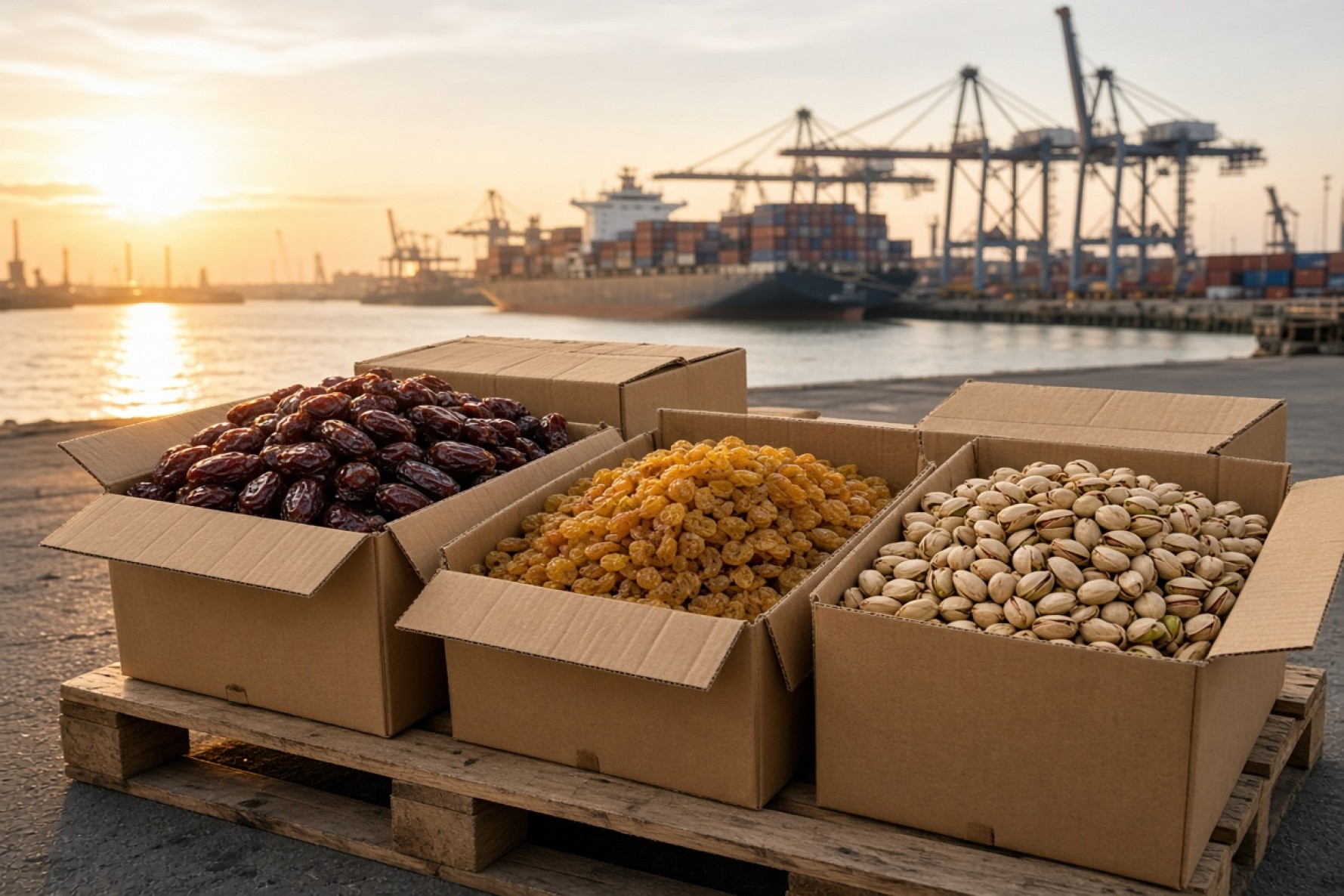
The Netherlands is among the world’s largest importers of agricultural and food products, and the Port of Rotterdam–Amsterdam is Europe’s leading container hub. For Iranian exporters, the Netherlands is both a consumption market and a logistics and re-export gateway; more than 24,000 tonnes of dates are re-exported from the Netherlands to other EU countries each year. This article covers twelve practical sections, a 24-point checklist, RFQ guidance and FAQs.
Introduction
Exporting Iranian food to the Netherlands is not justified by port proximity alone. The Netherlands is part of the EU single market; every shipment cleared at Rotterdam, Vlissingen or Schiphol must comply with Union law — from Regulation (EU) 2017/625 to contaminant limits in Regulation (EU) 2023/915. Trade structure shows large, stable flows in dried fruit and dates, with a measurable direct share for Iran in pistachios, saffron and part of raisins and dates.
Dutch agri-food imports were about €95.1 billion in 2025, making the country a primary entry point for food into north-west Europe. Rotterdam handled roughly 14.2 million TEU in 2025 — the main sea route for bulk and containerised nuts and dried fruit from the Gulf and eastern Mediterranean. Registered date imports into the Netherlands reached about 29,516 tonnes in 2025; dried grapes and dried fruit under HS 080620 totalled about 58,058 tonnes in 2024, covering both domestic consumption and EU distribution stock.
Professional trade rests on three pillars: numeric contract specs, lot uniformity and lab documentation aligned with EU law. Dutch buyers often purchase for domestic retail (AH, Jumbo, ethnic chains) and for re-export to DE/BE/FR; Incoterms, customs entry and labelling responsibility must be fixed upfront.
1. Why the Netherlands matters for Iranian food exports
The Netherlands combines high consumption, processing (confectionery, cereals, trail mixes), wholesale (Horeca) and international logistics. Many German and Belgian importers clear goods in the Netherlands and haul them inland — without paying customs again in the single market, provided traceability and documents are correct.
For dates, the Netherlands is a major EU hub: besides local and ethnic demand, more than 24,000 tonnes of dates are re-exported annually to other Member States. A Dutch buyer may order not for a local shelf but for distribution in Germany or Scandinavia — specs and QC must match the final destination.
Rotterdam and Maasvlakte handle 20'/40' containers and break-bulk; Schiphol serves saffron and urgent samples. Entry via the Netherlands can shorten lead times to Benelux and access sorting and contract packing — if the lot passes border control with valid COAs.
2. Which Iranian food products have opportunity in the Netherlands?
The table summarises Dutch market size (total imports) and Iran’s direct import position in 2024 for main groups. Direct Iran figures refer to bilateral trade flows, not mixed EU re-exports.
| Product | NL market size | Direct IR imports 2024 | HS | Main barrier |
|---|---|---|---|---|
| Raisins & dried fruit | ~58,058 t (2024) | Material share in 080620 | 080620 | Ochratoxin A, SO₂, Turkey |
| Dates | ~29,516 t (2025) | Growth on direct routes | 080410 | IL/EG competition, grade |
| Pistachios | Nuts & industry | Presence 080251/252 | 080251 / 080252 | Aflatoxin, 50% IR checks |
| Saffron | High value, low volume | Key supplier role | 091020 | ISO 3632, identity, MRL |
| Other dried fruit | Within 080620 / 0813 | Figs, barberry, plums | 080620 / 0813 | Mycotoxins, labelling |
Iranian raisins serve industrial channels (breakfast, bakery mixes) and ethnic retail; competition with Turkey on volume and price is intense. Dates matter for Ramadan, ethnic trade and re-export; Israel and Tunisia hold large value shares (Israel about 54% of date import value in some years). Iranian pistachios compete with the USA and Turkey — differentiation is documented COA and sizing, not origin alone.
Pistachios
Sold in-shell for retail and as kernels for confectionery and industrial mixes. Aflatoxin class, open-shell percentage and moisture separate accepted Rotterdam lots from NVWA holds under EU 2019/1793.
Saffron
High unit value and small air shipments via Schiphol. Contract on ISO 3632-1:2025 parameters, moisture and identity testing — not marketing grades alone.
Dates and raisins
Large NL import pools with strong origin competition. Grade, moisture, SO₂ (raisins) and landed cost through Rotterdam drive buyer decisions; re-export buyers need uniformity across pallets.
3. Dutch buyer types
Buyer profile defines who applies Dutch labelling, when EU re-testing is required, and whether the shipment serves NL consumption or re-export to DE/BE. Many B2B contracts distinguish «EU-ready goods» from «needs repacking in NL» — that split changes price and lead time.
| Buyer type | Typical products | QC expectation | Labelling |
|---|---|---|---|
| Importer / wholesaler | Raisins, dates, bulk nuts | COA, sorting, EU re-test | Minimal B2B; NL before retail |
| Packers & re-exporters | Dates, nut mixes | Uniformity, traceability | NL label for DE/BE |
| Retail / private label | Consumer SKUs, saffron | Audit, shelf life | Full Dutch, 1.2 mm x-height |
| Food industry (NL/DE) | Kernels, industrial raisins | Contaminant class, performance | B2B; importer as FBO |
| Ethnic & specialty | Saffron, premium dates | Authenticity, pack appeal | NL + sometimes EN/AR |
4. Technical specs before price discussion
Dutch buyers rarely engage on FOB without a spec sheet. Parameters below should be fixed before quoting; changes after approved samples trigger re-quotes or rejection.
| Group | Mandatory parameters | NL/EU note |
|---|---|---|
| Pistachios | Size, open %, moisture, aflatoxin class (8/10 or 12/15) | Use tier in contract |
| Raisins | Type (golden/green), capstem, SO₂, OTA ≤8 µg/kg | EU 2023/915 for OTA |
| Dates | Cultivar, moisture, defect %, texture | Phyto exemption in CHED |
| Saffron | ISO 3632-1:2025, moisture, style | Complements EU; not MRL substitute |
| Dried fruit | Moisture, size, foreign matter | Mycotoxin programme |
The approved golden sample must link to the export lot number; for re-export, the same spec should suffice for secondary destinations (e.g. Germany) unless the final buyer requires stricter limits.
5. Quality control and laboratory testing
HACCP and ISO 22000 build initial trust but do not replace EU requirements. Dutch importers often compare origin COAs with independent or EU lab results.
| Topic | Limit / reference |
|---|---|
| Pistachio aflatoxin — ready to eat | B1 8 / Total 10 µg/kg — EU 2023/915 |
| Aflatoxin — sorting/physical treatment | B1 12 / Total 15 µg/kg |
| Ochratoxin A — raisins/dried fruit | 8 µg/kg — EU 2023/915 |
| Pesticide MRL | EU 396/2005 |
| Microbiology | EU 2073/2005 where applicable |
| Saffron | ISO 3632-1:2025 (+ ISO 3632-2 testing) |
For saffron and dried fruit, plan moisture, metals and MRL testing as required by the Dutch buyer and product risk profile.
6. EU entry requirements via the Netherlands
Clearance in the Netherlands is supervised by NVWA under EU law. The importer (FBO) is responsible for placing compliant food on the market.
| Regulation | Relevance for IR exporter |
|---|---|
| EU 2017/625 | Official controls; TRACES/CHED |
| EU 2019/1793 | Iran pistachios: 50% identity/physical + aflatoxin |
| EU 2023/915 | Aflatoxin, OTA and other contaminants |
| EU 396/2005 | MRLs — especially saffron and dried fruit |
| EU 1169/2011 | Consumer labelling — Dutch language |
| EU 2018/848 | Organic — supply chain and TRACES |
- Dates: Often exempt from phytosanitary certificate in CHED; QC, labelling and traceability still apply.
- Iran pistachios: Budget time and cost for possible 50% border holds.
- Organic: Certificate alone without TRACES and EU chain is insufficient.
- Sanctions & payment: Banking route and EU compliance must be explicit in the contract.
7. HS codes
| Goods | HS | NL note |
|---|---|---|
| Dates | 080410 | High re-export; grade critical |
| Raisins | 080620 | OTA, SO₂ |
| Pistachios in shell | 080251 | EU 2019/1793 — IR |
| Shelled pistachios | 080252 | 50% control |
| Saffron | 091020 | High value; air freight |
8. Packaging and Dutch labelling
Retail sale in the Netherlands requires EU 1169/2011 particulars in Dutch (Nederlands): product name, ingredients, emphasised allergens (e.g. tree nuts), net weight, FBO, country of origin, batch, dates and nutrition table. Mandatory text often requires minimum 1.2 mm x-height.
- Bulk B2B: minimal labels with lot and origin; importer applies full NL retail label before shelf sale.
- Food-contact materials: migration compliance per EU rules.
- Mixed nuts: all major allergens highlighted in the ingredient list.
9. Shipping by product group
Sea remains default for raisins, dates and pistachios; air is reserved for saffron and approved samples. Budget NVWA time for Iranian pistachios and seasonal congestion around Ramadan for dates.
| Group | Typical route | Entry point | Lead time |
|---|---|---|---|
| Raisins / dried fruit | Sea — Bandar Abbas / Jebel Ali | Rotterdam | ~25–35 days |
| Dates | Sea or reefer per spec | Rotterdam / Vlissingen | Ramadan seasonal |
| Pistachios | Sea 20'/40' + border control | Rotterdam | + NVWA 50% time |
| Saffron | Air — Amsterdam Schiphol | Airport BCP | 2–5 days |
| Re-export to DE | NL clearance + truck | T1 / EU customs | +1–3 days |
10. Pricing and competition
FOB Iran is only part of landed cost. Turkey supplies about 46% of Dutch raisin imports — fierce price competition. For dates, Israel holds about 54% of import value; Iran competes in niches by grade and cultivar (e.g. Mazafati). Pistachios face US competition in retail and Turkey in price-sensitive channels.
| Factor | Effect on NL price |
|---|---|
| Grade & defects | Direct on FOB |
| EU lab programme | €/ton QC |
| Pack + NL label | Retail SKU cost |
| Freight Rotterdam | CIF/DDP |
| 50% pistachio control | Warehouse delay |
| Banking / sanctions | Compliance cost |
11. 24-point importer checklist
- Exact product name, grade and form (bulk / consumer).
- Correct HS code (080410, 080620, 080251, 080252, 091020).
- Define pistachio aflatoxin tier (8/10 vs 12/15) in contract.
- Raisin OTA limit 8 µg/kg on COA.
- MRL programme (396/2005) per line.
- Golden sample tied to export lot.
- Accredited lab and composite sampling plan.
- Review HACCP/ISO alongside EU law.
- Dutch label text before print (1169/2011).
- Allergens and minimum 1.2 mm x-height.
- Food-contact packaging and net weight.
- Minimum shelf life on arrival in Rotterdam.
- Dutch importer EORI.
- TRACES/CHED and notifying party.
- Budget 50% control under EU 2019/1793 for IR pistachios.
- Confirm date phyto exemption in the system.
- Incoterms (FOB/CIF/DDP Rotterdam).
- Insurance and border rejection liability.
- Payment route and sanctions compliance.
- Re-export plan if destination is DE/BE.
- Match invoice, COA and bill of lading.
- Reference sample retained in warehouse.
- Written accept/reject criteria.
- Organic plan + TRACES if organic claimed (2018/848).
12. RFQ information and sourcing via Iranco
- Product name, grade and attached spec sheet
- Volume (ton/container), pack type (25 kg / retail)
- Aflatoxin class and extra tests (OTA, MRL, ISO 3632)
- Destination port (Rotterdam), Incoterms, schedule
- NL consumption vs re-export need
- Payment terms and expected documents
Iranco can review structured RFQs to match Iranian producers and suppliers — emphasising lot-linked COAs for pistachios and ISO 3632-1:2025 identity for saffron instead of vague “premium” labels.
State whether the destination is NL consumption or re-export to DE/BE in the RFQ so packing, labelling and Incoterms are quoted on the same basis.
Summary
With ~€95.1B agri imports and ~14.2M TEU at Rotterdam, the Netherlands is an EU gateway for Iranian dried foods — a market for 29k+ tonnes of dates and ~58k tonnes of dried grapes, plus a re-export bridge. Success depends on numeric specs, contaminant QC, Dutch labelling and Rotterdam logistics more than raw FOB.
Professional importers fix aflatoxin tier and OTA limits in writing first, then compare landed cost. Exporters must guarantee batch traceability and correct composite sampling before issuing any COA tied to a Rotterdam-bound shipment.
FAQ
Is the Netherlands a good market for Iranian food exports?
Yes — for consumption, the Rotterdam hub and re-export (e.g. 24k+ t dates). EU compliance and landed cost decide outcomes.
Which products should we prioritise?
Raisins and dried fruit (volume), dates (re-export), pistachios (strict QC), saffron (high value).
What is the main pistachio problem for Iran in the Netherlands?
Aflatoxin and 50% border control under EU 2019/1793; US competition in retail.
What are the pistachio aflatoxin limits?
EU 2023/915: 8/10 µg/kg for ready-to-eat; 12/15 for sorting/physical treatment.
Do dates need a phytosanitary certificate?
Often exempt in CHED; QC, labelling and traceability still required.
Which label language applies in the Netherlands?
Dutch (Nederlands) for retail; minimum 1.2 mm x-height for mandatory text.
Is HACCP enough for the EU?
Not alone; 2017/625, 2023/915, 396/2005 and 1169/2011 are mandatory.
How is pricing calculated and how to source via Iranco?
Landed cost = product + QC + Rotterdam freight + border control + payment. Submit a structured RFQ through Iranco contact.
For food export advice to the Netherlands and purchase requests from Iranian suppliers
Contact Irancoinfo@iranco.com · WhatsApp: +98 913 104 4182 · Telegram: @irancofood
Featured Products














Related Articles



