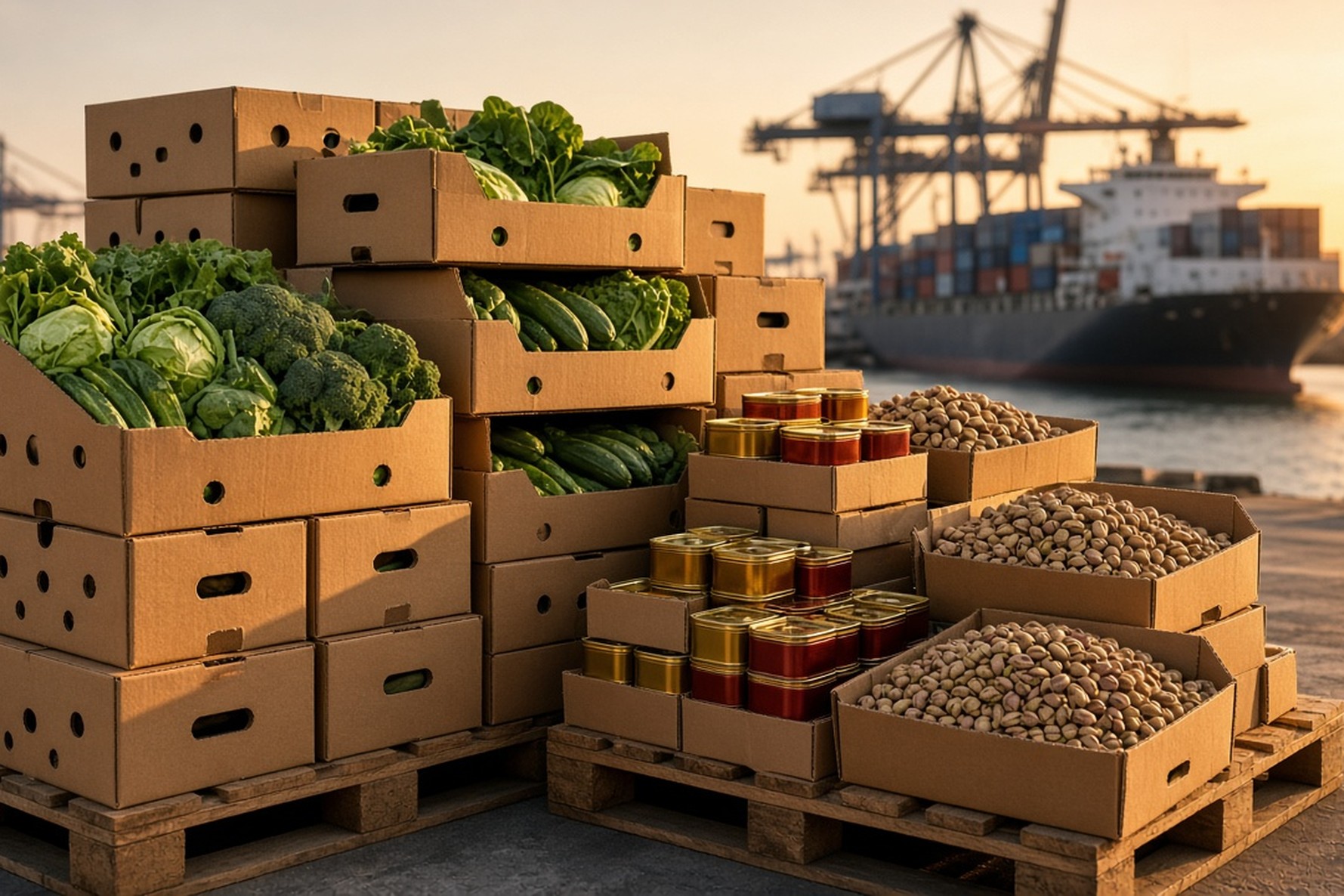
 Iranco Magazine Team
UAE, Oman, Qatar, Kuwait, Bahrain and Saudi Arabia — product choice, entry rules, packaging, logistics, pricing and professional buyers
Export guide · Gulf (GCC)
Iran Food Export Opportunities in the Gulf Cooperation Council (GCC)
UAE, Oman, Qatar, Kuwait, Bahrain and Saudi Arabia — product choice, entry rules, packaging, logistics, pricing and professional buyers
Introduction — real opportunity vs regional competition
Gulf export potential combines short haul from southern Iran, diverse Iranian production and import-dependent southern GCC markets. The UAE, Oman, Qatar, Kuwait, Bahrain and Saudi Arabia are six different buyers.
Proximity does not guarantee sales. Exporters must deliver consistent quality, suitable packs, full documents, regular delivery and defensible pricing — not FOB alone.
Growth should strengthen existing lanes and expand into higher-value lines: paste, frozen, retail packs, saffron and pistachio.
1. Why GCC markets matter for Iranian food exports
GCC states run continuous food imports, solid purchasing power, professional distribution and relatively short sea legs from Iran’s south.
Water limits and heat drive import reliance — but dairy, dates and greenhouse output also exist locally; assess opportunity by product and channel.
Shorter transit helps fresh and chilled lines only when pre-cooling, sorting and packs are right.
- Produce wholesale — landed price and freshness
- Modern retail — GSO 9 labels and SKU registration
- HORECA — bulk packs and stable specs
- Food industry — COA and industrial packs
2. How the six main GCC markets differ
A common mistake is treating the six countries as one market. GSO standards overlap, but distribution, rivals, enforcement and buyer behaviour differ.
| Market | Commercial trait | Better Iran fit | Main challenge |
|---|---|---|---|
| UAE | Import hub & re-export | Fresh, nuts, packed foods | Very intense competition |
| Oman | Sea access & Iran trade history | Veg, fruit, processed | Price & supply continuity |
| Qatar | High purchasing power, smaller pool | Premium fresh, nuts, retail packs | Quality & packaging |
| Kuwait | Import-dependent consumption | Retail foods, nuts, processed | Rules & documentation |
| Bahrain | Compact market | Specialist packed SKUs | Limited volume |
| Saudi Arabia | Large retail & HORECA | Broad range if registered | SFDA & pre-registration |
UAE: ~$1.346B HS07 imports in 2023 and ~$63.8M from Iran — competes with India, Canada, Australia and China.
Oman: ~$239.4M HS07 imports and ~$31.4M from Iran — stable veg and fruit lane.
Qatar: ~$250.7M imports and ~$25.3M from Iran — appearance and clean packs.
Kuwait: Ministerial Decision 6/2023 — import food controls and documents.
Bahrain: compact market — specialist packs via local distributor.
Saudi Arabia: SFDA registration before entry — large market, heavier compliance.
3. Which Iranian foods have stronger export potential?
Prioritise using four filters: prior import history, Iran supply edge, quality at destination and margin for pack and distribution.
| Group | Examples | Iran edge | Deciding factor |
|---|---|---|---|
| Fresh produce | Tomato, cucumber, pepper, onion | Proximity & variety | Sort & cold chain |
| Fresh fruit | Apple, kiwi, grape, pomegranate | Climate diversity | Size, colour, shelf life |
| Dried fruit & nuts | Pistachio, raisin | Value per kg | Aflatoxin & moisture |
| Premium | Saffron | High unit value | Authenticity & COA |
| Tomato products | Paste & ingredients | Industrial capacity | Brix & pack type |
| Confectionery | Biscuits, chocolate | Diverse plants | Brand & shelf life |
Iran’s veg presence in the UAE, Oman and Qatar is visible in HS07 data — the upside is often sorting and retail packs, not tonnage alone.
Saffron and pistachio: strong value per kg; aflatoxin, moisture and batch COA matter.
- Paste & concentrate: Brix, colour, Arabic label, registration
- Frozen: cold chain without refreeze
- Confectionery: brand, shelf life, retail listing
4. Specs a professional importer expects
Product name and per-kg price are not enough. A professional RFQ must make two offers truly comparable.
Sample vs commercial lot mismatch is the top dispute driver — acceptance criteria must be numeric, not “export quality”.
| Parameter | Sample data | Importance |
|---|---|---|
| Product | Exact commercial name | Avoid definition disputes |
| Grade | Premium / Grade 1 / contract | Price linkage |
| Size | Weight or diameter range | Shelf uniformity |
| Defects | Agreed tolerance | Dispute control |
| Testing | Product-specific | Safety & compliance |
| Pack | Material, dims, units | Freight & retail |
| Incoterms | As agreed | Cost split |
The same detail can anchor an RFQ on Iranco so sourcing matches the real product definition.
5. Standards, registration and entry rules
GSO 9:2022 is the baseline for pre-packaged food labels; align 2025 technical updates with the destination importer.
Saudi Arabia: SFDA importer and SKU registration before arrival. UAE: Dubai product registration. Qatar: food registration and labels. Kuwait: Decision 6/2023. Bahrain: import label guide.
- Product name, ingredients, allergens
- Net weight, origin, manufacturer
- Production/expiry dates, nutrition where required
- Halal for animal-origin lines when required
- Health claims only with evidence
6. Pre-export quality control
Test plans follow product risk and destination rules. COA must trace to the same production batch.
Fresh fruit & vegetables
- Pesticide residues (MRL)
- Visual quality & defects
- Size uniformity
- Cold chain & loading temperature
Pistachio & dried fruit
- Aflatoxin
- Moisture
- Breakage & foreign matter
- Storage pests
Paste & concentrate
- Brix, pH, colour
- Microbial load
- Pack integrity
Packed foods
- Micro & chemical panels
- Food-contact rules (GSO 2231)
- Formula compliance
An old lab sheet from a similar SKU does not replace shipment control.
7. Packaging — bulk vs retail
In the GCC, packaging is part of the product spec. Heat, humidity and multiple handlings turn weak packs into claims.
- Fresh: ventilated cartons, net weight, pallet pattern, strength in cold chain
- Nuts/saffron: moisture & oxygen barrier, master bags for bulk
- Industrial: drum, tin, aseptic — matched to buyer process
- Retail: barcode, label language, units per master carton
8. Shipping routes from Iran to the GCC
Sea from Bandar Abbas and other southern ports is the main mode. Port choice depends on sailing schedule, reefer availability and final city — not distance alone.
| Mode | Best for | Advantage | Limitation |
|---|---|---|---|
| Standard sea | Nuts, cans, shelf-stable | Lower cost at volume | Longer transit |
| Reefer container | Fruit, veg, frozen | Temperature control | Higher cost |
| Air freight | Saffron, samples, sensitive | Speed | High unit cost |
| Small shipment | Market trial | Lower inventory risk | Higher unit cost |
- Pre-cool at origin — reefer is not pre-cooling
- Remove damaged units before loading
- Temperature records (data loggers on sensitive loads)
- Minimise container waiting time at port
9. Tariffs, HS codes and landed cost
The GCC customs union uses a 5% external tariff base from 2003 — many staples are exempt or rated differently. “All food is 5%” is wrong.
Fresh, frozen, dried and processed goods sit in different HS lines — confirm codes before proforma with the broker.
- Common chapters: 03 fish · 04 dairy · 07 vegetables · 08 fruit & nuts · 09 spices · 18 cocoa · 19 cereals · 20 prepared fruit/veg
| Factor | Effect |
|---|---|
| Production season | Raw material cost swings |
| Grade | Commercial value gap |
| Packaging | Direct cost & freight weight |
| Order volume | Production & freight |
| Testing | QC spend |
| Cold chain | Reefer & energy |
| Incoterms | Who pays what |
| Destination | Freight & port fees |
Ex-works price without Incoterms, pack and quality is not a valid comparator.
10. Competition — Iran vs India, Turkey and others
In 2023 HS07 trade India was very strong into the UAE and Qatar. Iran’s durable edge is not a price war — it is stable quality, fast delivery, suitable packs and clean documents.
| Country | Typical edge | Note |
|---|---|---|
| India | Scale & trade network | Longer haul on some fresh |
| Turkey | Packs & commercial presence | Distance varies by port |
| Egypt | Broad farm output | Variable quality |
| Iran | Proximity & variety | Needs tighter QC & packs |
- Stable quality across consecutive shipments
- Fast delivery and flexible supply programmes
- Channel-fit packs (bulk / retail / HORECA)
- Private label and responsive RFQ handling
11. From bulk export to GCC-specific SKUs
Much growth is a sales-shape change: bulk → foodservice pack → consumer brand. Each step needs more QC and design but adds margin.
- Nuts: bulk / foodservice / consumer pack
- Vegetables: wholesale carton vs sorted retail pack
- Ingredients: Brix/pH matter more than shelf graphics
Chain retail entry needs stable weight, barcodes, supply planning and returns control.
Summary
GCC opportunity is real but uneven. 2023 HS07 data shows Iran in the UAE, Oman and Qatar — a base to grow value-added lines.
Six markets are not one: the UAE is a hub; Oman and Qatar show import history; Kuwait and Bahrain run defined food controls; Saudi Arabia demands SFDA registration.
Define specs, QC, packs and logistics before quoting price to improve odds of repeat supply.
Importer pre-order checklist (20 steps)
- Exact product name and form (fresh, frozen, dried, processed)
- Grade and quality level
- Size or weight range
- Separate trial vs commercial volume
- Sample representative of commercial lot
- Sample acceptance criteria
- Required tests and accepted lab
- Agreed defect tolerance
- Net pack weight
- Pack material and dimensions
- Units per master carton
- Label approval before print
- Required remaining shelf life at delivery
- Storage and transport temperature
- Supplier production capacity
- Lead time in writing
- Delivery port or city
- Incoterms
- Document checklist before loading
- Pre-shipment inspection on large lots
Information needed for an export RFQ
- Product name, type, grade, size
- Volume, pack weight, bulk or retail
- Destination country & port, Incoterms
- Ambient or reefer, pallet needs
- Brand or private label, certificates
- For fresh: ripeness, defects, temperature
Iranco accepts purchase requests with this detail to compare like-for-like supply options in Iran.
Frequently asked questions
Which GCC countries suit Iranian exports best?
Product-dependent: UAE for variety and re-export; Oman and Qatar show HS07 history from Iran; Kuwait and Bahrain are import-led with clear rules; Saudi Arabia is larger but SFDA-heavy.
Which products fit best?
Vegetables, fruit, pistachio and dried fruit, saffron, paste, frozen, confectionery and ingredients — by season and channel.
Does proximity mean cheap freight?
Shorter distance helps but freight depends on line, reefer and port; for fresh, pre-cool and sort matter more than a few hours saved.
Is Arabic labelling mandatory?
For packed foods in Arabic markets, GSO 9 and national rules apply — align art before print with the importer.
What is the GCC import duty?
5% base but exemptions and exact HS drive the rate — verify before contract.
One pack for all GCC?
Not necessarily — importer on label and SKU registration can differ.
What must fresh contracts include?
Grade, size, defects, carton net weight, pack, temperature, accept/reject criteria.
How to source from Iran?
Full specs → sample → like-for-like quotes — via Iranco RFQ.
What is needed for pricing?
Product, grade, pack, quantity, destination, Incoterms; for industry add Brix/pH and COA.
Supply and export through Iranco
Iranco aligns Iranian food producers with GCC importers on technical specs, QC, packaging and shipping to Jebel Ali, Muscat, Doha and other destinations.
- Saffron, pistachio, onion, greenhouse pepper, paste and packed foods
- COO, phytosanitary and COA support
- Samples and B2B bulk orders
Featured Products








Related Articles



