 Iranco Magazine Team
Market analysis, top-selling basket, ANSA standards, border terminals and commercial logistics protocols
Export Guide · Afghanistan · ANSA · Land Corridors
Iran Food Exports to Afghanistan: High-Demand Products & Trade Routes
Market analysis, top-selling basket, ANSA standards, border terminals and commercial logistics protocols
This strategic report covers trade opportunities, food technical specs and export requirements from Iran to Afghanistan — from tomato paste Brix and lab parameters to Dogharoon, Mahiroud, Milak and the Khaf–Herat railway.
1. Macro market structure and Iran’s role
With over 40 million people and limited industrial food processing, Afghanistan sources staples from neighbouring markets. Proximity to Iranian production hubs in Khorasan, Tehran, East Azerbaijan and Fars gives exporters a structural edge.
Non-oil exports to Afghanistan have ranged from USD 1.8–2.3 billion recently, with food, dairy and processing industries carrying a large share. Urbanisation in Kabul, Herat, Mazar-i-Sharif and Kandahar shifts demand toward packaged, factory-made goods.
Sustainable entry now requires engineered quality and supply chains: ANSA oversight, labelling, remaining shelf life, border labs, transshipment discipline and robust cartons.
2. High-demand export basket
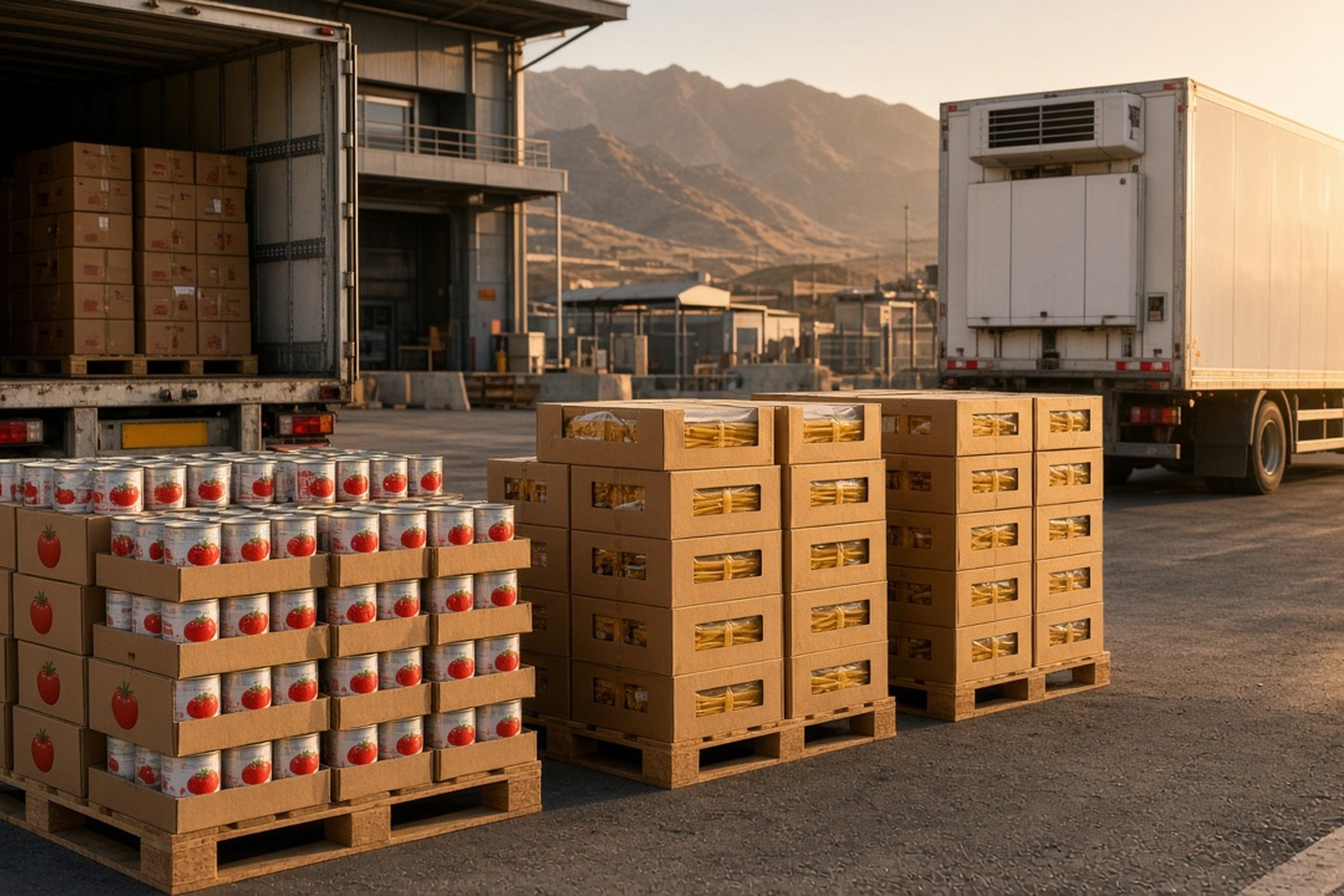
Tomato paste: Core condiment; 400–800 g cans and 4.5 kg tins for food service; aseptic 220 L drums at high Brix for ketchup plants in Herat and Kabul.
Biscuits, wafers & chocolate: Affordable nutrition and shelf stability; cocoa wafers and tea biscuits dominate family snacking.
Dairy: UF white cheese, sterilised cream and UHT milk outperform chilled milk without a cold chain deep inside Afghanistan; skim milk powder for confectionery.
Pasta & oil: 1.2–1.4 mm spaghetti in 500–700 g packs; sunflower and rapeseed oil in PET and 16 kg tins; CBR for chocolate workshops.
Fresh produce: Apples, citrus, tomatoes, onion and potato move in volume from eastern borders in off-season windows.
| Product group | HS code | Common demand formats | Iran supply edge |
|---|---|---|---|
| Tomato paste | 20029010 | 800 g can, 4.5 kg tin, aseptic bulk | Stable Brix, natural colour, no preservatives |
| Biscuits & wafers | 19053100 | Cocoa wafer, tea biscuits | Flavour range, strong cartons, competitive price |
| Dairy | 040120 / 040690 | UHT, UF cheese, sterilised cream | Ambient shelf life |
| Pasta | 19021900 | 1.2–1.5 mm spaghetti | Quality semolina, cooking strength |
| Vegetable oil | 1512 / 1517 | Retail PET, 16 kg bakery tin | Crushing capacity & modern packs |
| Fruit & vegetables | 0702 / 0808 | Apple, tomato, citrus, onion | Proximity & freshness at clearance |
3. Technical specs and lab limits
Reputable importers and border inspection rely on certificates of analysis (COA). Breaches on critical indices trigger rejection at the frontier.
| Product | Parameter | Acceptable range | Buyer focus |
|---|---|---|---|
| Tomato paste | Brix | 25–27% can; 36–38% aseptic | Sauce body and cooking yield |
| Tomato paste | pH / acidity | pH 4.1–4.3; acidity ≤2.2% | Microbial stability |
| Tomato paste | Sn / Pb | Sn <200; Pb <0.1 mg/kg | Can lining safety |
| Biscuits | Moisture | Max 4.5% | Crisp texture |
| Biscuits | Oil peroxide | <2 meq O₂/kg fat | Rancidity control |
| Processed cheese | Fat / moisture | Fat >45%; moisture <55% | Sliceability |
| UHT milk | Micro culture | Negative after 7 days | Ambient distribution |
| Pasta | Ash / fat acidity | Ash <0.9%; acidity <0.05% | Semolina grade |
Intact internal can lacquer and semolina protein/gluten control prevent paste failure and mushy pasta.
4. Border terminals and Khaf–Herat rail
Dogharoon (Taybad): >60% of bilateral flows; ~120 km to Herat; full customs yards; seasonal truck queues (24–48 h dwell).
Mahiroud (South Khorasan): Corridor to Farah and central provinces; lighter traffic and faster exit (12–24 h); grains, pasta and canned goods.
Milak (Zabol): Nimroz, Kandahar and southern markets; Chabahar transit link; avoid midday summer heat on food loads.
Khaf–Herat railway: Rozanak terminal; bulk flour, sugar, wheat and canned goods at lower tonne-km cost than road.
| Terminal | Corridor / province | Border dwell | Main advantage | Operational note |
|---|---|---|---|---|
| Dogharoon | Razavi Khorasan → Herat | 24–48 h | Full customs infrastructure | Seasonal clearance planning |
| Mahiroud | South Khorasan → Farah | 12–24 h | Fast truck exit | Dust-proof tarpaulins |
| Milak | Sistan → Zaranj | 24–36 h | South & Chabahar | Heat-window scheduling |
| Khaf–Herat | Khaf → Rozanak | Wagon plan | Bulk economics | Factory loading sync |
5. Transshipment, cold chain and packaging
Because Iranian trucks rarely reach deep provinces, transshipment at the border is the fragile link. Five-layer cartons, bottle dividers, stretch and shrink-wrapped pallets are mandatory.
Chilled distribution mostly reaches Herat; for Kabul or Kandahar plan ambient-stable lines: UHT, cans, lacquered UF cheese and paste.
6. ANSA, labelling and customs
Afghanistan National Standards Authority (ANSA) sets import quality rules. Steps include origin COA, customs declaration, sampling, label/expiry checks and final release.
- Production and expiry dates in Gregorian and Solar Hijri with durable print — secondary date stickers are invalid.
- Brand, factory mark and “Made in Iran” in Dari, Pashto or English; nutrition table and E-numbers.
- Iran standard mark and recognised international halal certificate.
- At least two-thirds of shelf life remaining at customs delivery.
- Documents: CMR or wagon papers, stamped invoice & packing list, certificate of origin, Food and Drug Organisation COA, phytosanitary/veterinary certificates as applicable.
- HS duties: raw grains 1–2.5%; oils ~3.5%; canned paste and pasta 5–10%; sugar and beverages 8–16%.
7. Wholesale geography
Mandawi Kabul: Capital’s main wholesale food hub and national price reference with redistribution east and centre.
Herat: Strongest Iranian brand presence; modern supermarkets and organised local distribution.
Kandahar & Mazar-i-Sharif: Competition with Pakistan; Iran leads on quality paste, biscuits and pasta; moisture-barrier packs for long hauls.
8. Landed cost and settlement
Delivered price stacks ex-factory cost, haul to border, export charges, Afghan import duty, transshipment labour, insurance and local trucking to destination city.
Rajab, Sha’ban, Ramadan and Eid seasons spike demand for rice, sugar, paste, sweets and oil.
- Hawala via trusted Kabul (Shahzada) and Herat exchangers with counterpart in Mashhad or Tehran.
- Rial settlement at factory gate through Afghan representatives in Iran.
- Escrow with exchanger until buyer confirms waybill or border warehouse receipt.
9. Regional competition
| Country | Strengths | Limits | Afghan position |
|---|---|---|---|
| Iran | Border, language, taste, industry depth | Banking, seasonal border queues | #1 paste & dairy; west & centre |
| Pakistan | Southern border, grains & rice | Torkham/Chaman closures | Grains in Jalalabad & Kandahar |
| Turkey | Premium branding & packs | Distance & cost | Modern retail in Kabul/Herat |
| India | Rice & spices | Sea lanes & volatility | Tea & spice leader |
Iran’s western borders operate year-round versus sudden Pakistan closures; competitive Iranian pricing keeps mass-market access.
10. Industrial inputs & importer checklist
Herat and Kabul plants import aseptic paste, CBR fats, gluten and starch; 25–50 kg bags on Khaf–Herat rail minimise landed cost for processors.
- Verify Iranian production and health licences
- Contract COA: Brix, moisture, micro, heavy metals
- Sealed witness sample from loading batch
- Approve bilingual label against ANSA
- Five-layer cartons & standard pallets for transshipment
- Match border or Rozanak rail handover to province
- Define Incoterms and hawala release conditions
11. Data needed for accurate quotes
State product name and grade, Brix/fat/moisture, pack type and net weight, cartons per pallet, order volume (tonnes or trucks/wagons), brand/label language, delivery border and payment currency. Vague RFQs produce unrealistic prices.
12. Conclusion
Iran–Afghanistan food trade rests on land access, shared taste and competitive ex-factory economics. Lasting margin needs ANSA compliance, five-layer export cartons at transshipment and the right corridor among Dogharoon, Mahiroud, Milak or Khaf–Herat rail.
Buyers and exporters who anchor deals on lab specs and clear contracts build durable bilateral food trade.
Frequently asked questions
Top demand items?
800 g paste and bulk tins, biscuits and wafers, spaghetti, vegetable oil and ambient dairy such as UHT and UF cheese.
Dogharoon vs Mahiroud vs Milak?
Dogharoon for Herat/Kabul; Mahiroud faster to Farah; Milak economical for south and Nimroz.
ANSA food rules?
Gregorian/Solar dates without secondary stickers, two-thirds shelf life, Dari/Pashto/English pack data.
Khaf–Herat rail benefit?
Lower freight for bulk flour, sugar and canned goods with less road damage.
Perishables inland?
Focus on UHT, cans, UF cheese and ambient-stable paste.
Why five-layer cartons?
Manual transshipment destroys three-layer board.
How is payment settled?
Hawala, factory Rial payment or escrow until waybill sight.
Direct factory supply?
Submit specs via Iranco purchase request for samples, COA and proforma.
Purchase request & supply from Iranian manufacturers
Register grade, pack, Brix, border and tonnage on Iranco so ANSA alignment and stable supply can be reviewed.
Contact Irancoinfo@iranco.com · WhatsApp: +98 913 104 4182 · Telegram: @irancofood
Featured Products


Related Articles



