 Iranco Magazine Team
From saffron, pistachios, dates and dried fruit to processing: origin advantage, quality, price, geography, standards, packaging and real export opportunities
Export Guide · Competitive Edge · Food
What Are Iran’s Main Competitive Advantages in International Food Markets?
From saffron, pistachios, dates and dried fruit to processing: origin, quality, price, geography, standards, packaging and real export opportunities
Iran’s food edge is not only price or proximity. Climate diversity, saffron and pistachio origin strength, land and sea access, processing depth and multi-tier quality are the base—paired with QC, traceability, packaging and compliance for sustainable sales.
Analytical introduction
Core advantages combine origin strength in flagship lines, climate and product diversity, proximity to regional markets, land and sea routes, processing industry and supply across quality tiers.
Professional buyers do not pay more for “Iranian” alone unless origin converts to measurable quality, price, supply reliability or provable technical traits.
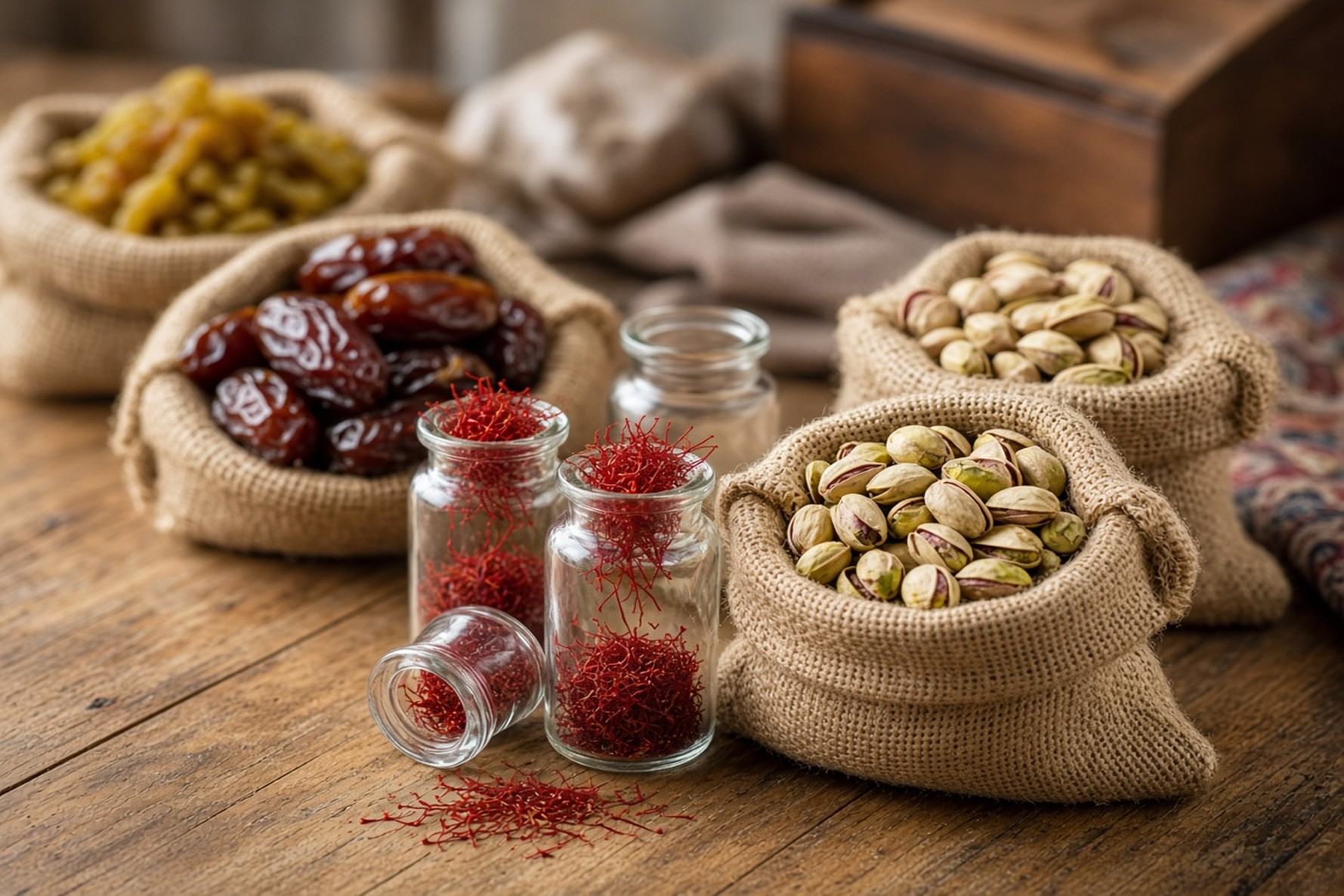
With over 90% of world saffron, Iran illustrates origin advantage; pistachio, dates, dried fruit, fresh produce and processed foods follow the same commercial logic.
Seven land borders plus Caspian and Gulf access create regional leverage—the buyer’s question is: what problem does Iran solve better than rival origins?
1. How should Iran’s food competitive advantage be measured?
In food trade, competitive advantage cannot be proved with phrases like “high quality” or “good price” alone. A professional importer checks advantage against practical indicators: repeatable quality, delivered price, supply lead time, product risk, scope for laboratory control, packaging flexibility and supply continuity.
For example, pistachios that look right in an initial sample—colour, size and taste—but where the seller cannot contractually commit on aflatoxin, moisture, kernel percentage, defects, breakage and lot uniformity are not necessarily a competitive offer. By contrast, a supplier who delivers average but fully standardised, traceable and repeatable product may be more valuable to a food manufacturer.
| Advantage base | Value for buyer | Condition to become real advantage |
|---|---|---|
| Strong origin | Access to recognised product | Proven authenticity and uniformity |
| Large domestic output | Commercial volume supply | Supply plan and stable contracts |
| Geographic proximity | Shorter time and part of logistics cost | Reliable transport route |
| Production cost | Wholesale competitiveness | Stable quality and landed cost |
| Product diversity | Choice for different uses | Precise specification definition |
| Processing industry | Higher added value | Technology, food safety and packaging |
| Regional export experience | Knowledge of nearby markets | Compliance per destination |
Iran’s food advantage is not the same for every country. Proximity to Iraq is a major edge for fresh produce, dairy or everyday packaged foods, but the same factor matters less for saffron exports to East Asia—freight cost is a small share of final price on high-value, low-weight goods.
Exporters should first decide whether their edge is product-led, cost-led, geographic, technical or commercial—and then choose the market that matches that edge.
2. Which Iranian food groups have stronger competitive edge?
Iran does not have equal advantage across all foods. Competitiveness is stronger in groups that have at least one of three traits: recognised origin, access to domestic raw material, or proximity to consuming markets.
Saffron
Saffron is Iran’s clearest origin advantage. Future edge is not volume alone: authenticity, standardisation, fraud prevention, post-harvest control and traceability drive competition. ISO 3632-1:2025 updates specifications for dried saffron; for professional buyers, technical specs must be testable.
Pistachio
Iran’s edge combines production history, consuming markets, supply formats and trade experience—but it depends heavily on aflatoxin management, moisture, uniformity, kernel percentage and separation of contaminated lots.
Dates, dried fruit, fresh produce and processed foods
Dates span soft, semi-dry and dry grades across several channels. Dried fruit and nuts benefit from shelf life and value-to-freight ratios. Fresh fruit and vegetables lean on geographic advantage; in the year to March 2024, reported Iranian exports included about 776k t watermelon, 755k t apple and 473k t tomato. Processed lines—paste, concentrate, dairy and canned goods—add value and depend on plant efficiency and ISO 22000.
| Product group | Main Iran advantage | Buyer concern | Value uplift path |
|---|---|---|---|
| Saffron | Origin and very high global share | Authenticity, purity, uniformity | Testing, traceability, final packing |
| Pistachio | Production history and global presence | Aflatoxin and uniformity | Control from orchard to pack |
| Dates | Product diversity and processing | Moisture, texture, pests | Grading and packaging |
| Dried fruit/nuts | Shelf life and freight economics | Contamination and residues | Sorting and lab control |
| Fresh produce | Proximity to regional markets | Commercial life and cold chain | Pre-cooling and packing |
| Processed foods | Domestic raw materials and industry | Formula stability and food safety | Standard production and brand |
3. Climate diversity—an advantage that must become product specifications
Iran stretches from humid Caspian coast to cold highlands, dry plateau and hot south. “Climate diversity” has commercial value only when it converts into product traits—harvest timing, fruit sugar, dried-goods moisture, aromatic compounds and supply capacity.
Supply-season advantage
Entering a market before a rival has harvested creates a large edge; analyse arrival timing against export-grade quality, sorting capacity and weekly competitor supply.
Origin advantage
For saffron, pistachio and some dates, production region, harvest method, processing and traceability can be sales tools—not merely “Made in Iran” on the label.
4. Processing depth—advantage beyond raw commodity exports
Pistachio is not only in-shell; kernel, green kernel, slivers and powder serve different markets. Dates can be consumer packs, paste or syrup. That diversity reduces dependence on raw markets and targets industrial buyers.
A confectionery plant cares about kernel colour after chopping, moisture and microbiology; a beverage plant about Brix and aseptic packing; industrial bakery about cut uniformity and oxidative stability. Iran’s expandable edge is selling by end use.
5. Geography and logistics—Iran’s major edge in regional markets
Iran has seven land neighbours plus Caspian and Gulf access. Through 19 March 2024, Iraq, the UAE, Russia, Pakistan and Afghanistan were the top five markets; about 80% of ag/food export value went to 15 neighbouring countries.
Iraq: Short distance and multiple border routes; fresh, dairy and packaged lines benefit. Gulf: The UAE is a redistribution hub; packing and supply stability are critical for saffron and dried goods. Russia and Eurasia: The free trade agreement from 15 May 2025 creates preferential framework but depends on HS codes and rules of origin. Europe: Sustainable entry depends on MRL, contaminants and traceability; about €412 million in ag/food imports from Iran was reported in 2025.
| Market group | Main Iran advantage | Buyer sensitivity | Better product groups |
|---|---|---|---|
| Iraq and western Iran rim | Distance and land freight | Supply continuity and delivered price | Fresh, dairy, processed |
| Afghanistan and Pakistan | Land access | Price and supply capacity | Staples, fruit, processed |
| Gulf states | Sea access | Packaging and stable quality | Nuts, saffron, dates |
| Russia and EAEU | Land/Caspian routes and FTA | Standards and logistics | Fruit, vegetables, dried goods |
| Europe | Origin strength in select lines | MRL, contaminants, traceability | Saffron, pistachio, dried fruit |
| East and South Asia | Demand for nuts and spices | Price, specs and volume | Pistachio, saffron, dates |
6. Market advantage is created when Iran defines a different product for each destination
Offering one fixed specification to every market is a common mistake. Price-driven markets focus on pack weight, freight and delivered price; quality-driven markets on lab reports and uniformity; premium retail on packaging and origin story; industrial markets on technical specs—even second-grade appearance is acceptable if safety and composition fit the application.
7. Food safety and standards—the point where Iran’s advantage is strengthened or removed
Codex CXC 1-1969 provides the HACCP framework; ISO 22000:2018 is the food safety management system. For the EU, MRL under Regulation (EC) No 396/2005 and contaminants under Regulation (EU) 2023/915 matter directly. The phrase “export standard” without naming destination rules, test methods and acceptance limits has limited contract value.
| Product group | Key controls |
|---|---|
| Pistachio and nuts | Aflatoxin, moisture, defects, insects, foreign matter |
| Dried fruit | Moisture, water activity, mould, pesticide residues |
| Fresh produce | Pesticide residues, quarantine, appearance |
| Saffron | Authenticity, purity, moisture, chemical and sensory traits |
| Dairy | Microbiology, fat, protein, cold chain |
| Concentrates | Brix, acidity, colour, microbiology |
| Packaged foods | Net weight, ingredients, allergens, dates and label |
A COA is not enough unless it ties to the same traceable batch.
8. Packaging—one of the largest value-uplift opportunities
The gap between origin and retail price comes from grading, packaging, branding and buyer confidence. Bulk packing for factories (protection, net weight, warehousing), retail packs (legal destination labels) and buyer-branded packs (minimum runs and approved copy) are the three main models. Repacking after arrival can erase a factory’s price advantage.
9. Does Iranian food have a price advantage?
In some groups, yes—but “Iran is cheaper” is not a universal rule. Competitive price is measured at the delivery point with the same technical specs, net weight, packaging, freight, payment terms and Incoterms.
- Raw quality, season, grade, processing, testing, packaging, order volume, sorting waste
- Inland and international freight, insurance, payment terms, delivery place, packaging material volatility
- For premium saffron/pistachio, a few percent price gap matters less than quality; for industrial paste and fresh fruit, freight weighs more
- Investigate abnormally low prices; comparing without a spec sheet compares two different goods
10. Iran versus competing origins
The rival origin differs by product. Iran’s defensible edge is usually stronger where origin and domestic raw material are decisive; the more generic the product, the more plant, logistics and sales network in the exporting country matter.
- Quality swing between shipments
- Selling without adequate documentation
- Over-reliance on bulk sales
| Competitor origin | Competing area | Known strengths | Iran opportunity |
|---|---|---|---|
| Turkey | Nuts, fruit, processed | EU access, packing, trade network | Specific origins and regional markets |
| USA | Pistachio | Standardisation and scale | Product diversity and Asian markets |
| Spain | Saffron and spices | Packing and international marketing | Production share and origin authenticity |
| Tunisia and others | Premium dates | Positioning and packaging | Iran date diversity and processing |
| Egypt | Fruit and processing | Scale and trade access | Proximity to Iraq and Central Asia/Caucasus |
| India | Spices and ingredients | Export network | Saffron, pistachio, dried fruit niches |
11. Importer checklist before placing an order
Finalise these 20 points before payment or production.
- Define exact product name and supply form: fresh, dried, frozen, processed, whole, crushed or powder.
- State end use: retail, factory, restaurant, repacking or wholesale distribution.
- Write measurable technical specs: moisture, size, Brix, breakage, colour or related indices.
- Set destination market standards before ordering.
- Obtain a representative commercial sample—not a show sample only.
- Agree sampling and testing for the main shipment from the start.
- Request relevant lab reports: contaminants, pesticide residues or microbiology as applicable.
- Record defect tolerances in the contract.
- Separate net weight per pack and total net from gross weight.
- Confirm packaging materials and structure.
- Align label text and language with destination regulations.
- Verify supplier monthly or seasonal capacity.
- Separate order preparation time from transit time.
- Define transport route and delivery point.
- Record transport and storage temperature for sensitive goods.
- Set Incoterms precisely; “delivered price” without place and rule is insufficient.
- Check HS code with broker or destination customs specialist.
- Confirm health, quarantine or halal documents before production starts.
- Require batch number and traceability for sensitive lines.
- Document rejection/acceptance criteria before loading.
12. Information required for an accurate price quote
A professional RFQ replaces vague “pistachio price” requests.
| Information required | Example of what to specify |
|---|---|
| Product | Pistachio, saffron, dates, concentrate, fresh fruit… |
| Product form | Whole, kernel, crushed, dried, frozen, puree… |
| Quality level | Technical specs and acceptance criteria |
| Size / moisture / Brix | As relevant to the product |
| Testing | Aflatoxin, MRL, microbiology… |
| Packaging and weight | Pack material and net weight |
| Volume and destination | Total weight, country, port or city |
| Freight and delivery | Road/sea/reefer, Incoterms and loading date |
Register the same details in an Iranco purchase request.
Sourcing Iranian food against buyer specifications
Quotes differ on far more than per-kilo price: quality, specs, testing, net weight, packing and delivery.
Start with a precise RFQ; set acceptance tests upfront for sensitive lines.
Iranco accepts structured purchase requests and matches Iranian food supply options.
Summary
Iran’s edge is origin, raw materials, climate, processing and geography—not low price alone.
Buyers judge in the contract: vague specs, non-repeatable quality or non-traceable COAs erase advantage.
The export opportunity is defined, provable product with destination-ready packing.
FAQ
What is Iran’s main food competitive advantage?
There is no single factor: origin share for saffron, trade history for pistachio, regional proximity for fresh produce, and plant plus packaging for processed lines.
Which Iranian foods are best known globally?
Saffron and pistachio lead; dates, dried fruit, fresh produce, dairy and processed foods matter strongly in regional trade.
Is Iranian food always cheaper than competitors?
No—compare delivered price at the same place for identical specifications.
What matters most for Europe?
Compliance with MRL, contaminants, traceability and labelling, including EC 396/2005 and EU 2023/915 where applicable.
Why do pistachio and saffron still need strict QC despite strong origin?
Origin raises the odds of suitable supply but does not guarantee each lot; aflatoxin and authenticity must be contractual.
For which products is geography most important?
Fresh, chilled and heavy lines; for saffron, quality and authenticity outweigh distance.
How to source directly from Iran?
Define product, specs, volume, packing, destination and tests; submit a structured request via Iranco.
What is needed for a meaningful price quote?
Form, quality, pack, volume, destination, freight and Incoterms; add lab parameters for pistachio, nuts and concentrates.
Featured Products










Related Articles



