 Iranco Magazine Team
From Iraq and the UAE to Russia, Pakistan and Afghanistan — demand structure, suitable products per market, transport routes, entry requirements and Iran's export concentration risk
Market Report · Food & Agriculture Exports
Top Export Destinations for Iran's Food and Agricultural Products
From Iraq and the UAE to Russia, Pakistan and Afghanistan — demand structure, suitable products, transport routes, entry requirements and export concentration risk.
Analytical Introduction
Iran's food and agricultural export market is heavily region-focused, with neighbouring countries absorbing a large share of demand. In the breakdown report on Iran's agricultural trade for the first nine months of 1404, Iraq accounted for 39%, the United Arab Emirates for 21%, Russia for 10%, Pakistan for 5% and Afghanistan for 4% of Iran's agricultural exports. In food processing, concentration on Iraq is even higher — roughly half of exports in this group went to the Iraqi market.
The short answer to "Which countries are the largest export destinations for Iran's food and agricultural products?" is clear: Iraq, the UAE, Russia, Pakistan and Afghanistan form the core of this market. After them, countries such as Oman, Turkmenistan, Turkey, India and Qatar absorb part of Iran's agricultural export flow. However, the commercial value of these countries is not the same for every exporter.
One market may be critical for dairy, tomato paste and packaged foods but not a primary destination for pistachios or saffron. Conversely, a market such as India may hold a smaller share of Iran's total agricultural exports than Iraq, yet matter greatly for nuts and other high unit-value groups. Export destination assessment must therefore be done at the product–market level, not solely on overall country rankings.
Iran's agricultural export structure has another important feature: geographic proximity plays a major role. In the year ending Esfand 1402, more than 8.8 million tonnes of livestock, fishery, agricultural, greenhouse and food products were exported from Iran, with export value of about $6.3 billion. In the same period, nearly 80% of the value of this export basket went to 15 neighbouring countries.
This concentration creates both advantage and risk. Short routes, overland transport, familiarity with Iranian brands and packaging flexibility are strengths. In contrast, heavy dependence on a few markets can leave exporters vulnerable to regulatory changes, border restrictions, demand swings or increased competition.
For a professional exporter, the main question is no longer "Which country buys the most from Iran?" but: For my product, which market is better in terms of demand, standards, achievable price, freight cost and commercial stability?
1. How Is Iran's Real Food and Agricultural Export Map Shaped?
Iran's agricultural export market can be divided into three main layers: high-volume neighbouring markets, regional markets with higher standards and purchasing power, and more distant or specialised markets for high unit-value products.
Iraq is a clear example of a volume market. A wide range of fresh fruit and vegetables, dairy, processed foods and Iranian consumer goods can be sold there. Short overland distance and an extensive network of Iranian and Iraqi traders also ease market entry.
The UAE presents different conditions. Part of Iran's exports is consumed domestically in the UAE and part enters distribution, processing or re-export networks. In this market, appearance quality, packaging, specification consistency and product documentation matter more.
Russia is also a distinct market. Greater distance, higher importance of the cold chain, phytosanitary and health controls, and Eurasian Economic Union standards mean successful exports require tighter technical management.
Pakistan and Afghanistan benefit more than other core markets from overland border access. Price competition matters strongly in both, but product requirements and sales channels differ from one product group to another.
| Destination | Reported share of agri exports | Main market feature | Product groups with notable Iranian presence |
|---|---|---|---|
| Iraq | 39% | Large overland consumer market | Dairy, fruit, vegetables, processed foods |
| UAE | 21% | Domestic consumption, regional distribution and re-export | Fruit & vegetables, nuts, processed foods |
| Russia | 10% | Large market with higher technical requirements | Fruit, vegetables and agricultural products |
| Pakistan | 5% | Border market, price-sensitive | Selected agricultural and food products |
| Afghanistan | 4% | Nearby overland market | Food products, fruit, consumer goods |
| Oman | ~2–3% | Gulf market with packaged food capacity | Food products, fruit, some processed items |
| Turkmenistan | ~2–3% | Overland Central Asian market | Food and agricultural products |
| Turkey | ~2–3% | Competitive market and route to Europe | Nuts and specialised products |
| India | ~2–3% | Large market for selected groups | Nuts and high unit-value products |
| Qatar | ~2–3% | Smaller but import-dependent market | Food products and fresh produce |
High shares refer to the first nine months of 1404 report and should not be equated with countries' share of Iran's total non-oil exports.
A fundamental issue in this structure is export concentration. In the first nine months of 1404, Iran's agricultural and food processing trade balance was reported at roughly $4.6 billion negative. Export value for this group fell about 4% versus the same period a year earlier, while import value rose about 6%.
For exporters, this sends a clear commercial message: developing new markets must go hand in hand with retaining core markets. Replacing Iraq or the UAE in the short term is not realistic, but remaining dependent on one or two buyers or one country is not a low-risk strategy either.
2. Iraq — The Largest Regional Market for Iran's Food and Agricultural Products
Iraq holds a different position among Iran's food and agricultural export destinations. It is not only a buyer of raw agricultural products but also a major consumer of Iranian processed foods.
In the first nine months of 1404, Iraq absorbed 39% of Iran's agricultural exports and about 50% of Iran's food processing exports. Trade reports for the same period cite dairy, tomatoes, cucumbers, apples, watermelons and dates among important product groups supplied to the Iraqi market.
Why Does Iraq Matter So Much to Iran?
The first factor is geography. The long overland border between Iran and Iraq allows use of multiple customs posts and terminals. This matters greatly for products with medium or low unit value, where freight can form a large share of delivered price.
The second factor is demand diversity. In Iraq, it is not only a limited segment that buys Iranian goods. Fruit and vegetable wholesalers, food retailers, restaurants, hotels, food industries and local distributors can all be buyers of different product groups.
The third factor is the ability to offer different pack formats. A producer can supply bulk for distribution networks or consumer packs for retail. The pack type must match the sales channel.
Which Products Suit the Iraqi Market Best?
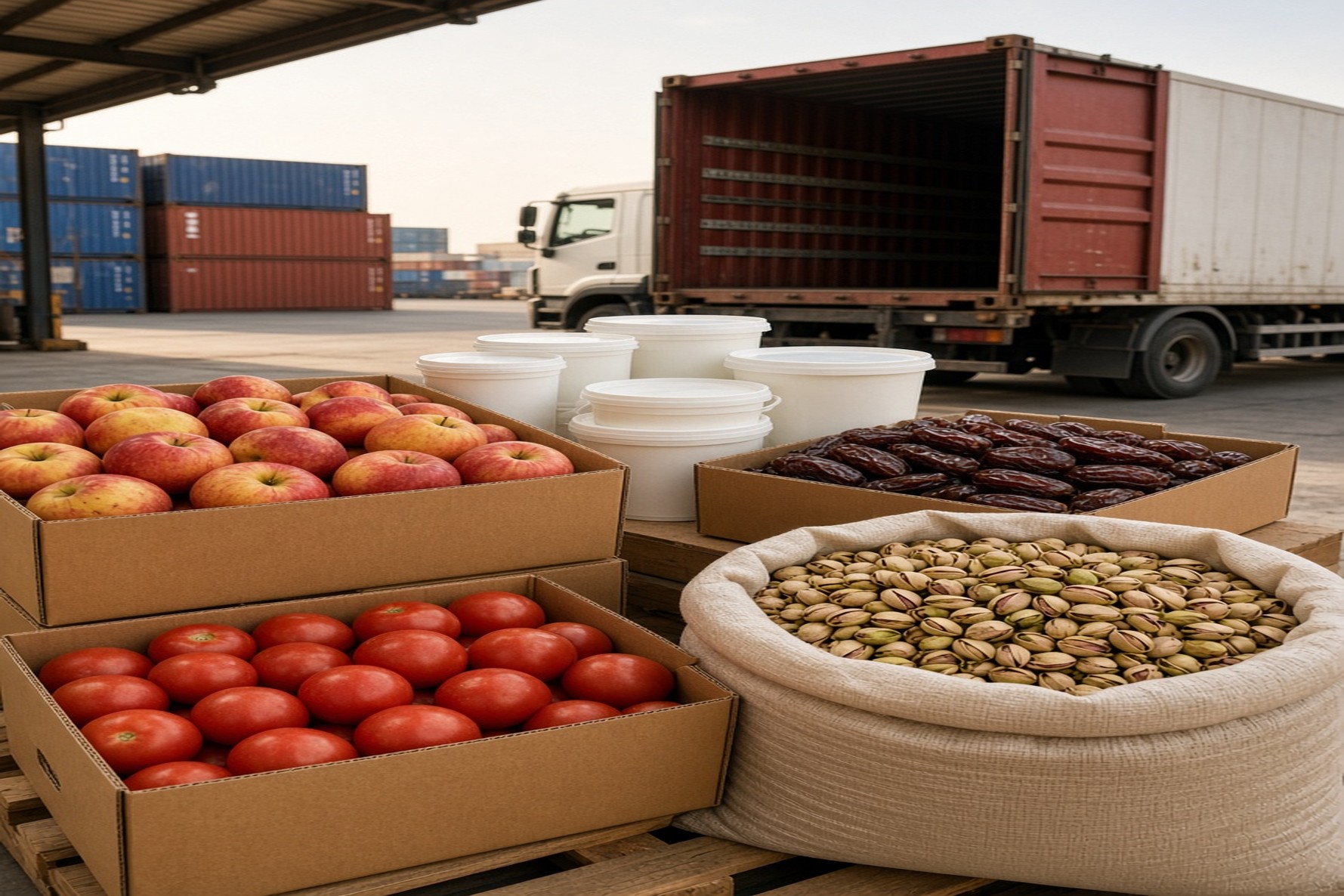
Iran exports a wide range of agricultural and food products to Iraq. In fresh produce, apples, watermelons, tomatoes and cucumbers are well known. Dates also have a place in bilateral trade.
In food processing, dairy products are especially important. Other packaged food groups can also gain presence depending on brand, price and distribution network.
However, "the Iraqi market" should not be treated as uniform. Consumer taste, acceptable price, purchasing power and distribution networks differ among Baghdad, the Kurdistan region and southern cities.
Key Points in Iraqi Contracts
Before production or loading, the exporter must define exactly: product type, quality grade, size, net weight, packaging, production and expiry dates, label language, delivery terms, destination customs and allocation of border costs.
In Iraq, the Central Organization for Standardization and Quality Control plays a role in controlling imported goods standards. Clear country-of-origin marking and production and expiry information are important labelling topics for packaged foods.
For fresh products, the commercial agreement must turn acceptance criteria into measurable terms. Phrases such as "export quality" alone are not enough. Size, colour, ripeness, defect percentage, sort type, net weight and pack condition must be measurable.
3. United Arab Emirates — Consumption, Distribution and Re-Export Market
With a 21% share in the first nine months of 1404 report, the UAE was the second most important destination for Iran's agricultural goods.
But the UAE's importance is not limited to domestic consumption volume. Logistics position, port infrastructure, food distribution companies and links to Gulf markets give this country a broader commercial role.
Which Products Have Better Prospects in the UAE?
In the UAE market, product quality must come with presentation quality. For many goods, weak packaging can exclude even a suitable product from professional sales channels.
This is especially true for nuts, saffron, premium fruit, branded foods, products for supermarket chains and goods supplied to hotels and restaurants.
For fresh products, load uniformity matters greatly. A professional buyer does not expect only the initial sample to be acceptable — the entire shipment must match the sample or specification sheet.
The UAE Is Not Just Dubai
The UAE market should be analysed by sales channel:
- Fruit and vegetable wholesale
- Supermarket chains
- Food distributors
- Hotels and restaurants
- Packing and processing companies
- Re-export to other countries
The product suitable for wholesale is not necessarily the same pack chosen for supermarket shelves.
Food Registration and Control
Imported or locally produced food in the UAE is subject to registration and control mechanisms before market release. The national food registration and accreditation system and each emirate's food control authorities play a role. For example, in Dubai, food product registration, assessment and import clearance are handled under municipal supervision.
Iranian exporters should therefore not design labels after final production. Product name, ingredients, weight, manufacturer details, country of origin, dates and other required information must be checked with the importer before bulk printing.
4. Russia — Important Destination, Dependent on Technical Quality and Logistics
With a 10% share of Iran's agricultural exports in the first nine months of 1404, Russia was the third main destination in this group.
The Russian market is attractive to Iran in several ways: large population, need to import part of its fruit and vegetables, and Iran's access to overland routes and the Caspian Sea create commercial capacity. However, the gap between "export possibility" and "sustainable export" in Russia is wide.
Why Is Russia Not a Simple Market?
Fresh product exports to Russia depend on precise control of several factors: sort quality, plant health, pesticide residues, supply consistency, packaging suited to longer transport, temperature and humidity management matched to the product, and document coordination.
For an exporter who selects product only by orchard or farm gate price, the Russian market can be high risk. Professional buyers in this market pay more attention to consistency across shipments.
Eurasian Standards Framework
For food supplied in Russia, Eurasian Economic Union technical regulations matter. Food safety requirements, health controls, some contaminant and residue limits and labelling requirements are set within this framework.
Before contracting, it must be clear which product category applies and which certificates, tests and documents are required for entry.
Main Routes
Exports to Russia can move via Caucasus overland routes and Caspian Sea routes. Route choice should be based on product, season, delivery point and product sensitivity.
For fresh fruit and vegetables, the cheapest transport is not always the most economical. Delay, temperature fluctuation or long stops can cause more quality loss than initial freight savings.
5. Pakistan and Afghanistan — Overland Border Importance and High Price Sensitivity
In the first nine months of 1404, Pakistan and Afghanistan absorbed about 5% and 4% respectively of Iran's agricultural exports.
These two markets do not share the same economic structure or regulations, but they share one feature: the overland border plays a decisive role in Iranian product competitiveness.
Pakistan
Pakistan is itself a large agricultural producer. Iranian exporters must therefore check before entry whether the target product faces supply shortage in a given period or offers a specific advantage over domestic production and imports from other countries.
For plant products, quarantine is a serious issue. Pakistan's Department of Plant Protection states that entry of plants, plant material and plant products requires a valid import permit issued according to product and country of origin. Phytosanitary certificate, invoice, packing list and transport documents are also part of clearance.
Agreement with a Pakistani buyer must include verification of the import permit for that product before loading.
Afghanistan
Afghanistan is a natural market for many Iranian food and agricultural groups, especially due to overland access and extensive trade links.
But market proximity should not simplify document control. Regulations published by Afghanistan's Ministry of Public Health emphasise holding an official trade licence and food entry permission, and in some cases require shipment analysis certificates from the producing factory.
For packaged food exports to Afghanistan, buyer and seller must agree in advance on labelling, importer licence, expiry date, batch number and quality documents.
6. Next-Tier Markets — Oman, Qatar, Turkey, Turkmenistan, India and China
Not being in the top five destinations does not mean a country is unimportant for a specific product.
This is especially visible in nuts and high unit-value products. Iran's pistachio exports, for example, have a different structure from overall agricultural trade.
In the nine months ending Dey 1404, about 100,000 tonnes of Iranian pistachio products worth roughly $730 million were exported to 67 countries. India, the UAE, Russia, Kazakhstan and China were among the important markets in this group.
Destination ranking must therefore always be rebuilt at product level.
Oman
For exporters targeting Gulf markets, Oman is worth reviewing for packaged foods, some fresh products and consumer goods. Maritime proximity to southern Iran creates an important logistics advantage.
Qatar
Qatar's population is far smaller than Iraq or Russia, but high dependence on food imports means some fresh produce, nuts and suitably packaged foods can enter the market.
Turkey
Turkey is itself a large agricultural and food exporter. Competition in generic goods is difficult. Iran's advantage in this market should rest more on products where Iran has a defensible position in supply, production season, special quality or cost structure.
India
India is an example of a market whose value for some products far exceeds its share of Iran's total agricultural exports. Pistachios and other specialised goods can hold a very different position from generic fruit and vegetables.
China
China also matters for some nuts, fishery products and specialised goods, but transport distance, import protocols and product or facility registration requirements can make entry more complex.
7. Which Iranian Product Fits Which Market Best?
Market choice should follow precise product definition. An exporter who picks the country first and then searches for a suitable product usually accepts more risk.
| Product group | Notable markets | Main success factor |
|---|---|---|
| Fresh fruit | Iraq, UAE, Russia, Afghanistan, Gulf countries | Sort, shelf life, packaging and logistics |
| Vegetables & greenhouse products | Iraq, UAE, Russia, Qatar and regional markets | Uniformity, plant health and cold chain |
| Dairy | Iraq and some regional markets | Price, shelf life, cold chain or storage conditions and product registration |
| Pistachios & kernels | India, UAE, Russia, China and specialised markets | Size, kernel percentage, aflatoxin, quality and application |
| Saffron | Regional, Asian and European markets | Purity, colouring strength, packaging and authenticity |
| Dates | Iraq and regional and Asian markets | Variety, moisture, size, cleanliness and packaging |
| Tomato paste & derivatives | Iraq and regional consumer markets | Brix, colour, pack type and delivered price |
| Confectionery & flour-based products | Iraq, Afghanistan and regional markets | Taste, price, shelf life and packaging |
| Seafood | Gulf markets and some Asian markets | Species, size, processing, health control and cold chain |
| Dried fruits & nuts | UAE, India, Russia and specialised markets | Size, moisture, defects, contaminant testing and packaging |
This table is an initial selection map, not a substitute for tariff code analysis and trade data for the same product.
Separate Actual and Potential Markets
Iraq is a very large actual market for Iran. Trade infrastructure, transport routes and product familiarity already exist.
A potential market may have high imports but low Iranian share. Entering such a market requires examining why: tariff barriers? Strict standards? Weak Iranian packaging? Competitors with long-term contracts? Or freight cost erasing Iran's advantage?
High import volume alone does not create an export opportunity.
8. Standards, Testing and Documents — Where Many Exports Fail
A common mistake is asking about destination documents after the shipment is produced. The professional order is reversed: market requirements are defined first, then production and packaging follow.
Fresh Plant Products
For many fruits and vegetables, the phytosanitary certificate is among the most important documents. But the certificate alone does not guarantee entry. The destination country may also require conditions for specific pests, pesticide residues, disinfection, place of production or packaging.
Processed Foods
For packaged foods, the following should be reviewed before production: product composition, permitted additives, labelling, nutrition facts where required, production and expiry dates, batch number, country of origin, manufacturer details, storage conditions and health documents.
Nuts
For nuts, moisture and contaminant control matter especially. In products such as pistachio, aflatoxin is a decisive parameter for entry to sensitive markets. Non-representative sampling can make even a valid test result commercially worthless.
Livestock and Fishery Products
These groups usually have more veterinary and health requirements than generic dry or plant products. Facility approval, health certificates, processing conditions, storage and cold chain must be checked against the destination country.
| Market | Topic to resolve before final production |
|---|---|
| Iraq | Product specs, origin, dates, packaging and importer requirements |
| UAE | Product registration, label compliance and health documents |
| Russia | EAEU requirements, plant or health status and residue controls |
| Pakistan | Import permit and quarantine for plant products |
| Afghanistan | Importer licence, quality documents and food requirements |
| Sensitive European markets | Contaminants, pesticide residues, traceability and strict standard compliance |
In export orders, test results should not be viewed only as final proof. Acceptable limits should be written into the contract or purchase specification.
9. How Do Transport Routes Change Competition Among Export Markets?
Iran's advantage in many regional markets comes from transport distance. This allows even medium unit-value products to be exportable.
| Destination | Main usable route | Products suited to route | Main risk |
|---|---|---|---|
| Iraq | Overland from western and south-western borders | Fresh produce, dairy and food products | Border delays and damage to sensitive goods |
| Afghanistan | Overland from eastern Iran | Food products and agricultural goods | Border delay and transport conditions |
| Pakistan | Overland from south-east and in some cases sea | Selected agricultural and food products | Quarantine and clearance time |
| UAE | Sea from southern ports and in special cases air | Nuts, food products, fruit and vegetables | Product registration coordination and clearance time |
| Oman & Qatar | Sea and air for special shipments | Food products and fresh produce | Maintaining quality until delivery |
| Russia | Overland via Caucasus or Caspian Sea | Fruit, vegetables and agricultural products | Route length and cold chain |
| India | Mainly sea | Nuts and higher-value goods | Transit time and destination formalities |
| China | Sea and combined routes | Specialised goods | Distance and entry requirements |
Do Not Compare Fresh and Dry Product Transport
For nuts, exporters often have more freedom in route and timing choice. For fresh products, commercial shelf life is part of transport cost.
If cheaper transport takes a few days longer and spoilage rises, true landed cost may be higher.
The same logic applies to overland borders. Short distance alone does not guarantee suitable transport. Truck type, ventilation, carton stacking, pre-cooling and border stops all affect final quality.
10. A Large Market Is Not Necessarily the Most Profitable
A common error in food exports is choosing a destination based only on trade volume.
Iraq is Iran's largest agricultural market, but that does not mean the highest margin for every product. Intense competition, price sensitivity and multiple suppliers can limit selling margin for some goods.
The UAE may allow higher unit value for some products, but packaging, registration, marketing and distribution costs are also higher.
Russia is a large market, but logistics cost, quality control and fresh shipment risk must be built into price.
India can be attractive for nuts, but for low-value fresh products transport distance may not create an economic advantage.
Market comparison should therefore be based on achievable destination price minus all costs and risks.
Main Export Pricing Factors
Price offered to a foreign buyer is affected by a set of variables:
- Product type and grade
- Size and classification
- Quality and defect tolerance
- Production season
- Order volume
- Packaging type
- Testing and certificate cost
- Transport method
- Delivery point
- Payment terms
- Expected spoilage rate
- Private label requirement
- Cold storage or cold chain cost
Comparing two offers without matching delivery terms and technical specifications is therefore misleading.
11. Importer Checklist Before Placing an Order
A foreign buyer planning to source food or agricultural products from Iran should define the following before requesting a price:
- Exact product name and supply form — fresh, dry, frozen, processed or packaged.
- Required type, grade or quality class.
- Size, weight or sort specifications where relevant.
- Acceptable limits for appearance and quality defects.
- Required laboratory parameters such as moisture, Brix, pesticide residues or contaminants.
- Destination country standard or regulation.
- Net weight per pack.
- Packaging material and master carton specifications.
- Whether palletisation is required.
- Label language and content.
- Manufacturer brand or buyer's private label.
- Trial order quantity and commercial order quantity.
- Delivery city, port or border.
- Preferred transport method.
- Delivery terms under Incoterms.
- Required health, phytosanitary or veterinary documents.
- Need for pre-contract samples.
- Sampling method and shipment acceptance criteria.
- Lead time required for regular supply.
- Approximate schedule for follow-on orders.
Recording these items helps the seller provide a comparable offer instead of a generic price.
Buyers seeking supply from Iran can include the same specifications in an Iranco purchase request so available supply options are reviewed by product, quality, packaging, quantity and destination.
12. What Information Is Needed for an Accurate Price Quote?
The question "What is the export price of Iranian agricultural products?" has no precise commercial answer without further specifications.
To receive a usable offer, at minimum the following information should be sent:
| Information | Example required content |
|---|---|
| Product | Exact product name |
| Supply form | Fresh, dry, frozen, processed |
| Quality | Grade and defect limits |
| Technical specs | Size, moisture, Brix or other relevant parameters |
| Packaging | Material, net weight and master carton |
| Quantity | Total order weight |
| Destination | Country and city, port or border |
| Transport | Road, sea or air |
| Delivery terms | Agreed Incoterms rule |
| Documents | Required certificates and tests |
| Brand | Manufacturer brand or private label |
For example, a request for "export apple price for Russia" is too broad. Apple variety, size, colour, sort type, carton weight, stacking method, order volume and delivery location can fundamentally change price.
The same applies to pistachio. Pistachio price is not comparable without defining product type, size, defect percentage, kernel condition, packaging and destination tests.
13. How to Manage Export Market Mix More Professionally
An exporter targeting only one market may sell well in a boom period but remain vulnerable to any commercial change.
A more professional approach is to divide markets by role. One market can be a volume destination. Another serves premium product and higher margin. A third can act as an overflow market in surplus seasons.
For example, a fresh fruit exporter may treat Iraq as a nearby volume market, develop Russia for better-sorted product and review Gulf markets for premium packaging.
The same logic works differently for nuts. In this group, countries such as India, the UAE, China or some European markets may matter more for a specific product despite a smaller share of Iran's total agricultural exports.
Four Criteria for Choosing a Second Destination
An alternative market should be reviewed from at least four angles:
- Demand: Does the country actually import the target product?
- Access: What effect do tariff, health restriction or registration barrier have?
- Logistics: Can the product reach destination at reasonable cost and acceptable quality?
- Competition: Which countries are the main suppliers and what is Iran's advantage against them?
Geographic diversification without answering these four questions may only increase marketing cost.
14. Export Supply of Iranian Food and Agricultural Products Based on Buyer Needs
In food trade, supplier choice is not made by comparing initial price alone. Two offers for a similarly named product may differ greatly in quality, sort, actual weight, testing, packaging and ability to supply consistently.
A professional buyer should first define purchase specifications and then compare sellers against those specifications.
Iranco can serve as a platform for submitting purchase requests for Iranian food and agricultural products. Buyers can specify product type, required quality, order quantity, packaging, destination country and general delivery conditions so supply options matching their needs are reviewed.
For specialised orders, technical parameters matter more. For pistachio, size and defect specifications; for fresh fruit, sort and packaging; for paste, Brix and pack type; and for frozen product, processing form and pack weight must be clear from the start.
If you need a product for Iraq, the UAE, Russia or other destinations, include technical specifications, approximate order quantity, packaging type and delivery location in your purchase request so supply can be reviewed against the same criteria.
Summary
The largest export destinations for Iran's food and agricultural products are currently mainly in the country's geographic periphery. Iraq is by far the most important market, followed by the UAE, Russia, Pakistan and Afghanistan, which absorb a major share of agricultural exports. Oman, Qatar, Turkmenistan, Turkey, India, China and others can also be important markets depending on product.
But overall country ranking should not be the final basis for export decisions. The pistachio market structure differs from apples; dairy is not the same as saffron; and a product sold in volume in Iraq may be offered in the UAE with different packaging and higher unit value.
For a professional exporter, four factors must be reviewed together: real product demand, entry requirements, delivered cost and ability to maintain quality to destination. Only then can price and market size be compared.
Iran's current export structure has a clear geographic advantage, but high concentration on a few countries also creates risk. The rational strategy is therefore not to abandon core markets but to build complementary destinations alongside them.
A company that standardises product specifications, keeps shipment quality repeatable, adapts packaging to each destination and reviews entry regulations before selling has a better chance of turning a one-off shipment into a lasting commercial relationship.
Frequently Asked Questions
Which country is the largest buyer of Iran's food and agricultural products?
Iraq is the most important destination for Iran's agricultural and food processing exports. In the first nine months of 1404 report, this country absorbed 39% of agricultural exports and about 50% of food processing exports. Geographic proximity, overland access and demand diversity are main factors in this position.
After Iraq, which are the most important markets for Iran's agricultural products?
In the first nine months of 1404 report, the UAE with 21%, Russia with 10%, Pakistan with 5% and Afghanistan with 4% followed Iraq. Oman, Turkmenistan, India, Turkey and Qatar each absorbed part of Iran's exports.
Is Iraq the best market for all Iranian products?
No. Iraq is the largest overall destination for Iran's agricultural and food products, but the best market for a specific item must be reviewed separately. For example, important pistachio markets can be India, the UAE, Russia and China, while for some fruit, vegetables or dairy Iraq plays a much larger role.
Why does the UAE matter for Iran's food exports?
Besides domestic consumption, the UAE has a developed network for food import, distribution and re-export. This market is attractive for nuts, packaged foods, fruit and vegetables and some premium products. Product registration, correct label design, packaging quality and coordination with the importer are highly important.
What is the main challenge in exporting agricultural products to Russia?
For fresh products, maintaining quality along the route and meeting technical requirements are among the main challenges. Plant health, pesticide residues, packaging, transport condition control and document alignment with Eurasian Economic Union regulations must be reviewed before shipment.
Is an import permit required to export agricultural products to Pakistan?
For plant products subject to quarantine regulations, the Pakistani importer must obtain a valid import permit related to the product and country of origin. Phytosanitary certificate and commercial and transport documents are also part of clearance. Permit status must therefore be checked before loading.
What information is needed to get an export price from Iran?
Exact product name, supply form, type and grade, technical specifications, packaging, order quantity, destination, transport method, delivery terms and required tests or certificates must be specified. Without this information, two apparently similar prices may refer to goods with completely different quality and delivered cost.
How can food and agricultural products be sourced from Iran?
Product, quality level, order volume, packaging and destination must first be defined. Then samples, technical specifications and seller documents should be reviewed and shipment acceptance criteria set. Buyers can record the same information in an Iranco purchase request so available supply options in Iran are reviewed against purchase specifications.
Does proximity to the destination country always mean cheaper exports?
Short distance usually reduces freight cost but does not determine total export cost. Border delays, packaging type, cold chain, tariff, testing cost, spoilage, clearance time and product registration requirements can change final price. Comparison should be based on delivered cost at destination.
Why should an exporter not focus on only one country?
High concentration makes a seller vulnerable to regulatory change, border restrictions, demand decline or price pressure. The core market can be retained, but one or more complementary destinations for the same product should be developed so sales capacity has more flexibility across different periods.
Featured Products






Related Articles



