 Iranco Magazine Team
Guide to buying and importing fresh Iranian eggplant — product selection, quality control, packaging, cold chain, phytosanitary documents and bulk order terms
Export Guide · Fresh Produce · HS 070930
Iran Eggplant Exports: Regional Markets and Wholesale Buyer Requirements
Guide to buying and importing fresh Iranian eggplant — product selection, quality control, packaging, cold chain, phytosanitary documents and bulk order terms
Iranian eggplant combines field and greenhouse supply with road access to Iraq, the Caucasus, Central Asia and Gulf markets and year-round shipping windows. Export success depends more on load uniformity, sound skin, firm flesh, sizing, robust cartons and holding 10–12°C from harvest to delivery than on farm price alone.
Introduction
Eggplant export is not like dry or shelf-stable goods. A wholesale buyer decides on a full chain: shape, skin colour and gloss, firmness, size, length, weight, calyx condition, defect tolerance, carton layout, net weight, loading temperature and harvest-to-dispatch time all move commercial value.
Regional markets differ: Iraq for volume and competitive price; Azerbaijan for uniformity and phytosanitary compliance; Kazakhstan for transit durability and cold chain; Gulf buyers for appearance, packaging and shelf life. Professional export starts with the buyer’s written spec, not with unsorted spot stock.
1. Regional trade position of Iranian eggplant
Iran’s geography matters for short-life vegetables. 2024 import data place Iraq, Azerbaijan, Kazakhstan, Qatar and Oman among key fresh eggplant destinations for Iranian supply.
In Azerbaijan over 95% of recorded import value came from Iran; in Kazakhstan Iran held about three quarters of the market; Oman also shows a strong Iranian share. Strategy should keep high-volume nearby markets while growing sorted, professionally packed sales in higher-value channels.
| Market | Value from Iran | Iran position | Buyer priority |
|---|---|---|---|
| Iraq | ~USD 13.6M | Very strong | Price, volume, continuity, load condition |
| Azerbaijan | ~USD 5.1M | Very strong (>95%) | Uniformity, appearance, phytosanitary |
| Kazakhstan | ~USD 3.0M | Strong (~75%) | Transit life, packing, plant health |
| Qatar | ~USD 577k | Competitive multi-origin | Premium look, pack, shelf life |
| Oman | ~USD 488k | Strong | Freshness, price, delivery quality |
2. Which eggplant types suit export?
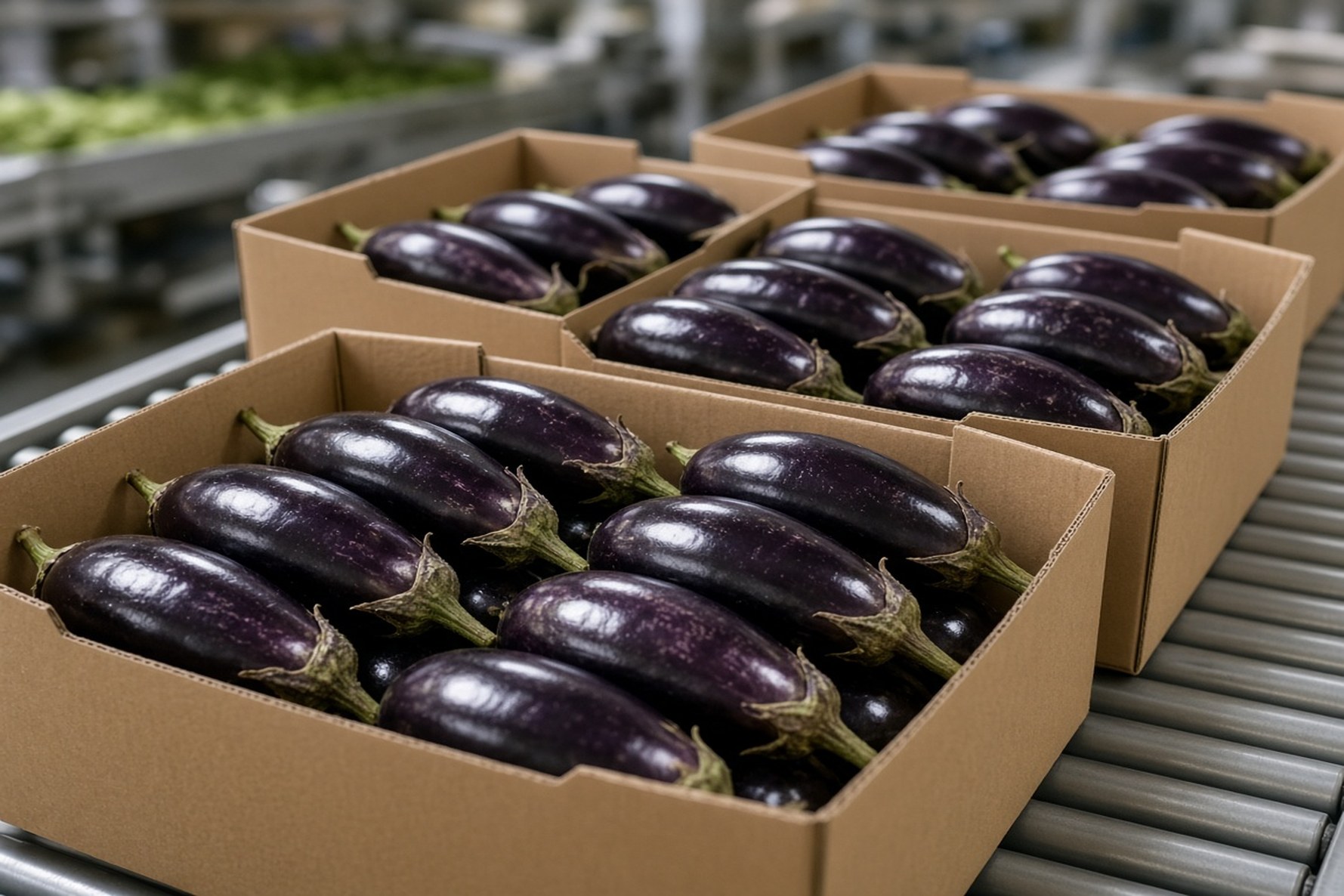
The label “export eggplant” is not a contract spec. Long dark-purple fruit with glossy skin and firm flesh fits many regional loads, but length, diameter and weight must match the destination channel.
Harvest before full over-maturity; fruit left too long on the plant loses gloss and firmness. Contracts should state shape, length, diameter, weight, colour, curvature and defect caps in measurable terms.
| Type | Trait | Typical use | Buying note |
|---|---|---|---|
| Long dark | Greater length, dark purple | Wholesale and general retail | Length and diameter uniformity |
| Slim pencil | Smaller diameter, elongated | Some stores and niches | Control breaks and bend |
| Round / oval | Shorter, wider | Different consumption habits | Weight grading weighs more |
| Sorted greenhouse | More uniform look | Retail programmes | Clear per-load specs |
3. Technical specs wholesale buyers expect
Vague quality causes disputes; specs must be measurable. Commercial standards size by diameter, weight or count per pack; higher classes need tighter uniformity.
- Commercial type and shape
- Acceptable skin colour
- Length or diameter range
- Unit weight range when required
- Acceptable bend percentage
- Allowed surface scratch
- Acceptable size spread in the pack
- Calyx and stem condition
- Minimum expected firmness
- Allowed defective units per carton
- Net weight per carton
- Stacking layout and approximate count per pack
- MRL testing required or not
- Loading and transport temperature
- Labelling and load traceability
4. Sorting and export quality control
Eggplant is pressure- and abrasion-sensitive; quality is won or lost at harvest, transfer to the sort line and packing. Skin, firmness, gloss, calyx and size mix must be checked.
| Defect | Commercial effect | Sort action |
|---|---|---|
| Deep surface scratch | Lower appeal | Segregate |
| Bruising | Fast breakdown | Remove from export |
| Wrinkling | Water loss | Downgrade or reject |
| Size mix | Irregular cartons | Re-size |
| Dry brown calyx | Looks less fresh | Segregate |
| Rot / soft flesh | Unacceptable | Reject |
| Chilling injury | Pitting, poor texture | Do not ship |
International Class I logic allows limited minor skin defects (e.g. about 3 cm² total in some standards) if overall appearance and shelf life remain acceptable — mirror that logic in your purchase sheet.
5. Iraq — the main volume market
Proximity and road haul make Iraq the natural bulk outlet. In 2024 reported fresh eggplant imports from Iran were about USD 13.6M and Iran covered nearly all recorded Iraqi imports of the item.
Competition is among Iranian suppliers: price, quality stability, regular delivery and destination shrink drive retention. Import permits and phytosanitary certificates are baseline documents; size, carton net weight, defect cap and delivery point must be fixed before final loading.
6. Azerbaijan and Kazakhstan
Azerbaijan imported about USD 5.35M of eggplant in 2024, over USD 5.11M from Iran (>95% share). Focus on long-term importer relationships, standardized sorting and lower load-to-load variation. Official requirements for HS 070930 include freedom from pests such as Spodoptera frugiperda and Tetranychus evansi.
Kazakhstan recorded about USD 4.08M total imports, over USD 3.04M from Iran (~75%). Distance demands firmer, cleaner fruit at loading; soft or pre-damaged fruit may collapse at destination. As an EAEU member, phytosanitary rules include Pepino mosaic virus (PepMV) freedom for fresh eggplant under 070930.
7. Qatar, Oman and the Gulf
Gulf markets reward sorted packs and retail-ready presentation but are more contested. Qatar imported about USD 2.8M in 2024, roughly USD 577k from Iran alongside Saudi Arabia, India, Lebanon and Jordan.
Oman sourced about USD 488k of ~USD 608k total from Iran. GCC food and plant import controls require health certificates, import permits and packing lists aligned with quarantine rules. Carton labels must match documents: product, origin, net weight and load code.
8. Suitable export packaging
Packs must stop pallet crush and skin abrasion. Cartons need vertical strength, adequate ventilation and orderly stacking; avoid heavy pressure on stems and calyx against neighbouring fruit.
| Channel | Pack priority | Practical choice |
|---|---|---|
| Traditional wholesale | Cost and strength | Sturdy economic carton |
| Retail chain | Uniformity and traceability | Printed carton or full label |
| Long road leg | Crush and airflow | Strong carton, tight layout |
| Premium market | Appearance protection | Extra layer, tighter sort |
| Consumer pack | Fixed weight and look | Final pack to buyer spec |
Some markets use ~5 kg cartons, but regional trade should fix net weight per buyer. Humidity, pallet pattern and cold-store time affect carton strength choice.
9. Cold chain
Typical holding is 10–12°C at 90–95% RH; quality usually holds for somewhat less than about two weeks. Below 10°C — especially near 5°C — chilling injury risk rises.
Rapid pre-cooling after harvest and shade at loading matter. Ethylene exposure can accelerate browning; mixed storage with high-ethylene fruit is poor practice. Temperature loggers help resolve disputes.
10. Export documents and requirements
Files include commercial invoice, packing list, certificate of origin, transport documents, customs declaration and phytosanitary certificate. Some destinations require import approval before the truck moves.
| Market | Main control | Pre-load action |
|---|---|---|
| Iraq | Permit and phytosanitary | Align with importer |
| Azerbaijan | Quarantine pests | Match certificate text |
| Kazakhstan | EAEU rules | Plant health and quarantine |
| Qatar | Food and plant control | Health and packing docs |
| Oman | Food import control | Certificate coordination |
| UAE | Quarantine and entry docs | Phytosanitary, origin, PL |
Costly mistake: packing first and asking entry rules later. Importers should send quarantine and certificate wording before harvest and final packing.
11. Pesticide residues and traceability
MRL results can accept or reject a load. Record farm or greenhouse, harvest date, packhouse and load code; mixing untraced sources raises risk.
- Active substances to test
- Accepted laboratory and sampling timing
- Report issuer and destination MRL limits
- Validity tied to the contracted shipment
12. How export eggplant price is formed
There is no single seasonal price. Quality, uniformity, size, season, volume, carton, sorting, tests, inland haul, export formalities, equipment, destination and Incoterms all move the number. Compare quotes only on one identical technical sheet and delivery point.
Importer checklist before ordering
Before bulk purchase from Iran, define:
- Exact commercial type and shape
- Acceptable length, diameter or unit weight range
- Colour and gloss with reference photos
- Allowed bend, scratch and visible defect rates
- Required stem and calyx condition
- Net carton weight and weight tolerance
- Carton type, strength and stacking method
- Cartons per pallet and pallet pattern
- Destination quarantine rules sent before harvest
- MRL test list when required
- Contracted loading and transport temperature
- Use of in-transit temperature loggers
- Photo or video after sort, before loading
- Invoice, origin and phytosanitary checked pre-departure
- Delivery point and border/freight cost allocation
- Destination quality dispute procedure in contract
- Time limit to report damage or mismatch
- Traceability to farm, greenhouse or packhouse
What to send for an accurate price
A message asking only “export eggplant price?” rarely yields comparable offers. Structure the RFQ.
- Destination city and volume per shipment
- Weekly or monthly purchase plan
- Shape, type and size range
- Quality level and defect cap
- Net carton weight and pack type
- Palletized or not; cold store and reefer need
- Requested tests and phytosanitary wording
- Label language and Incoterms
- Target first loading date
Iranco can turn these fields into a technical enquiry so suppliers prepare the right product from the start.
Eggplant supply and export with Iranco
Wholesale buyers need sorting, packing and loading aligned with export papers. Iranco starts from your technical sheet — destination, volume, type, size, quality, pack weight and delivery.
For repeat programmes, share weekly or monthly plans. Pre-harvest alignment, approved samples and acceptance criteria are part of fresh-produce risk management.
Summary
Iraq is the main volume market; Azerbaijan and Kazakhstan rely heavily on Iran; Oman shows a strong Iranian share while Qatar is more competitive. Market access does not guarantee margin — weak harvest, sort, pack or haul shows up as discounts at destination.
Hold 10–12°C at 90–95% RH and avoid chilling injury. Phytosanitary and MRL rules for Azerbaijan, EAEU and the Gulf are non-negotiable. Define product, pack, volume, destination and delivery before you ask for price.
Frequently asked questions
What is the HS code for fresh eggplant?
Fresh or chilled eggplant is traded under 070930. Confirm national tariff lines at destination when ordering.
Which are Iran’s main eggplant markets?
2024 data highlight Iraq, Azerbaijan and Kazakhstan; Oman and Qatar in the Gulf. Iran’s share is especially high in Azerbaijan, Kazakhstan and Oman.
What is the best transport temperature?
About 10–12°C; holding below 10°C risks chilling injury. RH around 90–95% limits shrivelling.
What defines good export eggplant?
Firm flesh, glossy skin, even colour and sound calyx; severe scratches, bruises, rot, softness and wide size mix should be capped in contract.
Which packaging works best?
Strong ventilated cartons and non-crush stacking; net weight per buyer. Long routes need cartons that survive cold-store stacking.
Is a phytosanitary certificate required?
For most import markets, yes; destinations may specify quarantine pests (e.g. Azerbaijan lists) or PepMV under EAEU rules.
Why is export price not fixed?
Season, sort level, carton, freight, tests and delivery terms differ; compare quotes only on identical specs.
What should a bulk buyer send?
Destination, volume, schedule, shape and size, quality, pack weight, transport, phytosanitary needs and delivery terms.
Is Iranian eggplant suitable for retail?
Yes, with tighter sorting, agreed packs and labels, MRL compliance and load-to-load consistency.
Featured Products






Related Articles



