 Iranco Magazine Team
Target market analysis, shipment technical specs, laboratory testing, packaging engineering and an operational guide to international procurement
Dried nut export · Market capacity · Technical specs · Lab QC
Iran Dried Nuts & Fruit Exports: Which Countries Have the Greatest Buying Capacity?
Target markets, shipment technical specs, laboratory tests, packaging engineering and an operational guide to international procurement for pistachios, raisins, dates, figs and almonds.
Introduction
Iranian dried nut exports are a pillar of non-oil trade. Taste heritage alone no longer wins deals — buyers demand mycotoxin, pesticide and heavy-metal guarantees before pricing talks. Success means data-driven trade from origin sorting to destination food law.
Iran’s global position in dried nuts & fruit
Climate, orchard heritage and product diversity give Iran a strong dried-fruit portfolio. Kerman, Khorasan, Fars, Azerbaijan and central provinces are core production zones.
In 2024 China, India, Turkey, the EU and Germany were major pistachio buyers; India, the EU, Pakistan, Turkey, Kazakhstan and Azerbaijan matter for dates. Export is not limited to neighbours.
Products with the strongest export potential
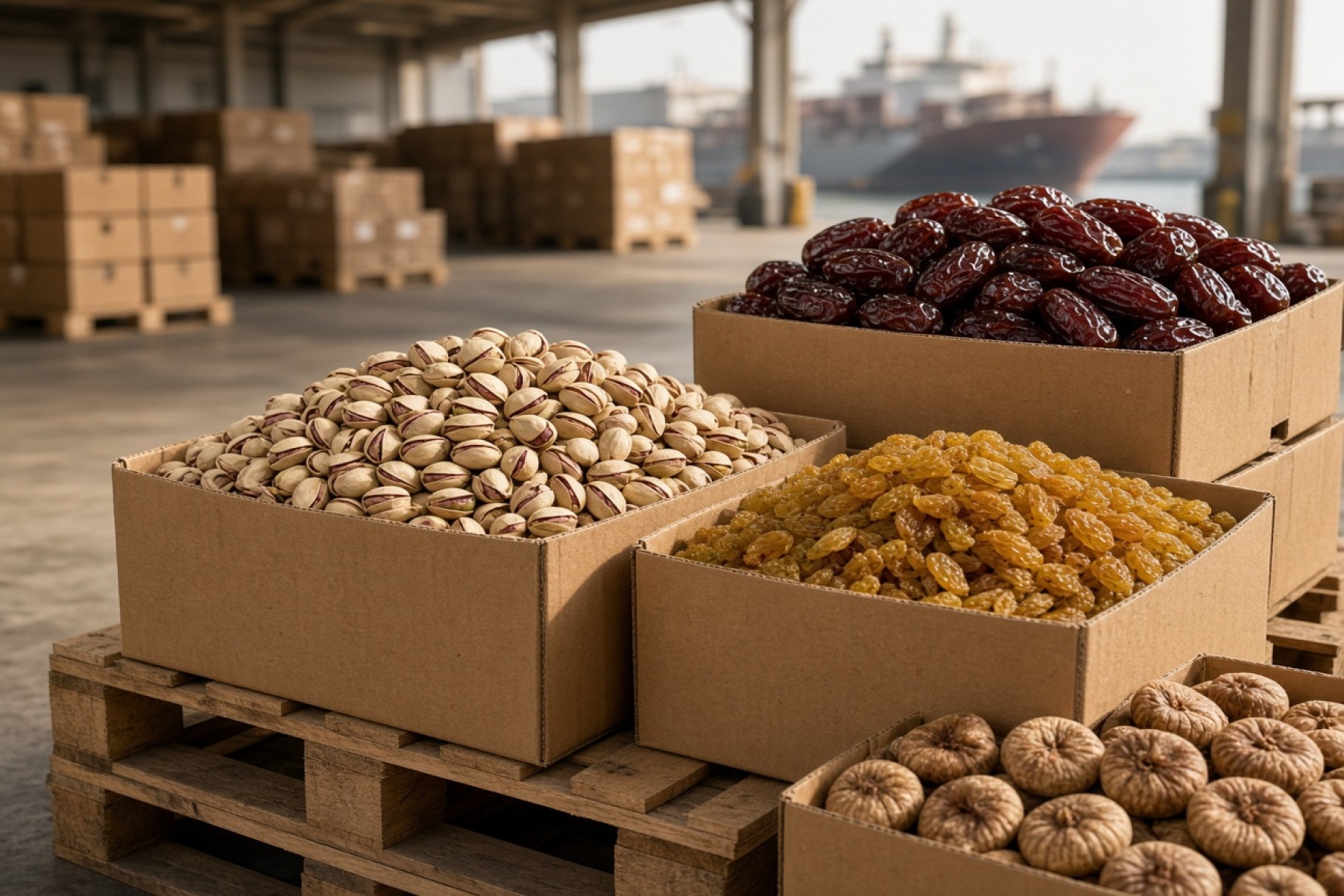
- In-shell and kernel pistachios
- Green, golden, sun-dried and processed raisins
- Dates — retail, industrial and packed grades
- Dried figs, almonds, walnuts, mulberries, apricot sheets
- Nut mixes, slivers and crushed kernels for food industry
- Bulk for confectionery plants and retail packs for stores
1. Production geography, harvest calendar and export corridors
Kerman, Khorasan, Yazd and Fars dominate pistachios and almonds; Azerbaijan and Qazvin for raisins; the south for dates; Estahban for tree-dried figs. Harvest timing allows delivery before global peaks such as Lunar New Year and Ramadan.
Shahid Rajaee port, Turkey/Caucasus land routes and Central Asian rail create transit options; premium markets still need accredited labs, optical sorting and regulatory alignment.
2. Commercial grades and physical indices
| Product | Grade | Sizing | Moisture | Key market |
|---|---|---|---|---|
| Pistachio | Fandoghi | 28–32 count/oz | <5% | China, Russia |
| Pistachio | Ahmad Aghaei | 24–28/oz | <5% | India, EU |
| Pistachio | Akbari | 20–24/oz | <5% | UAE, luxury |
| Raisin | Sultana | 300–380/100g | 13–15% | Russia, Germany |
| Date | Mazafati | 75–95/500g | 20–25% | Russia, India |
| Date | Piarom | 35–45/250g | 12–14% | France, Canada |
| Almond | Mamra 5A | 80–85/100g | <6% | India |
3. Buying power in destination markets
| Country | Value/volume | Top SKUs | Regulator |
|---|---|---|---|
| China | $268M+ pistachio | Fandoghi, Ahmad Aghaei, fig | GB 2761, customs 248 |
| India | $180M+ pistachio/almond | Mamra, Ahmad Aghaei, Mazafati | FSSAI |
| Germany | $76M+ pistachio | Green kernel, sultana | EU 2023/915 |
| Russia | $60M+ date/raisin | Mazafati, sultana | TR CU 021/2011 |
| UAE | $84M+ dried goods | Akbari, Piarom | GSO |
| Turkey | $130M+ pistachio | Closed shell, slivers | Turkish food code |
1. India — volume market for pistachio and dates
India is among the world’s largest consumers of nuts and dried fruit. 2024 trade shows 20k+ t pistachios ($123M+) and 105k+ t dates.
Competitive pistachios, kernels, industrial dates, raisins and bakery inputs fit well. Final landed price matters; selling to importers and food manufacturers is often easier than direct retail entry.
2. China — pistachios and edible kernels
China imported 40k+ t Iranian pistachios (~$268M+) in 2024. Demand spans gifting, e-commerce, chains and food industry.
Size uniformity, cleanliness, colour and professional packing move price. Serious entry needs a stable importer partnership, not spot deals only.
3. UAE — consumption and re-export
Dubai is a regional food trade hub; much cargo is stored, repacked or consolidated for other destinations.
Short sea links from southern Iran, strong wholesale networks and premium gift/retail packs add value beyond bulk.
4. Russia — raisins, dates and packed snacks
Caspian and land routes plus a large consumer base create opportunity.
Appearance, labelling, reliable supply and on-time delivery matter — not only the cheapest quote.
5. Germany & Europe — standards and value-add
Germany is a major nut and dried-fruit market; direct Iranian pistachio imports exceeded $76M in 2024.
Aflatoxin, pesticide residues, traceability and food-grade packing are entry gates. Professional exporters can outperform informal traders.
6–10. Turkey, Iraq, Central Asia, GCC and Netherlands
| Market | High-potential products | Trait | Sales approach |
|---|---|---|---|
| India | Pistachio, dates, raisins | Huge, price-sensitive | Bulk & industrial |
| China | Pistachio, kernels | Volume & appearance | Large importer |
| UAE | Pistachio, dates, dried fruit | Consume + redistribute | Bulk & premium |
| Russia | Raisins, dates | Large regional market | Steady supply |
| Germany | Pistachio, dates | Strict standards | Traceable product |
| Turkey | Pistachio, dates | Retail & industry | Wholesale |
| Iraq | Mixed dried goods | Proximity | Wholesale & retail |
| Kazakhstan | Dates, raisins | Growing | Wholesale |
| GCC | Dates, premium pistachio | High purchasing power | Luxury pack |
| Netherlands | Dried fruit, kernels | EU hub | Importer-led |
Turkey is both producer and buyer ($129M+ pistachio imports in 2024). Iraq allows lower-volume starts. Kazakhstan imported $10M+ Iranian dates in 2024.
Saudi Arabia, Oman, Qatar and Kuwait suit premium and gift packs. The Netherlands is both consumption and EU redistribution.
4. Contract technical parameters
| Parameter | Range | Why it matters |
|---|---|---|
| Pistachio count | 20–22 to 30–32/oz | Price band |
| Natural split | 95–98% | Oxidation risk |
| Kernel moisture | <5–6% | Aflatoxin control |
| Raisin moisture | 13–16% | Sugar bloom |
| SO₂ in raisins | 1500–2000 ppm max | EU clearance |
| Closed shell | 1–2% max | Retail appearance |
5. QC: natural split vs water-split pistachios
- Spring test: natural split shells do not fully re-close after finger pressure.
- Kernel fill: water-split lots show shrunken kernels inside oversized shells.
- Shelf life: water infiltration accelerates rancidity within weeks.
- Seal a witness sample with COA and inspect every pallet before loading.
6. Laboratories, standards and contaminants
EU 2023/915 caps aflatoxin B1 at 8 µg/kg for tree nuts (10 µg/kg total). China GB 2761: 5 µg/kg B1. Raisins: ochratoxin A max 2 µg/kg in the EU.
LC-MS/MS and GC-MS/MS for MRLs; HPLC-FLD for aflatoxins; Salmonella negative in 25 g; lead and cadmium per destination.
7. HS codes and clearance documents
- In-shell pistachio: 080251 — kernel: 080252
- Dates: 080410 — dried fig: 080420
- Sultana raisin: 08062030 — other raisins: 080620
- In-shell almond: 080211 — kernel: 080212
- Phytosanitary, health certificate, fumigation, COA, origin, B/L, Incoterms invoice, China registration 248
8. Packaging engineering and palletisation
Bulk: 5-ply kraft cartons with PE liner; premium kernels: vacuum MAP with nitrogen. Retail: stand-up pouches with aluminium foil; Mazafati in 500–700 g telescopic boxes.
ISPM 15 or plastic pallets, strapping and stretch wrap; phosphine fumigation before loading. Buyers can file pack specs via Iranco.
9. Logistics, cold chain and container sweat
Bandar Abbas–China 20–28 days; Nhava Sheva 7–10 days; Jebel Ali 1–2 days. Mazafati: reefer −3 to +2°C. Summer pistachio/raisin moves: 10–15°C and RH <60%.
Fight container sweat with <5% product moisture, kraft lining and calcium-chloride desiccant hooks. Astara–Moscow 5–8 days refrigerated; Bazargan–Istanbul 4–7 days.
10. Pricing, competitors and industrial use
Price follows count, season, natural split share, aflatoxin testing cost and Incoterms (FOB Bandar Abbas vs CIF). Competitors: California pistachios, Turkish raisins, Tunisian dates.
Chocolate, ice cream, bakery and date-syrup applications consume pistachio slivers, sultanas and industrial Zahidi dates.
12-point importer checklist
- Cultivar and crop year; count or berries/100 g; moisture caps
- Aflatoxin and SO₂ limits per destination
- Closed-shell and defect tolerances
- Sealed sample + COA; pack spec and MAP
- Independent pre-loading survey; container type and desiccants
- Full customs dossier; Incoterms and payment tied to inspection certificate
Choosing markets and common mistakes
- Import volume, Iran purchase history, average market price
- Import rules vs your QC capability
- Freight cost, customer type (factory, wholesaler, chain)
- Payment terms and repeat business potential
- Mistake: buying stock before securing the buyer — define market and spec first
- Pricing without shrink, sort, pack, tests and freight turns profit on paper into loss
Which product for which country?
Pistachio: China & India for volume; EU for health and uniformity; GCC for gift grades.
Dates: India, Pakistan, Central Asia, Iraq and GCC; value-add via washing, pitting and packing.
Raisins: Russia, Central Asia, EU — colour, moisture and uniformity drive contracts.
Dried figs and specialty fruit: health-positioned markets with small packs often yield better margins.
Volume markets vs premium margin markets
Volume: large orders, price pressure, simple packs, lower per-kg margin, faster turnover.
Premium: appearance, hygiene standards, branding, traceability and retail with higher margin.
A dual model — bulk for volume plus premium SKUs for EU/GCC — suits larger exporters.
Eight export steps from sourcing to delivery
- 1. Pick market and SKU before buying
- 2. Lock buyer spec (size, moisture, pack)
- 3. Source from reliable suppliers with stable quality
- 4. Cleaning, grading and uniformity
- 5. Testing (aflatoxin, residues, microbiology)
- 6. Packing suited to mode of transport
- 7. Export documentation aligned with the lot
- 8. International carriage with moisture and stack control
Documents, pricing and finding buyers
Invoice, packing list, certificate of origin, transport docs, health/lab certificates and PO must match the shipment before loading.
Price = purchase + cleaning + shrink + sort + pack + tests + warehouse + inland haul + customs + ocean/air + insurance + finance + margin.
Key buyers: food importers, wholesalers, confectionery plants, private-label packers and sometimes chains. Samples must represent the actual lot.
Supply stability, harvest timing and starter markets
Professional buyers prefer reliable supply on time over a one-off cheap quote.
Harvest-season buying with proper storage helps; poor storage ruins high-fat kernels.
Iraq, UAE, Oman and Central Asia are practical starts; EU entry when QC and docs are mature.
FAQ
Best pistachio grade for luxury markets?
Akbari (super long) for GCC gifting; Ahmad Aghaei for India/EU with better price balance.
How is export price built?
Count, natural split, moisture, aflatoxin testing, packing and Incoterms — harvest timing matters.
Shelf life and storage?
Pistachio/almond <5% moisture: 12–24 months cool store; Mazafati needs cold chain; vacuum/nitrogen slows oxidation.
Best pack for EU pistachio kernels?
Vacuum MAP with nitrogen in 10–12.5 kg export cartons.
Reefer temperature at sea?
Mazafati: −3 to +2°C; pistachio/raisin on hot lanes: 10–15°C plus desiccants.
Mandatory EU tests?
Aflatoxin B1/total, raisin ochratoxin A, MRLs, SO₂, microbiology and heavy metals with accredited COA.
Buying direct from Iran?
Technical spec, sealed sample, matching COA, customs files and pre-loading survey — request via Iranco.
RFQ information needed?
Grade, count, moisture, defect tolerance, pack, mycotoxin cap, tonnage, Incoterms and discharge port.
Summary
Sustainable success ties numeric contract specs, moisture and aflatoxin control, MAP packing and reliable cold chain to customs knowledge. China and India absorb volume pistachios and Mamra almonds; the EU gates COA-heavy lots; Russia and EAEU remain strategic for Mazafati and industrial raisins. Combining these pillars stabilises Iran’s share in global dried-nut trade beyond seasonal swings.
Featured Products












Related Articles



