 Iranco Magazine Team
Comprehensive guide to export market analysis, technical specifications and quality standards, packaging engineering and international sales development
Dried fruit export · Markets · Packaging · Quality
Iran Dried Fruit Exports: Target Markets, Packaging and Sales Growth
Export market analysis, technical specs, quality standards, packaging engineering and international sales development — Iranco Magazine.
Introduction
Iranian dried fruit exports are among the highest-value segments of agro-processing, backed by orchard diversity, natural Brix and modern drying lines.
Moving from bulk to coded specs, COA, MAP and reefer logistics is essential for Russia, the Gulf and the EU — not optional extras.
1. Production geography and global position
East Azerbaijan (Tabriz, Maragheh, Shabestar) leads industrial apricot, plum and peach drying; West Azerbaijan apples; Qazvin/Hamedan grapes and apricots; Khorasan prunes; Fars (Estahban) rain-fed figs.
Stone fruit runs June–September; apple and persimmon extend through winter cold storage. Active markets: Russia, EAEU, Iraq, UAE, Pakistan, Turkey; high-margin potential in Central Europe, UK and East Asia.
2. Product taxonomy and technical traits
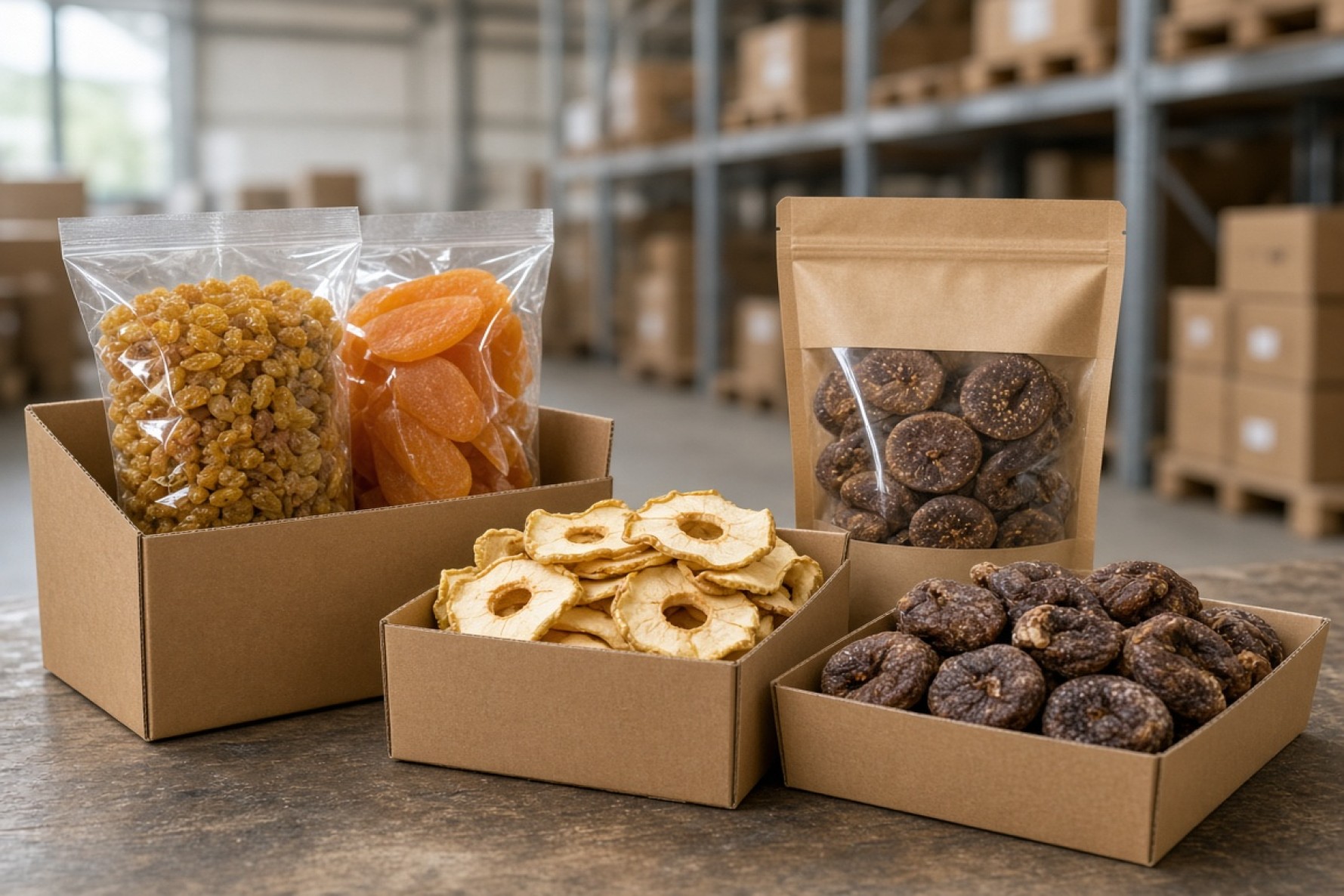
Sulfured golden apricot for Russia/Gulf; unsulfured natural for EU organic. Ring and cube apple with enzymatic browning control. Prunes and slips with size uniformity. Freeze-dried at 2–4% moisture for premium snacks.
| Type | Process | Moisture % | aw | Form | Use |
|---|---|---|---|---|---|
| Sulfured apricot | SO₂ + heat | 18–24 | 0.55–0.65 | Whole | Snacking / premium |
| Natural apricot | Sun | 15–20 | 0.50–0.60 | Whole | Organic / EU |
| Apple rings | Tunnel air | 10–18 | 0.50–0.60 | Slice | Snacks |
| Prune | Steam + oven | 18–24 | 0.50–0.60 | Pitted | Cooking |
| Peach/plum | Hot air | 14–20 | 0.55–0.65 | Sheet | Cereal / HORECA |
| Persimmon | Heat | 12–16 | 0.50–0.58 | Ring | East Asia |
| Freeze-dried | Vacuum | 2–4 | <0.20 | Pieces | Chocolate / granola |
3. Buyer specifications and contract indices
Missing numeric limits in purchase orders drives most destination disputes. Submit your spec via Iranco for matched supply options.
| Parameter | Range | Method | Priority |
|---|---|---|---|
| Moisture | 12–22% | AOAC 934.06 | Critical |
| Water activity | <0.60 | Chilled mirror | Critical |
| SO₂ | 0–2000 mg/kg | AOAC 990.28 | Critical |
| Slice thickness | 3–6 mm | Caliper | High |
| Foreign matter | Zero metal | Metal detector | Critical |
| Burn / discolor | <2% | Witness lot | High |
| Pesticide MRL | Destination law | LC-MS/MS | Critical |
4. Quality grading, defects and spoilage
Sugar bloom, Maillard darkening, clumping and mould above aw 0.65. Grade one: pliable, clean colour, no sulfurous off-notes.
| Defect | Cause | Grade 1 | Industrial | Impact |
|---|---|---|---|---|
| Pits/hard | Pitter | 1/10 kg | 5/10 kg | Claims |
| Mould | High moisture | Zero | 0.5% | Destruction |
| Dust | Open drying | <0.05% | <0.1% | Customs reject |
| Size drift | Blades | <5% | <15% | Pack line |
| Edge burn | Oven temp | <1% | <3% | Bitter taste |
5. Laboratory testing and COA
Moisture AOAC 934.06; SO₂ Monier-Williams AOAC 990.28. EU aflatoxin B₁ max 2 µg/kg, total 4 µg/kg.
Micro sampling ISO 2859-1: APC <10⁴/g, coliforms <10/g, Salmonella negative in 25 g.
6. Target export markets
EAEU under TR CU 021/2011 and 022/2011; Gulf GSO and halal; EU no-SO₂ and MRL; India FSSAI volume; East Asia freeze-dried uniform cuts.
| Region | SKUs | Rules | Pack | Price sens. | Iran edge |
|---|---|---|---|---|---|
| Russia/EAEU | Apricot, apple, mix | TR CU 021/2011 | 5–10 kg carton | Medium | Transit |
| Gulf | Premium apricot | GSO 9, 2233 | Vacuum/zip | Low | Flavour |
| EU | No SO₂ | MRL, traceability | Multilayer | Low | Natural Brix |
| India | Raisin, prune | FSSAI | 10–20 kg | High | Volume |
7. HS codes and documentation
Added sugar can reclassify to Chapter 20 (2008) with different duty. Phytosanitary, origin, invoice/packing list, health certificate, ISO 22000/HACCP.
| Product | Code |
|---|---|
| Dried apricot | 081310 |
| Dried prune | 081320 |
| Dried apple | 081330 |
| Other dried fruit | 081340 |
| Mix | 081350 |
| Raisins | 080620 |
| Fig/date | 080420 / 080410 |
8. Export packaging and MAP
Five-ply cartons, PE liner, PA/PE vacuum. MAP with >99.5% N₂ and <1% O₂ for up to 18 months. ISPM 15 pallets, edge boards and stretch wrap.
| Format | Materials | Weight | Benefit | Channel |
|---|---|---|---|---|
| Bulk carton | 5-ply + PE liner | 5–12.5 kg | Crush resistance | B2B |
| Vacuum | PA/PE | 2.5–5 kg | Low O₂ | Soft fruit |
| Zip pouch | Metallised | 100–500 g | Light/O₂ barrier | Retail |
| MAP | Barrier + N₂ | 150–400 g | 18-month shelf | Premium |
9. Logistics, reefer and container rain
Dew-point rain on long warm-to-cool sea legs — CaCl₂ blankets and thermal liners. Reefer 10–15 °C, RH 50–60%, low ventilation 15–25 m³/h. Dry box only for short lanes below ~18 °C ambient.
| Mode | Lane | Time | Control | Risk |
|---|---|---|---|---|
| Reefer road | Astara–Moscow | 5–12 d | 12 °C | Border queue |
| FCL sea | Bandar–Gulf/India | 4–25 d | Reefer + desiccant | Container rain |
| Rail | Sarakhs–Russia | 10–18 d | Insulated wagon | Day/night swing |
| Air | IKA–EU/Gulf | 1–2 d | ULD | Cost |
10. Global competitors and Iran strategy
Turkey leads apricot with EU systems; Iran competes on Brix and price in mid-tier markets. Chile/US uniform but distant logistics. Uzbekistan/China on price; Iran on flavour and seasonal breadth.
| Country | Lines | Strength | Weakness | Price |
|---|---|---|---|---|
| Turkey | Apricot, fig | EU compliance | Energy cost | High |
| Chile | Prune, raisin | Uniform size | Distance | High |
| Uzbekistan | Apricot, raisin | EAEU tariff | Sorting | Low–mid |
| China | Diced apple | Scale | Residue concerns | Low |
| Iran | Apricot, plum, apple | Brix, taste | Retail branding | Competitive |
11. Industrial uses
Bakery and chocolate: controlled rehydration; <12–14% moisture to avoid chocolate bloom.
Cereal and energy bars: free-flowing dice; freeze-dried for yogurt and muesli.
Tea and dairy: unsulfured apple, citrus peel, berry; strict micro specs.
12. Pricing and Incoterms
6–10 kg fresh fruit per 1 kg dried; oven and freeze-dry energy; optical sort; accredited COA and phytosanitary fees; EXW vs FOB vs CPT vs CIF spreads.
Register structured purchase requests through Iranco.
Importer checklist
- Fruit type, drying method and cut shape
- Contract moisture cap and aw <0.60
- SO₂ per destination customs
- Burn, breakage and defect tolerances
- Sealed witness sample from current line
- Accredited lab and COA scope
- 5-ply carton, liner, ISPM 15 pallet
- Reefer 10–15 °C and container desiccants
- Label and nutrition table per market
- Payment conditional on loading survey
RFQ fields for accurate quotation
- Product name and grade
- Sulfured vs natural SO₂ ceiling
- Target moisture and texture
- Pack format: bulk, zip or vacuum
- Lot size and annual programme
- Country, port or border
- Incoterms (FOB Bandar Abbas, CPT Moscow, etc.)
- Certificates: phytosanitary, halal, aflatoxin
FAQ
Sulfured vs natural dried fruit?
Sulfured: stable colour, 18–24 month shelf; natural: amber brown, 6–12 months, premium in EU organic.
EU SO₂ limits?
Apricot and raisin up to 2000 mg/kg; others often 500–1000; allergen label above 10 mg/kg.
Moisture for container transit?
Heat-dried 15–24%; above 22% raises souring risk; freeze-dried 2–4%.
Main price drivers?
Fresh fruit cost, 6–10:1 yield, energy, sorting, tests and packaging.
Prevent quality loss at sea?
Reefer 10–15 °C, RH <60%, CaCl₂ desiccants, carton liners.
Typical MOQ?
From one pallet (~500–700 kg) to a 20 ft FCL (~12–14 t).
Source from Iran?
Submit full technical specs via Iranco.
What to send for pricing?
SKU, grade, SO₂ status, moisture, pack, tonnage and Incoterms.
Analytical summary
Iranian dried fruit trade is shifting from anonymous bulk to engineered SKUs with food-safety proof. Climate and Brix remain durable advantages; EU, EAEU and Gulf growth depends on COA-backed contracts, MAP retail packs and reefer discipline including container-rain control.
Featured Products


Related Articles



