 Iranco Magazine Team
From market and product specs to quality control, packaging, refrigerated haul, veterinary documents and regional market entry rules
EXPORT GUIDE · DAIRY · COLD CHAIN · REGIONAL MARKETS
Iranian Dairy Exports: Target Markets, Cold Chain and Sanitary Requirements
From market selection and product specs to QC, refrigerated haul, veterinary documents and entry rules for Iraq, Pakistan, Afghanistan, the UAE and Russia
Introduction
Iranian dairy export now spans milk powder, cheese, butter, milk, cream, yogurt, doogh and more. Professional buyers weigh composition, micro load, aflatoxin M1, shelf life, haul conditions, plant credibility and health paperwork — not price alone.
Large plants, UHT lines, powder dryers and cold storage plus decades of neighbour trade allow many pack formats. Dry powder ships without refrigeration; fresh cheese, cream and pasteurized milk need continuous temperature control. Aseptic UHT is usually ambient until opening.
Safety starts upstream: feed, veterinary drugs, aflatoxin M1, pasteurization and filling hygiene. Codex treats time–temperature control in distribution as a core tool against microbial risk in perishable dairy.
The professional question is which SKU, from which plant, with which shelf life, documents and route enters the destination with lowest risk.
1. Position of Iranian dairy exports and market structure
The export basket is mixed: powder, cheese, butter and fermented lines differ in logistics cost and regulation. In the eleven months to late February 2025, Iran exported over 587,000 tonnes of dairy worth about USD 948.9 million — volume up 19% and value 43%. Milk powder accounted for about USD 366.7 million and cheese about USD 146.2 million.
Longer shelf life opens farther markets; yogurt, doogh and fresh cheese depend on haul distance and cold-chain quality. Iran’s geography gives land routes to Iraq, Pakistan and Afghanistan and short sea links to the Gulf.
2026 research on Iranian dairy trade shows distance remains a significant trade barrier, with Iraq, Afghanistan and Pakistan among the highest-efficiency destinations.
2. Which Iranian dairy products export best?
Product choice must match the destination. Long routes favour dry, shelf-stable goods; nearby markets with strong refrigeration allow a wider range.
| Group | Export trait | Cold chain | Main buyer |
|---|---|---|---|
| Skim / whole milk powder | Long shelf life, easier haul | No (dry storage) | Food & dairy industry |
| UHT milk | Aseptic pack | Usually no until opened | Retail & distributors |
| Ripened / stable cheese | Added value | Usually yes | Wholesale |
| Fresh cheese | Time- and temperature-sensitive | Yes | Nearby markets |
| Yogurt & doogh | Fast turnover | Yes | Retail & food service |
| Cream | Highly perishable | Yes | Retail & industry |
| Butter | High value per kg | Often yes | Retail & industry |
| Whey powder | Industrial ingredient | No (moisture control) | Formulation plants |
Milk powder
Logical for long-haul export: no reefer, high density, use in chocolate, ice cream and milk recombination. Codex CXS 207-1999 sets a 5% maximum moisture for many powder grades.
Cheese
“Export cheese” is not a specification — type, fat, moisture, salt, ripening and pack must be defined. Codex uses moisture and fat-in-dry-matter for classification.
Fermented products
Yogurt and doogh suit near markets; microbial activity, acidity, swelling and container strength need pre-shipment review.
3. Target countries for Iranian dairy exports
| Market | Position | Better SKUs | Entry focus |
|---|---|---|---|
| Iraq | Core nearby market | Broad dairy basket | Delivery speed & distribution |
| Pakistan | Large regional market | Stable & industrial lines | Price & technical specs |
| Afghanistan | Land access | UHT, powder, shelf-stable | Pack integrity & distribution |
| UAE | Structured, competitive | Packed & industrial SKUs | Product registration & Arabic label |
| Russia | Large, regulatory | Butter, powder, approved plants | Plant listing & EAEU rules |
Iraq
Largest destination; short haul and familiar Iranian brands. Importers need steady supply, consistent taste and adequate remaining shelf life. For chilled loads, factory-to-border time and border dwell must be planned.
Pakistan
About 18% of 2023–2025 export volume. Industrial powder and stable lines logistically outperform fresh dairy; industrial buyers focus on fat, protein, moisture and batch consistency.
Afghanistan
Land haul and cultural proximity; UHT and dry goods suit multi-leg routes. If chilled product is shipped, temperature responsibility to the importer warehouse must be contractually clear.
United Arab Emirates
Product registration, Arabic labelling and federal food rules are mandatory. SKUs should be destination-designed before final production — formula, claims, nutrition and shelf life.
Russia
TR CU 033/2013 on milk safety plus EAEU labelling; veterinary approval and plant listing are prerequisites for sustainable entry.
4. Technical specifications buyers expect
Quoting without specs is a common failure mode. Phrases like “export quality” are not measurable — numbers and test methods belong in the contract annex.
| Product | Parameters | Why it matters |
|---|---|---|
| Milk powder | Fat, protein, moisture, solubility, micro, pack weight | Industrial use |
| UHT milk | Fat, protein, pack size, shelf life | Consumer segment & price |
| Yogurt | Fat, solids, pH, texture, weight | Stability |
| Doogh | Fat, salt, acidity, still/sparkling | Market fit |
| Cheese | Moisture, FDM, salt, ripening, weight | Texture & shelf life |
| Butter | Fat, moisture, salt, pack | Commercial grade |
| Cream | Fat, heat treatment, shelf life | Retail or industrial |
| Whey powder | Protein, lactose, ash, moisture | Formulation |
Approved samples must tie to batch and COA; disputes rise when moisture, fat or salt were never written down.
5. Quality control, aflatoxin M1, micro and pasteurization
Safety starts on farm: feed, animal health, milking, cooling and filling hygiene.
Aflatoxin M1
Codex CXS 193-1995 caps aflatoxin M1 in milk at 0.5 µg/kg; concentrate/dry forms need concentration factors applied. Some destinations are stricter.
Microbiology & HACCP
Total count, coliforms and pathogens matter in ready-to-drink milk. UAE import rules expect HACCP or equivalent at the producing establishment.
Pasteurization
Codex reference: 72°C for 15 seconds (HTST continuous) or 63°C for 30 minutes (batch). The word “pasteurized” on the label is not proof without process validation.
Typical shipment tests
- Composition, fat, protein, moisture, pH, salt
- Microbiology and aflatoxin M1
- Veterinary drug residues when required
- For powder: solubility, scorched particles, functional performance
6. Health certificates — UAE, EAEU and regional markets
Documents should be agreed before commercial production: veterinary/health certificate, origin, invoice, packing list, transport document and agreed COA.
UAE
Health certificates for milk and dairy stress fitness for human consumption, origin herd health, official plant supervision and veterinary drug MRL compliance.
Russia & EAEU
Food safety, dairy-specific technical rules and labelling apply together; the producing plant often must appear on an approved list.
Iraq, Afghanistan & Pakistan
One document template does not fit all — labels, dates and certificates must match importer practice. Private-label artwork must be approved before mass print.
7. Cold chain, temperature logging and pre-cooling
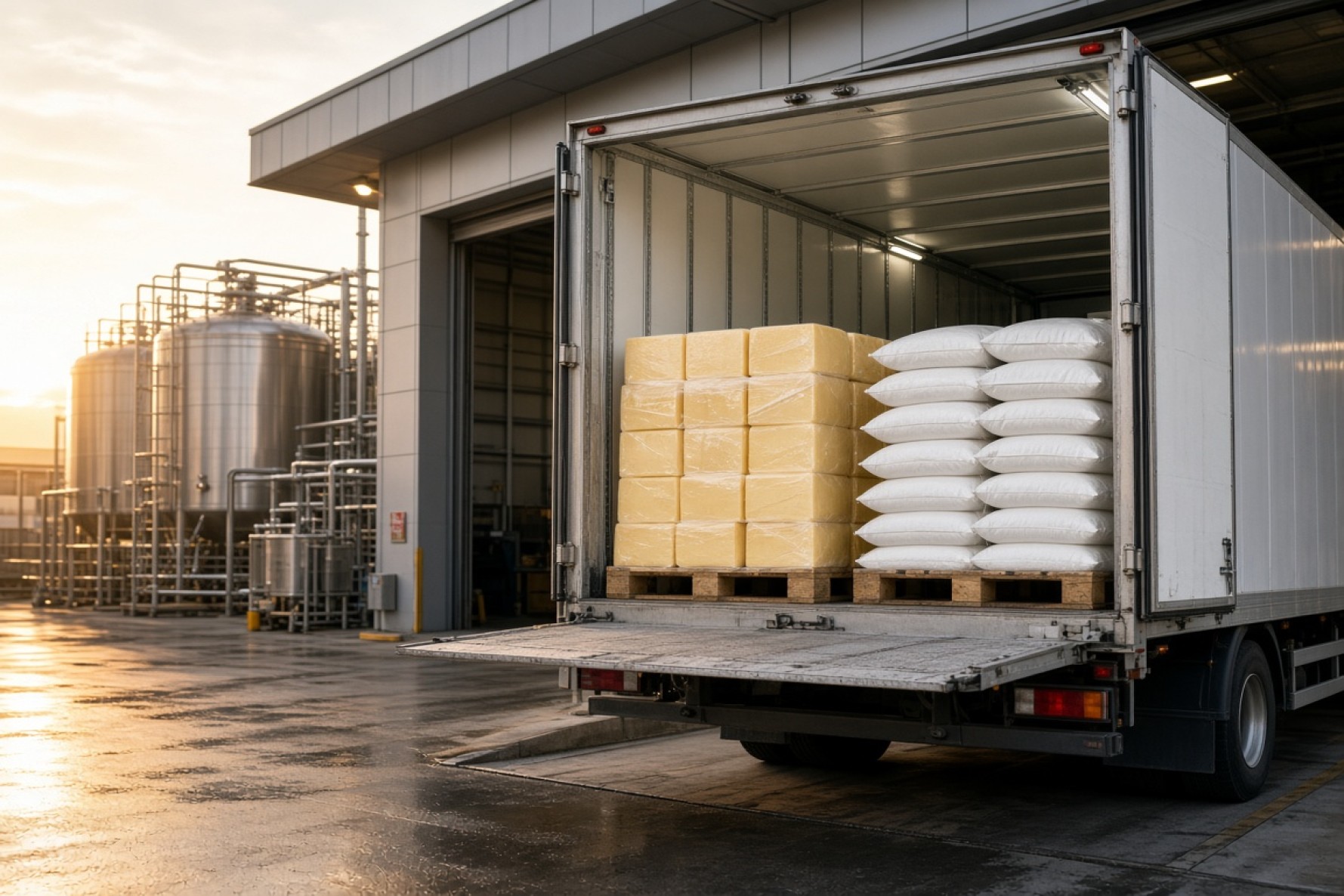
Cold chain spans exit from the line through loading, border, importer warehouse and distribution — not “a reefer truck” alone.
| Product | Temperature regime | Primary risk |
|---|---|---|
| Pasteurized milk | Chilled | Microbial growth |
| Yogurt & doogh | Chilled | Package swelling, texture change |
| Fresh cheese | Chilled | Spoilage |
| Cream | Chilled | Rapid spoilage |
| Butter | Cool/chilled per spec | Oxidation |
| Packed UHT | Controlled ambient | Heat & pack damage |
| Milk powder | Dry, low humidity | Caking |
| Ice cream | Frozen ≤ −18°C | Melt–refreeze |
Abu Dhabi operational rules cite cold food below 5°C and frozen below −18°C — validate against your SKU and destination contract, do not copy blindly to every country.
Temperature logging
Data loggers settle disputes cheaply; loggers should sit in warm zones of the load, not only at the refrigeration unit outlet.
Pre-cooling
Reefers are not blast chillers — product must reach target temperature before loading, with airflow paths kept open in the stack.
8. Export packaging and labelling
Packaging must protect the product and match how the destination market sells it.
Milk powder
Multi-layer 20–25 kg bags are common; in standard sea containers, floor moisture and condensation control are critical.
UHT milk
Aseptic layer integrity matters — corner impacts on Tetra Pak can shorten shelf life without obvious leaks at loading.
Yogurt, doogh & cheese
Containers must survive vibration; swelling on fermented packs signals control issues. Labels need name, ingredients, net weight, origin, dates, storage and nutrition — Arabic is legally required in the UAE.
9. HS codes and document alignment
Dairy sits mainly in HS Chapter 04; ice cream is classified under 2105. Six-digit codes depend on fat, form and packaging.
| HS Code | Group |
|---|---|
| 0401 | Milk & cream, not concentrated |
| 0402 | Concentrated milk / powder |
| 0403 | Yogurt, buttermilk, fermented |
| 0404 | Whey & natural milk constituents |
| 0405 | Butter & dairy fats |
| 0406 | Cheese & curd |
Net weights on invoice, packing list, labels and customs declaration — and batch numbers on health certificates — must match the physical load.
10. Logistics, export pricing and RFQ information
The cheapest lane is not always lowest landed cost if shelf life or cold integrity fails.
Road freight
Iraq, Afghanistan, Pakistan: refrigerated trucks; define where temperature responsibility transfers.
Sea and air
Gulf destinations: powder and UHT in dry or controlled ambient containers; reefer needs port power and fast inland pull. Air suits high-value, time-critical chilled SKUs.
- Price builds from raw milk through processing, pack, testing, certificates and freight
- Milk powder fat percentage drives most price spreads
- Professional RFQs state product name, composition, volume, pack, destination, Incoterms and required tests
- “One container of milk powder” without fat/protein/use case is not comparable
11. Importer checklist (18 points)
- Define exact product name and end use.
- Fix fat, protein, moisture, salt and related indices.
- Obtain and approve a sample at production spec.
- Review COA for sample or trial batch.
- Agree destination micro and aflatoxin tests.
- Confirm acceptable health certificate before production.
- Verify plant approval status where lists apply.
- Approve label language and text before print.
- Set pack weight, units per case and pallet pattern.
- Contract minimum remaining shelf life at delivery.
- Define haul temperature band for chilled/frozen SKUs.
- Require data loggers on sensitive loads when needed.
- Clarify delivery terms and responsibility transfer point.
- Plan production, prep and transit time in advance.
- Write numeric accept/reject criteria in the contract.
- Confirm batch traceability.
- Approve final pack artwork before bulk run.
- Reconcile invoice, packing list, origin and health papers before dispatch.
Most dairy disputes happen when specs were agreed verbally but never measurable in the contract.
12. Supply path from Iranian producers — Iranco
Compare offers only on identical specifications. Build a purchase brief: product, composition, volume, pack, destination, haul mode, shelf life and tests.
The Iranco B2B portal at iranco.com accepts RFQs with dairy SKU, technical spec, quantity, pack type, private-label need and destination so Iranian supply options are screened on the same basis. For temperature-sensitive loads, specify vehicle type and temperature range upfront.
Frequently asked questions
Which countries buy the most Iranian dairy?
Iraq is the primary market; Pakistan, Afghanistan and the UAE are also major. Russia matters for butter, powder and approved plants. Product type and sanitary compliance determine the best fit.
Which dairy SKU suits long-distance export?
Milk powder and other dry lines avoid reefer dependency. Aseptic UHT is more flexible than pasteurized milk. Fresh and fermented products need a tight cold chain.
At what temperature should exported dairy travel?
It depends on SKU, validated shelf life and destination rules. Gulf markets often use below 5°C for chilled food and −18°C or colder for frozen.
Which laboratory tests matter most?
Composition, fat, protein, moisture, pH, micro counts and aflatoxin M1. Powder buyers add solubility and functional tests. Align the panel with product and destination law.
Why is aflatoxin M1 control critical?
It enters milk from contaminated feed and is not fully removed by normal processing. Codex sets 0.5 µg/kg in milk; some buyers demand lower.
Does UHT milk need a refrigerated container?
Properly aseptic UHT in intact packs is usually ambient before opening — but protect from heat, humidity and physical pack damage.
What is needed for an Iranian milk powder quote?
Powder type, fat, protein, moisture, micro spec, pack weight, volume, end use, destination and delivery terms.
How to source dairy from Iranian manufacturers?
Fix specs, volume, pack, destination and haul; then review samples, COA and plant documents. International buyers can submit the same data through an Iranco RFQ.
Summary
Iranian dairy export works best when product, market and logistics are planned together. Iraq, Pakistan and Afghanistan offer established flows; the UAE demands registration and Arabic labels; Russia requires EAEU compliance and plant approval.
Powder and shelf-stable lines reach farther markets; pasteurized milk, yogurt, doogh, cream and fresh cheese need an unbroken cold chain from plant to importer warehouse.
Risk falls when vague marketing language becomes numeric specs and when health papers, labels and batches are checked before loading. The right product delivers the quality that was approved at purchase — at delivery.
Featured Products

Related Articles



