 Iranco Magazine Team
Real markets for Iranian cucumber, buyer quality specs, export sorting and packaging, sanitary requirements and cold-chain management from farm to destination
Cucumber export · FFV-15 · Packaging · Cold chain
Iran Cucumber Exports: Buyer Countries, Packaging and Cold-Chain Shipping
From FFV-15 and HS 070700 to Iraq ~6,982 t and Qatar ~6,310 t, 10–12.5°C storage and 95% RH — what professional buyers fix before price.
Introduction
Iranian cucumber exports depend on freshness, load uniformity, robust cartons and tight temperature control. Greenhouse and field cycles support supply planning, but durable deals need numeric specs, real pre-cooling, destination MRL compliance and phytosanitary certificates.
1. Commercial export cucumber groups
| Group | Trait | Use |
|---|---|---|
| Long greenhouse | Straight, uniform | Retail & chains |
| Medium greenhouse | Firm, stackable | Wholesale |
| Small cucumber | Uniform size | Consumer packs |
| Fresh field | More shape variation | Near wholesale |
| Processing grade | Industrial traits | Pickling/processing |
Export cucumber is not the same as domestic day-market fruit; uniformity, haul resilience and orderly packing drive value.
'Export cucumber' without commercial type, size range, in-carton spread and defect ceilings is not arbitrable.
2. Technical order specifications
| Parameter | Definition | Why it matters |
|---|---|---|
| Commercial type | Greenhouse/small/field | Market channel |
| Size | Length or weight | Uniformity |
| Colour & firmness | Green, firm | Shelf life |
| MRL | Destination rules | Clearance |
| Pack | Carton net weight | Trade control |
| Loading temp | 10–12.5°C | Cold chain |
FFV-15 caps weight spread in sized packs (100 g or 150 g bands) and 5 cm length spread within a pack.
Uniformity beats oversized mixed lots — buyers reject wide size gaps when cartons are opened.
3. Buyer markets in 2024
| Market | Volume from Iran | Focus |
|---|---|---|
| Iraq | ~6,982 t | Fast road haul |
| Qatar | ~6,310 t | Cold-chain sensitive |
| Kazakhstan | ~5,922 t | Transit & pre-cool |
| Armenia | ~5,176 t | North-west neighbour |
| Azerbaijan | ~4,214 t | Caucasus corridor |
| Georgia | ~871 t | Turkey competition |
| Kyrgyzstan | ~562 t | Central Asia |
2024 trade data shows Iraq and Qatar among the largest recorded buyers; Kazakhstan, Armenia, Azerbaijan, Georgia and Kyrgyzstan are active corridors.
Distance, competitors and cold-chain sensitivity differ — one playbook rarely fits every destination.
4. FFV-15, phytosanitary, MRL and HS 070700
UNECE FFV-15 (2023) stresses pack uniformity, clean contact materials and origin marking.
Phytosanitary certificates (ISPM 12) and pre-harvest MRL alignment are clearance-critical; HS 070700 is fresh or chilled cucumber only.
5. Export carton packaging
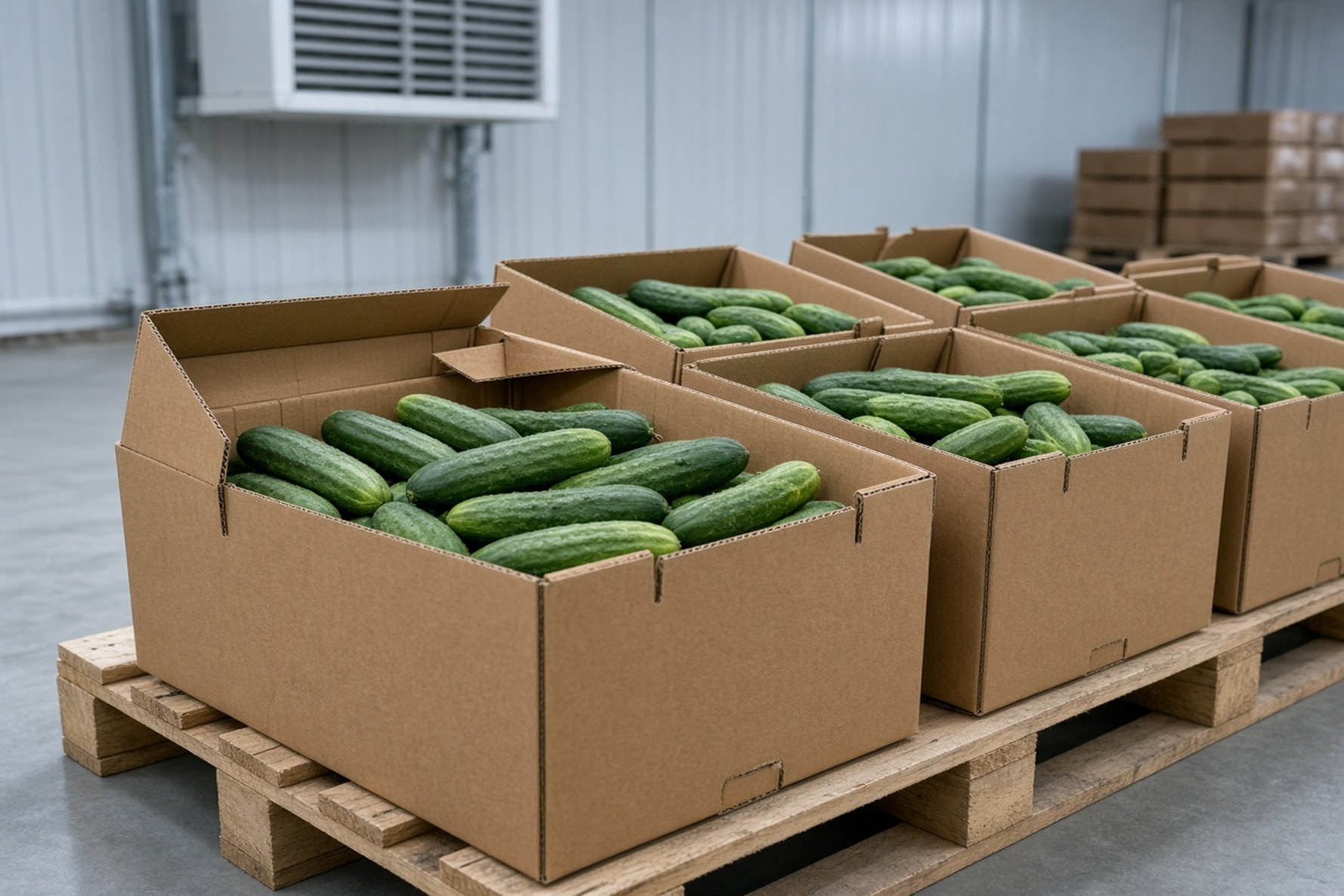
Cartons must balance stack pressure, moisture retention and vents; test board strength at cold-chain RH.
Orderly layout, limited void space and flush pallet edges reduce point pressure and scuffing.
6. Cold chain
| Factor | Range | Risk |
|---|---|---|
| Temperature | 10–12.5°C | Chilling or yellowing |
| Humidity | ~95% RH | Shrivelling |
| Hold time | < 14 days | Rapid breakdown |
| Ethylene | Segregate | Yellowing |
| Pre-cool | Before truck | Warm carton core |
Hold at about 10–12.5°C and ~95% RH; colder storage risks chilling injury and yellowing.
Reefers do not replace pre-cooling — probe several cartons at loading and segregate from ethylene producers.
7. Road, sea and air transport
Iraq, Armenia and Azerbaijan rely mainly on road; Central Asia needs transit time and stable temperature; Gulf south often uses reefer sea legs with fast inland cold handover.
Air freight is rarely economic for bulk fresh cucumber except time-critical niche orders.
8. Pricing drivers
Price follows commercial type, uniformity, season, sorting, carton, pre-cool, routing, MRL testing and delivery terms.
Compare quotes only when product spec and delivery point match.
- Commercial type, size and uniformity
- Season, sorting and packing cost
- Carton, pre-cool and cold store
- Freight and MRL testing
- Incoterms and payment terms
9. Common export mistakes
Many disputes stem from weak order definition and post-harvest handling, not field quality alone.
- Buying from photos without numeric specs
- Weak cartons at pallet base
- Loading warm fruit into a reefer
- Over-chilling instead of proper pre-cool
- Vague 'export quality' with no defect %
10. Importer checklist (18 items)
Before signing and loading, document the following in your contract annex:
- Define commercial type (long greenhouse, medium, small, field or processing grade).
- Set acceptable size by numeric length or weight.
- State in-carton size spread per FFV-15 or an equivalent contract rule.
- Define green colour and fresh-eating ripeness stage.
- Set maximum curvature and allowed visible defects.
- Write contract limits for soft, yellow, bruised or damaged fruit.
- Approve a real sample from the same production before the first order.
- Align pesticide MRL testing panel and laboratory with the destination market.
- Specify net weight per pack and weight-check method.
- Trial carton strength at cold-chain humidity before bulk packing.
- Define in-carton layout and layer pressure limits.
- Document pallet pattern, stack height and strapping.
- Measure and record actual product temperature at loading.
- Book refrigerated equipment and a 10–12.5°C transit plan in advance.
- Place temperature data loggers in the load.
- Verify phytosanitary and destination commercial documents before loading.
- Fix delivery point, Incoterms and cold-chain accountability in writing.
- Match arrival time to commercial life (typically under 14 days).
FAQ
Which countries buy Iranian cucumber most?
2024 recorded trade points to Iraq, Kazakhstan, Armenia, Azerbaijan, Qatar, Kyrgyzstan and Georgia — match destination to haul time and cold-chain cost.
Best temperature for export cucumber?
About 10–12.5°C at ~95% RH; much colder risks chilling injury.
Can cucumber travel near 0°C?
Not for typical fresh export — very low temperatures cause pitting and faster breakdown after warming.
How long is export shelf life?
Usually under 14 days in good conditions; harvest-to-sale time matters more than transit alone.
What packaging works?
Strong vented cartons sized to the fruit with pallet-safe stacking.
Key laboratory test?
Pesticide MRL against destination rules, plus visual and hygiene checks.
HS code for fresh cucumber?
070700 — fresh or chilled cucumber and gherkins, not pickled or otherwise preserved.
Why does cucumber yellow in transit?
High temperature, late harvest, long haul and ethylene exposure.
What is needed for a comparable price quote?
Commercial type, size, quality, volume, pack, destination, delivery and tests — submit via Iranco.
Summary
Iranian cucumber exports stand on near-market access, year-round supply windows and delivering fresh product. Uniformity, FFV-15, route-fit cartons and a 10–12.5°C chain at ~95% RH define professional trade — not a vague 'export grade'.
Featured Products




Related Articles



