 Iranco Magazine Team
From green, red, yellow and orange bell peppers to export sorting standards, pesticide residue control, packaging, cold chain and markets in Russia, Central Asia, the Caucasus and the Persian Gulf
Export Guide · Fresh Produce · UNECE FFV-28
What Types of Iranian Bell Pepper Exist, How Do They Differ, and Where Are They Exported?
From green, red, yellow and orange bell peppers to export sorting standards, pesticide residue control, packaging, cold chain and markets in Russia, Central Asia, the Caucasus and the Persian Gulf — a professional buyer's guide to ordering Iranian greenhouse bell peppers.
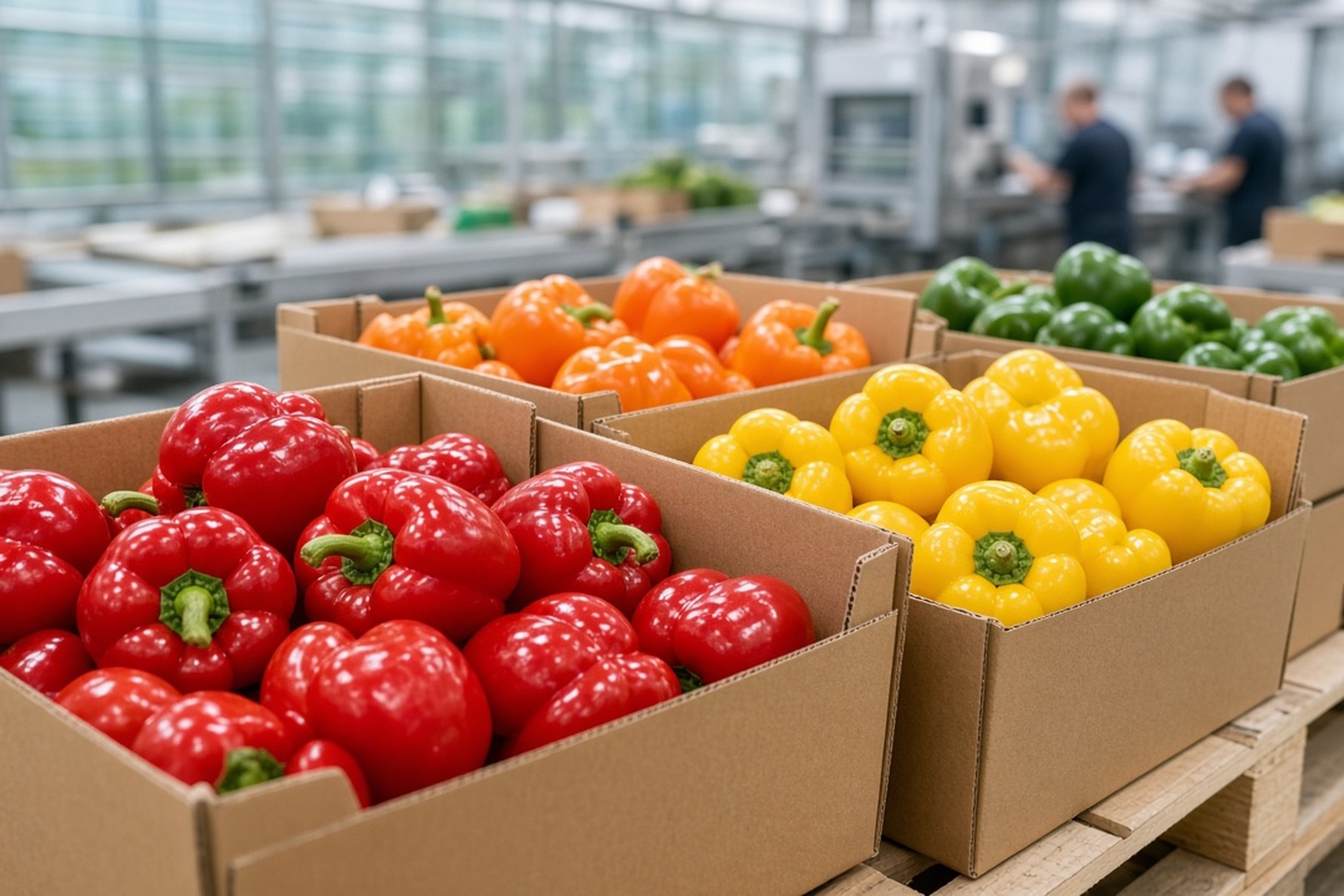
Iranian bell pepper is a major greenhouse crop in fresh produce trade. Commercial quality is defined above all by colour, shape, size, uniformity, firmness, skin condition and pesticide residue status. For foreign buyers, distinguishing pepper types is not only about colour — ripeness stage, post-harvest life, target market, sorting quality and the supplier's cold-chain capability directly affect shipment value.
Storage at about 7.5°C with relative humidity above 95% is recommended. Under these conditions, potential shelf life can reach three to five weeks; prolonged storage at lower temperatures, especially around 5°C, increases the risk of chilling injury, skin pitting, decay and internal colour change.
Introduction
Bell pepper is a crop where appearance at delivery matters almost as much as internal quality. A wholesale buyer expects colour, size, form, weight, ripeness and skin quality to be as uniform as possible across the load. A lot that is "perfectly healthy" on the farm may still fail export retail standards.
Iran can produce bell peppers in diverse climates, especially in greenhouse systems. Provinces such as Isfahan, Yazd, Hormozgan and Fars are recognised production and export hubs. Iran's commercial advantage is not only geographic proximity — year-round greenhouse production, land access to Eurasia and experience in coloured pepper sorting create real export capacity.
1. Market position of Iranian export bell pepper
A significant share of Iran's commercial bell pepper is greenhouse-grown. Green, red, yellow and orange are the four colours of greatest trade importance. Isfahan (including Tiran and Karvan), Yazd, Hormozgan and Fars are known production regions — but province name alone does not guarantee quality.
Greenhouse production enables more reliable supply planning. When evaluating a supplier, check weekly capacity, harvest window, contracted production units and sorting/cold-storage facilities — not only a sample lot.
2. Types of Iranian bell pepper and their differences
Export bell peppers are classified by colour, commercial shape, size, weight, lobes, wall thickness and ripeness stage. In practice, colour and form are the first attributes specified in an order.
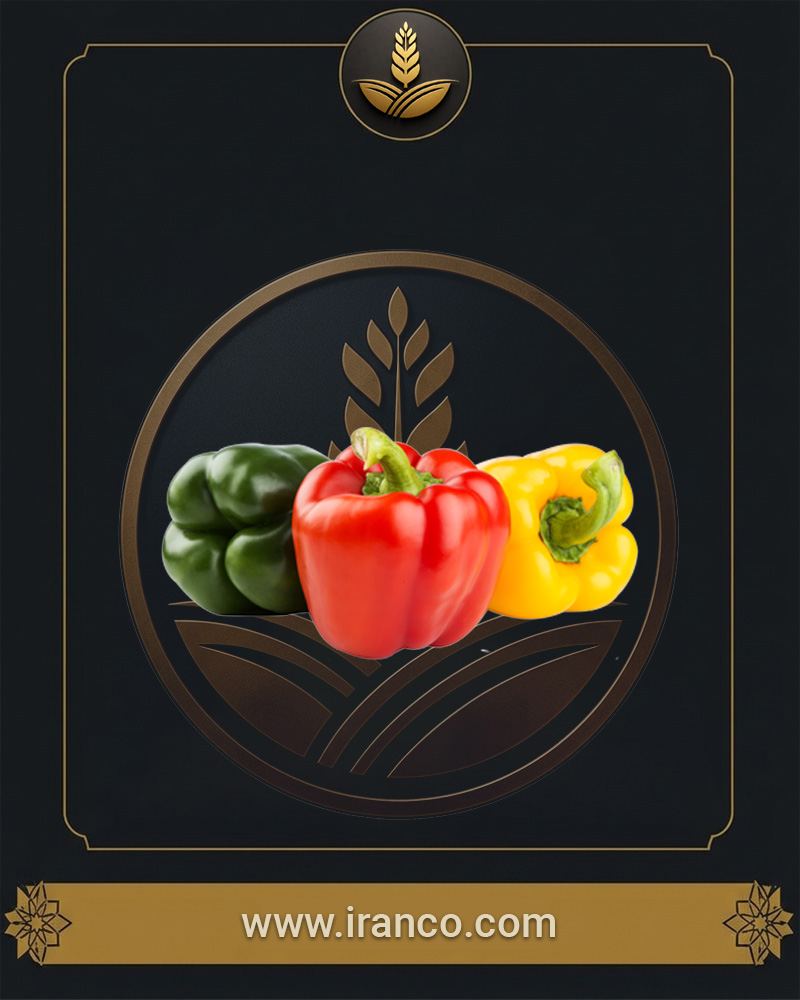
Green bell pepper
Usually harvested at commercial size before full colour break. More vegetal flavour and less sweetness than fully coloured fruit. Important for wholesale, foodservice and industrial kitchens.
Red bell pepper
In many commercial varieties, fruit turns from green to red on the plant. Sweeter and visually stronger for retail and mixed-colour packs. Uniform ripeness and defined colour coverage % are essential in contracts.
Yellow and orange bell pepper
Yellow is popular in mixed packs; retail markets take yellow uniformity seriously. Orange has smaller volume but appeals in premium and mixed retail packs. Define acceptable green blush and skin quality — not just "yellow" or "orange".
| Type | Colour stage | Sensory profile | Typical use | Buying note |
|---|---|---|---|---|
| Green | Pre full colour | More vegetal | Wholesale, foodservice | Uniform firmness |
| Red | Fuller colour break | Sweeter | Retail, mixed packs | Red coverage % & firmness |
| Yellow | Final yellow | Sweet, mild | Retail, mixed packs | Colour uniformity |
| Orange | Final orange | Sweet | Premium mixed packs | Colour stability & skin |
| Special colours | Variety-dependent | Varied | Niche markets | Buyer-specific order |
Shape differences
| Shape | Appearance | Suitable use |
|---|---|---|
| Blocky / square | Relatively wide, regular body | General retail & export |
| Elongated | Longer than wide | Specialty & cooking markets |
| Tapered blocky | Wide shoulder, narrower end | Specialty markets |
| Flat | Low height, wider profile | Specialised use |
In professional buying, an approved reference photo should accompany the written product description.
3. What should foreign buyers specify in the order?
"Export red bell pepper" is not enough for a professional contract. Quality must be converted into measurable parameters. UNECE FFV-28 is a key reference for commercial sweet pepper quality.
| Parameter | What to specify | Importance |
|---|---|---|
| Colour | Green, red, yellow, orange or mix | Target market |
| Colour coverage | Minimum acceptable colour | Avoid ripeness disputes |
| Shape | Blocky, elongated, etc. | Customer expectation |
| Quality class | Extra, Class I or custom | Inspection basis |
| Size | Diameter or weight range | Pack uniformity |
| Firmness | Firm, no wrinkling | Shelf life |
| Skin condition | No cracks, rot, major damage | Retail quality |
| Pesticide residues | Per destination rules | Customs clearance |
| Packaging | Carton, crate or consumer pack | Product protection |
| Net weight | Weight per pack | Commercial control |
| Loading temperature | Per cold-chain plan | Post-harvest life |
| Destination | Country, city or delivery point | Transport planning |
Under FFV-28, diameter-graded packs must not vary by more than 20 mm within a single pack.
4. How to recognise export-grade bell pepper
Export-grade pepper should look fresh, glossy, firm and uniform at first glance — but professional QC goes beyond visual inspection.
| Defect | Likely causes | Commercial effect |
|---|---|---|
| Wrinkling | Moisture loss, delayed cooling | Loss of fresh appearance |
| Pressure marks | Over-packing, poor handling | Secondary decay |
| Skin cracks | Uneven growth, field damage | Grade downgrade |
| Stem-end rot | Moisture, contamination | Spread risk |
| Skin pitting | Chilling or mechanical injury | Severe quality loss |
| Silvering | Thrips damage | Reduced visual appeal |
| Colour variation | Mixed harvest stages | Unsuitable for retail |
| Size variation | Weak sorting | Inconsistent pack look |
Inspection from only the top cartons on a pallet is insufficient. Sample from different pallets and top, middle and bottom layers.
5. Testing and quality control
For fresh pepper, the main laboratory issue is usually pesticide residues. There is no single global MRL — EU limits follow Regulation (EC) No 396/2005. "Pesticide test done" is not enough; define actives tested, method, lab scope, destination rules and traceability to greenhouse/batch.
6. Where is Iranian bell pepper exported?
Russia/Eurasia, Caucasus countries, Iraq and several Persian Gulf states are active in Iran's fresh pepper trade. Important: HS 070960 covers all fresh/chilled Capsicum and Pimenta — not bell pepper alone.
| Market | Trade evidence | Market trait | Success factor |
|---|---|---|---|
| Russia | Specific bell pepper shipments | Large Eurasian market | Traceability & residue control |
| Kazakhstan | Significant trade + shipments | Competes with China, Uzbekistan | Price, quality, transit time |
| Uzbekistan | Imports from Iran | Strong domestic production | Right season selection |
| UAE | High 070960 imports | Retail & redistribution | Appearance & packaging |
| Iraq | Imports from Iran | Near land market | Freshness & delivered price |
| Qatar | Recorded imports | Quality-sensitive | Cold chain |
| Oman | Recorded imports | Southern Gulf market | Transport & shelf life |
| Azerbaijan | Significant 070960 imports | Caucasus market | Price & delivery speed |
| Armenia | Recorded imports | Near land route | Supply stability |
7. Standards, documents and tariff code
Fresh or chilled Capsicum/Pimenta falls under HS 070960 at six-digit level. Countries may subdivide further for customs. UNECE FFV-28 defines Extra, Class I and Class II. For retail export, Class I is a more practical reference than vague terms like "top quality". EU marketing rules are in Regulation (EU) 2023/2429.
8. Export packaging
| Pack type | Suitable market | Advantage | Main risk |
|---|---|---|---|
| Ventilated carton | Bulk export | Light, pallet-friendly | Weak in high humidity |
| Plastic crate | Wholesale | Strong, good ventilation | Return logistics cost |
| Consumer pack | Retail | Shelf-ready | Higher cost |
| Mixed colour pack | Premium retail | Visual appeal | Requires precise sorting |
9. Cold chain and transport from Iran
Bell pepper loses water quickly; delay between harvest and pre-cooling is a high-risk point. Land transport dominates for Russia, Caucasus, Iraq and Central Asia. Sea freight can work for UAE, Oman and Qatar. Use temperature loggers on sensitive loads.
10. How export bell pepper price is determined
Key drivers: colour and ripeness, quality class, size and colour coverage %, season, packaging, residue testing, delivery point and order volume. Align specifications before comparing prices.
11. Competition in foreign markets
| Origin | Typical advantage | Limitation |
|---|---|---|
| China | High volume in Central Asia | Longer distance to some destinations |
| Uzbekistan | Proximity to Central Asia | Seasonal capacity swings |
| Turkey | Strong fresh export experience | Price & seasonal competition |
| Jordan | Near Arab markets | Season-dependent scale |
| Spain & Netherlands | Strong retail standardisation | Distance & higher cost |
Iran's advantage is sustainable when uniform product, real residue control and predictable logistics align — not when farm-gate price alone is lowest.
12. Importer checklist before ordering
- Define colour or colour mix required.
- Set commercial shape with reference photos.
- Specify quality class or acceptable defect limits.
- Define size by diameter, weight or count per carton.
- Write acceptable colour coverage for red, yellow and orange.
- Obtain a sample from real commercial production.
- Define residue test panel per destination country.
- Verify test results link to greenhouse or shipment batch.
- Evaluate supplier weekly capacity.
- Confirm carton type, net weight, ventilation and pallet pattern.
- Set expected product temperature at loading.
- Check pre-cooling method and cold-storage availability.
- Calculate real transit time including borders and transfers.
- Define rejection criteria for rot, wrinkling and mechanical damage.
- Write net-weight tolerance in the contract.
- Define pre-shipment inspection procedure.
- Check origin, phytosanitary and test documents before dispatch.
- Clarify delivery terms and responsibilities en route.
- Plan a trial shipment sized to market risk for first cooperation.
- Evaluate several consecutive loads before long-term commitment.
13. Information needed for an accurate price quote
Include at minimum: colour(s), commercial shape, quality class, size/weight range, colour coverage, order volume and frequency, packaging type and net weight, consumer-pack requirement, destination and delivery point, transport mode, required tests and preferred delivery terms. Without this, supplier quotes are not comparable.
14. Sourcing export bell pepper from Iran to buyer specifications
In international bell pepper buying, two offers differ by far more than price per kilo. Colour, size, ripeness, class, uniformity, carton type, residue management and harvest-to-pre-cool time all change the outcome. Iranco lets buyers submit requests with product details, approximate volume, packaging and destination so available Iranian options are reviewed against the same defined need.
Summary
Iranian export bell pepper is a sensitive fresh product whose value depends on measurable attributes. Green, red, yellow and orange each have different markets and ripeness stages. Russia, Kazakhstan and Uzbekistan appear in specific bell pepper shipment records; broader HS 070960 data also shows trade with UAE, Azerbaijan, Iraq, Armenia, Qatar and Oman — but that code is not bell-pepper-only. Export advantage becomes commercial results when greenhouse quality, precise sorting, destination-appropriate testing, pre-cooling, robust packaging and refrigerated transport work together.
Frequently asked questions
In which colours is Iranian bell pepper mainly exported?
Green, red, yellow and orange are the main commercial colours. Red, yellow and orange are sold single-colour or in mixed retail packs; green is important for wholesale and foodservice.
What is the difference between green and red bell pepper?
Green is usually picked at commercial size before full colour break; red is sweeter and more retail-attractive after full colour development on the plant.
Which countries import Iranian bell pepper?
Russia, Kazakhstan and Uzbekistan appear in specific bell pepper shipment records. Broader HS 070960 data also includes UAE, Azerbaijan, Iraq, Armenia, Qatar, Kyrgyzstan and Oman.
What is the best transport temperature for bell pepper?
About 7.5°C with RH above 95% is a common scientific reference. Prolonged storage around 5°C can cause chilling injury.
What tests should export bell pepper have?
Pesticide residues are the main laboratory issue for many import markets. The test panel must match destination MRLs and be traceable to the same greenhouse or production batch.
How is export bell pepper sized?
By diameter or weight. FFV-28 allows a maximum 20 mm diameter spread within a diameter-graded pack.
Why do some shipments wrinkle after a few days?
Bell pepper is sensitive to water loss. Delayed cooling, low RH, poor airflow and weak packaging reduce firmness and cause wrinkling.
What information is needed for a price quote from Iran?
Colour, shape, size/weight, quality class, colour coverage, volume, packaging, net weight, destination, transport mode and required tests.
What does Class I mean for bell pepper?
Class I under FFV-28 is good quality that retains the variety's main characteristics with limited minor defects in shape, skin or stem — far more precise than generic "grade one export".
Can red, yellow and orange peppers be packed in one carton?
Yes — mixed-colour packs are common if quality is uniform and colour ratios match the buyer's order, with aligned size and ripeness stage.
Featured Products






Related Articles



