 Iranco Magazine Team
From choosing the right apple for each market to calibration, QC, export packing, pre-cooling and refrigerated transport
Export guide · Apple · FFV-50 · Cold chain
Iran Apple Export: Key Markets, Sorting, Packaging and Cold Chain
From choosing the right apple for each market to calibration, quality control, export packing, pre-cooling and refrigerated transport
Fresh apples are a major item in Iran’s horticultural export basket, with commercial presence in India, Iraq, Central Asia and neighbouring countries. Success depends not only on orchard quality but on uniform sorting, appearance, size, flesh firmness, robust packaging and an unbroken cold chain to destination — all of which drive price and waste.
Introduction
Apple export is a quality-management business. Two loads from the same orchard can differ in harvest timing, colour, firmness, calibre, pack-line pressure, time to cold store and loading method — one may meet the foreign buyer’s spec, the other may be downgraded. West and East Azerbaijan and Tehran are key production hubs; West Azerbaijan is especially important for storage, sorting and export. Export apples should be managed as a standardised product from day one, with measurable diameter or weight, surface colour, tolerable defects, firmness, Brix, net pack weight and cold-chain terms written into the contract — not vague labels like “export grade” alone.
1. Iran’s position in apple export
Iran’s strengths include diverse growing areas, altitude range, commercial volume, on-farm cold storage and proximity to large markets. India was the largest recorded destination for Iranian apples in 2024 import statistics; Iraq offers overland access and high fresh consumption; Uzbekistan and Kazakhstan are important Central Asian buyers.
| Market | Approx. volume | Key factor |
|---|---|---|
| India | ~157,000 t | Large market, strong competition, colour & pack matter |
| Iraq | ~62,000 t | Overland access, fast turnover |
| Uzbekistan | ~60,000 t | Commercial demand, road haulage |
| Kazakhstan | ~23,000 t | Shelf life and fruit strength |
| Pakistan | ~17,500 t | Regional market, price sensitivity |
2. Commercial apple cultivars
| Cultivar | Trait | Buyer focus |
|---|---|---|
| Red Delicious | Red skin, retail appeal | Colour %, firmness, calibre |
| Golden Delicious | Yellow skin, balanced flavour | Skin soundness, uniformity |
| Gala | Sweet, crisp | Colour, firmness, speed to cold |
| Granny Smith | Green, higher acidity | Green colour, firmness, skin |
3. Export sorting
Export sorting must control size or weight, pack uniformity, colour, firmness, skin condition and absence of rot, bruising, cracks and insect damage. UNECE FFV-50 sets a general minimum of 60 mm or 90 g; under defined conditions smaller fruit (50 mm / 70 g, min. 10.5° Brix) may be accepted. Contract specs always override the generic phrase “export size”.
4. Technical order parameters
A professional apple order must be measurable: cultivar, diameter or weight range, colour, optional Brix and firmness, defect tolerances, pack type and net weight, and transport temperature per the cold-chain plan. Acceptance criteria must apply to the whole shipment, not only the initial sample.
5. Export packaging
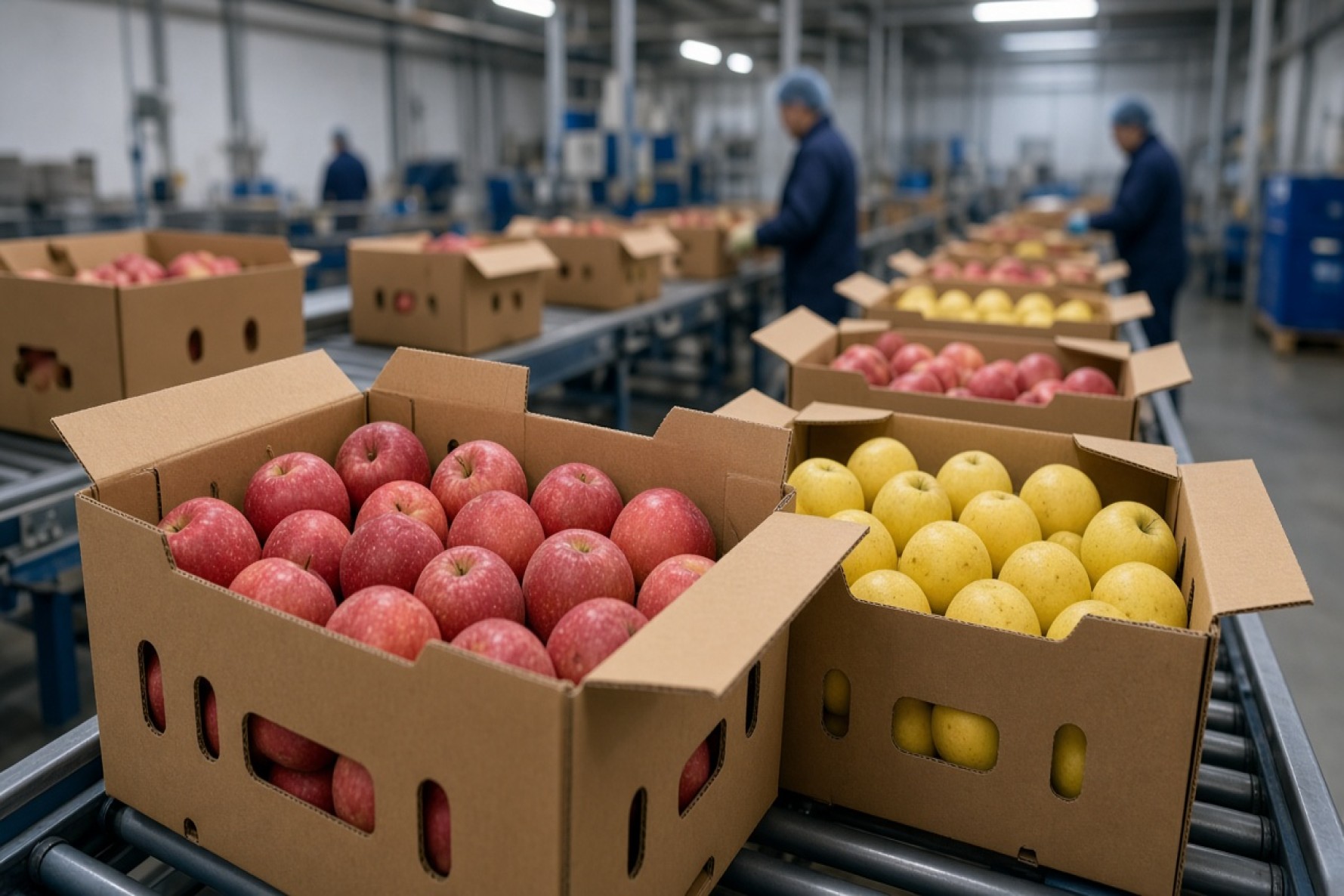
Packaging protects mechanically and supports respiration and cooling. Strong ventilated cartons and ventilated plastic crates are common; ~9–10 kg net packs appear often on India trade documents. Premium lines may use cell trays or dividers. Label requirements must match the destination country.
6. Cold chain
For many commercial apples (Red Delicious, Gala, Fuji), storage near 0 °C (±1 °C) and 90–95% RH is standard. The correct sequence: harvest at agreed maturity → shaded rapid transfer → cull damaged fruit → pre-cool → sort and pack in a controlled environment → cold store → load pre-cooled product into a reefer → maintain temperature to delivery. Reefer units preserve temperature; they are not designed to cool a warm load in transit.
7. QC and documents
QC runs before final packing and again at loading. Pesticide programmes must align with the export market from the orchard — MRL checks at loading cannot fix spray mistakes. Fresh apples are classified under HS 080810. Typical documents: phytosanitary certificate, certificate of origin, invoice, packing list and transport papers.
8. Competition and pricing
Competition covers season, uniformity, cold-store technology, packaging and distribution — not price per kg alone. In India 2024, Iran and Turkey were major suppliers. Final price reflects calibre, colour, defects, firmness, storage time, sorting and pack costs, volume, destination and reefer freight — compare offers only with matching specs.
9. Importer checklist
- Exact cultivar, diameter/weight, colour, firmness and Brix
- Allowed and rejected defects; net weight and pack layout
- Pack sample, pulp temperature before loading, reefer type
- Phytosanitary and commercial documents; sampling and cold-chain liability
10. Sourcing through Iranco
Iranco connects buyers with Iranian agricultural supply. For apples, include destination market, volume, size, colour, packaging and delivery timing in the purchase request from the start.
FAQ
Which Iranian apples are most in demand for export?
Red and Golden Delicious are the best known; final choice depends on the destination market.
What is the right export size?
There is no single size for all markets; FFV-50 uses 60 mm / 90 g as a general minimum — define the calibre band in the contract.
What transport temperature?
Near 0 °C and 90–95% RH for many cultivars; fine-tune by cultivar and trip length.
Best packaging?
Strong ventilated cartons with trays for premium; ventilated crates for some wholesale channels.
Why pre-cool?
Warm fruit respires faster and loses firmness; transport refrigeration maintains temperature, it does not cool a warm load.
HS code for fresh apples?
080810 in the harmonised system; national customs codes may add digits.
Featured Products





Related Articles



