 Iranco Magazine Team
Annual Iranian almond kernel procurement planning by harvest timing, size, breakage, colour, moisture, bitterness, pest damage, uniformity, packaging and India market requirements
Almond kernel · Buying season · Dried nuts · Export to India
Iran Almond Kernel Buying Season: When Is Best for Quality, Price and Availability?
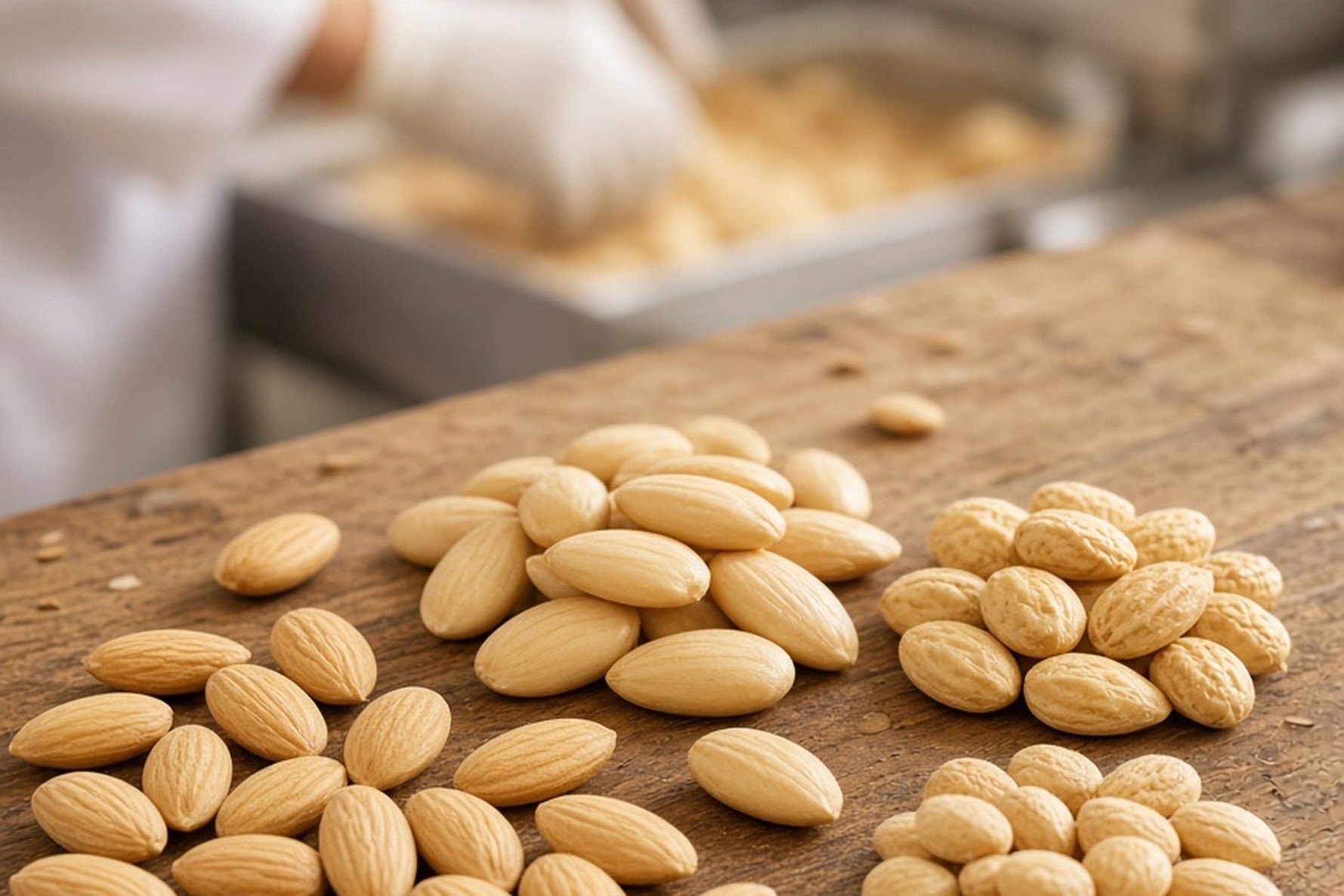
Annual procurement planning for Iranian almond kernels — harvest timing, size, breakage, colour, moisture, bitterness, pests, uniformity, packaging and India market requirements.
The best time to buy Iranian almond kernels is not necessarily the cheapest month of the year. A professional buyer must weigh new-crop arrival, drying status, grade uniformity, storability and destination-market needs at the same time. This guide shows how to design an annual almond kernel procurement programme from harvest through storage to export delivery — and compare real shipment quality against price.
Analytical introduction
Almond kernel buying, despite the product's apparent simplicity, is a transaction where timing directly affects quality and price. Two shipments may look alike in product name, origin and even first inspection — yet differences in crop year, drying method, moisture, breakage rate, uniformity, bitter kernels, insect contamination and warehouse conditions can make their true commercial value completely different.
In Iran, almond harvest starts in summer depending on climate, elevation and cultivar, and in some regions continues into early autumn. In Fars, for example, harvest is reported from mid-August through late September; in Estahban from early August to mid-September; and in Neyriz for some orchards until mid-October. This spread means "Iran almond buying season" is not one fixed day or month — it is a multi-month window as product from different regions enters the market gradually.
For importers and bulk buyers, the main opportunity usually begins when new-crop supply stabilises — when a significant share of the harvest has been hulled, dried, shelled, sorted and graded and the seller can quote real shipment specifications. Buying too early increases risk of uneven moisture and unstable quality; buying too late may limit choice to warehouse stock, leftover grades or mixed origins.
This matters especially for the India market. India is one of the world's largest almond-consuming countries. Although most Indian almond volume comes from the United States and Australia — mainly as in-shell almonds — Iran has a notable commercial presence in shelled kernels. In 2024, Iran was India's largest recorded source by value in HS six-digit code 080212. In the total almond market including in-shell product, Iran's share is smaller; Iran's position should therefore be analysed specifically in shelled kernels, not the whole Indian almond market.
1. How does Iran's almond harvest season shape the buying calendar?
In short: for many new-crop purchases, late summer and early autumn are the most important market-evaluation period — but the best contract timing depends on production region, cultivar, drying method and order volume.
Iran has wide climatic diversity in almond production. Harvest begins earlier in warmer areas and later in highland zones or late cultivars. In Fars, one of Iran's main almond provinces, official reports show harvest can start in August and in some districts continue into October. Counties such as Eghlid, Darab and Neyriz play important roles in provincial output.
For kernel buyers, orchard harvest date is only the first step. After picking, hulling, drying, shelling, kernel separation, sorting and packing must follow. Peak supply of "export-ready shelled almond kernels" therefore does not necessarily coincide with peak orchard harvest.
| Period | General market status | Suitable buyer approach |
|---|---|---|
| August | Early product from some early regions | Initial sampling and new-crop review |
| September | Harvest expands across production areas | Compare suppliers and grade specs |
| October | Completion of much late-region harvest | Good period to fix new-crop contracts |
| Nov–Feb | Harvested, sorted inventory | Regular buying and standard shipments |
| Late winter–spring | More dependence on storage quality | Check crop year, odour, moisture and oxidation |
| Early summer | Short gap before new crop | Buy on inventory need and actual warehouse quality |
This table is a decision calendar, not a fixed price promise. Frost, drought, pests, orchard yield and domestic or export demand can change supply every year.
Why buying on the first harvest days is not always best
Fresh kernels must reach stable moisture. If product is packed after poor or uneven drying, mould risk, sensory downgrade and warehouse problems increase. Bulk buyers should focus not only on the phrase "fresh product" but on specification certificates and a representative shipment sample.
2. Best buying time for quality, price and availability is not the same
The almond market has three distinct goals: access to fresh product, access to wider grade choice and purchase at a competitive price. These three do not necessarily peak at the same moment.
If quality and freshness are the priority
When new product enters the market after drying and initial sorting, natural skin colour, almond aroma, texture and oxidation status are easier to assess. In this period, access to lots with shorter warehouse history is also more likely.
Freshness alone, however, does not guarantee quality. New-crop kernels packed with high moisture or weak drying can perform worse than properly stored almonds from the previous year.
If grade selection is the priority
After harvest in several main regions is complete and processing finished, more options usually exist for comparison. The buyer can choose among grades by size, colour, breakage and uniformity instead of accepting the first available stock.
If price is the priority
There is no rule that product is cheapest exactly at harvest peak. High supply can push prices down, but grower expectations, crop size, exchange rates, export demand, sorting cost and new-crop quality also matter.
3. Define almond kernel grade before negotiating price
One of the most common buying errors is requesting a price for the generic phrase "Iranian almond kernel". Without a defined grade, comparing two offers is unreliable.
Almond kernels can come from different cultivars and regions and differ clearly in shape, size, skin colour, texture and sound-kernel ratio. Iranian orchards grow many local and improved cultivars. Fars horticultural reports, for example, mention Sangi, Mamaei, Tono, Supernova, Shokoufeh Tabriz and Shahroodi-type groups.
In kernel trade, cultivar name must be paired with physical specifications — a local commercial name alone does not create a measurable standard.
| Parameter | What to define | Why it matters |
|---|---|---|
| Cultivar or commercial type | Specified or mixed | Affects shape, colour, taste and uniformity |
| Size | Count method or agreed dimensional range | Determines appearance and application |
| Whole kernels | Required percentage | Determines commercial value |
| Breakage | Maximum allowed percentage | Direct grade impact |
| Skin colour | Light, natural, uniform or per reference sample | Important in retail sales |
| Moisture | Contract limit and test method | Main stability factor |
| Bitterness | Absence or agreed limit | Critical for sensory acceptance |
| Insect damage | Maximum allowed level | Linked to safety and appearance |
| Foreign matter | Permitted limit | Sorting and cleaning indicator |
| Uniformity | Percentage or reference sample | Important for consumer packs |
| Crop year | Explicit in contract | For freshness assessment |
| Packaging | Material, net weight and inner layer type | Determines transport protection |
How should size be defined?
In international almond trade, size may be defined by kernel count per weight unit or by screen and diameter. The UNECE commercial standard for almond kernels also recognises size grading as a key trade component; higher grades have defined sizing roles.
If a seller uses terms such as "large", the buyer must convert them to measurable criteria. "Large" without a measurement method is not a contract standard.
4. How to assess real almond kernel quality
Good almond kernels should be sound, dry, free of abnormal odour, free of visible mould, free of live pests and without obvious rancidity or fat deterioration. Colour, size and shape must match the purchased grade.
The UNECE commercial standard for almond kernels requires product to be sound, sufficiently developed, clean, free of insects and mites, free of mould, free of rancidity and free of abnormal external moisture; bitter kernels are not accepted in the sweet almond definition.
Skin colour
Kernel skin colour depends on cultivar, growing conditions, product age, drying and storage. Lighter colour alone is not synonymous with higher quality.
- Colour uniformity within one grade
- No widespread abnormal spotting
- No mould marks or spoilage discolouration
- Final shipment matching the approved reference sample
In markets where whole kernels are sold directly to consumers, appearance matters more than in industrial uses such as slivers, powder or processing.
Breakage
Broken kernels are not necessarily unsuitable for food use, but their commercial value differs from whole kernels. For powder, paste, confectionery or some industrial uses, broken kernels can be an economical choice. For premium retail packs, breakage percentage must stay low.
Under India's product standard, the combined total of split, broken and half kernels is maximum 5%. A shipment offered as standard almond kernel for this market must meet this and other prescribed limits.
Bitterness
Bitterness is one of the most sensitive sensory defects in almonds. Even a limited number of very bitter kernels can ruin a retail pack experience.
The phrase "sweet almond" on a proforma is not enough. Sensory sampling must be done on a representative lot; on sensitive orders, specific acceptance criteria for bitter kernels can be defined.
Rancidity and off-flavour
Almonds contain significant oil; fat oxidation under poor storage can lead to sharp, stale or unpleasant taste and odour. India's standard sets minimum kernel oil at 45% and maximum oil acidity as oleic acid at 1.25%.
Quality control of stored product therefore cannot rely on appearance alone.
5. Moisture, pests and laboratory control — three points not to overlook
For export almond kernels, moisture control is the starting point — but it is not the only required test.
Moisture
India's regulations for almond kernels set maximum moisture at 6%. The UNECE commercial standard DDP-06 cites 6.5%. This difference shows the buyer must use destination-market criteria as the contract basis, not one generic number for all deals.
- Reduced warehouse stability
- Higher mould risk under poor conditions
- Texture change
- Discrepancy in true dry-matter weight
- Increased quality loss on long transit
Aflatoxin
Almonds, like other tree nuts, must be managed for aflatoxin risk. The Codex Code of Practice for prevention and reduction of aflatoxin contamination in tree nuts follows control from farm through harvest, drying, processing, storage and transport, emphasising good agricultural, production and storage practice.
Aflatoxin testing should be set by destination market and contract specifications. Acceptable levels must not be assumed from one country to another.
Pests and insects
Live insects in an export shipment are not tolerable. Beyond commercial rejection, destination quarantine requirements may apply. Inspection should cover product, packaging and container space.
| Control | Practical method | Expected outcome |
|---|---|---|
| Moisture | Composite sample test | Within contract and destination limit |
| Breakage percentage | Separation and weighing | Below agreed limit |
| Insect damage | Inspection and required testing | Within acceptance criteria |
| Mould | Sensory check and lab test if needed | No undesirable signs |
| Aflatoxin | Accredited laboratory | Within destination regulations |
| Odour and taste | Sample evaluation | Natural, no rancidity or unacceptable bitterness |
| Colour | Comparison with reference sample | Uniform within contract range |
| Foreign matter | Separation and weighing | Below prescribed limit |
| Net weight | Random pack check | Matches contract |
| Pack condition | Inspection | Sound, dry and intact |
6. Storage effect on almond kernels — why last year's crop is not necessarily unsuitable
Crop year is an important indicator, but storage conditions are sometimes more important than time since harvest. Fresh product kept in a warm, humid warehouse can deteriorate faster than older product stored under controlled conditions.
Codex guidance for tree nuts recommends dry storage with adequate ventilation and protection from rain, rodents and birds. Aflatoxin control guidance suggests warehouse relative humidity below 70% and optimal temperature in the 0–10 °C range to reduce fungal growth.
- When were kernels separated from the hard shell?
- What conditions applied from shelling until today?
- Is the warehouse temperature-controlled?
- Was product held in permeable bags or protective packs?
- Were packs stored on pallets?
- Was product moved between different warehouses?
- Is the sample you received from the same stored lot?
Signs of poorly stored product
Reduced natural aroma, papery or unpleasant oily taste, rancidity, severe colour change, loss of crunch, insect marks and wide variation among kernels can indicate weak storage.
Importers with predictable monthly consumption should not buy a full year's need without a storage plan. A volume contract with phased delivery is often more logical — especially if the seller can hold stock under suitable conditions and re-check each lot before dispatch.
7. India market — where exactly does Iran have an advantage?
To analyse Iran's position in India, distinguish the total almond market from the shelled-kernel market without hard shell.
In India's total almond market, the United States is the main player and most trade is in-shell almonds broken and sorted in India. The USDA 2025 market report for trade year 2024/2025, after converting in-shell to kernel equivalent, estimates US share at about 85% and Australia at about 10%, with Iran below 1% of the total market.
The picture under code 080212 — almonds without hard shell — is different. 2024 trade data shows India imported about 13.2 million kg of shelled almonds worth roughly USD 83.9 million. Iran supplied about 2.76 million kg worth USD 32.7 million — the largest recorded source by value in this category. Australia shipped a higher volume by weight, but recorded unit value of Iranian product was higher.
This difference matters for Iran's export strategy. Iran's advantage in India should not be framed as "direct competition with all California almonds". The more attractive segment is shelled kernels and certain higher-value grades.
| Origin | India import volume | Approx. value | Commercial note |
|---|---|---|---|
| Iran | 2.76 million kg | USD 32.7 million | Strong value position in shelled kernels |
| Australia | 5.62 million kg | USD 22.3 million | Higher volume |
| Afghanistan | 2.79 million kg | USD 18.8 million | Important regional presence |
| United States | 1.03 million kg | USD 5.0 million | Main US presence in India is in-shell |
| Syria | 0.36 million kg | USD 1.9 million | Smaller share |
2023 data also shows Iran's notable presence in shelled almonds: India imported about 2.37 million kg from Iran in HS 080212 worth over USD 28 million. Continuity matters more than a single-year ranking.
8. How do India's almond kernel requirements affect buying from Iran?
The India market does not judge product by appearance alone. The official FSSAI product standard for almond kernels sets a range of physical and chemical parameters.
Under FSSAI, almond kernels must be sound, whole, clean and sufficiently dry, and free of live or dead insects, rancidity, visible foreign matter, visible mould and rodent contamination. Product must have relatively uniform colour and characteristic almond aroma and taste, and be free of off-odour or signs of fermentation.
| Parameter | Prescribed limit (India) |
|---|---|
| Moisture | Maximum 6% |
| Residue with skin, shell or hull | Maximum 0.25% |
| Rancid or insect-damaged kernels | Maximum 1% |
| Gum spots and brown stains | Maximum 2% |
| Stains and discolouration | Maximum 4% |
| Shrivelled or underdeveloped kernels | Maximum 4% |
| Halves and broken kernels | Maximum 5% |
| Split and scratched kernels | Maximum 10% |
| Twin kernels | Maximum 10% |
| Acid-insoluble ash | Maximum 0.1% |
| Oil content | Minimum 45% |
| Oil acidity as oleic acid | Maximum 1.25% |
These figures must be taken seriously in commercial negotiations. If India is the destination, the seller should not quote on domestic standard or visual sample alone. Specifications must be aligned with destination requirements from the start.
9. Almond kernel packaging must be designed for oxidation, moisture and pests
After separation from the hard shell, kernels are more exposed to the environment. The woody shell is a natural barrier; removing it increases exposure to oxygen, moisture, contamination and mechanical damage.
For bulk export, packaging choice should follow transit time, destination conditions and storage duration. Bulk shipments may use suitable multi-layer food-grade packs with a protective inner layer. For more sensitive product or longer storage, low oxygen and moisture permeability matter more.
| Supply type | Main priority | Key risk |
|---|---|---|
| Bulk bag | Cost and handling ease | Moisture and oxygen ingress in weak packs |
| Multi-layer pack | Higher protection | Higher cost |
| Vacuum pack | Reduced oxygen contact | Requires appropriate pack design |
| Modified atmosphere | Quality stability in some uses | Process control required |
| Retail pack | Appearance, exact weight and brand | High sensitivity to breakage and uniformity |
In export orders, "export packaging" is not a technical specification. Material, layer count, net weight, seal type, master carton, units per carton and pallet conditions must be defined.
10. How to compare Iranian almond kernel prices with real quality
Price per kilogram without product specifications is an incomplete metric. Two offers may differ by 10% in headline price — yet the cheaper lot may have more breakage, irregular size, an older crop year or higher re-sort cost.
- Crop year and season: new crop enters with different supply structure
- Cultivar and type: some types command higher destination value
- Size: large, uniform grades often worth more
- Whole-kernel percentage: less breakage means lower sort loss
- Colour and uniformity: more important for direct retail
- Moisture: higher moisture means paying for more water and storage risk
- Test results: destination-tested lots differ from unchecked bulk
- Packaging: multi-layer, vacuum, cartons and pallets add cost
- Delivery terms: ex-works vs delivered port price are not comparable
Suppose a cheaper lot has 7% unusable material for the buyer's application while a more expensive lot has only 2% loss. Nominal price difference should be compared against usable product value. In professional RFQs, grade and acceptance limits are fixed first; then seller prices are compared.
11. Importer checklist before placing an order
Before confirming an Iranian almond kernel contract, the following must be clear:
- Specify cultivar or commercial type. If mixed cultivars, state this from the start.
- Write crop year in the contract. "Fresh product" alone is not enough.
- Define sizing method. Terms like "large" or "medium" without numeric criteria are insufficient.
- Set maximum breakage percentage. Define how halves, fines and breakage are calculated.
- Set moisture limit by destination. For India, the product standard limit is 6%.
- Obtain a representative sample from the actual grade and lot — not a separate show sample.
- Fix colour and appearance against a reference sample. Contract should state shipment must match within a reasonable range.
- Define bitterness criteria. Sensory control is especially important for consumer packs.
- Specify safety tests. Depending on destination, set aflatoxin, pesticide residues and other required parameters.
- Define pest and insect conditions. Product and packs must be free of unacceptable contamination.
- State packaging type and net weight exactly — material, net weight, master carton and pallet.
- Review pre-shipment storage conditions, especially for off-season purchases.
- Set destination acceptance criteria. Define dispute resolution if lab or grade results differ.
- Confirm transport method and delivery terms. Cost, risk and responsibility must be clear.
- Assess the seller's real supply capacity. Ability to deliver one excellent sample is not the same as supplying several tonnes at the same spec.
- For annual contracts, consider phased delivery to reduce buyer warehouse risk.
12. Information needed for an accurate price quote
"What is the price of Iranian almond kernels?" is not enough for a commercial transaction. To provide comparable offers, the seller needs at minimum:
- Desired type or cultivar
- Crop year
- Whole kernels or industrial grade
- Size or sizing method
- Maximum breakage
- Moisture limit
- Colour and uniformity criteria
- Bitter-kernel requirements
- Required laboratory tests
- Total order quantity
- Weight per pack
- Packaging type
- Private-label requirement
- Destination country
- City, port or delivery point
- Transport mode
- Commercial delivery terms
- Pre-contract sample requirement
- Single or phased delivery schedule
The more precise this information, the more meaningful apparent price differences become. For example, price for uniform whole kernels with low breakage, controlled moisture and protective packaging should not be compared directly with mixed product requiring re-sorting.
13. Iranian almond kernel supply based on an annual buying programme
In international almond kernel buying, a good decision usually goes beyond choosing a "purchase month". The buyer should divide annual need into periods and plan minimum inventory, order timing, preparation time and transit for each.
For markets such as India where Iranian product has a commercial presence in shelled almonds, consistency across shipments matters greatly. If the first lot is large, light and low-breakage but the next differs clearly in size or colour, the importer will face resale or repacking problems.
The practical approach is to define a "master specification" before contract: crop year, product type, size, breakage percentage, moisture, defect limits, tests and packaging. Each delivery should then be checked against that basis.
Iranco allows international buyers to submit supply requests with this level of detail. Instead of a generic almond kernel request, quantity, grade, size, packaging, destination country and quality-control criteria can be specified so available supply options in Iran are reviewed on that basis.
For multi-phase buying programmes, state in the initial request whether the order is a single shipment or part of annual need — this affects inventory planning and the ability to maintain grade uniformity.
Summary
The best season to buy Iranian almond kernels does not have a single-month answer. Almond harvest in different parts of Iran starts in August and, depending on climate and cultivar, can continue through September and in some regions into October. Late summer and early autumn are therefore the most important window for evaluating new crop, comparing grades and planning annual contracts.
Professional buyers should not decide on calendar alone. The right time to buy is when product has reached stable moisture, real sorting is defined, a representative sample is available and the seller can maintain the grade at required volume.
Size, breakage percentage, colour, moisture, bitterness, pests, uniformity and packaging type must be fixed before price comparison. For the India market this is doubly important: India has specific quantitative standards for almond kernels, and Iran has built a notable commercial position in shelled almonds without hard shell. 2024 data shows Iran was one of India's main import sources by value in HS 080212.
If the goal is to reduce purchase risk, the stronger annual strategy is three stages: evaluate new crop, fix grade and contract, then controlled phased delivery. In that model, price is only one variable — the main metric is the real cost per kilogram of usable kernel aligned with destination-market need.
FAQ
When is the best time to buy fresh Iranian almond kernels?
In many production regions, new product enters the market from August and September, with harvest in some areas continuing into October. For bulk buying, timing is usually better once product has stabilised after harvest, drying and initial sorting. Buying on the first harvest day is not necessarily an advantage — final moisture and grade specifications must be measurable.
Is new-crop almond kernel always better than product from the previous year?
No. Crop year matters, but storage method plays an essential role. Previous-year product stored dry, cool and under control can have acceptable sensory quality, while new crop with high moisture or poor warehousing may deteriorate quickly. Odour, taste, moisture, oxidation status and insect marks should be checked together with crop year.
What is the appropriate moisture for export almond kernels?
Acceptable figures must align with destination regulations. Under India's FSSAI product standard for almond kernels, maximum moisture is 6%. The UNECE commercial standard cites 6.5%. Export contracts should state which standard and test method govern acceptance.
How can stale or oxidised almond kernels be identified?
Unpleasant odour and taste, rancidity, stale oily notes, reduced natural aroma and abnormal texture change are important signs. Appearance alone is insufficient. In bulk buying, evaluate a representative shipment sample and, where relevant, laboratory parameters linked to oil quality.
How does breakage percentage affect price?
The higher the whole-kernel share, the greater the value for retail and direct sales. Broken kernels can be fully suitable for some industrial uses such as powder, paste, confectionery and processing — but should not be priced like whole-kernel grade. India also has a specific limit for broken and half kernels in its product standard.
What is Iran's position in India's almond kernel market?
In India's total almond market, the United States dominates because of large in-shell exports. In shelled kernels without hard shell, Iran's position is different. In 2024 India imported about 2.76 million kg of almond kernels from Iran worth roughly USD 32.7 million — placing Iran among the most important recorded sources in HS 080212 by value.
Which laboratory tests matter most when buying Iranian almond kernels?
Moisture is one of the first parameters. Depending on destination and application, aflatoxin, pest status, rancidity and oil-quality parameters, foreign matter and other regulated contaminants may also be required. Tests should follow destination regulations and contract specifications, not one fixed list for all markets.
Is buying directly after harvest necessarily cheaper?
Not necessarily. Price is influenced by crop volume, demand, cultivar, grade, exchange rate, processing cost and seller expectations. Peak supply can create more comparison opportunity, but does not guarantee the year's lowest price. The main advantage of new-crop season is better access to options and inventory planning.
What information is needed to obtain almond kernel prices from Iran?
At minimum: type or cultivar, crop year, size, breakage percentage, moisture limit, order quantity, packaging, destination country and delivery terms. Required certificates or tests should be stated from the start. Buyers can submit these specifications via Iranco so supply options are reviewed against actual need.
Featured Products






Related Articles



