 Iranco Magazine Team
From elongated form and light shell colour to sizing, natural split, aflatoxin, lot uniformity and Iran’s real position in the India market
Export Guide · Ahmad Aghaei Pistachio · India Market
Iranian Ahmad Aghaei Pistachio Export: Quality, Packaging & India Market Guide
Expert guide to Ahmad Aghaei pistachio quality, size, split type, aflatoxin, packaging and shipping for export markets — with special focus on India.
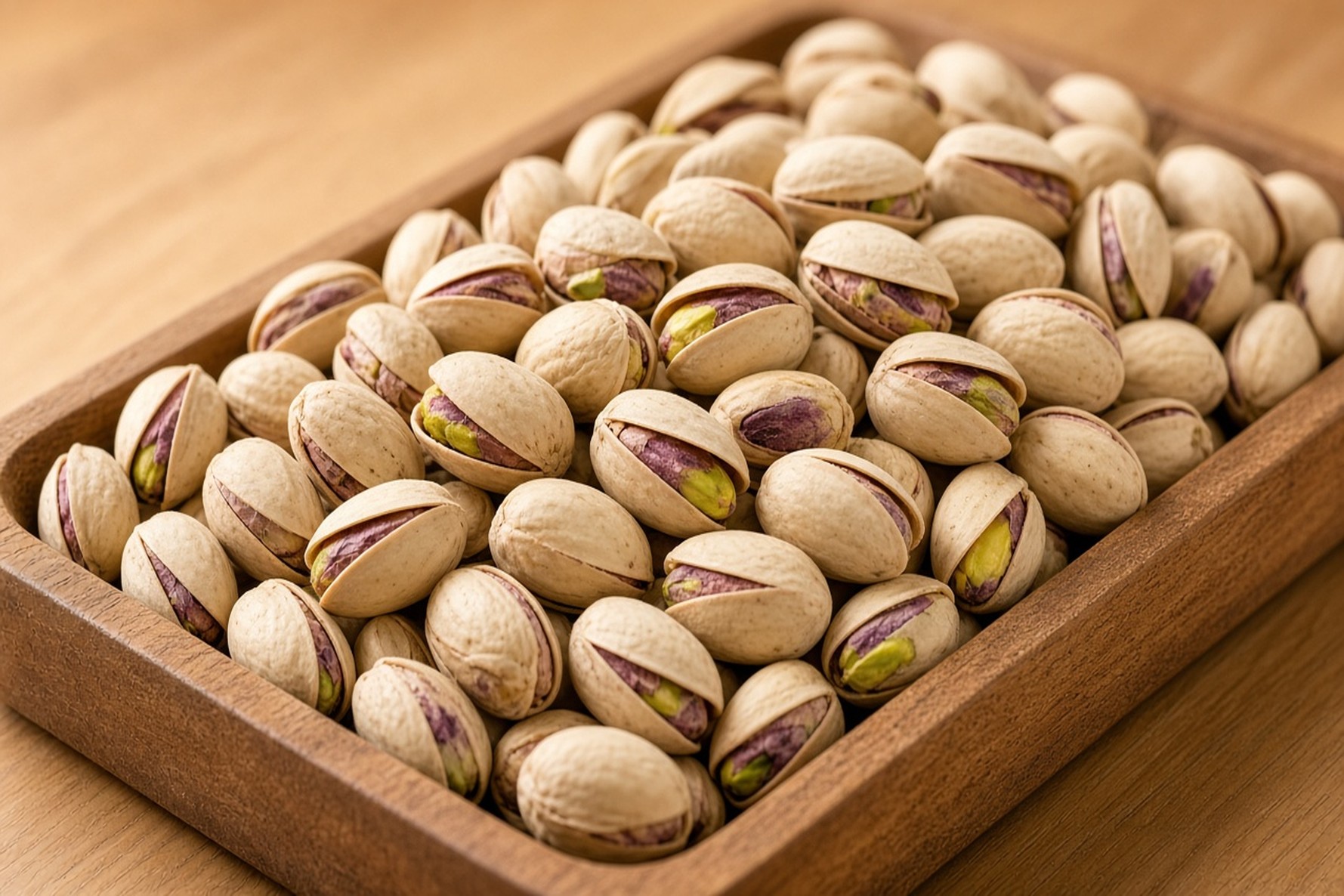
Ahmad Aghaei is one of Iran's best-known elongated pistachio cultivars in international trade. Its export value is not limited to appearance alone — light shell colour, elongated form, favourable flavour, availability in multiple commercial sizes and suitability for both retail and wholesale channels make it a product of real interest to foreign buyers.
2024 trade data shows India imported more than 40,000 tonnes of pistachio, with over 20,000 tonnes sourced from Iran — roughly half of India's recorded pistachio imports by weight. This figure covers all pistachio types and must not be interpreted as Ahmad Aghaei-specific market share.
Ahmad Aghaei export cannot be explained with phrases like "elongated, tasty Iranian pistachio" alone. For a professional buyer, a transaction only becomes meaningful when appearance is converted into measurable specifications: how many kernels per ounce? What percentage is closed-shell? Is the split natural or mechanical? How uniform and light is the shell? What is lot moisture? What are the aflatoxin test results?
Ahmad Aghaei is an elongated Iranian type typically recognised by light shells, green kernels and a thin red-to-purple skin on the kernel. Commercial sizes such as 24/26, 26/28 and 28/30 are common in trade; in this ounce-count system, a lower number means a larger kernel because the basis is the number of pistachios per ounce of weight.
India's importance to Iranian exporters is not merely geographic proximity. 2024 foreign trade data shows India was among Iran's largest pistachio import markets, with Iran and the United States as the two main suppliers. Indian buyers can therefore compare sources directly — and Iranian exporters must demonstrate advantage through measurable specifications, lot consistency and appropriate packaging.
1. Why Ahmad Aghaei matters for export
Ahmad Aghaei belongs to Iran's elongated pistachio group. Its defining visual characteristics are greater length relative to width, relatively light shells and an appearance well suited to nut retail. In commercial sources, this type is offered across multiple sizes from approximately 22/24 to 30/32, though actual availability of each size depends on the harvest year and grading operations.
Its retail advantage is that end consumers evaluate quality largely by eye before tasting. Elongation, shell whiteness or lightness, appropriate opening at the seam and kernel uniformity all help the product stand out on shelf.
That same dependence on appearance means inconsistent lots lose commercial value quickly. If an initial sample shows elongated, large, uniform kernels but the final shipment mixes sizes, stained shells, closed-shell kernels and light-kernel nuts, the gap between sample and cargo becomes obvious to the buyer.
India's position
India is a major market for Iranian pistachio. In 2024 the country imported approximately 40.15 million kg of pistachio, of which 20.32 million kg originated in Iran — valued at roughly USD 123.5 million. The United States supplied approximately 17.56 million kg as another leading source.
The practical message for Iranian exporters is clear: the Indian customer is usually familiar with competing product. A sales offer must therefore go beyond the label "Iranian pistachio" and specify appearance, size, split percentage, processing status, safety tests and packaging type.
2. Commercial specifications to define before purchase
The term "export Ahmad Aghaei pistachio" is not a complete purchase specification. Two lots with the same name can differ materially in size, opening status, moisture, colour, uniformity and defect level.
| Parameter | Option or expression | Importance for buyer |
|---|---|---|
| Product type | Ahmad Aghaei in-shell | Prevents mixing with other cultivars |
| Opening status | Natural split, mechanical or closed-shell | Direct effect on price and market position |
| Size | Count per ounce; e.g. 24/26 or 26/28 | Defines kernel size and uniformity |
| Shell colour | Light, uniform, with defined stain limit | Critical in consumer packs |
| Kernel colour | Green with red-to-purple skin | Visual and functional indicator |
| Moisture | Tested value per lot | Stability, mould risk and storage quality |
| Aflatoxin | Per destination regulations | Safety and customs clearance |
| Closed-shell % | Contractual acceptance limit | Prevents delivery disputes |
| Empty-shell & light-kernel | Contractual acceptance limit | Affects real purchase yield |
| Breakage & damage | Defined maximum | Affects appearance and waste |
| Heat treatment | Raw, roasted, salted or flavoured | Defines market and storage conditions |
| Packaging | Material, net weight, inner pack and master carton | Controls moisture, pressure and oxygen |
How size is read
In in-shell pistachio trade, size is usually expressed as kernel count per ounce. For example, 24/26 means approximately 24 to 26 pistachios per ounce — so 24/26 is larger than 28/30. This converts "large" from a subjective term into a measurable criterion.
For bulk orders, sampling method and size tolerance should also be agreed. Simply stating "26/28" without defining how uniformity is controlled does not eliminate the risk of dispute between seller and buyer.
3. How real Ahmad Aghaei quality is evaluated
Quality is a combination of appearance, flavour, kernel integrity, moisture, safety and uniformity. A lot with only light shells is not necessarily a superior shipment.
Elongated, uniform appearance
Elongated form is a key Ahmad Aghaei characteristic. Light shells and green kernels with red or purple skin are also well recognised. For export lots, "elongated" must be seen together with uniformity — large variation in length and diameter makes retail packs look irregular even if average size is acceptable.
Flavour
Acceptable pistachio flavour should be clean, fresh and free of rancidity, sourness, mould or warehouse odour. India's pistachio product standard also emphasises acceptable taste and aroma and absence of rancid fat odour. Sensory testing before bulk purchase must be performed on a sample that truly represents the lot — not freshly separated product from the processing line.
Split type
Naturally split pistachio opens during growth and ripening. Mechanically opened pistachio is opened after harvest by mechanical means. Buyers must define these groups separately. The word "split" alone is insufficient for a contract — specify natural or mechanical, acceptable closed-shell percentage and how partially open kernels are classified.
Shell colour
Light shell colour is a commercial advantage for Ahmad Aghaei. However, colour must be assessed alongside stains, discolouration, attached green hull residue, mechanical damage and uniformity. Abnormal whiteness should not replace genuine quality testing — buyers should receive clear information on processing and any product treatment.
4. Aflatoxin — the most critical food safety control point in pistachio export
Aflatoxin is not merely a laboratory topic — it is one of the most important commercial risks in international pistachio trade. Toxin-producing mould growth can be influenced by moisture, temperature, time, insect damage, processing delay, poor ventilation, water leakage or condensation in storage and transport.
Aflatoxin control must begin in the orchard at harvest and continue through drying, sorting, warehousing and shipping. Separating stained, mouldy, damaged or green-hull-contaminated pistachios is a key processing step.
European limits
Under EU regulations, pistachio intended for further sorting or physical processing before final sale has maximum aflatoxin B1 of 12 µg/kg and total of the four main aflatoxins of 15 µg/kg. For pistachio placed directly on the market for final consumption or as a food ingredient, the limits are 8 and 10 µg/kg respectively. The phrase "EU compliant" is insufficient without specifying product use status, test results and measurement units.
India market
For India, beyond contaminant limits, the product itself must comply with that country's food regulations. Under India's pistachio product standard, maximum moisture is 7%, unopened shells maximum 2% and empty shells maximum 1%. The product must also be free of foreign matter, live insects, mould and specified contaminants. Buyers must not accept an old test report or one from a different lot in place of results from a representative sample of the actual shipment.
Sampling matters more than the test certificate appearance
Aflatoxin may not be evenly distributed throughout a lot. In professional purchasing, the following should be defined:
- Which parts of the lot were sampled
- Who performed the sampling
- Which batch or lot the sample represents
- Sampling and test dates
- How aflatoxin B1 and total aflatoxin results are reported
- Acceptance criteria based on destination country
5. Ahmad Aghaei packaging by distance and sales channel
One package type is not suitable for all markets. Pistachio is a high-fat product and flavour quality is affected by oxygen, temperature, moisture and time. Vacuum packaging or nitrogen flushing are common methods for reducing oxygen inside packs.
| Sales & transport situation | Appropriate packaging approach | Main risk |
|---|---|---|
| Fast-turnover wholesale | Bulk bag or food-grade bulk pack with suitable inner layer | Moisture uptake and physical damage |
| Long sea route | Inner pack with moisture and oxygen barrier inside strong carton | Heat, humidity, condensation |
| Roasted & salted product | Wrapper with adequate moisture and oxygen barrier | Loss of crunch and fat rancidity |
| Retail pack | Multi-layer food-grade pouch, with nitrogen if needed | Oxygen, light and moisture ingress |
| Premium sale | Smaller pack with tighter appearance and uniformity control | Breakage, stains and visual downgrade |
| Industrial use | Bulk pack matched to factory consumption speed | Extended open-pack storage after opening |
The longer the route, the longer the product is exposed to temperature change, ambient humidity, port delays, loading and unloading, vibration and pressure. Moisture control is a core principle in mould prevention; if cold product enters a warm, humid environment, condensation can form on or inside the pack.
6. Pressure, stacking and pack strength in export transport
Pistachio is less pressure-sensitive than fresh fruit, but shell breakage, crushing, increased broken-kernel content and pack appearance damage still result from poor stacking.
In bulk transport, pressure can arise from:
- Weight of cartons stacked above
- Stacking beyond carton crush strength
- Compression during stowage
- Excessive strapping tension
- Carton strength loss in high humidity
- Impact during handling
- Excessive empty space inside packs
- Cargo movement inside the container
Bag or carton?
Bags are economical and practical for some bulk transactions and remain common in traditional pistachio trade. Where product appearance, pressure control, palletisation and warehouse order matter more, cartons can offer greater advantages. Cartons alone are not moisture or oxygen barriers — if the route requires such protection, product must be placed in a suitable primary pack or inner bag and the carton serves as mechanical protection and transport unit.
Overly empty packs allow excessive kernel movement. Overly tight packs transfer pressure directly to shells. Fill weight, pack dimensions and stacking pattern must therefore be designed together.
7. Packaging selection for the India market
India's market is not a single sales channel. Product may reach nut wholesalers, small retail packs, roasting operations, mixed-nut blends, confectionery or food service. The Indian buyer should therefore define the product's post-import path before selecting packaging.
Bulk pack for importer regrading and repacking
If the importer regrades, roasts or repacks after arrival, focus should be on transport protection, net weight, warehouse handling ease and moisture ingress reduction. Paying for consumer-grade packaging at origin may not be economically justified in this case.
Retail-ready product
For product going directly to retail shelves, packaging is part of the consumer experience. Aroma and crunch protection, seal strength, light and oxygen control, label readability and distribution-chain compatibility gain greater importance. Consumer packs are commonly offered in weights such as 100, 200, 250 and 500 g — but final weight choice should follow sales channel and target price, not mere imitation of an existing pack.
Gift and premium product
In this segment, Ahmad Aghaei's visual uniformity carries greater value. Light shells, elongated kernels, uniform size and low defective-kernel percentage directly affect customer quality perception. Higher sorting and packaging cost can be justified because appearance itself is part of product value.
8. Shipping and storage — preserving quality to destination
Dried pistachio does not require a strict cold chain like fresh produce, but heat remains a major factor in quality decline. Specialist pistachio sources recommend post-drying storage at approximately 10°C or below and relative humidity around 65–70% to reduce quality loss and mould risk. Actual transport design must align with route duration, season, pack type and destination infrastructure.
Sea freight
For large-volume orders, sea freight can be the economical choice. The main risk is not travel time alone but the combination of time with temperature change, humid air and condensation. Before loading: container must be dry and leak-free; packs must not sit directly on a wet floor; stowage must prevent collapse; inner packs must match route humidity; and large temperature differentials at loading must be managed.
Land transport
Land transport offers time advantages for some regional markets. However, vehicle stops in direct sun, passage through hot zones and repeated handling can affect quality. If heat-sensitive retail packs are transported, in-vehicle thermal conditions should be part of logistics assessment.
Air freight
For small lots, samples or higher-value orders, air freight can shorten transit time. Higher cost does not eliminate the need for proper packaging — cargo still passes through airport warehousing, loading and ground transfer.
9. Export markets and Iran's competition
In 2024, China, Turkey, India, the European Union and Germany were among the largest recorded destinations for Iranian pistachio. China imported approximately 40.7 million kg, India approximately 20.3 million kg and the EU approximately 7.7 million kg from Iran. These figures cover all pistachio types — Ahmad Aghaei is not separately broken out in aggregate trade statistics.
| Market | Demand characteristic | Control priority |
|---|---|---|
| India | Large direct consumption and nut market | Size, appearance, price, moisture and safety |
| China | High volume of Iranian pistachio trade | Size grading and commercial terms |
| European Union | High contaminant control sensitivity | Aflatoxin and traceability |
| Germany | Key market in European nut chain | Safety, uniformity and documentation |
| Regional markets | Wide variation in wholesale and retail channels | Packaging and delivered price |
Iran vs USA in India
2024 data shows India imported approximately 20.3 million kg from Iran and 17.6 million kg from the United States. Professional comparison therefore includes: kernels per ounce, natural or mechanical split, closed-shell percentage, actual waste, shell appearance, flavour, uniformity, aflatoxin, packaging, freight cost, sellable net weight and quality on arrival.
A lot with a nominally lower price may cost more after accounting for closed-shell kernels, defective nuts, weight loss and sorting cost.
10. Standards, tariff codes and purchase documentation
Under the current Harmonized System classification, fresh or dried pistachio falls into two main groups:
- HS Code 080251: pistachio in shell
- HS Code 080252: pistachio kernels
2024 global trade data shows worldwide imports of in-shell pistachio at approximately USD 3.39 billion and shelled pistachio at approximately USD 1.35 billion. For in-shell Ahmad Aghaei — the main subject of this article — code 080251 is the relevant HS code in the current structure. Some historical databases using older HS versions may show all pistachio under aggregated code 080250; classification version must be checked when comparing year-on-year statistics.
UNECE standard DDP-09 applies to in-shell pistachio and covers quality, classification, size, uniformity, presentation and packaging. For pistachio kernels, standard DDP-10 applies — emphasising pack content uniformity by origin, crop year, quality, size and commercial type, as well as adequate product protection within the pack. In real transactions, general standards should be converted into measurable contractual specifications.
11. How to compare Ahmad Aghaei pistachio prices correctly
Price should not be compared only as USD or EUR per kilogram. A purchase offer must be converted into "sellable quality at destination."
- Size and crop year
- Natural split and closed-shell percentages
- Shell colour and uniformity
- Stain and defect percentages
- Moisture and aflatoxin test results
- Raw or roasted status
- Packaging, order volume and sorting cost
- Delivery point, transport mode and payment terms
Analytical example
Suppose offer one has a lower price but includes higher closed-shell percentage, breakage and out-of-range sizes. Offer two is more expensive but delivers a more uniform, more sellable product. Comparing only invoice amount divided by total weight is wrong — procurement managers should calculate cost per sellable quantity at their own grade standard.
Larger size is not always the better choice. In wholesale or economy packs, medium uniform size may deliver better commercial results if the destination market does not reward extra-large kernels with higher price.
12. Pre-loading lot control
Pre-loading control must distinguish between "sample approval" and "lot approval." An initial sample supports decision-making, but the final shipment must be evaluated separately.
- Verify pistachio type matches order
- Check size by weight count
- Assess uniformity, moisture and closed-shell rate
- Control empty-shell, breakage, stains and discolouration
- Evaluate flavour and odour
- Perform aflatoxin sampling
- Verify net weight, pack integrity and carton condition
- Inspect container or transport vehicle condition
Importer checklist before placing an order
- Record the exact product type — "Iranian pistachio" is not enough; Ahmad Aghaei must be specified.
- Define in-shell or kernel status — this affects both price and tariff code.
- State size using the per-ounce count system — e.g. 24/26 or 26/28.
- Specify natural or mechanical split — the two must not be compared without agreement.
- Set the closed-shell acceptance limit with a clear contractual definition.
- Define acceptable empty-shell and light-kernel limits.
- Set acceptable breakage, stain and visual defect levels.
- State moisture numerically — India's product standard sets a 7% ceiling.
- Request aflatoxin test results for the same lot.
- Agree laboratory and sampling method in advance.
- Review a sample before the main order.
- Control final or random pre-loading sample as well.
- Define net weight per pack unit.
- Specify inner pack and master carton type.
- Align pack strength with transport route.
- Review storage conditions at origin and destination.
- Record crop year if commercially relevant.
- Clarify raw, roasted, salted or flavoured status.
- State destination country, port or city before requesting price.
- Compare prices on identical delivery terms.
What information is needed for an accurate quote?
To receive a comparable offer, an Ahmad Aghaei purchase request should include at minimum:
- Ahmad Aghaei in-shell or kernels
- Natural or mechanical split
- Desired size and closed-shell acceptance limit
- Uniformity level and target moisture
- Destination-based aflatoxin requirements
- Raw, roasted or salted status
- Pack weight — bulk or consumer format
- Nitrogen flushing requirement (yes/no)
- Total order volume, destination country and delivery port or city
- Transport mode, private-label requirement and test or certificate needs
- Commercial delivery terms
Export Ahmad Aghaei supply matched to buyer specifications
In international Ahmad Aghaei procurement, product name is only the starting point. Two offers may both be Ahmad Aghaei yet carry very different commercial value in size, split type, uniformity, moisture, aflatoxin and packaging. Buyers should convert their requirements into a purchase specification sheet before price negotiation — for example: in-shell Ahmad Aghaei, natural split, size 26/28, defined closed-shell limit, bulk pack with moisture barrier, aflatoxin testing and India destination is far more evaluable than "export pistachio price."
Iranco (iranco.com) enables buyers and importers to submit purchase requests with these details — product type, size, order volume, processing form, packaging and destination — so available supply options in Iran are reviewed against actual buyer requirements.
Conclusion
Ahmad Aghaei export delivers its real value when visual characteristics are converted into measurable specifications. Elongation, light shells and good flavour are important — but insufficient for a professional contract. Size must be defined by per-ounce count, natural and mechanical split must be separated, closed-shell and defects must have ceilings, and moisture and aflatoxin must be controlled with test results from the same lot.
For the India market, this precision matters even more. India imported more than 40,000 tonnes of pistachio in 2024 and Iran supplied over 20,000 tonnes. The market is both large and competitive — exporters relying only on Iran's name or product appearance overlook a major part of professional purchasing requirements.
Packaging must be part of transaction design. Transport distance, humidity, route temperature, stacking pressure, storage duration and sales channel determine whether simple bulk bags, moisture-barrier inner packs, strong cartons, vacuum or nitrogen flushing is the logical choice. The practical sequence for buyers is clear: define market and sales channel first, write technical product specifications second, request price third — so offers are truly comparable and the risk of sample-contract-shipment mismatch is reduced.
FAQ
Is Ahmad Aghaei pistachio suitable for the India market?
Yes. Ahmad Aghaei is a recognised Iranian type in Asian trade and its elongated form and light shell appeal to nut retail channels. India was among Iran's largest pistachio buyers in 2024. However, customs data does not report cultivar types separately — specific Ahmad Aghaei import volume should not be inferred from total pistachio statistics.
Is size 24/26 better than 28/30?
24/26 is larger because the number represents pistachio count per ounce. "Better" depends on sales channel — larger size may appeal in premium product, while medium uniform size may deliver better margin in economy packs. Uniformity and market fit matter more than absolute size.
What is the difference between natural split and mechanical split pistachio?
Natural split opens during growth and ripening; mechanical split is opened after harvest by mechanical means. Both exist in trade but must not be mixed or compared without explicit status declaration and defined closed-shell and partially-open classification.
What is the most important test for export pistachio?
Aflatoxin is one of the most important safety tests but not the only criterion. Moisture, sensory evaluation, mould status, pests and physical specifications also matter. In strict markets such as the EU, aflatoxin limits depend on whether product is for further processing or direct final consumption.
What is the maximum moisture for pistachio in the India market?
Under India's pistachio product standard, maximum moisture is 7%. The same specification sets unopened shells at maximum 2% and empty shells at maximum 1%. Buyers may set stricter contractual limits for quality or shelf-life purposes.
Is nitrogen flushing necessary for pistachio packaging?
Not mandatory for all shipments. Nitrogen is more useful when product remains in pack for extended periods and flavour preservation and oxygen reduction are priorities. Effectiveness depends on film material and seal quality — a permeable pack gradually loses the nitrogen advantage.
Why does packaging matter more on sea routes?
Sea routes typically take longer and cargo may experience significant temperature and humidity change. This increases risk of moisture uptake, condensation, carton strength loss and flavour decline. On long voyages, inner pack, carton strength, container stowage and moisture protection must be designed as one integrated system.
What is the tariff code for Ahmad Aghaei pistachio?
Under current HS classification, in-shell pistachio uses code 080251 and shelled pistachio uses 080252. Ahmad Aghaei is a commercial cultivar name — it does not have a separate HS code. Some historical databases using older HS versions may show all pistachio under code 080250.
What information is needed to buy Ahmad Aghaei pistachio directly from Iran?
Specify product type, in-shell or kernel status, size, natural or mechanical split, moisture, defect limits, aflatoxin requirements, order volume, pack weight, destination and delivery terms. Sample and test results should then be reviewed. International buyers can submit this information through an Iranco purchase request so supply options matching their specifications are evaluated.
Featured Products


Related Articles



