 Iranco Magazine Team
A comprehensive assessment of rheology, quality indices, industrial standards and sourcing for ketchup and condiment manufacturers
Hot break · Bostwick · Sauce industry · Aseptic · Quality control
Hot-Break Tomato Paste: Technical Specifications for Sauce Industries
Comprehensive assessment of rheological behavior, quality indices, industry standards, and supply process for ketchup and condiment manufacturers
This technical report provides a comprehensive analysis of the physicochemical, rheological, and quality-standard characteristics of hot-break tomato paste for use in ketchup and sauce production lines. Quality managers, formulators, and food-industry procurement specialists can rely on technical data, texture-control testing, and regional market analysis to reduce stabilizer-related costs and manage raw-material supply with technical confidence.
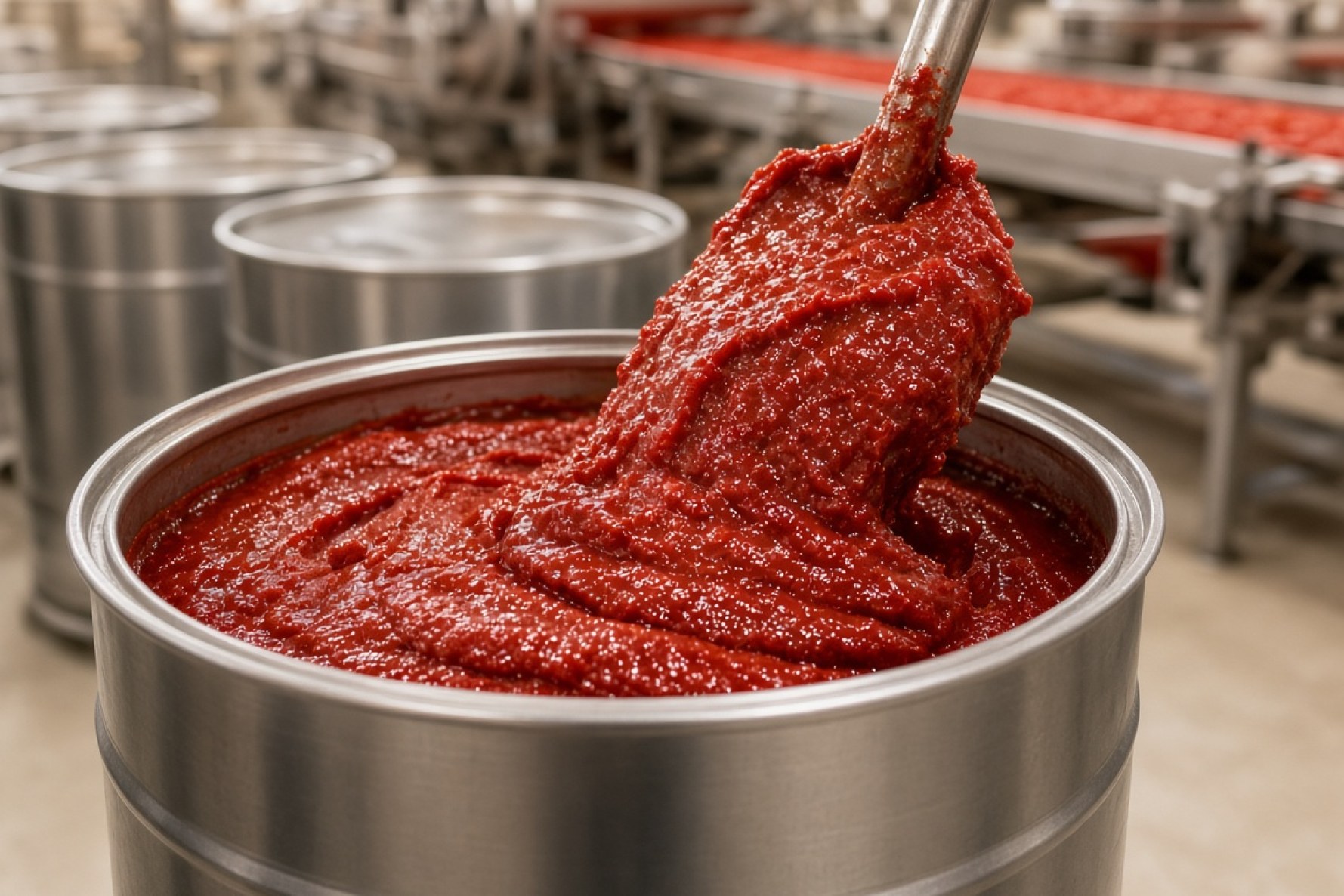
Texture stability and continuous-phase integrity are among the most challenging aspects of formulation in tomato-based sauce manufacturing. Tomato paste is not merely a flavor or color ingredient; it forms the structural matrix of the finished product. Changes in the thermal breakdown process of tomatoes fundamentally alter cellular structure and fruit pectin composition. The hot-break process rapidly inactivates pectin-degrading enzyme systems, locking intrinsic paste viscosity at the highest achievable level. This technical advantage allows sauce plants to reduce hydrocolloids, external stabilizers, and costly modified starches while preventing syneresis.
Iran’s warm, dry climate and high annual sunshine hours in regions such as Fars, Khorasan, the Qazvin plain, and the Moghan plain provide an ideal basis for industrial tomato cultivation with high dry matter and excellent initial Brix. The country’s processing industry, using modern vacuum evaporation and continuous aseptic filling lines, produces paste with physicochemical standards aligned with international markets. Understanding technical parameters such as Bostwick consistency, HunterLab color ratio, total acidity, microbiological spore load, and serum stability is the line between economic profitability and quality loss on continuous sauce lines.
1. Biochemical and thermomechanical foundations of hot break
The physical structure of fresh tomato fruit consists of cell walls rich in pectin, cellulose, and hemicellulose, which provide mechanical cohesion. In the plant cell wall, pectic polysaccharides in the middle lamella bind cells together. At the moment of mechanical breakdown on industrial crusher lines, cell walls rupture and intracellular enzymes previously sequestered in separate compartments immediately contact pectic substrates. The most important of these enzymes are pectin methylesterase and polygalacturonase.
Pectin methylesterase creates new active sites on the pectin molecule through de-esterification of methyl ester groups on the polygalacturonic acid chain and releases methanol. Polygalacturonase, which exists in endo- and exo-molecular forms, then rapidly hydrolyzes the alpha 1→4 glycosidic bonds of the homogalacturonan backbone. This continuous hydrolysis, within seconds, breaks long pectin polymer chains into low–molecular-weight fragments. Destruction of the pectin network sharply reduces surface tension of tomato liquid, causes severe viscosity loss, and prevents the product from retaining the aqueous phase in later production stages.
The hot-break process is a thermal engineering solution to definitively stop this hydrolytic cascade. On hot-break processing lines, crushed tomatoes in pressurized heat exchangers reach 90 to 100 °C within seconds. This rapid thermal shock breaks secondary and tertiary bonds in the protein structure of pectinase enzymes and, through irreversible denaturation of the active site, makes catalytic activity of pectin methylesterase and especially heat-resistant polygalacturonase impossible.
Inactivation kinetics show that at 90 °C, polygalacturonase activity stops completely in less than 60 seconds. With high–molecular-weight soluble and insoluble pectins stabilized, a robust gel network forms within the pulp mass. This network physically and chemically traps water and greatly increases yield stress.
2. Comparative rheological analysis: hot break vs. cold break
The process difference between hot break and cold break relates to initial breakdown temperature and tomato heating. On cold-break lines, preheat temperature is set in the 60 to 70 °C range. This thermal window is insufficient for rapid, complete denaturation of polygalacturonase. Enzymes therefore have time before the product reaches evaporators to hydrolyze a large share of pectin polymer chains. Cold-break paste has a more fluid structure with lower flow resistance but, due to gentler heating, shows fresher aroma, flavor, and a more natural red color.
| Evaluation parameter | Hot break | Cold break | Technical impact on sauce line |
|---|---|---|---|
| Breakdown temperature | 90 to 100°C | 60 to 70°C | Degree of pectin enzyme degradation |
| Pectic enzyme stability | Complete inactivation | Partial activity and hydrolysis | Preservation of cell-wall network in paste texture |
| Bostwick (12 Brix, 20°C) | 3.0 to 5.5 cm / 30 s | 8.0 to 10.0 cm / 30 s | Ketchup stand-up and shape retention |
| HunterLab color (a/b) | 1.90 to 2.05 | 2.10 to 2.30 | Final red brightness and appeal |
| Serum phase stability | Very high | Weak to moderate | Syneresis prevention |
| Yield stress | Very high, pseudoplastic | Moderate, tendency to flow | No unwanted spread on food |
| Formulation cost | Lower starch and gum requirement | Requires external thickeners | Lower COGS and clean label |
| Primary applications | Ketchup, BBQ, pizza and pasta sauce | Juice, soup, household paste | Rheology aligned with product target |
Hot-break paste is a time-dependent non-Newtonian fluid with strong pseudoplastic and thixotropic behavior. Coarse particles and elongated cell-wall fibers together with long dissolved pectin molecules in the serum phase create a physical barrier to flow. This yields high yield stress: until shear stress exceeds a threshold, paste or sauce behaves like a gelled solid.
On ketchup filling lines, when pressure is applied in pipes and nozzles, apparent viscosity drops sharply and pumping becomes easy; once in the bottle and shear is removed, viscosity recovers immediately. Using cold-break paste for ketchup typically requires cross-linked modified starch, xanthan, guar, or extracted pectin, which raises cost and can add starchy off-notes and haze.
3. Technical specification matrix and sauce-industry quality standards
Quality control units and R&D specialists in sauce manufacturing evaluate certificate-of-analysis parameters against official standards such as Iran National Standard No. 761 before accepting bulk paste shipments. Each index plays a specific role in texture stability and storage performance.
Natural Brix and formulation efficiency
Brix represents the weight percentage of natural soluble solids excluding added salt. Sauce industries use two standard concentrations: 30–32% Brix and ultra-concentrated 36–38% Brix. 36–38% Brix reduces freight and storage cost but requires advanced vacuum concentration so the product does not caramelize. Higher Brix means less paste is needed to reach final ketchup dry solids (typically 28 to 32%).
Bostwick consistency test
Bostwick is the reference index for evaluating the hot-break process. Concentrated paste must first be diluted with distilled water to 12.0 or 12.5% Brix at 20 °C and homogenized. A defined volume is placed in the viscometer trough; after opening the gate, fluid advance in centimeters over 30 seconds is measured. Quality hot-break paste records 3.0 to 5.5 cm; super-hot-break grades achieve less than 3.5 cm.
HunterLab color, acidity, and pH
In the HunterLab system, a indicates redness, b yellowness, and L lightness. For sauce industries, the key factor is the a/b ratio expressing red purity; hot-break paste should be at least 1.90. Total acidity as citric acid is typically 1.8 to 2.4%, and pH should be controlled in the 4.10 to 4.35 range. Under Standard 761, adding salt to bulk and export aseptic paste is not permitted.
| Quality index | Approved range | Test method | Role in product |
|---|---|---|---|
| Brix (no salt) | 30–32% or 36–38% | Refractometry at 20°C | Usage factor and dry-matter balance |
| Bostwick (12 Brix) | 3.0 to 5.5 cm in 30 s | Bostwick viscometer at 20°C | Flow behavior and ketchup shape retention |
| HunterLab color (a/b) | Minimum 1.90 (target 1.98–2.05) | Reflectance spectrophotometry | Natural redness without artificial color |
| Total acidity | 1.8 to 2.3% w/w | Titration with 0.1 N NaOH | Acid-to-sugar ratio and final tartness |
| pH | 4.10 to 4.30 | Potentiometric electrode | Control of bacterial spores |
| Howard mold count (HMC) | Maximum 35 to 40% positive fields | Howard mold count microscopy | Incoming fruit hygienic quality |
| Blotter test | Less than 10 mm in 30 minutes | Water spread on filter paper | Syneresis tendency assessment |
| Defective black specks | Maximum 4 per 10 g | Macroscopic inspection | Prevention of dark spots in sauce |
| Finisher mesh size | 0.8 to 1.2 mm per order | Cylindrical steel sieve | Mouthfeel and sauce texture |
4. Texture engineering in tomato-based sauce formulation
Industrial sauce production is a colloidal stability process. Hot-break paste structure acts as a dense dispersed phase; pectin polymer chains distribute in the serum phase and form a network that surrounds free water and blocks water migration to upper packaging layers.
Squeeze-bottle ketchup and removal of external stabilizers
In squeeze ketchup bottles, consumers expect sauce to dispense under hand pressure without excess water on food. If pectic body is insufficient, syneresis appears after two to three months of storage and a yellow water layer collects at the top. Super-hot-break paste with Bostwick below 4.0 cm can cut xanthan gum from about 0.3% to less than 0.05% while preserving clarity and sheen.
Pizza, pasta, and barbecue sauces
Pizza and marinara sauces in industrial ovens are exposed to 250 to 300 °C. If pectins were hydrolyzed by cold break, cell walls collapse, water evaporates unevenly, and aqueous phase wicks into dough. Hot-break paste with coarser mesh (1.2 to 1.5 mm) preserves hydrogen bonds at oven temperature. In barbecue sauce, high yield stress keeps spice particles in suspension and prevents sedimentation.
| Product category | Primary paste function | Suitable Brix | Finisher mesh | Water separation sensitivity |
|---|---|---|---|---|
| Premium ketchup (clean label) | Body without gum or starch | 30–32% | 0.8 mm | Critical |
| Economy ketchup | Structural support with starch | 36–38% | 0.8–1.0 mm | Critical in storage |
| Pizza and pasta sauce | Boil resistance in oven | 28–30% | 1.2–1.5 mm | High under thermal stress |
| Barbecue and steak sauce | Stable spice and smoke suspension | 36–38% | 1.0 mm | Moderate (particle settling) |
| Hot pepper sauces | Coating and acidity retention | 30–32% | 0.6–0.8 mm | High due to elevated acidity |
5. Food safety profile, microbiology, and contaminant limits
Tomato paste as an acidified product falls in the moderate microbiological risk category, but failure to meet requirements in the concentration line and aseptic system has serious food-safety consequences. Below pH 4.50, Clostridium botulinum spores cannot grow or produce toxin; nevertheless, heat-resistant acidophilic microorganisms can remain active.
- Howard test (HMC): Maximum permitted mold filaments are typically 40 to 44% positive fields; modern ketchup lines often require Howard below 30 to 35%.
- Acid-tolerant spores: Bacillus coagulans and Alicyclobacillus can cause “flat sour” spoilage; incubation tests at 31 and 55 °C are essential to rule out thermophilic spores.
- Heavy metals and residues: Maximum limits include tin 50 mg/kg, lead 0.05 mg/kg, and cadmium 0.02 mg/kg; verification of mancozeb, diazinon, and organophosphate pesticide residues is mandatory.
6. Aseptic packaging, gas permeability, and storage chain
Bulk paste supply in international markets relies on continuous thermal processing and aseptic filling without added salt or preservatives. The typical process path is:
- Vacuum concentration
- Short-time high-temperature sterilization (108 to 115°C)
- Rapid cooling (25 to 30°C)
- Filling in steam-sterile container
- Sealing multilayer bag and installing steel drum lid
Aseptic bags are built from metallized polyethylene terephthalate layers, aluminum foil, and heavy polyethylene. Oxygen transmission rate in quality films should be less than 0.05 cm³/m²·day. Bags are placed in 220 L steel drums (net weight approximately 235 to 245 kg) or 300-gallon bins (about 1,250 to 1,300 kg).
| Format | Approximate net weight | Specifications | 20-foot container |
|---|---|---|---|
| 220 L steel drum | 235–245 kg | 4-layer metallized bag, 2-inch nozzle | 80 drums ≈ 19.2 t |
| Conical drum | 230–240 kg | Telescopic nesting when empty | 80 drums on pallet |
| Industrial wooden bin | 1,250–1,300 kg | 300-gallon bag | 15–16 bins ≈ 19–20 t |
| Octabin (corrugated) | 1,000–1,200 kg | Moisture-resistant octagonal carton | 16–18 units |
7. Production geography and Iran’s climatic advantages
With four-season climate diversity and high solar radiation, Iran is one of the Middle East’s hubs for industrial tomato production. Low relative humidity, controlled evaporation, and day–night temperature swings drive accumulation of solids, sugars, and dense cell walls; incoming tomato initial Brix is typically 4.8 to 5.5%, which lowers evaporation energy demand.
Summer: Khorasan and Golestan ← Late summer: Fars and Qazvin ← Autumn: Fars ← Winter and spring: Bushehr, Khuzestan, and Hormozgan
- Fars (Marvdasht, Pasargad, Eqlid, Kazerun): Concentrated processing hub with deep red color and high viscosity.
- Khorasan Razavi (Mashhad, Chenaran, Neyshabur, Quchan): Fully automated Italian lines and high structural pectin.
- Golestan and Qazvin plain: Meaty tomatoes with thick skin and super-hot-break yield below 4 cm.
- South (Bushehr, Khuzestan, Hormozgan): Winter harvest and fresh paste supply when global producers lack fresh crop.
Iran’s processing industry exports more than 100 to 140 thousand tonnes of bulk and packed paste annually, worth over USD 140 million. Access to natural gas, domestic drum manufacturing, and road freight keeps the cost of aseptic hot-break paste competitive.
8. Target export markets and commercial requirements
Bulk paste demand structure in destination countries depends on reprocessing infrastructure, local sauce production, and repackaging. Understanding each market’s technical requirements enables shipment alignment with customs and food standards.
| Destination market | Dominant demand | Technical grade | Preferred packaging | Iran competitive factor |
|---|---|---|---|---|
| Russia and Belarus | Ketchup and composite mayonnaise | Brix 36–38, Bostwick < 4 | 220 L drum and bin | High body and cold stability |
| Iraq | Sauce, repack, and HORECA | Brix 30–32 with good color | Aseptic steel drum | Short overland distance |
| UAE and Oman | Condiments and re-export | Super-hot-break Codex-aligned | New drum on treated pallet | Brix quality and port delivery |
| Kazakhstan and Uzbekistan | Pasta sauce, pizza, household paste | Brix 36–38, 1.0 mm mesh | Drum on rail wagon | Sarakhs and Incheh Borun rail corridors |
Turkey is the main competitor in Eurasia and Iraq but faces higher energy and fresh-tomato costs. China offers aggressive pricing, but long sea transit and container costs preserve Iran’s advantage for fast regional supply.
9. Cost structure and price volatility drivers
- Farm-gate tomatoes: About 60 to 70% of cost of goods; conversion factor 5.5 to 6.5 kg fresh tomato per kg of 30–32% Brix paste.
- Packaging: New steel drum and aseptic bag costs track aluminum, steel sheet, and polymer markets.
- Brix grade: 36–38% requires more evaporation and higher steam and power use.
- Super-hot-break premium: Bostwick below 3.5 cm and color ratio above 2.0 typically trade at a price premium.
Buyers planning to source this product from Iran can review available options on Iranco and submit purchase requests based on required specifications.
10. Importer operational checklist before contract
- Explicit contract wording: “Hot-break tomato paste (Hot Break).”
- Target Brix tolerance (30–32 or 36–38) without salt at 20°C.
- Maximum Bostwick limit (e.g. 5.0 cm max at 12 Brix, 20°C, 30 seconds).
- Minimum HunterLab a/b color ratio of 1.95.
- Howard ceiling 35 to 40% maximum per Standard 761.
- Absolute prohibition of salt, starch, thickeners, preservatives, and artificial color.
- Finisher mesh size (0.8 to 1.2 mm depending on sauce type).
- New steel drums with sanitary coating and production date and batch number.
- Metallized aseptic bag with oxygen permeability below 0.05 cm³/m²·day.
- Sealed representative sample and pilot syneresis test in laboratory.
- Third-party pre-shipment inspection before loading.
- Palletization protocol, stretch wrap, and container temperature conditions on hot routes.
11. Essential information for price quotation (RFQ)
- 100% pure hot-break tomato paste
- Brix 30–32 or 36–38 (natural soluble solids, 20°C)
- Maximum Bostwick (e.g. 4.5 cm max at 12 Brix)
- Required HunterLab a/b color ratio
- Finisher mesh size (0.8 mm for ketchup or 1.2 mm for pizza)
- Maximum Howard (35 or 40%)
- Packaging type (220 L drum or bulk bin)
- Order volume (tonnage or number of 20-foot containers ≈ 19.2 t)
- Incoterms 2020 (FOB Bandar Abbas, FCA factory, CFR Jebel Ali, etc.)
- Health certificate, full COA, Non-GMO, and international halal
12. Industrial sourcing through Iranco
In international hot-break paste procurement, differences among offers are not limited to unit price. Deviation from committed Brix, Bostwick variation, color index, aseptic bag integrity, and pre-loading quality oversight can change the economics of the deal. The smallest texture defect in incoming paste can sharply increase reformulation cost or syneresis incidents.
Iranco enables buyers, food manufacturers, and traders to register purchase requests against engineered specifications—thermal process type, target Brix, Bostwick range, maximum Howard, finisher mesh, and delivery port—so sourcing from capable domestic plants can be reviewed transparently.
Summary
Choosing hot-break tomato paste for high-viscosity ketchup and condiment formulation is a technical decision that underwrites colloidal stability, sensory properties, and production economics. Rapid heating at 90 to 100 °C suppresses pectinase activity and, by protecting pectin chains, delivers desirable structural viscosity and thixotropic behavior. Sunny climate and dry-matter-rich tomatoes in hubs such as Fars and Khorasan, together with vacuum concentration and aseptic filling lines, make Iran a strategic source of 30–32 and 36–38 Brix hot-break paste. Transparent contracts based on Bostwick, HunterLab a/b ratio, Howard ceiling, and aseptic packaging integrity reduce quality risk.
Frequently asked questions
1. What is the main behavioral difference between hot break and cold break in ketchup?
Hot-break paste preserves natural pectin by inhibiting polygalacturonase above 90 °C and delivers high thixotropic viscosity that prevents phase separation. Cold break has degraded pectin and usually requires substantial starch and gum.
2. What is the standard Bostwick number for sauce industries?
After dilution to 12 Brix at 20°C, hot-break Bostwick should be 3.0 to 5.5 cm in 30 seconds. Values below 4.0 belong to super-hot-break grades.
3. Why is HunterLab color for hot break slightly lower than cold break?
90 to 100 °C thermal shock causes minor lycopene changes and mild sugar–amine reactions; hot-break a/b is typically 1.90 to 2.05 versus 2.15 to 2.30 for cold break.
4. What is the shelf life of aseptic paste in drums?
With intact metallized bag, up to 24 months below 25°C. For long-term Bostwick stability, storage at 4 to 15 °C is preferred.
5. What is the permitted Howard limit in sauce industries?
Under Standard 761 the maximum is about 40% positive fields; quality-focused manufacturers often specify below 30 to 35%.
6. How does hot break support a clean label?
Preserved natural pectin reduces need for hydrocolloids and modified starches, allowing removal of these additives from ketchup labels.
7. How can I source precise hot-break paste from Iran?
Submit Brix, Bostwick, color, and order volume in a purchase request on Iranco so verified production options can be reviewed.
8. What is the typical economic minimum order?
One 20-foot container with about 80 × 220 L drums, equivalent to roughly 19.2 to 19.5 tonnes net weight, is the common export unit.
Featured Products




Related Articles



