 Iranco Magazine Team
Supply chain analysis, starch physicochemistry, authenticity validation tests, pricing dynamics, milling standards and logistics for East Gilan premium grains
Export Guide · Sadri Hassan-Sarai Rice
Hassan-Sarai Rice: Wholesale Buying, Authenticity Checks and Iran’s Premium Rice Market
Supply-chain analysis, starch physicochemistry, authenticity validation tests, pricing dynamics, milling standards and logistics requirements for East Gilan premium grains.
Introduction: Hassan-Sarai in premium grain trade
This specialist guide reviews traditional Hassan-Sarai rice in full: grain morphology, cooking behaviour, structural differences versus other northern native types, and precise fraud-detection methods for wholesale buying. Trade managers, food distributors and exporters gain operational tools for milling oversight, durable packaging rules and strategies to enter luxury markets.
In Iran’s commercial grain market, quality native rices always outrank improved high-yield types; price is set by aroma, cooked length and texture longevity. In that ranking, Hassan-Sarai — from the ancient Sadri family — is a symbol of premium ceremonial grain. Its exclusive origin in East Gilan’s coastal plain and biological fit with Rudsar sedimentary soils produce a dense crystalline structure, excellent cooking stability and a very strong natural aroma.
Despite outstanding quality, limited acreage and agronomic sensitivity keep annual supply tiny versus commercial high-yield cultivars. That imbalance exposes the Hassan-Sarai wholesale market to blending with cheaper varieties, chemical fragrance abuse and sharp price swings. Success in high-tonnage buying depends on starch physicochemistry literacy, modern mill conversion standards, and lab plus sensory tests before contracting. This report covers the technical, quality and commercial dimensions needed for wholesale and export of this precious grain. To file specs and receive supply options, contact Iranco.
1. Ecological origin, agronomic history and cultivation spread in Gilan
Hassan-Sarai rice traces to the coastal village of Hassan-Sara and linked plains of Rudsar County in eastern Gilan. In past decades the traditional variety also spread across Langarud, Kelachay, Amlash and parts of the Astaneh Ashrafieh and Kiashahr plains. Soils are clay–loam alluvium rich in organic matter, micronutrients and exchangeable potassium from perennial rivers such as Polrud. Fertile soil, mild Caspian breeze and controlled atmospheric humidity create ideal conditions for strong starch chains in the endosperm.
Cultivation follows a fixed calendar: nursery and sowing from late Farvardin; transplanting in Ordibehesht. Growth from transplant to field maturity is 110–125 days. Panicle initiation mid-Tir; traditional or mechanised harvest mid-Mordad to early Shahrivar. Hassan-Sarai is heat-loving with balanced light need; grain fill under sunny Mordad weather maximises aromatic metabolite accumulation in husk and kernel.
Field morphology shows tall, slender stems often exceeding 135 cm. Height aids light capture but raises lodging risk under late-summer coastal winds or heavy rain. Paddy yield is only 3–3.5 t/ha versus 5–6+ t for high-yield types. Difficult agronomy and blast susceptibility have pushed many growers to tougher cultivars, leaving authentic Hassan-Sarai largely with veteran East Gilan farmers.
2. Physicochemistry, starch molecular structure and cooking behaviour
Commercial value hinges on starch rheology during cooking. Most dry matter of milled grain is starch granules of amylose and amylopectin.
Pure Hassan-Sarai amylose sits in the optimal 19.5–21.5% band — critical for Iranian premium long-grain. Below 18% yields sticky, soft gel like short-grain; above 25% makes cooked grain hard, dry and brittle. Balanced amylose lets grains absorb enough water while keeping cell-wall integrity and avoiding pastiness.
- Gel consistency: 70–85 mm (soft gel) — soft, light, cottony texture for up to 24 hours after cooling.
- Gelatinisation temperature: 68–72 °C (intermediate) — even hot-water penetration without belly burst.
- Signature aroma: 2-acetyl-1-pyrroline in aleurone and endosperm; deep fragrance on wash and cook.
| Physicochemical index | Hassan-Sarai value | Commercial & cooking impact |
|---|---|---|
| Raw grain length | 7.5–8.2 mm | Bone-like structure; Sadri authenticity |
| Raw grain width | 1.6–1.8 mm | Needle shape; no belly bulge |
| Length/width ratio | 4.2–4.6 | Extra-long grain class |
| Cooked grain length | 14.0–16.2 mm | Rare elongation; premium plate look |
| Linear expansion (ri) | 1.9–2.05× | More portions per dry kilogram |
| Amylose content | 19.5–21.5% | Separate grains without brittle stickiness |
| Gel consistency | 70–85 mm | Lasting softness after cooling |
| Gelatinisation temp. | 68–72 °C | Uniform water uptake without cracking |
3. Specialist comparison with other northern premium rices
The comparative table below places Hassan-Sarai against Tarom Hashemi, Gilan Dom-Siah Sadri and Mazandaran local Tarom on structure and market position:
| Criterion | Hassan-Sarai (Gilan) | Dom-Siah Sadri | Tarom Hashemi | Local Tarom |
|---|---|---|---|---|
| Native root | Unimproved Sadri, East Gilan | Classic Dom-Siah Sadri | Natural mutant of Binam | Authentic Babol / Fereydunkenar Tarom |
| Raw length | 7.5–8.2 mm | 7.4–8.0 mm | 7.2–7.6 mm | 7.0–7.4 mm |
| Cooked length | 14.0–16.2 mm | 13.5–15.5 mm | 12.5–13.8 mm | 12.0–13.2 mm |
| Grain geometry | Needle-thin, sharp tip | Elongated, bony, dark tip | Elongated, slightly wider belly | Thicker, slight curve |
| Elongation ratio | > 1.95× | 1.85–1.9× | 1.7–1.8× | 1.65–1.75× |
| Aroma intensity | Very high, penetrating, durable | High and lasting | Medium to high | High, mild, traditional |
| Softness longevity | Up to 24 h | Up to 18 h | Up to 12 h | Up to 10 h |
| Annual volume | Very limited (scarce) | Limited, niche | Very abundant | Very abundant |
| Wholesale price class | Top premium tier | Premium | Market baseline | Commercial premium |
Cooked length puts Hassan-Sarai ahead of Tarom Hashemi. Hashemi grains are popular but wider with lower elongation. Morphologically Hassan-Sarai is close to Dom-Siah Sadri, yet finer and more ceremonial in stretch and softness.
4. Quality assessment, sensory tests and wholesale fraud detection
Scarce supply versus high demand tempts blenders to mix Khazar, Fajr, Neda or Shiroudi. Wholesale buyers must prove authenticity at the mill with science and sensory checks.
Palm friction–heat aroma test
Rub ~50 g between palms for 40 seconds. Genuine Hassan-Sarai releases gradual bran and plant aroma lasting minutes on skin. Synthetic essence starts perfume-like then fades within ~10 seconds to cardboard, stale moisture or rancid fat.
Geometry on a dark board
Grains show full longitudinal symmetry, narrow tip, semi-crystalline uniformity and no asymmetric belly. Spread 100 g on matte black. Broad tips, chalky white spots over 3%, or unnatural curves point to high-yield blends such as Shiroudi or Fajr.
Immersion and density separation
Drop a handful into cold water. Quality Hassan-Sarai sinks at once. Immature, chalky or heat-damaged grains float mid-layer. An oily or rainbow film signals paraffin or polish oils.
Boil and laboratory elongation
The most reliable fraud check is cooking ≥250 g. Pure Hassan-Sarai elongates only lengthwise; width stays stable; pot water stays clear without sticky scum. Cloudy viscous water and mid-line cracks or belly burst mean high-yield starch contamination.
5. Technical specs, lab requirements and ISIRI 127 limits
Wholesale quality limits follow Iran National Standard 127 “Rice — Specifications and test methods”. Premium Hassan-Sarai contracts use tighter tolerances than general commercial grades:
| Quality index | ISIRI 127 limit | Premium Hassan-Sarai lot | Deviation impact |
|---|---|---|---|
| Final moisture | ≤ 14.5% | 12.5–13.5% | Weevil and mould risk |
| Broken grains | ≤ 8.0% (grade 1) | < 1.5% (laser sorted) | Less elongation; pasty glaze |
| Chalky / opaque | ≤ 3.0% | < 1.0% | Breakage; uneven cook |
| Red / streaked | ≤ 2.0% | < 0.2% | Visual downgrade |
| Damaged grains | ≤ 1.0% | < 0.1% | Microbial risk |
| Variety purity | ≥ 85% | ≥ 98% | Multi-phase cook times |
| Mineral foreign matter | ≤ 0.1% | Absolute zero | Dental risk; brand damage |
| Storage insects | Absolute zero | Absolute zero | Return / contract void |
| Total aflatoxin | ≤ 30 µg/kg | < 4 µg/kg | Health seizure |
| Lead (Pb) | ≤ 0.15 mg/kg | < 0.05 mg/kg | FDA/IFDA non-compliance |
| Cadmium (Cd) | ≤ 0.06 mg/kg | < 0.02 mg/kg | Customs rejection |
Measure on random uniform samples with calibrated dielectric moisture meters, standard sieves and atomic-absorption spectrometers.
6. Industrial processing, milling technology and ageing management
Narrow, sensitive Hassan-Sarai needs advanced mills; traditional lines shatter endosperm and destroy yield.
Paddy drying is the critical step. Field paddy holds 20–24% moisture. Bring to a safe ~13% in indirect warm-air vertical dryers at 38–42 °C over 48–72 hours. Sudden heat above 45 °C creates hidden sun-checks that become broken grains at husking.
- Rubber-roll huskers with differential speed for gentle dehulling.
- Two-stage vertical abrasive whitening with graded stones — less heating, aroma retention.
- Multi-deck vibrating screens and gravity destoners for brokens and grit.
- Optical/laser sorting with HD cameras and NIR sensors for yellow, spotted, black-tip and chalky grains.
Starch settling and grain ageing
Freshly milled white Hassan-Sarai is not ready for banquet or restaurant cook. Free intercellular water and incomplete hydrophobic protein bonds make new rice shed water and stick. Hold lots 2–3 months in dark, cool, ventilated stores. Amylase activity falls, free membrane lipids oxidise in a controlled way and protein walls densify — yielding aged rice with maximum elongation and separate grains.
7. Wholesale market dynamics, seasonal swings and pricing drivers
Scarce, niche supply gives Hassan-Sarai different price behaviour from mass rices — tied to season, mill intake and upper-income purchasing power.
| Calendar season | Mill supply | Trade demand | Buyer strategy |
|---|---|---|---|
| Mordad–Shahrivar | Peak harvest & fresh milling | Low (aversion to new rice) | Buy paddy/new rice at floor; store to age |
| Mehr–Azar | Falling paddy; cook stable | Gradual corporate/wholesale orders | Best window for sorted stable lots |
| Dey–Esfand | Mills emptying | Nowruz & office-voucher peak | Accept rising prices; tighter authenticity |
| Farvardin–Tir | Drip supply from trader stores | Steady luxury restaurant demand | Year-high prices; storage pest risk |
Core price drivers:
- Harvest rain: Continuous Mordad rain can raise mill breakage ~30% and spike sound-grain prices.
- Optical sorting: Traditional cleaning trades 15–25% cheaper than laser-sorted lots (<1% broken).
- Lot purity: Lab-proven 100% Hassan-Sarai commands a clear quality premium.
Organisations wanting direct supply with purity guarantees can use Iranco to query and compare offers from established Gilan mills.
8. Commercial uses, target segments and luxury foodservice standards
- Five-star hotels & diplomatic clubs: Ceremonial look and aroma that hold through long service; crystalline elongated grains on formal ware.
- First-class airline catering: Deep natural aroma and soft texture offset muted taste in dry, low-pressure cabins.
- Corporate gift baskets & luxury retail: Hardbox or brocade sacks of 2–5 kg alongside top saffron.
9. Export capacity, international markets and entry rules
Volume in world grain trade sits with cheap Pakistani/Indian basmati — dry after cooling. Sadri Hassan-Sarai is sold abroad as ultra-luxury authentic Iranian food, not a daily staple.
| Destination | Demand profile | Preferred pack | Legal requirements |
|---|---|---|---|
| UAE (Dubai) | Fine dining; affluent Arab & expat traders | Jute/cloth 5 & 10 kg, double-stitched | Dubai Municipality; heavy metals & aflatoxin |
| Germany | Iranian diaspora; organic & gourmet | Clear vacuum 1–2 kg | Strictest EU pesticide MRLs |
| Canada | Toronto/Vancouver Iranians; ME specialty retail | 5-layer laminate zip with handle | CFIA pest & total ash rules |
| Qatar & Oman | Ceremonial; high-end Doha/Muscat hotels | Heavy muslin 10 & 20 kg; AR/EN print | Phytosanitary, origin & GSO |
HS code and exit documents
Iranian white rice exports declare under HS 1006.30.20 “wholly milled polished or glazed rice”. From Anzali, Bandar Abbas or Bushehr you need:
- Valid phytosanitary certificate (Plant Protection Organisation)
- Human-consumption health certificate (Ministry of Health Food & Drug)
- Physicochemical test report (breakage %, moisture)
- Conformity certificate to destination technical specs
10. Packaging tech, pest-safe storage and international logistics
| Pack type | Advantages | Limits | Ideal use |
|---|---|---|---|
| Cotton muslin | Air exchange; traditional look | Moisture & insect permeable | Fast-turn domestic wholesale |
| Multi-layer PA vacuum | O₂ out; aroma hold; kills larvae | Puncture risk; higher cost | Ocean export to Europe & Canada |
| Laminated PP | Tensile strength; dust/water barrier | Traps grain moisture | Road haul to neighbours in dry season |
| Metal/glass + inert gas | Full light/O₂/physical protection | Weight & pack cost | Gift sets; ultra-luxury boutiques |
Rice weevil control (Sitophilus oryzae)
- Hold stores at 12–15 °C and relative humidity under 50%.
- Stack on plastic pallets 40 cm off floor and 60 cm from walls for airflow.
- Ozone aeration or intermittent CO₂ injection — no toxic phosphine residue.
Container logistics and sweat (“container rain”)
In 20-ft Persian Gulf or ocean moves, day–night temperature swings condense vapour under the roof. Use thermal container liners and calcium-chloride desiccant poles in all four corners. Wash, disinfect and dry the container before stuffing; no fuel or previous-cargo odours.
11. Pre-contract checklist for wholesale buyers and importers
12. How to write a price inquiry and required proforma data
Vague asks like “what is Hassan-Sarai rice price?” invite misleading quotes on grade-two lots. Include:
- Exact grain: pure East Gilan Sadri Hassan-Sarai
- Requested tonnage (kg or t)
- Guaranteed breakage: <1%, max 2%, or commercial normal
- Sorting: simple sieve vs double optical/laser without foreign grain
- Age: aged 2–6 months or autumn new crop
- Pack format/size: muslin, nylon vacuum, laminate 2/5/10/20 kg
- Bag mark: buyer private label or mill brand
- Delivery point: East Gilan mill door or buyer warehouse
- Chemical tests: pesticide residues and heavy metals
Wholesale buyers can file the same specs on Iranco so formal inquiries go to vetted northern processors for competitive quotes.
Direct Hassan-Sarai supply from Gilan producers via Iranco
Buying scarce northern luxury rice always risks supplier credibility, lot inconsistency and blending in storage. Small shifts in breakage, moisture or impurity can erase high-tonnage value.
Iranco — Iran’s specialist food-industry trade platform — connects professional buyers, distributors, hospitality managers and international traders with modern mills and veteran East Gilan growers. Buyers register sorting grade, broken tolerance, barrier packs and delivery windows. Quality validation, sealed factory samples and pre-loading inspection coordination reduce execution risk on premium lots.
If you need stable authentic Hassan-Sarai for domestic or cross-border clients, submit specs and estimated tonnage via the Iranco purchase form so supply options can be reviewed and followed up.
Analytical summary and market strategy
Hassan-Sarai is the peak ecological expression of Gilan paddies — aromatic, fine-cooking, ceremonial grain. Limited yield and hard agronomy block commodity scale, yet scarcity creates profit in ultra-premium grain segments.
Informed wholesale decisions rest on: (1) geometry and physicochemistry to reject fakes and high-yield blends; (2) laser sorting plus starch dormancy for maximum cook elongation; (3) modern moisture-barrier packs and cool storage against pests and volatile aroma loss. These technical principles protect large buyers’ margins and exporters’ reputations in competitive global markets.
FAQ for buyers and market players
What is the main visual trait of pure Hassan-Sarai?
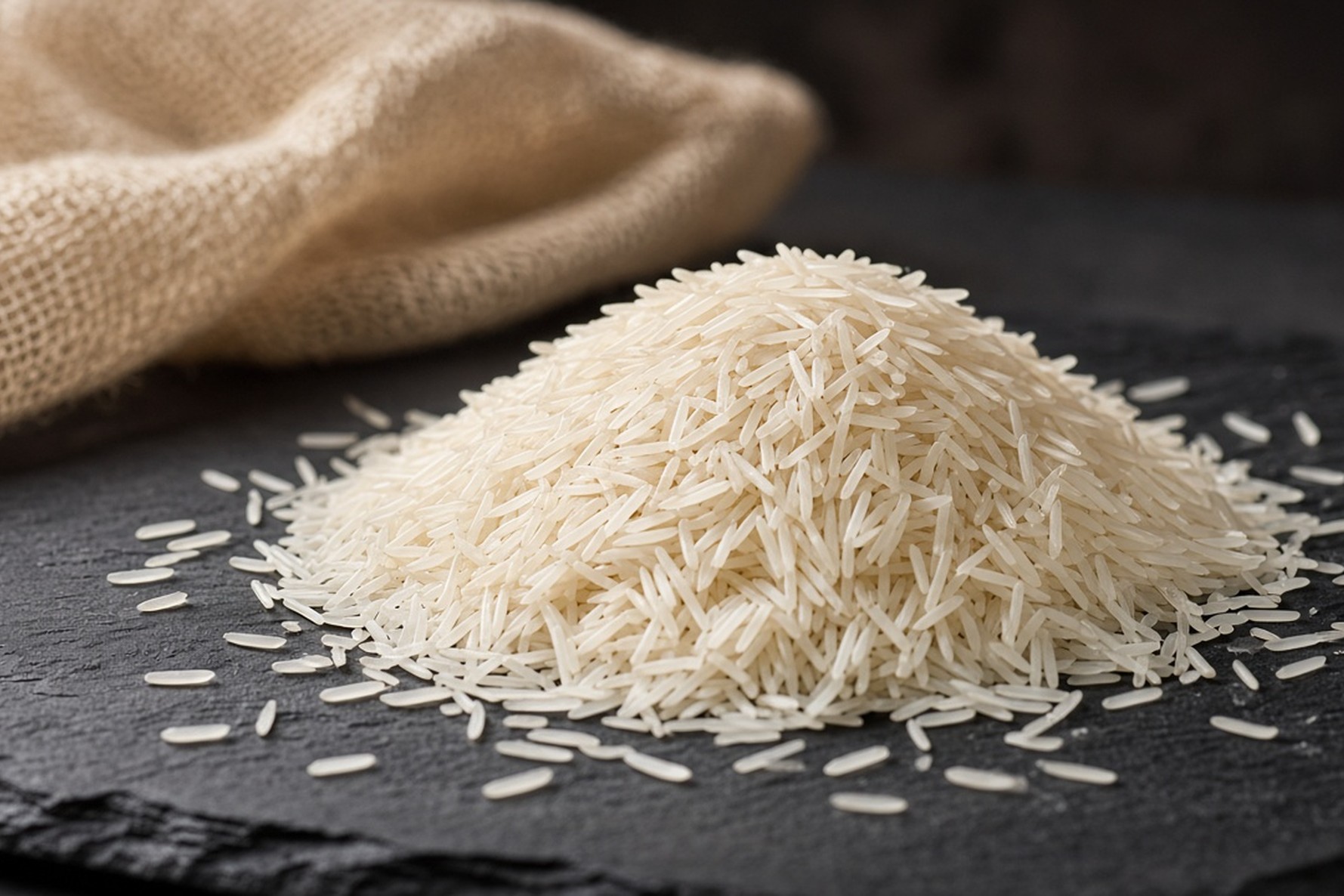
Narrow, long, highly elongated needle (“qalami”) grain with semi-crystalline ivory colour. Unlike many high-yield types it has no flat tip cut and no asymmetric belly chalk.
What is the cooked elongation (ri) ratio?
Raw length ~7.5–8.2 mm reaches 14–16.2 mm cooked — nearly 2× — elongating without widening.
Why is wholesale price higher than Tarom Hashemi?
Lower field yield (~3 t paddy/ha), lodging-prone stems, limited East Gilan acreage and constant ceremonial/luxury demand.
Advantage of aged vs new Hassan-Sarai in cook?
Aged grain has stabilized protein bonds and less free moisture — absorbs less surface water, does not burst, sheds no sticky glaze and maximises height and grain separation.
How to check aroma authenticity without a lab?
Rub ~50 g in palms for 40 seconds; friction heat should release lasting bran/paddy aroma. Sharp perfume that vanishes into burnt-oil smell signals chemical essence.
Best pack for ocean export?
Multi-layer polyamide vacuum — blocks O₂ and moisture, keeps aroma and stops weevil eggs on long ocean routes.
How does Iranco wholesale supply from Gilan work?
Buyer files tonnage, breakage, pack and destination; options from vetted Gilan plants are assessed; sealed samples ship; after cook approval, supply and delivery proceed.
Pest-safe storage against rice weevil?
Store under 15 °C and RH under 50%; bags on pallets away from walls; regular ventilation.
Featured Products




Related Articles



