 Iranco Magazine Team
Technical specs, hygiene requirements, cold-chain management, slaughterhouse assessment and wholesale distribution strategies
Sourcing Guide · Poultry Protein · Distribution
Frozen Quail: Sourcing Guide for Distribution Companies
Analysis of technical specifications, hygiene requirements, cold-chain management, slaughterhouse assessment and wholesale distribution strategies — published in the Iranco magazine.
This specialist guide examines technical dimensions, quality indices, veterinary hygiene standards and contractual considerations for purchasing frozen quail meat. Distribution company buyers and traders who study this report master carcass quality criteria, freezing technology assessment, transport rules and RFQ documentation.
Introduction
Protein distribution networks have recently shifted toward white meats with high biological value and greater basket diversity. Frozen quail meat has moved from a niche luxury SKU to a product with steady throughput in both last-mile and national distribution chains. Biological traits of the bird—fast growth, a short 35-to-42-day rearing cycle and solid carcass yield—create continuous production flow. Preserving commercial value at industrial scale nevertheless faces multiple technical challenges. Quail meat, with its high soluble-protein ratio and fine muscle texture, is highly vulnerable to thermal shock, moisture loss and cold-chain damage.
In Iran, concentrated farming hubs with industrial slaughter and packing lines provide the tonnage distributors need. Despite that infrastructure, many wholesale buyers still face carcass weight inconsistency, severe drip loss after thawing, freezer burn and visual defects. These failures threaten distributor margin and trigger returns from store shelves or professional kitchens. A sound buying strategy requires command of freezing technologies, microbiology requirements, secondary packaging standards and transport risk management. This report gives commercial managers, QA leads and supply-chain planners an operational framework to contain wholesale buying risk and build a stable protein assortment.
1. Production geography and quail meat supply-chain capacity in Iran
Quail farming in Iran has shifted from scattered traditional units to concentrated industrial complexes with full chains. Japanese quail is the main breed reared in the country. Climatic suitability for hot, dry conditions has concentrated parent stock, hatcheries and grow-out farms on the central plateau.
Provincial hubs and production capacity
Yazd Province is unequivocally Iran’s main hub for quail rearing and meat production, supplying more than 60 to 70 percent of volume. Taft, Meybod and Yazd host specialised small-poultry slaughter plants that process, freeze and pack product for domestic and export destinations.
Beyond Yazd, industrial units operate in Isfahan, Kerman, Lorestan, Fars and Tehran. Equipped farms in Isfahan and Lorestan provide useful backup capacity for distribution networks. Modern plants in these regions process carcasses under continuous veterinary supervision using advanced chilling systems and mechanised evisceration lines.
| Province / region | Approx. share | Supply-chain competitive edge | Industrial infrastructure |
|---|---|---|---|
| Yazd (Meybod, Taft, Yazd) | 60%–70% | Full chain from parent flock to blast tunnels | Specialised poultry plants and sub-zero cold stores |
| Isfahan | About 15% | Fast access to the national distribution network | Automated grow-out halls and packing bases |
| Kerman & Fars | About 8% | Production stability in cold seasons | Industrial grow-out and dual-purpose slaughter units |
| Other (Lorestan, Tehran…) | About 10% | Proximity to major consumption hubs and metros | Semi-industrial farms and last-mile packing lines |
Year-round supply stability
The short quail rearing cycle (about six weeks) versus other poultry creates exceptional flexibility in placement capacity. Feed and fuel price swings still affect output by season. Large farms stabilise bird inflow to plants through forward contracts with national distributors. Wholesale buyers who focus on integrated parent and slaughter complexes in Yazd and Isfahan minimise tonnage volatility.
2. Qualitative anatomy, weight grading and physical carcass specs
Cook-ready quail carcass assessment follows precise slaughterhouse criteria and muscle morphology. A dressed quail carcass is the whole bird after complete plucking, feet removed at the hock joint (between tibia and tarsus), head removed at the first cervical vertebra, and full removal of the digestive tract, lungs, excess peritoneal fat and reproductive organs.
Tissue ratios and slaughter yield
Live weight at slaughter usually sits between 210 and 260 g. Cook-ready carcass yield versus live weight typically stabilises at about 68 to 72 percent on industrial lines. Breast muscle is the core protein value; more than 32 to 35 percent of carcass weight is breast, with higher protein and far less intramuscular fat than broiler chicken. The skeleton is fine, dense and light, so extractable lean meat relative to total carcass weight rates high.
Standard weight classes in the wholesale market
Carcass weight uniformity is a key sales success factor. Carcasses fall into three weight bands:
- Light (120–140 g): Early-slaughter birds used mainly for industrial soups, extract production or value-priced retail packs.
- Medium / standard (140–180 g): The most popular range in retail and restaurant channels, balancing carcass size, cook time and meat ratio.
- Heavy (180–220 g): From heavy meat flocks; sought by premium traditional restaurants and hotels for impressive platter presentation.
| Anatomical trait | Premium (industrial) grade | Standard grade | Buyer / distributor relevance |
|---|---|---|---|
| Individual carcass weight | 150–170 g (±5 g tolerance) | 130–210 g (wide band) | Kitchen cost control and shelf uniformity |
| Carton uniformity ratio | >95% of carcasses in the same band | 80–85% of carcasses | Fewer end-customer complaints on size variance |
| Plucking & skin cleanliness | Free of pin feathers, stubs and sheaths | Max. 2 fine stubs on the back | Less kitchen prep time; better appearance |
| Skeleton integrity | No keel, femur or shoulder fractures | Wing-tip breaks <3% of carcasses | Tissue hold in cooking; fewer pack tears |
| Viscera removal | Full removal of crop, trachea, lungs, kidneys | General removal; minor kidney residues possible | Prevents internal spoilage and off-odours |
| Freezing integrity | Separate freeze; firm tissue, no deformation | Dense freeze with surface carcass contact | Easy portion separation without full defrost |
3. Biochemical analysis and freezing technology: blast vs IQF
Freezing directly affects protein structure, water-holding capacity and flavour shelf life of quail meat. Freezing speed determines ice-crystal size and location in the cellular matrix.
Crystallisation thermodynamics and tissue damage
Free water in quail muscle fibres freezes most readily between −0.5 and −5 °C. Slow passage through this critical band drives water into extracellular space and forms large, elongated, irregular ice crystals that puncture the sarcolemma. Very fast transit through the thermal phase forms millions of fine intra- and extracellular crystals with minimal physical damage to actin–myosin fibres.
Conventional air-blast freezing in cold tunnels
On many packing lines, tray or vacuum packs are placed on mesh trays and enter blast tunnels at −35 to −40 °C. Strong airflow at 2–4 m/s removes heat. Reaching −18 °C at bone depth takes about 3 to 6 hours. The method is economical for pre-packed loads, but longer freeze times raise post-thaw drip risk to about 4–7 percent of total meat weight.
Individually Quick Frozen (IQF) technology
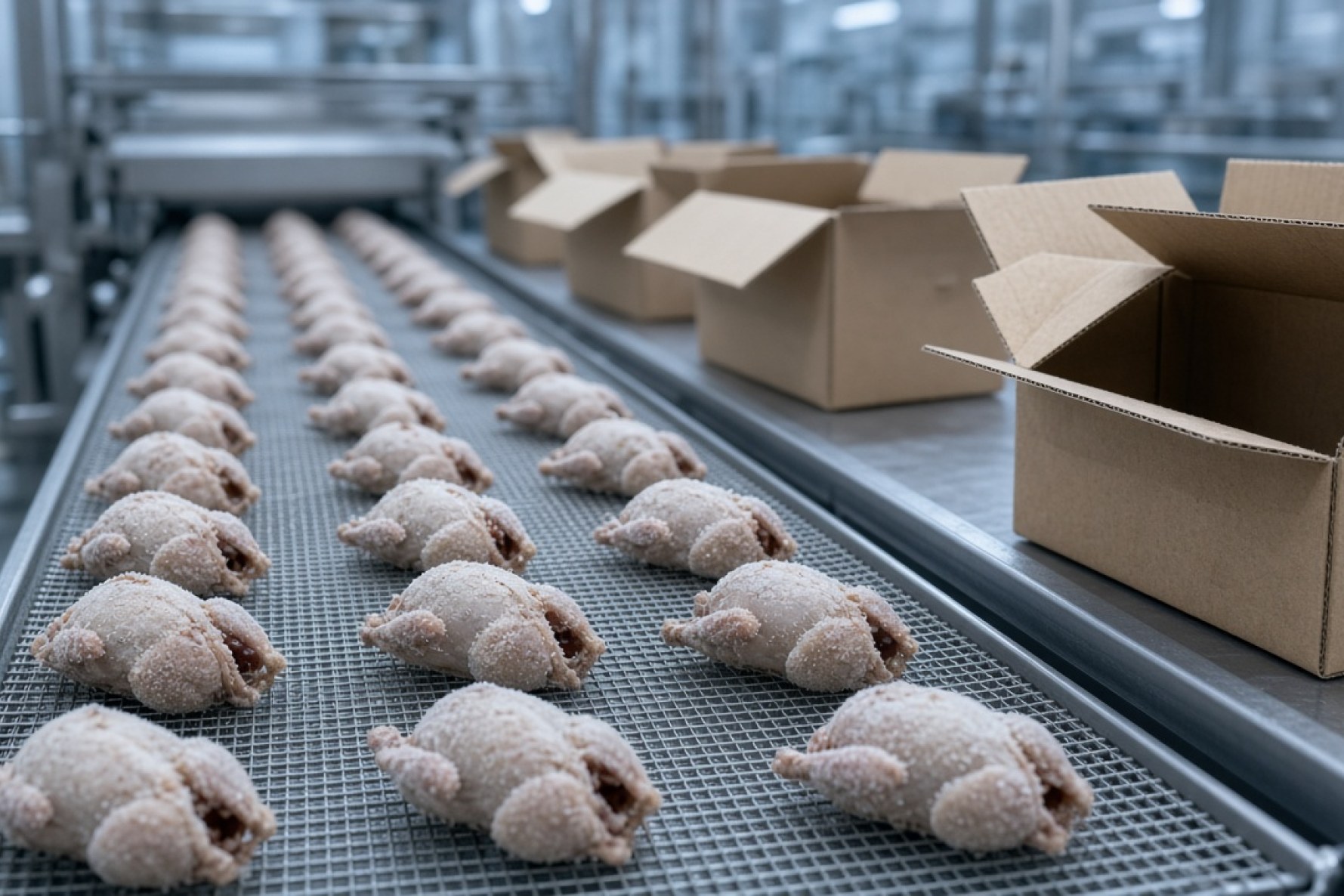
In IQF systems, clean carcasses without primary packaging travel separately on moving belts or fluidised-bed tunnels. Exposure to −40 °C air with powerful vortex flow reaches core freeze in 15 to 25 minutes. Cellular structure is preserved and drip loss falls below 2 percent.
IQF carcasses have a glossy surface without white frost crystals and do not stick together. Distributors supplying restaurants and foodservice prefer this technology because chefs can remove only the number of birds needed without opening an entire frozen block.
| Conventional tunnel blast | Individually Quick Frozen (IQF) |
|---|---|
| Process time: 3–6 hours | Process time: 15–25 minutes |
| Large ice crystals | Microscopic ice crystals |
| Muscle cell wall rupture | Protein structure and membrane preserved |
| Post-thaw drip: 4–7% | Post-thaw drip: 1–2% |
| Carcasses may stick together | Fully separated carcasses |
4. Hygiene requirements and veterinary microbiology standards
Freshly slaughtered quail meat has a pH of about 5.8 to 6.2—highly favourable for pathogens and spoilage flora. Distributors must require shipment conformity with national standards and Iran Veterinary Organization rules in purchase documents to protect public health and avoid regulatory seizure.
Critical bacteriological tests
- Salmonella spp.: The primary pathogen risk index on poultry carcasses. Veterinary rules require Salmonella absence in 25 g of tissue. Even one colony makes the lot unfit for consumption and legally requires destruction.
- Escherichia coli: Marker of faecal contamination and hygiene failures during evisceration. Standard maximum load is typically 500 to 5,000 CFU/g of meat tissue.
- Total viable count (TVC): Reflects plant hygiene, chiller water temperature and transfer speed to the freeze tunnel. Desirable limit is below 10⁵ CFU/g; critical acceptance ceiling is 5×10⁶ CFU/g.
Chemical indices of protein and fat degradation
During frozen storage, intracellular enzymes and fat oxidation continue slowly. Two chemical factors are monitored:
- Total volatile nitrogen (TVN): From bacterial or enzymatic amino-acid breakdown. In good frozen quail, TVN should stay below 15 mg/100 g meat. Above 20 mg/100 g signals early spoilage and certain loss of eating quality.
- Peroxide value: Index of unsaturated fatty-acid oxidation. Quail body fat turns oxidatively rancid under long storage or temperature swings. Peroxide value should remain below 2 meq active oxygen per kg carcass fat.
| Quality test | Reference standard | Desirable limit | Critical acceptance | Consequence of breach |
|---|---|---|---|---|
| Salmonella | INSO 1810-122 | Negative in 25 g | Negative in 25 g | Lot destruction and supplier legal action |
| E. coli | INSO 2946 | <50 CFU/g | 500 CFU/g | Shorter shelf life; plant hygiene warning |
| Total viable count (TVC) | INSO 9714 | < 10⁵ CFU/g | 5×10⁶ CFU/g | Souring and off-odour after thawing |
| Drug residues (MRL) | Official IVO rules | Below detection threshold | Maximum MRL ceiling | Quarantine seizure and health risks |
| Total volatile nitrogen (TVN) | Meat chemical assays | <14 mg | 20 mg/100 g | Sharp ammonia odour and muscle spoilage |
Sourcing from plants with valid hygiene certificates, HACCP systems and periodic analyses secures the distributor’s network.
5. Primary and secondary packaging engineering and palletisation
Frozen quail packaging is essential to block moisture exchange, curb oxidative reactions and provide physical resistance in distribution. The delicate quail skeleton requires covers that limit air ingress and mechanical damage.
Primary (food-contact) packaging
Three packaging technologies dominate the protein market:
Tray with stretch film
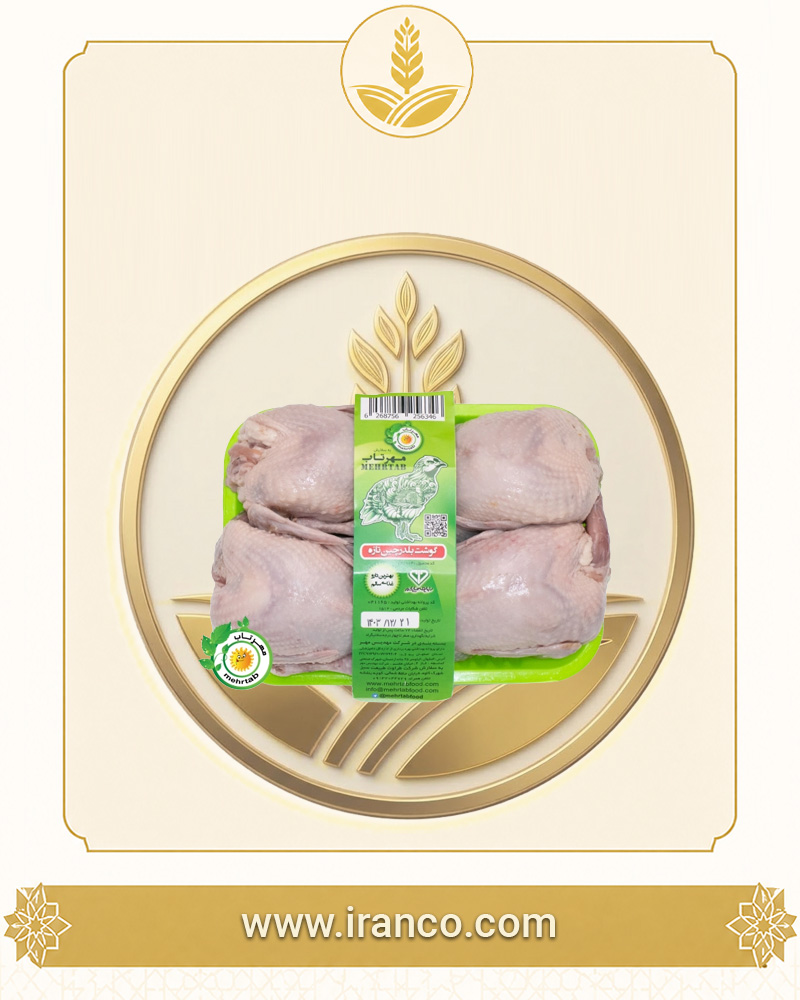
The most common method in traditional retail: carcasses (usually 2, 4 or 6 pieces) sit in foam polystyrene or clear polypropylene trays wrapped with PVC stretch film. Unit cost is low, but gas permeability is high and freezer burn often appears after 3–4 months in store freezers. A food-grade absorbent pad in the tray base is essential to control free water.
Vacuum skin pack
Multilayer PA/PE film under deep vacuum conforms directly to carcass contours. No free headspace remains for air or frost crystals. Birds stay fixed in place, shelf life rises to 12 months, and hypermarket shelves gain a professional look.
Modified-atmosphere packaging (MAP)
Inert gas blends of carbon dioxide (to inhibit aerobic bacteria) and nitrogen (as a non-reactive filler) are injected into impermeable heat-sealed trays. MAP delivers the highest flavour and texture retention.
Master cartons and pallet layout
- Cartons should be five-ply corrugated with a waterproof kraft outer liner.
- Net carton weight is usually 5–10 kg for easy manual dock handling.
- Standard ventilation openings must allow cold-air flow in stores and containers.
- Load onto standard 100×120 cm wood or plastic pallets; interlocking stack; overall pallet height must not exceed 160 cm.
- Compressed board edge protectors at four corners plus full-length strapping and 23-micron stretch wrap are required for transport stability.
| Pack type | Shelf life at −18 °C | Freezer-burn resistance | Shelf visual appeal | Distributor use case |
|---|---|---|---|---|
| Tray + stretch film | Up to 6 months | Medium to weak | Medium (frost risk) | Local supermarkets; economy loads |
| Thermal vacuum (skin) | 9–12 months | Excellent (no free air) | Very high (clear tissue view) | Hypermarkets and premium chains |
| Bulk 10 kg carton | 6–9 months | Depends on inner liner | No display use | Hotels, restaurants, catering (HoReCa) |
| MAP | 9–12 months | Excellent | Very clean and premium | Chain retail and export markets |
Distributors can use Iranco’s sourcing network to align tray specs, film thickness and master-carton volumes with their sales-channel patterns.
6. Cold-chain management and logistics risks in transport fleets
Continuous cold-chain integrity from plant to end consumer protects frozen quail shelf life and biochemical quality. The smallest temperature swing causes irreversible damage.
Pathology of refrigeration swings
Temperature fluctuation is the main driver of physical change in frozen tissue. When container or warehouse temperature rises from −18 °C to −12 °C and then re-cools, recrystallisation occurs: small crystals melt and reform as large, dense crystals. The result is dry, chalky, bleached surface spots known as freezer burn. Surface fats become sharply rancid and the carcass takes on a stale, overheated-oil odour.
Road fleet standards
Frozen quail haulage—especially from central plateau hubs such as Yazd to destinations nationwide—must follow defined technical conditions:
- Refrigerated vans, trucks and trailers must have independent cooling units able to hold −20 °C continuously.
- The cargo box must run for at least two hours before loading and reach −10 °C (pre-cooling).
- Electronic temperature loggers with live readout and trip charting are mandatory for the full route.
- Cartons must not sit on bare metal floors; floor pallets are required for convective airflow under the load.
At the distributor warehouse dock, inspectors must immediately probe three load points (rear, mid, front of container). Core carcass temperature in carton centres must never be warmer than −15 °C.
7. Market structure, channels and buyer demand segmentation
Clear demand segmentation lets distributors launch frozen quail packs with the right size, packaging and price architecture. Demand concentrates in four commercial channels.
Chain stores and modern hypermarkets
Household buyers seek healthy, easy-to-digest protein in controlled portion sizes. They choose neat packs, frost-free film and lighter weights. Four-bird packs of ~150 g carcasses (~600 g total) show the highest cold-shelf velocity. Clear use-by dates, hygiene licences and transparent price labels drive purchase.
Foodservice, restaurants and hotels (HoReCa)
Traditional restaurants, banquet halls and five-star hotels are steady buyers. Their requirements include:
- Precise weight uniformity; within-carton carcass weight spread must not exceed 10 g so cook yield and plate pricing stay stable.
- Intact keel, wings and legs for symmetric roast or grill presentation.
- Preference for 10 kg bulk IQF cartons to cut packaging cost and allow daily pull of a few birds without defrosting the whole load.
Clinical, care-home and healthy-eating centres
Low cholesterol, phosphorus and iron minerals, and high protein give quail a fixed place in elderly, clinical and diet menus. These buyers emphasise no late-cycle antibiotics, veterinary health lab sheets and freshness before freezing.
Livestock-product exporters
Steady demand comes from Gulf markets such as Oman, UAE and Kuwait, plus Iraq, for quality Iranian quail. Export hygiene approvals, bilingual labels and cold-chain integrity to exit points are deal-critical.
| Target segment | Preferred pack | Carcass weight grade | Price sensitivity | Primary buying factor |
|---|---|---|---|---|
| Large hypermarkets | 4-bird vacuum skin | 140–160 g | Medium | Transparency, shelf look, brand trust |
| Banquet restaurants | 10 kg bulk IQF carton | 160–180 g | Medium–low | Weight uniformity, symmetry, no bone breaks |
| Industrial catering | Economy 5 or 10 kg carton | 120–140 g | High | Cost per kg and official veterinary approval |
| Regional export markets | Waterproof laminated carton + vacuum packs | 150–170 g | Medium | IR code, Halal certificate, packing standard |
8. Carcass defect matrix and dock acceptance / rejection protocols
The distributor QA unit must run statistical sampling on unload per international goods-inspection standards. Physical defect checks stop defective product entering the market.
Defect classification by commercial impact
- Critical defects: Public-health breaches or legal non-distributability—sour or putrid odour, fungal spots, faecal/bile soiling, core temperature warmer than −15 °C. Any single critical defect stops acceptance and rejects the load.
- Major defects: Strong commercial value loss—main bone fractures, bruises >10 mm, retained viscera, dense frost from temperature swings. Maximum acceptance: 2% of sample volume.
- Minor defects: Do not block consumption but harm appearance—few fine pin feathers, bruises <5 mm, slight skin stick to film. Maximum acceptance up to 5%.
| # | Defect | Process origin | Commercial impact | Warehouse action |
|---|---|---|---|---|
| 1 | Breast or wing bruising | Catching trauma; weak stun | Grade drop; chef rejection | If >2% of sample: price cut or return |
| 2 | Yellow foot skin or feather stubs | Picker finger gap or scald temp error | Retailer prep complaints | >1 stub per premium pack not allowed |
| 3 | Darkened abdominal fat | Long storage, temp swing, oxidation | Off-flavour after cook; severe quality loss | Full reject if peroxide test confirms |
| 4 | Frozen purge in tray base | Pack-to-freeze delay; weak post-chiller drain | Consumer net-weight loss | Measure purge %; deduct net tonnage |
| 5 | Wing break or keel bend | Worn shackles or loading impacts | Unusable for banquet platters | Sort to industrial consumption channel |
| 6 | Master carton crush / crease | Origin store humidity or stacking >6 tiers | Lower packs damaged; pallet collapse | Reject deformed pallets; claim carton damage |
9. Cost-of-goods analysis and wholesale price drivers
Wholesale frozen quail pricing follows free-market balance between farm supply and consumption pull. Knowing cost drivers lets procurement managers forecast market trends.
Feed costs and feed conversion
Feed accounts for more than 65 percent of rearing cost. Meat-bird rations contain maize, soybean meal, amino-acid concentrates and minerals. Japanese quail FCR averages 2.6–2.9 kg feed per kg live-weight gain. FX allocation changes and swings in soybean meal and maize prices move live-bird farm-gate prices directly.
Seasonality and peak demand windows
- Cold seasons (autumn–winter): Domestic demand peaks on traditional beliefs about “warm” meat for respiratory issues, weakness recovery and local soups. Farms place densely, but hall heating raises live cost.
- Warm seasons (spring–summer): Household pull softens toward lighter foods; heat stress slows growth and worsens FCR.
Smart distributors lock forward contracts in late-summer demand troughs and hold stock at −18 °C for autumn–winter peaks.
| Carcass cost component | Approx. share |
|---|---|
| Live bird at farm gate | 60–65% |
| Slaughter line & yield loss | 10–12% |
| Primary packaging | 5–7% |
| Five-ply master carton & strapping | 3–4% |
| Tunnel / IQF freezing | 4–5% |
| Refrigerated transport | 4–6% |
| Plant margin & risk | 6–8% |
10. Customs tariff code and regional / export standards
Distributors exporting poultry products to Middle East and Central Asian markets need command of classification and legal formalities.
HS Code analysis
Under the Harmonized System, domestic poultry such as chicken, turkey, duck and goose fall under heading 0207. Birds outside conventional poultry—quail, pigeon, pheasant—are recorded in Chapter 02 under subheading 0208.90 as “other meat and edible offal, fresh, chilled or frozen.”
Some exporters declare under 0207 by operational analogy, triggering misclassification penalties, chilled-container holds at ports and clearance delays. Bills of lading, certificates of origin and proformas must use only HS 0208.90.
Destination market quality requirements
- Export hygiene code (IR Code): Plants must hold an IR export hygiene licence from the national veterinary authority confirming structure, cold lines and hygiene processes meet international rules.
- Veterinary Health Certificate: Issued by the origin province veterinary directorate with official inspector seal, confirming the flock is free of major viral diseases—especially highly pathogenic avian influenza and Newcastle disease.
- Halal Certificate: Required for Arab and Islamic markets; must be issued by bodies accepted in the target market.
- Specialist labelling: Cartons and trays need at least bilingual Persian/English or Arabic data: slaughter date, freeze date, expiry, licence number, plant address, freeze method and storage temperature.
Iranco commercial solutions help exporters and distributors validate plant eligibility, review hygiene dossiers and accelerate standard export paperwork.
11. Operational checklist for distributor buyers before ordering
To ensure load authenticity, quality stability and near-zero commercial risk, procurement managers should implement this 12-point checklist as formal buying protocol:
- Validate plant hygiene licence: System query of operating licence and hygiene code in the national veterinary portal.
- Assess origin freeze capacity: Confirm blast tunnels or IQF capacity matches ordered tonnage.
- Lock carcass weight specs: State target grade (e.g. standard 150–170 g) with max ±5 g tolerance in the contract.
- Specify freeze technology: Require standard blast or IQF in the proforma, with −40 °C process temperature where applicable.
- Define appearance defect tolerances: Cap breaks, bruises and feather stubs per the defect matrix.
- Set master-carton strength standards: Five-ply waterproof kraft able to withstand vertical cold-store stacking.
- Require lab certificate of analysis (COA): Conditional unload on Salmonella, E. coli and TVC results per production lot.
- Define net weigh / delivery basis: Price on net meat weight after deducting carton, shrink and tray mass.
- Mandate temperature data loggers: Review route temperature charts before breaking seals.
- Clarify rejection / return rights: Legal clause allowing full return on Salmonella-positive or proven cold-chain breach.
- Schedule phased delivery: Align daily container dispatch with sub-zero cold-hall capacity at the distributor warehouse.
- Approve a frozen pre-sample: One pallet for organoleptic, lab and cook tests before high-tonnage shipments start.
12. Formal RFQ guide for wholesale buying
Vague price requests produce non-comparable, misaligned offers. Commercial managers should send plants a structured RFQ with these parameters:
- Exact product description: Whole dressed quail carcass, without viscera, head, neck and feet; clean and frozen.
- Individual weight grade: Precise gram band (e.g. uniform 150–170 g).
- Required freeze technology: Tunnel blast or IQF.
- Primary packaging: Foam tray + stretch film, MAP, or barrier vacuum skin, with count per pack (e.g. 4 or 6).
- Master carton: Five-ply export die-cut, net 8 or 10 kg, double strapping.
- Order volume and dispatch plan: Total tonnage and per-lot volume (e.g. 40 t total in eight weekly 5 t lots).
- Delivery & Incoterms: EXW plant door or DDP with unload at distributor central cold store.
- Documents & certificates: Veterinary health movement certificate, microbial results matching lot number, cold-store calibration certificate.
- Payment terms: Advance %, cash against dock QA pass, or bank guarantees.
On export or institutional orders, defining these details in the first request speeds offer review. On Iranco you can lodge an RFQ with all of these fields so evaluation and plant enquiry run on a standard base.
Summary
Frozen quail meat is a high-value, growing product whose commercial worth depends on correct technical process control. Iran’s central plateau—especially Yazd—offers substantial capacity for distribution networks and regional markets. Sustainable distributor success rests on three pillars: precise weight grading and carcass uniformity matched to retail or HoReCa channels; insistence on sound freezing (especially IQF) to minimise drip and protect eating quality; and uncompromising −18 °C control across transport and storage. With coherent technical RFQs, strict microbial and chemical dock checks, and reliable sourcing platforms, distributors contain quality and commercial risk and secure a competitive position in the national protein market.
Frequently asked questions
What is the optimal weight range for frozen quail in chain retail?
For household shoppers in chain stores, 140–160 g carcasses work best. In four-bird packs they keep total pack weight near the standard 600 g band and align consumer price with household budgets.
How does IQF carcass quality differ from ordinary blast freezing?
Ordinary blast takes several hours, grows large ice crystals and damages muscle membranes, yielding 4–7% drip on thaw. IQF freezes in about 20 minutes and cuts drip below 2%, preventing carcass sticking and post-cook dryness.
What is standard frozen quail shelf life and how is quality kept?
Whole frozen quail at −18 °C typically keeps 9–12 months from freeze date, provided the cold chain is unbroken, gas-/oxygen-barrier films are used, and surface moisture evaporation is prevented.
What dock signs indicate cold-chain breach and quality loss?
Heavy frozen purge in pack bases, carcasses stuck together in bulk packs, thick frost under film, yellowed or darkened fat layers, and softened meat texture signal storage-temperature breaches.
What is the international customs code for frozen quail meat?
The product falls under HS 0208.90 (other meat and edible offal of non-conventional poultry). Declaring under 0207 (chicken, turkey and similar) contradicts regulations.
Which lab indices are critical in load quality inspection?
Definite Salmonella-negative in 25 g, E. coli under 500 CFU/g, total viable count under 5 million CFU/g, and TVN under 15 mg/100 g are foundational acceptance criteria.
How can distributors source frozen quail to spec from Iran?
Buyers first define carcass weight grade, freeze method, packaging and order volume. International buyers and distributors can send these specs via Iranco as a purchase request so Iranian supply options are matched to need.
What information is needed for an accurate wholesale frozen quail quote?
Wholesale rate depends on exact weight grade, freeze technology (tunnel or IQF), pack type (tray, vacuum or bulk), tonnage, payment terms and delivery point. The same fields can be lodged as a price request on Iranco for supplier comparison.
Featured Products



Related Articles



