 Iranco Magazine Team
Integrating weight-sorting indices, modified-atmosphere packaging (MAP) engineering, cold-chain standards and hygiene requirements for exporting fresh whole quail carcasses
Quality & standards · Poultry protein · MAP packaging
Fresh whole quail: comprehensive guide to weight grading, quality standards and commercial packaging
Integrating weight-sorting indices, modified-atmosphere packaging (MAP) engineering, cold-chain standards and hygiene requirements for exporting fresh whole quail carcasses — published by Iranco Magazine.
Successful industrial supply of fresh whole quail carcasses requires mastery of weight calibration, control of biochemical spoilage and advanced protective atmospheres. This specialist guide explains sorting frameworks, packaging materials engineering, cold-chain requirements and regional market-access rules for supply-chain managers and traders — so commercial errors and quality loss at origin and destination are prevented.
Introduction
Quail farming and processing in the Middle East has shifted from scattered traditional activity to a specialised industry with a concentrated value chain. Growing demand for high-yield white proteins with dietary attributes has moved quail meat from a novelty item into the permanent assortment of supermarket chains, hotels and international restaurants. High myoglobin density, short cook times, delicate muscle texture, elevated phosphorus and iron, and low intramuscular fat versus other poultry create clear biological and consumer advantages.
Iran’s parent-stock farms, specialised feed mills, day-old chick networks and slaughterhouses with automatic evisceration lines can supply this product continuously across seasons. Annual production near 5,000 tonnes of quail meat, competitive skilled labour and energy costs, and proximity to high-consumption Gulf markets create substantial export capacity.
The core challenge in fresh whole-quail trade is structural tissue vulnerability and rapid microbial spoilage under poor packaging. Because of a high surface-to-volume ratio, quail dehydrates, oxidises subcutaneous fat and loses freshness faster than chicken or turkey. Successful market entry depends on standardised weight calibration, MAP packaging and a stable cold chain. This article covers the operational criteria, technical specifications and international rules for the category.
1. Supply chain, production capacity and competitive advantages in Iran
Iranian quail production rests on dense industrial farms and regional clusters. Multi-tier climate-controlled houses combined with mechanised slaughter and processing enable export-grade quality consistency.
Breeding clusters and slaughter infrastructure
Yazd is the historic hub, supplying about 50–60% of national quail meat. The dry desert climate reduces contagious poultry disease pressure and veterinary drug use. Mechanised farms run automatic hatcheries through finishing houses into slaughter complexes with air and water chillers. Lorestan, Fars, Isfahan, Razavi Khorasan and Tehran also process significant industrial volumes, linked to feed mills that stabilise maize–soy diets and prevent flavour/texture inconsistency.
Process flow from farm to export
- Rearing: broiler flocks to standard slaughter age (38–42 days) under controlled density and continuous flock-health monitoring.
- Ante-mortem: loading in ventilated crates and 6–8 hours feed withdrawal to empty crop and gut.
- Industrial slaughter: stunning, Islamic neck cut, full bleed-out, soft rubber-finger plucking and automatic suction evisceration.
- Pre-chilling: counter-flow water chillers or air-chill tunnels bringing breast-muscle core below 4 °C within 120 minutes.
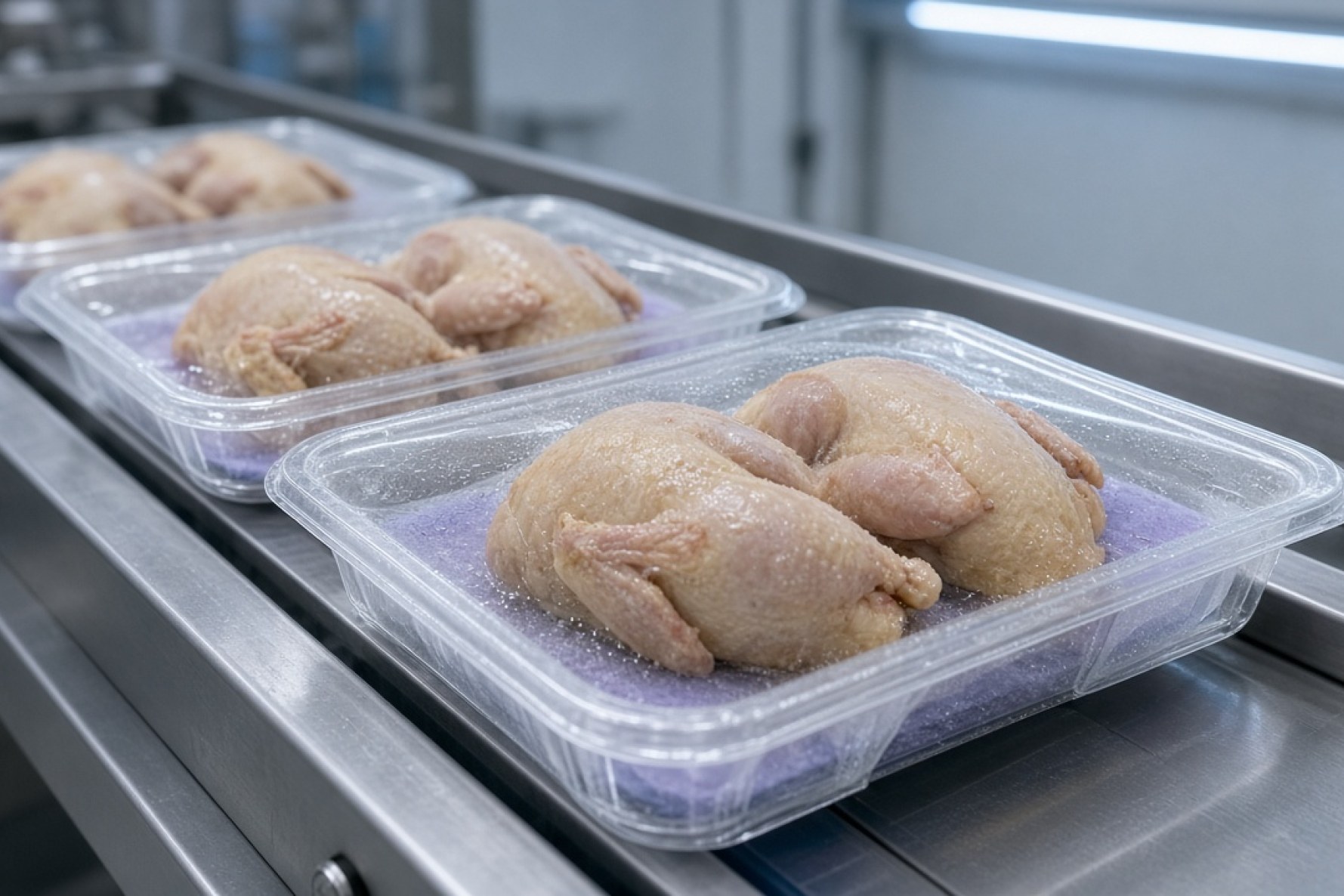
- Grading and MAP packing: automatic weight calibration, multi-layer trays with inert gas flush and heat-sealed barrier film.
- Storage and container loading: carton temperature stabilised at about 0 °C, then reefer or air cargo at stable chill temperatures.
Regional trade outlook
GCC states (UAE, Oman, Qatar, Bahrain, Kuwait, Saudi Arabia) plus Iraq are the region’s largest consumers of small farmed birds. Aridity and feed limits force more than 80% of protein needs to be imported. Iran’s sub-24-hour southern sea transit to UAE/Oman coasts and fast commercial flights give the shortest transit versus Eastern Europe or South America — critical for fresh meat freshness.
2. Commercial weight calibration and sorting systems
Weight tolerance is a key valuation variable. Small body size means modest weight differences affect industrial cook times, plate uniformity and margins for ready-meal plants and professional kitchens. After removing head, feet, trachea, oesophagus and all abdominal organs, ready-to-cook (RTC) carcasses pass dynamic weigh lines. Modern plants sort to ±1 g with optical sensors and continuous digital scales.
| Commercial weight grade | Single carcass (g) | Avg. 4-pack weight (g) | Target channel |
|---|---|---|---|
| Light (small calibre) | 150–179 | 600–715 | Economy packing, canning and further processing |
| Standard (medium) | 180–219 | 720–875 | Retail chains, households, value packs |
| Heavy (super) | 220–259 | 880–1,035 | Grill restaurants, 5-star hotels, banquet halls |
| Jumbo (premium export) | 260+ | >1,040 | Ceremonial orders and premium Gulf hypermarkets |
Standard calibre (180–220 g) dominates global trade: best muscle-to-bone economics in breast and thigh, with soft, juicy fibres without excess fat deposition.
3. Anatomical traits and buyer technical specifications
International buyers and chain procurement teams use a fixed technical data sheet as the acceptance basis at origin loading and destination customs.
| Quality parameter | Acceptance limits | Commercial / technical importance |
|---|---|---|
| Net carcass weight | Per contract calibre (tolerance ±5%) | Accurate pricing; avoid short weight in fixed-weight packs |
| Core temperature | 0 to +2 °C at loading | Pathogen control; veterinary compliance |
| Free purge / drip | Max 2.5% of pack weight at inspection | Shelf weight integrity and visual appeal |
| Abdominal cavity | Complete removal of lungs, trachea, kidneys, oesophagus, peritoneal fat | Prevent biochemical putrefaction and off-odours in storage |
| Skin & plucking | No pin feathers; no breast-skin tears | Avoid grade loss on visual inspection |
| Breast muscle pH | 5.8–6.2 at 24 h post-slaughter | Confirm normal rigor and water-holding capacity |
| Skeleton integrity | No fractures of clavicle, thigh or sternum | Prevent marrow leakage; keep carcass intact in cooking |
4. Quality defects, rejection criteria and premium-grade recognition
Premium fresh carcasses should feel elastic and moist (not slimy), with natural cream-to-pale-yellow skin free of dehydration spots. Breast meat is light pink to mild red; thigh meat shows even light-brown tones. Finger pressure should rebound quickly. Odour must be mild — free of ammonia, sourness, oxidised fat or stale moisture notes.
- Scald burns: water above 53–55 °C coagulates epidermis proteins, causing tears, bleaching or leathery skin and disqualifying export grade.
- Subcutaneous / joint haematomas: from incorrect stun, rail falls or rough catching; bruises >3 mm on thigh or wings drop product to industrial grade.
- Gut rupture / bile leakage: faecal bacteria and green-yellow staining; bitter taste cannot be washed out — carcasses must be condemned.
- Wing/tail pin feathers: mis-set plucker fingers; pin feathers under the skin reject high-end retail acceptance.
5. Laboratory quality-control protocols
Fresh poultry safety is verified in ISO 17025-accredited labs. TVB-N below 12 mg N/100 g indicates ultra-fresh quail; 14–18 shows early change; above 25 indicates unfitness. TBA must stay under 0.8 mg MDA/kg.
| Laboratory test | Fresh-product limit | Method basis |
|---|---|---|
| Mesophilic TPC | <5×10⁵ CFU/g | Standard plate count |
| E. coli | <10² CFU/g | Selective culture |
| Salmonella spp. | Absent in 25 g | Enrichment + biochemical ID |
| Coagulase-positive S. aureus | <10² CFU/g | Selective agar + coagulase |
| L. monocytogenes | Absent in 25 g | Serology / molecular |
| Drug / antibiotic residues | Below MRL | HPLC |
| Heavy metals (Pb / Cd) | Pb max 0.1 / Cd max 0.05 mg/kg | Graphite-furnace AAS |
A valid certificate of analysis (COA) matching the table above is mandatory for veterinary export health permits.
6. Commercial packaging engineering: MAP vs vacuum vs stretch
- EPS tray + PVC stretch: free atmospheric oxygen; shelf life max 3–4 days even in ideal chill — unsuitable for export.
- Deep vacuum: air <10 mbar suppresses aerobes but compresses the carcass, risks fine-bone fracture and heavy purge.
- MAP: engineered gas mix without physical deformation — longest commercial life.
For quail, oxygen is excluded: CO₂ 60–70% (antimicrobial) plus N₂ 30–40% (cushion gas). Food-grade gases >99.5% purity are required. At stable 0–2 °C, fresh whole quail keeps 10–14 days without sensory change.
| Comparison | Traditional stretch | Contact vacuum | MAP |
|---|---|---|---|
| Shelf life at 0–2 °C | 3–5 days | 7–10 days | 10–14 days |
| Carcass geometry | Acceptable, weak in transit | Deformed / compressed | Natural shape retained |
| In-pack purge | High | Very high (mechanical pressure) | Minimal (soaker + no pressure) |
| Subcutaneous fat oxidation | High (~21% O₂) | Low | Negligible (O₂ removed) |
| Air freight suitability | Unsuitable | Weak | Ideal with pressure management |
7. Barrier films, polymer trays and soaker pads
- Tray structure (350–500 µm thermoformed): PP base, EVOH barrier 10–25 µm, sealant PE.
- Lidding film (50–70 µm): OTR <5 cm³/m²·24 h·bar; WVTR <2 g/m²·day; anti-fog; easy-peel.
- Soaker pads: cellulose + SAP between porous PE layers; absorb at least 30–50 ml liquid per kg carcass without rewetting under pressure.
8. Secondary packaging, master cartons and palletising
- Five-layer corrugated cartons; flute BC or EB; kraft liner 175–200 g/m² with wax/laminate for >85% RH reefers.
- BCT sized for 6–8 stacked cartons with safety factor 2.5; oval vents ≥4–5% of wall area.
- ISPM 15 wood or plastic pallets 100×120 cm; column stacking only (brick stacking cuts compression ~45%); max 6–7 layers / 150 cm total height; ventilated stretch only — continuous impermeable wrap forbidden for chilled meat.
9. Refrigeration engineering and logistics
Core temperature must fall from ~38 °C to below 4 °C immediately after evisceration. Packing rooms stay at max 10–12 °C. Reefers set to 0 to +2 °C continuous mode; below −1.5 °C causes tissue freezing; above 4 °C activates psychrotrophs. Keep ≥10 cm headspace and use T-bar floors for airflow.
| Transport variable | Sea / road reefer | Air (insulated boxes) |
|---|---|---|
| Cargo temperature | 0 to +2 °C stable | 0 to +3 °C with dry ice / ice packs |
| Transit to Gulf | 1–3 days sea | 4–12 h airport transit |
| Cost per kg | Economical | Higher (suited to luxury calibres) |
| Temperature monitoring | USB/wireless loggers at three points | Loggers at aircraft hold entry/exit |
| Shelf-life impact | Deduct 2–4 days at destination | Arrives with near-full initial shelf life |
10. Customs tariff classification (HS Code)
Ordinary poultry (chicken, turkey, duck) falls under 0207. Quail does not: it is classified under 0208 (other meat and edible offal) and specifically 0208.90 (other farmed birds such as quail, partridge, pheasant, pigeon). GCC import duty on basic raw animal protein is typically 0–5% of CIF invoice value.
11. Regional standards, halal slaughter (GSO 993) and labelling
- Slaughterer: Muslim, sane, trained, certified (GSO 993:2015 / UAE.S 993:2022).
- Cut: front of neck below larynx; sever trachea, oesophagus and both jugulars without damaging the spinal cord.
- Bird must be alive at the cut; lethal stunning current forbidden.
- Knives: stainless, razor-sharp, free of non-halal contamination; shipment-level halal certificates from destination-accepted bodies.
Labels must be bilingual (Arabic/English): product name (Fresh Chilled Whole Quail), weight grade, plant name and hygiene licence, slaughter/production and expiry dates, storage 0–4 °C, veterinary logo, halal mark and Made in Iran.
12. Middle East target markets and regional competitors
- UAE: standard (180–220 g) and super (220–250 g) calibres in clear MAP.
- Oman: regular weekly 4-packs; strong cultural/logistics proximity.
- Iraq: high price elasticity; lighter 150–180 g grades; road reefers.
- Qatar: premium export grades, anti-fog films, mostly air freight.
| Supplier country | Main advantages | Constraints | Price level |
|---|---|---|---|
| Iran | Low energy & labour, geography, Yazd cluster | Ongoing MAP line upgrades; FX complexity | Highly competitive |
| Turkey | Advanced packing, banking access, branding | High energy & air freight to GCC | Medium–high |
| UAE (domestic) | Shelf proximity, no customs | Farm cooling cost; imported feed dependence | High / non-competitive |
| Saudi Arabia | Integrated domestic distribution | Domestic focus; high cost base | High |
Importer checklist before placing an order
- Lock weight grade and max ±5% tolerance.
- Specify MAP gas ratio (60–70% CO₂, remainder N₂).
- Require multi-layer trays with EVOH barrier and anti-fog lid.
- Mandate soaker pads ≥40 ml capacity.
- Reject loads if muscle-core temperature exceeds +2 °C at loading.
- Verify veterinary licence, ISO 22000 and HACCP.
- Confirm halal issuer acceptance under GSO 993.
- Approve bilingual Arabic/English label artwork.
- Require at least two temperature data loggers in sensitive pallet zones.
- Contract TVB-N <15 mg/100 g and Salmonella-negative in 25 g on the COA.
- Specify five-layer moisture-resistant cartons with vents and column pallet bracing.
- Clarify Incoterms (CIF, FOB or EXW).
Information needed for an accurate quotation
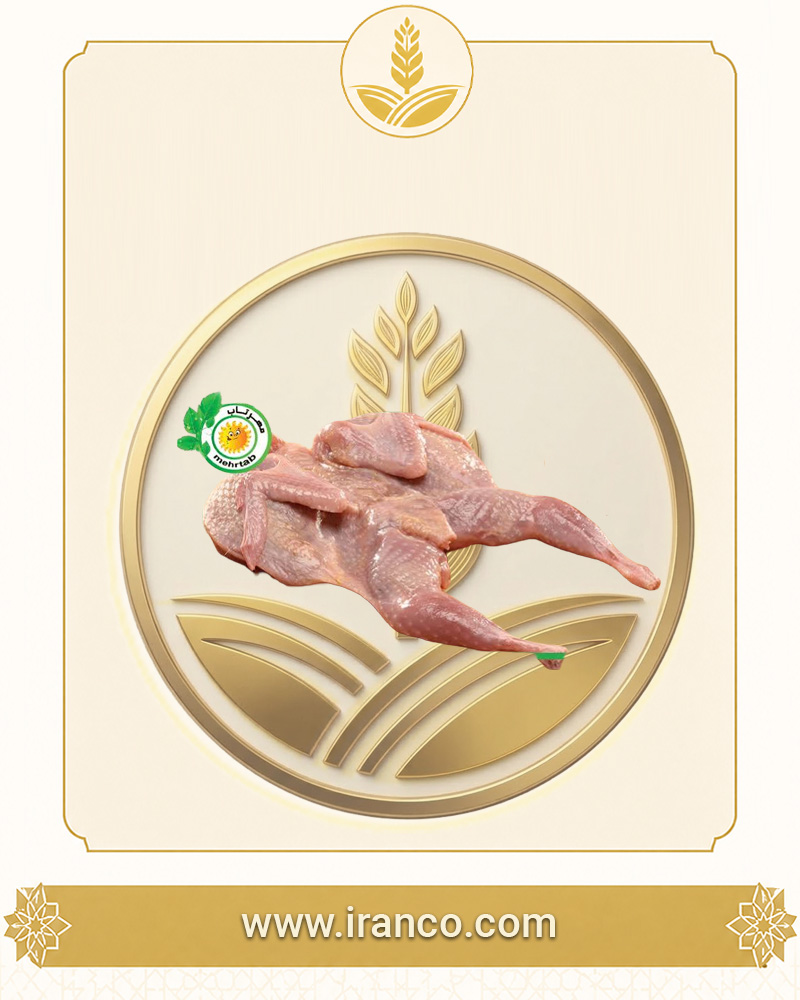
- Anatomy: whole skin-on carcass, head and feet removed, fully eviscerated.
- Weight calibre bands (e.g. 150–180, 180–220, 220–250 g).
- Pack system: MAP or vacuum; pieces per pack (2, 4 or 6).
- Secondary carton specs and primary packs per carton.
- Tonnage per shipment and total contract volume.
- Destination port/airport/border and Incoterms; private-label needs if any.
Summary
Successful fresh whole-quail trade combines biological engineering, modern packaging and precise refrigeration. High myoglobin and unsaturated fats accelerate spoilage in free air, making high-CO₂ MAP with multi-layer EVOH trays essential. Uniform commercial weight calibres and a 0–4 °C cold chain drive buyer satisfaction and cut destination waste. Iran’s specialised hubs — especially Yazd — plus short logistics to Gulf markets create a strong commercial base built on integrated quality and hygienic/halal compliance.
Frequently asked questions
What is the most popular weight grade for wholesale whole quail?
180–220 g per carcass is the highest-demand retail and restaurant grade; above 220 g suits luxury hotels and ceremonial catering.
What advantage does MAP have over vacuum?
Vacuum compresses the carcass and drives purge; MAP keeps natural geometry and suppresses spoilage bacteria with CO₂ without mechanical stress.
How long does fresh quail last in MAP?
With EVOH barrier trays and continuous 0–2 °C holding, shelf life is 10–14 days.
What is the optimal gas mix?
60–70% CO₂ plus 30–40% N₂ as cushion gas.
Which HS code applies to export whole quail?
Unlike chicken/turkey under 0207, quail falls under 0208 / 0208.90.
Which lab indices are mandatory on the COA?
TVB-N <15 mg/100 g, pH, Salmonella and Listeria absent in 25 g, TPC <500,000 CFU/g, and antibiotic residues negative/below MRL.
What reefer temperature is required in transit?
0 to +2 °C continuous airflow; above 4 °C risks spoilage; below −1.5 °C causes undesirable surface freezing.
How do buyers source export-grade fresh quail from Iran?
Define weight grade, packaging technology, bilingual label rules and volume, then submit via Iranco so industrial slaughterhouses and supply chains can be matched to your technical protocol.
Featured Products

Related Articles



