 Iranco Magazine Team
GSO, Eurasia, Iraq and EU standards — nutrition tables, fonts, allergens and a customs checklist for exporters
GSO · TR CU · COSQC · EU 1169
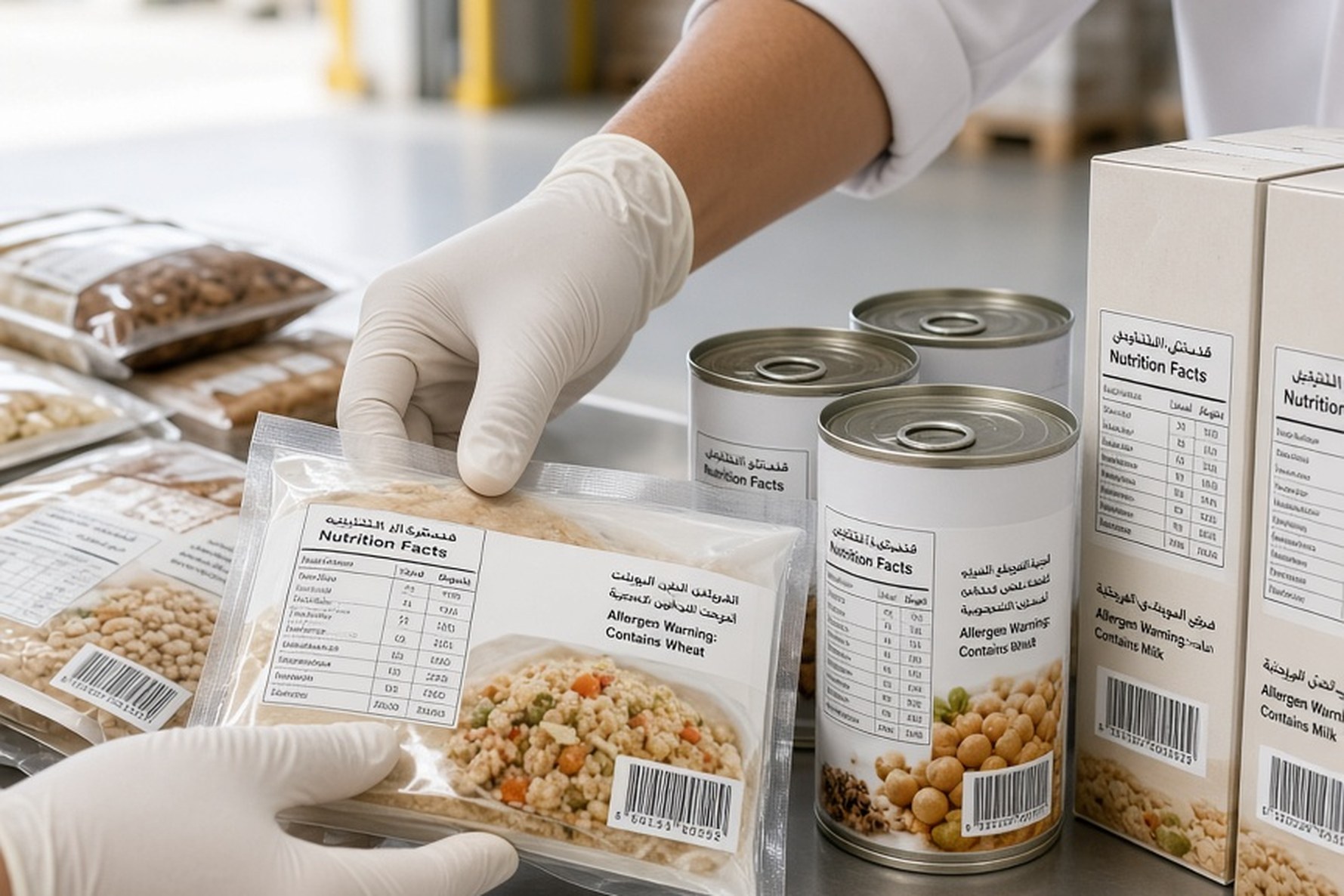
Food Export Labeling Regulations: Key Requirements for Entering Foreign Markets
A comprehensive analysis of international standards, regional regulations, nutrition facts panels, language requirements, and how to prevent customs seizure of food consignments
Export food labeling is a legal, technical, and sanitary document: precise compliance with destination-country rules is a definitive precondition for customs clearance and a sustained presence in international markets. This comprehensive guide reviews the rules governing the Gulf Cooperation Council region, the Eurasian Economic Union, the Iraqi market, and the European Union, and explains the principles of nutrition facts design, allergen warnings, font dimensions, and packaging requirements.
Sustainable exports of processed and agricultural food products rest on two foundational pillars: the product’s intrinsic quality as verified by biochemical testing, and the validation of on-pack documentation assessed by inspection bodies and border customs. In the international food supply chain, the label is not merely a marketing tool or brand introduction; it is the product’s registered identity, biochemical passport, consumer-safety instructions, and the producer’s legal commitment to the destination country’s sovereign laws. The slightest technical discrepancy between label statements and the actual formulation—or any breach of local rules on language, type size, date marking, or allergen declaration—can trigger immediate seizure, cancellation of health certificates, heavy warehousing and demurrage costs, and in more severe cases, destruction of the goods at the border.
Iran, as a regional producer of dried fruits and nuts, commercial dates, saffron, tomato paste, canned foods, confectionery, chocolate, and dairy, holds a significant share of cross-border trade. Nevertheless, the diversity of regulatory systems in target markets—including Gulf Standardization Organization rules, Eurasian Economic Union technical regulations, Iraqi Central Organization for Standardization and Quality Control standards, and European Union requirements—presents exporters and bulk buyers with numerous technical challenges. Precise knowledge of requirements, comparative study of standards, and implementation of label-monitoring systems before final print and shipment loading contain commercial risk and protect manufacturing brands’ credibility on a global scale.
1. Legal Framework and Foundations of the Codex Alimentarius International Standard
International food health and safety standards developed by the Codex Alimentarius Commission are recognized as the global policy baseline for prepackaged food labeling. The World Trade Organization also treats these rules as a reference in its Agreement on Technical Barriers to Trade. The Codex legal framework rests on absolute transparency of information and the prohibition of any deception or misleading impression regarding the authenticity, nature, composition, and sensory characteristics of a foodstuff.
Under this global standard, every food package unit offered for direct sale or public distribution must carry eight foundational technical data elements:
- Trade name and official name of the food, expressing the true identity and nature of the formulation.
- Complete list of ingredients in descending order of weight at the time of compounding.
- Net weight or volume of contents in the standard metric system.
- Full name and physical address of the manufacturer, packer, distributor, or importing entity.
- Batch/lot identifier for consignment traceability in emergency recall chains.
- Country of origin, stated clearly and unambiguously.
- Optimal storage conditions to preserve microbial and chemical integrity until consumption.
- Date marking, including day, month, and year of production and expiry, appropriate to the product’s biological deterioration rate.
2. Gulf Cooperation Council Technical Rules: GSO Standards and SFDA Requirements
Member states of the Gulf Cooperation Council—the United Arab Emirates, Saudi Arabia, Oman, Qatar, Kuwait, and Bahrain—operate a stringent regulatory system through the Gulf Standardization Organization. The reference labeling standard in this region is GSO 9:2022, titled “Labeling of Prepackaged Foodstuffs.” Oversight of these rules, especially in Saudi Arabia, is applied with high precision by the Saudi Food and Drug Authority (SFDA).
Arabic Language Requirement and Bilingual Structure
Consumer product labels in all Gulf countries must be in Arabic. Concurrent use of other languages such as English is permitted, but second-language information must be an accurate translation of the Arabic text. Any conceptual contradiction between Arabic and Latin statements regarding ingredients, additives, or warnings constitutes a violation. Where a factory uses supplementary stickers to convey Arabic information, those stickers must be affixed with industrial adhesive that is inseparable, moisture- and tear-resistant, and must not cover production or expiry dates or the batch number.
Nutrition Facts Rules under GSO 2233
Under the latest editions of GSO 2233, display of a nutrition information table is mandatory for all packaged foods. Items such as single-ingredient spices, dried herbs, table salt, unflavored packaged waters, and raw single-ingredient products such as fresh fruit and rice are exempt. The Gulf nutrition table must state the following indicators per 100 g or 100 ml and, where a serving size exists, per serving:
- Calories and total energy in kilocalories
- Total fat, saturated fats, trans fatty acids, and cholesterol
- Sodium in milligrams
- Total carbohydrate, dietary fiber, total sugars, and added sugars
- Protein in grams
The Saudi Food and Drug Authority enforces a policy prohibiting the use of partially hydrogenated oils as a primary source of trans fatty acids; accordingly, trans fat levels should approach zero, and added sugars must be declared in the table independently of intrinsic sugars.
Shelf-Life and Expiry Standards under GSO 150
Standard GSO 150 sets maximum permitted shelf life for various food commodities. Dates must be recorded on the Gregorian calendar in day/month/year format for products with a consumption period under three months, and month/year for products with longer shelf life. In the Gulf region, expiry dates must be printed thermally, by laser, or by direct engraving on the can, glass, or wrapper; permission for dated stickers is subject to severe restrictions.
| Regulatory indicator | Gulf region (GSO) | Eurasia (TR CU) | Iraq (COSQC) | European Union (EU 1169) |
|---|---|---|---|---|
| Mandatory languages | Full Arabic (or Arabic + English) | Russian (+ national language of the member) | Full Arabic (or Arabic + English) | Official language of the final destination country |
| Nutrition table basis | 100 g/ml or per serving | 100 g or 100 ml | IQS 230 + border requirements | 100 g or 100 ml |
| Trans fat and added sugar | Mandatory in all standard tables | Limited to vegetable fat and margarine | Depends on canned and dairy product type | Added sugar optional; industrial trans fat banned in formula |
| Allergen declaration | In the ingredient text with distinctive lettering | Highlighted textual separation in contents | Direct inclusion in the contents list | Bold, emphasized, or underlined font |
| Official conformity marks | National standard or official Halal mark | EAC mark with minimum height 5 mm | ICIGI conformity approval and certificate | Oval health mark for animal-origin products |
| Date format and marking method | Laser or inkjet print, Gregorian | Permanent Gregorian print on the pack | Permanent print or engraving; absolute ban on sticker dates | Day/month/year according to shelf-life type |
3. Eurasian Economic Union Labeling Rules and Standard TR CU 022/2011
Exports to Eurasian countries—including the Russian Federation, Belarus, Kazakhstan, Kyrgyzstan, and Armenia—require full compliance with Eurasian Economic Commission technical regulations. The central instrument is technical regulation TR CU 022/2011, titled “Food Products in Terms of Their Labeling.” This instruction is interpreted and applied in conjunction with the general food safety regulation TR CU 021/2011 and the packaging safety regulation TR CU 005/2011.
EAC Conformity Mark
Goods that successfully complete validation, laboratory testing, and issuance of a Eurasian declaration of conformity are eligible for the EAC conformity mark. This mark certifies that the product meets all Customs Union sanitary prerequisites. The EAC mark must be printed with precise geometric proportions, uniform ratios, and a minimum height of 5 mm on a surface with full contrast. Printing this mark on every consumer packaging unit and on master shipping cartons is mandatory.
Language, Importer Identity, and Registered Addresses
All label statements must be written in Russian. For distribution in countries such as Kazakhstan or Belarus, information in the official language of those countries alongside Russian is required under the member’s national laws. Under clause 4.1 of the Eurasian regulation, one supervisory pillar is the mandatory inclusion of the trade name, registration number, and full postal address of the legal representative or official importer established within Union territory. Russian supervisory bodies check for this legal entity’s details on the pack body to ensure legal accountability for consignment quality and safety.
Type Size and Visual Clarity
- The product name and net quantity must appear on the packaging body in characters with a minimum height of 2 mm.
- The ingredient list, storage conditions, production date, use-by date, and nutrition facts table must be printed in a font with a minimum lowercase letter height of 0.8 mm.
- Background and print color combination must provide sufficient contrast so that text is readable without changing the angle of illumination or using magnification aids.
Genetically Modified Organisms
If the finished product or any of its components is derived from genetically modified organisms and the concentration exceeds 0.9 percent, the statement “produced using genetically modified materials” must appear in the same type size as the product name. For products claiming to be GMO-free, valid laboratory confirmations in the technical registration file are indispensable.
4. Technical and Supervisory Rules of Iraq’s Standardization Body (COSQC) and Shelf-Life Management
Iraq is a pivotal market for Iranian food and beverage products. The upstream policymaking and quality-assessment body is the Central Organization for Standardization and Quality Control of Iraq (COSQC). In cooperation with leading international inspection companies, this organization operates a pre-export inspection and conformity certification program abbreviated ICIGI for granting entry clearance. Standard IQS 230 sets food labeling rules in this jurisdiction.
Language and Text Requirements
Under current COSQC instructions, all imported prepackaged food products entering Iraq’s customs territory must carry complete labeling in Arabic or bilingual form (Arabic and English). Exclusive use of Persian constitutes a customs violation and leads to rejection of the clearance application. Information such as product name, ingredients, net weight, country of origin with the explicit phrase “صنع فی إیران,” factory details, production and expiry dates, storage conditions, and consumption warnings must appear on the pack in clear Arabic type. At entry points in the Kurdistan Region of Iraq, adding Kurdish alongside Arabic and English facilitates distribution.
Date-Printing Methods and Maximum Shelf-Life Rules
- Date-printing method: Production and expiry dates on canned goods, juices, sauces, and dairy products must be recorded with indelible industrial inkjet, laser technology, or embossing on metal, glass, or board. Use of adhesive paper stickers for dates is prohibited; inspectors treat this as artificial alteration.
- Date format: For goods with shelf life under 3 months, day/month/year format is mandatory; for goods with longer shelf life, month/year is accepted.
- Border shelf-life ceiling rule: Food consignments at the moment of arrival at border terminals must retain the greater part of their nominal shelf life. If a product’s consumption period is one year, no more than one-third to one-half of that life should have elapsed when presented to customs. Consignments that miss this time window are rejected even when microbiologically sound.
| Region or country | Minimum general font height | Minimum product-name font height | Mandatory languages | Status of mandatory marks |
|---|---|---|---|---|
| European Union | 1.2 mm (0.9 on small surfaces) | 1.2 mm | Official language of the destination country | Veterinary health mark for animal-origin items |
| Gulf countries | 1.2 mm based on x-height | Prominent and legible on the principal face | Arabic or Arabic–English | National quality mark or Halal certification mark |
| Eurasian Economic Union | 0.8 mm for contents and dates | 2.0 mm for title and weight | Russian plus local language | Official EAC mark with minimum height 5 mm |
| Iraqi market | Proportionate to unaided eye readability | Largest type on the principal panel | Arabic or Arabic–English | Inspection conformity code of the supervising company (ICIGI) |
5. Nutrition Facts Table: Mandatory Indicators, Calculation Methods, and Rounding Rules
Preparing a nutrition facts table requires precise laboratory testing, including protein analysis by the Kjeldahl method, total fat by Soxhlet, ash, moisture determination, and carbohydrate by difference (subtracting the sum of other factors from one hundred).
Comparing Table Structure across Markets
Under the European standard, data must be presented in this order: energy (kilojoules and kilocalories), fat, saturates, carbohydrate, sugars, protein, and salt in a matrix table per 100 g or 100 ml. In Europe, the term “salt” replaces sodium.
Under Gulf legislation in GSO 2233, additional variables enter the table:
- Separation of trans fat from saturated fat
- Cholesterol amount in milligrams
- Independent declaration of sodium
- Separation of added sugars from natural sugars
- Dietary fiber as part of the carbohydrate structure
In the Eurasian Union (TR CU 022/2011), nutrition information is defined mainly on energy, protein, fat, and carbohydrate per 100 g of product; adding vitamins and minerals is permitted only when their amount exceeds 5 percent of the daily reference intake set in the regulations.
Technical Rounding Rules
- Trans fat: If trans fatty acids per serving are below 0.5 g, declaring zero in the table is contingent on the absence of any hydrogenated oil in the ingredient list.
- Sodium: If sodium per serving is below 5 mg, it may be declared as zero.
- Energy: Values below 5 kcal per serving may be treated as zero. Between 5 and 50 kcal, rounding is to the nearest multiple of 5; above 50 kcal, to the nearest multiple of 10.
Deviation between values measured in random customs inspections and nutrition-table figures has a defined tolerance, generally between 10 and 20 percent. Exceeding this range is treated as content fraud.
6. Requirements for Identifying Allergens, Additives, and Consumer Health Warnings
Protecting people with food allergies is one of the highest-risk areas in label review. Lack of awareness or carelessness in declaring allergens leads to product recall and safety alerts in international systems.
Mandatory Allergen List (14 Substances)
Under Codex, European Union, and Gulf standards, 14 food substances are classified as major allergens:
- Cereals containing gluten (wheat, rye, barley, oats)
- Crustaceans (shrimp, crab)
- Eggs and products derived from them
- Fish and fishery products
- Peanuts and similar legumes
- Soybeans and their processed derivatives
- Milk and lactose
- Tree nuts (pistachio, almond, walnut, cashew, hazelnut, Brazil nut, pecan, macadamia)
- Celery and its oil or seed derivatives
- Mustard and related seeds
- Sesame and sesame oil
- Sulphur dioxide and sulphites at concentrations above 10 mg/kg
- Lupin seed and its by-products
- Molluscs such as shellfish and octopus
Principles of Textual Allergen Display
In the ingredient list, the allergen name must be distinguished from other components by graphic means such as bold type, italics, a change in text color, or a colored background. Where a factory produces several product types and unintended allergen particles may enter another product on shared lines, a secondary-contamination warning is mandatory—for example: “May contain traces of peanut or sesame.”
Additive and Sweetener Warnings
Adding colors, preservatives, and non-nutritive sweeteners requires precise citation of international additive codes (INS codes or European system codes). Use of substances such as tartrazine, carmoisine, Allura Red, and Brilliant Blue in the Gulf and Europe requires a warning about possible adverse effects on activity and attention in children. Products formulated with aspartame must carry the explicit statement “contains a source of phenylalanine” for patients with phenylketonuria.
| Biochemical component | Gulf region (GSO 2233) | Eurasia (TR CU 022) | European Union (EU 1169) |
|---|---|---|---|
| Energy / calories | Kilocalories | Kilojoules and kilocalories | Kilojoules and kilocalories together |
| Total fat | Grams | Grams | Grams |
| Saturated fat | Grams | Optional (except in oils) | Grams |
| Trans fatty acids | Grams (mandatory separation and precise declaration) | Only for processed fats | Banned in industrial formulation |
| Cholesterol | Milligrams | Optional | Optional |
| Total carbohydrate | Grams | Grams | Grams |
| Total sugars | Grams | Optional | Grams |
| Added sugars | Grams (mandatory separation from base sugar) | Optional | Optional |
| Protein | Grams | Grams | Grams |
| Sodium / salt | Sodium (milligrams) | Sodium or salt equivalent | Salt (grams) from sodium × 2.5 |
7. Technical Rules for Visual Design, Type Size, and Legibility on Packaging
The visual structure of a food label must be designed so that consumer access to key information is facilitated and principles of visual clarity are observed.
Technical Indicator: Lowercase Letter Height (x-height)
In standardization systems, font measurement is based on the height of the lowercase letter excluding ascenders and descenders:
- On typical packaging whose principal display panel exceeds 80 cm², minimum lowercase letter height must be equal to or greater than 1.2 mm.
- On small packs with surface area under 80 cm², the minimum permitted height is reduced to 0.9 mm.
- Within the Eurasian regulatory framework, product name and weight values must not be designed below 2 mm.
Font size must be assessed with line spacing and stroke thickness so that industrial printing on plastic, metal, or gloss paper does not cause ink bleed and loss of clarity.
Separation of Packaging Panels
1. Principal display panel
The face presented to the buyer, containing product name, brand name, net weight, and graphics related to the product. Images must not depict attributes absent from the product (for example, showing pieces of natural fruit on a product flavored only with essence and color).
2. Information panel
The surface immediately adjacent to the principal panel, containing the full ingredient list, nutrition facts table, factory and importer addresses, barcode, official standard marks, and storage conditions. Packaging seams, fold lines, and perforations overlapping information-panel text constitute a technical violation.
8. Differentiating Label Requirements in the Logistics Chain: Consumer Pack, Master Carton, and Bulk Consignments
Rules governing packaging change with the goods’ physical position in the logistics chain. Mismatch among packaging layers is a common cause of cargo idle time in customs warehouses.
Primary Consumer Packaging
This unit reaches the end consumer on the retail shelf. It must therefore fully include destination language, nutrition table, allergen warnings, recycling symbols, and the standard retail barcode (international code EAN-13).
Secondary Packaging (Master Carton)
Master cartons or large transport shrink packs holding consumer cartons require specific logistics labels. These data matter for warehouse staff, customs, and carriers:
- Full product name and factory reference code
- Total number of consumer packs in the carton and net weight of each unit
- Total net carton weight and gross weight including board and pallet
- Batch and lot numbers (which must match the inner small packs 100 percent)
- Exact production and expiry dates in legible form
- ISO 780 pictorial marks for handling (orientation, protection from light and moisture, fragility, and maximum stacking rows)
- Transport temperature range and optimal storage conditions (e.g., −18°C for frozen goods or 15–18°C for chocolate)
- Logistics barcode in international format ITF-14 for rapid scanning in mechanized warehouse systems
Industrial and Bulk Consignment Packaging
Products exported as raw material for further processing at destination plants—such as fruit concentrates in aseptic drums, industrial tomato paste in metal drums, dried fruits in polypropylene bags, or bulk oils—are exempt from retail nutrition-table requirements. Nevertheless, these items must carry batch identity, certificate of analysis (COA), storage conditions, and the explicit statement “For industrial processing only — not for direct sale to the final consumer” in English and the destination’s official language.
| Information variable | Primary packaging (consumer) | Master carton (logistics and customs) | Legal consequences of mismatch |
|---|---|---|---|
| Production and expiry dates | Day/month/year with industrial print | Identical to inner packs | Any inconsistency triggers seizure on suspicion of spoilage |
| Batch / lot code | Printed on seam or pack body | Legible label on the carton | Cancellation of health inspection certificate and refusal of clearance |
| Weight declaration | Net product weight in g/ml | Total net weight and carton gross weight | Weight discrepancy leads to heavy fines for smuggling or under-declaration |
| Nutrition facts table | Mandatory with full micronutrients | Unnecessary (summary volume suffices) | Rejection of the standards file at retail |
| Logistics symbols | Recycling and waste-separation codes | Pictorial stacking and storage-temperature marks | Physical damage to cargo and loss of transport insurance cover |
| Barcode format | GS1 EAN-13 | GS1 ITF-14 or GS1-128 | Disruption and rejection in mechanized distribution warehouses |
9. Costly Label-Design Errors and Causes of Consignment Rejection at Customs
Analysis of seizure cases at ports and customs points shows that a substantial share of rejected consignments had no chemical defect or microbial contamination; administrative and design mistakes on the label caused the obstruction.
Language-transfer errors and machine translation
Using automated software translators for Arabic or Russian texts without native expert oversight is the most common source of error. Incorrect translation of ingredient names or use of colloquial terms instead of chemical names approved in national standards leads to reports of forgery, consumer deception, and technical file deficiencies. Use of international reference glossaries and product-specific standards in the destination language is essential.
Illegible dates and separate adhesive date stickers
At Gulf ports and Iraqi border terminals, affixing paper or plastic stickers bearing production and expiry dates is treated as a violation. Inspectors assess this as tampering with product shelf life. Dates must be printed directly on the pack body with indelible ink. Abrasion of dates during container transport also causes stoppage of the consignment at destination.
Mismatch between commercial documents and physical pack statements
If product name, net weight, quantity, and company address on documents such as the bill of lading, certificate of origin, health certificate, and inspection conformity certificate differ from the printed carton statements even by a single suffix, customs clearance systems block release from the warehouse. Comparative review before the container leaves the factory gate is critical.
Breach of slaughter rules and unauthorized Halal marks
In exports of gelatin-containing, animal-derived, or meat products to Islamic countries, the official Halal mark issued by authorized international bodies is mandatory. Using arbitrary graphic designs without a valid certificate constitutes deception and exposes both importer and exporter to severe legal action.
10. Importer and Exporter Checklist before Final Artwork Approval and Label Printing
Quality managers, commercial managers, and bulk buyers must review and confirm the following twelve points before issuing final authorization for lithography and cylinder or plate printing:
- Align the product’s standard and legal name with definitions approved by the destination country’s standards body.
- Maintain descending order of the ingredient list according to weight percentages in the factory formulation at processing.
- Review destination-language writing rules under a technical editor and align terminology with the destination national standard text.
- Calculate nutrition-table data from a valid laboratory analysis sheet and observe rounding rules.
- Distinguish regulated allergens with bold type, underline, or color change in the ingredient list.
- Write additive names or official codes per the international numbering system without ambiguous trade names.
- Control lowercase letter height precisely to meet the 1.2 mm minimum and other dimensions appropriate to pack size.
- Align date format (day/month/year or month/year) with the Gregorian calendar and define the direct industrial print method.
- Include full legal identity, factory name, country of origin, and details of the importer or authorized legal representative at destination.
- Affix mandatory standard marks such as the EAC mark at minimum 5 mm height or approved Halal marks.
- Assign a standard commercial barcode and test its scannability with industrial barcode readers.
- Fully align printed master-carton and consumer-pack information with the commercial invoice draft and health certificate.
11. Information Needed for Pricing Inquiries and Export Packaging Orders
To calculate landed cost and lead times for export wrappers, cartons, and labels accurately, international buyers and sourcing specialists should compile the following technical data in their requests:
- Technical name, physical form of the product, and storage conditions (ambient, refrigerated, frozen)
- Destination country or region and the regional standards governing the product
- Mandatory languages required on the consumer pack and logistics carton
- Physical structure of primary packaging (multilayer laminate wrappers, box, metal can, glass, MAP pack, or vacuum bag)
- Exact geometric dimensions including length, width, height, layer thickness, and net content weight
- Intended print technology (rotogravure, flexography, or industrial adhesive label)
- Whether production is under the buyer’s private brand or existing factory brands
- Final order quantity per production lot in pack count or total tonnage
- Requested barcode types (retail or logistics) and the product’s Harmonized System tariff code
- Delivery terms under Incoterms and the intended border customs or loading port
12. Sourcing Export Foods with Labeling Compliance through Iranco
Successful procurement of food products from Iran requires mastery of processing quality, labeling compliance, and packaging standards of target countries. The Iranco platform, as a commercial and supplier-evaluation system, provides an effective channel for importers, trading companies, and international distribution chains.
Foreign buyers and commercial operators can, when registering a purchase request, submit their technical specifications—including quality grade, packaging standards, language needs, nutrition-table structure, and importer-representative details—on the Iranco platform. Iranco reviews demand, identifies capable industrial units in Iran, and facilitates sample coordination, technical label validation against target-market rules, industrial print alignment with customs requirements, and quality-requirement management before the consignment moves toward the border.
Scientific and legal labeling compliance is the decisive indicator of sustainability in global food markets. In today’s trade environment, technical regulations are updated rapidly to protect public health and consumer rights. Reaching target markets and retaining export share requires manufacturers and traders to treat the product label as an inseparable part of formulation, technology, and commercial risk management. Continuous monitoring of GSO standards in the Gulf, TR CU regulations in the Eurasian Union, COSQC supervisory rules in Iraq, and international Codex guidelines protects against financial losses and underpins long-term presence of products in destination consumer baskets.
Frequently Asked Questions
Is Arabic labeling mandatory for food exports to Iraq?
Yes. Iraq’s Central Organization for Standardization and Quality Control (COSQC) requires Arabic on all packaged consumer goods. Exclusive use of Persian or English blocks issuance of the conformity certificate and prevents clearance at the country’s border customs.
What is the minimum permitted font size on food packaging in the Eurasian Union?
Under technical regulation TR CU 022/2011, the product name and net quantity must appear in a minimum 2 mm font. Other technical information—including the ingredient list, nutrition facts table, storage conditions, and expiry date—must have a minimum lowercase letter height of 0.8 mm.
What does GSO 2233 make mandatory in the nutrition facts table?
This regulation requires declaration of calories, total fat, saturated fats, trans fatty acids, cholesterol, sodium, total carbohydrate, dietary fiber, total sugars, added sugars, and protein on a per 100 g, 100 ml, or per-serving basis.
Is printing the expiry date with separate adhesive stickers allowed in the Gulf and Iraq?
No. Under both GSO rules and Iraqi standards, production and expiry dates must be applied directly, indelibly, and industrially (inkjet, laser, or engraving) on the product body. Separate adhesive date stickers are treated as a violation.
How should allergens be displayed on an export label?
Allergens must be distinguished in the ingredient list using graphic differentiation such as bold type, a distinct font, underline, or a colored background so the consumer immediately notices their presence in the formulation.
What is the EAC conformity mark and what are its physical specifications?
The EAC mark is the symbol confirming a product’s technical and sanitary conformity with Eurasian Economic Union rules. It must be applied with standard geometric proportions, symmetrically, at a minimum height of 5 mm, and with full contrast on both the consumer pack and the master carton.
What information is needed for an accurate quote and packaging review of Iranian export products?
Buyers should specify product type, quality grade, destination country, required languages, pack geometry, net weight, packaging material, order volume, and any private-label need. On Iranco, international buyers can register the same details as a purchase request so matching supply options can be reviewed.
How can Iranian foods be sourced with labeling aligned to destination-country law?
Importers can specify target-market legal requirements, languages, and packaging formats. Through the Iranco platform, they can connect with reputable factories and coordinate packaging artwork technically before print so it complies with destination customs rules.
Featured Products








Related Articles



