 Iranco Magazine Team
Quality indicators, colour and aroma analysis, customs requirements and a commercial checklist for wholesale export buds
Damask Rose · Dried Buds · Grading · Wholesale · Export
Dried Damask Rose Buds: Grading, Colour and Wholesale Buying Guide
A review of quality indicators, colour and aroma analysis, customs requirements and a commercial checklist for wholesale sourcing of export-grade Rosa damascena buds from Iran.
Dried damask rose buds (Rosa damascena Mill.) are among Iran’s best-known botanical products on global markets. The product sits in three value chains at once: herbal infusions and teas, food and confectionery, and cosmetics, personal care and perfumery. For this reason, a wholesale buyer cannot assess rose buds from a single photo or a per-kilo price; grade, colour, aroma, moisture, foreign matter and laboratory safety all shape the final value of a shipment.
| Indicator | Value / reference |
|---|---|
| Iran’s share of global damask rose production | More than 70% |
| Target moisture for export-grade dried buds | 8–10% |
| Common tariff codes (HS) | 12119091 and 060390 |
| Main essential oil constituents | Citronellol, geraniol, nerol and phenylethyl alcohol; together more than 50% |
This guide is written for importers, herbal tea packers, cosmetics manufacturers and traders who want to source damask rose buds from Iran in bulk with lower risk. Every stage is covered in order — from production geography and grading to laboratory testing, packaging, shipping and the contract checklist.
1. What Are Dried Damask Rose Buds and Why Do They Matter in Global Trade?
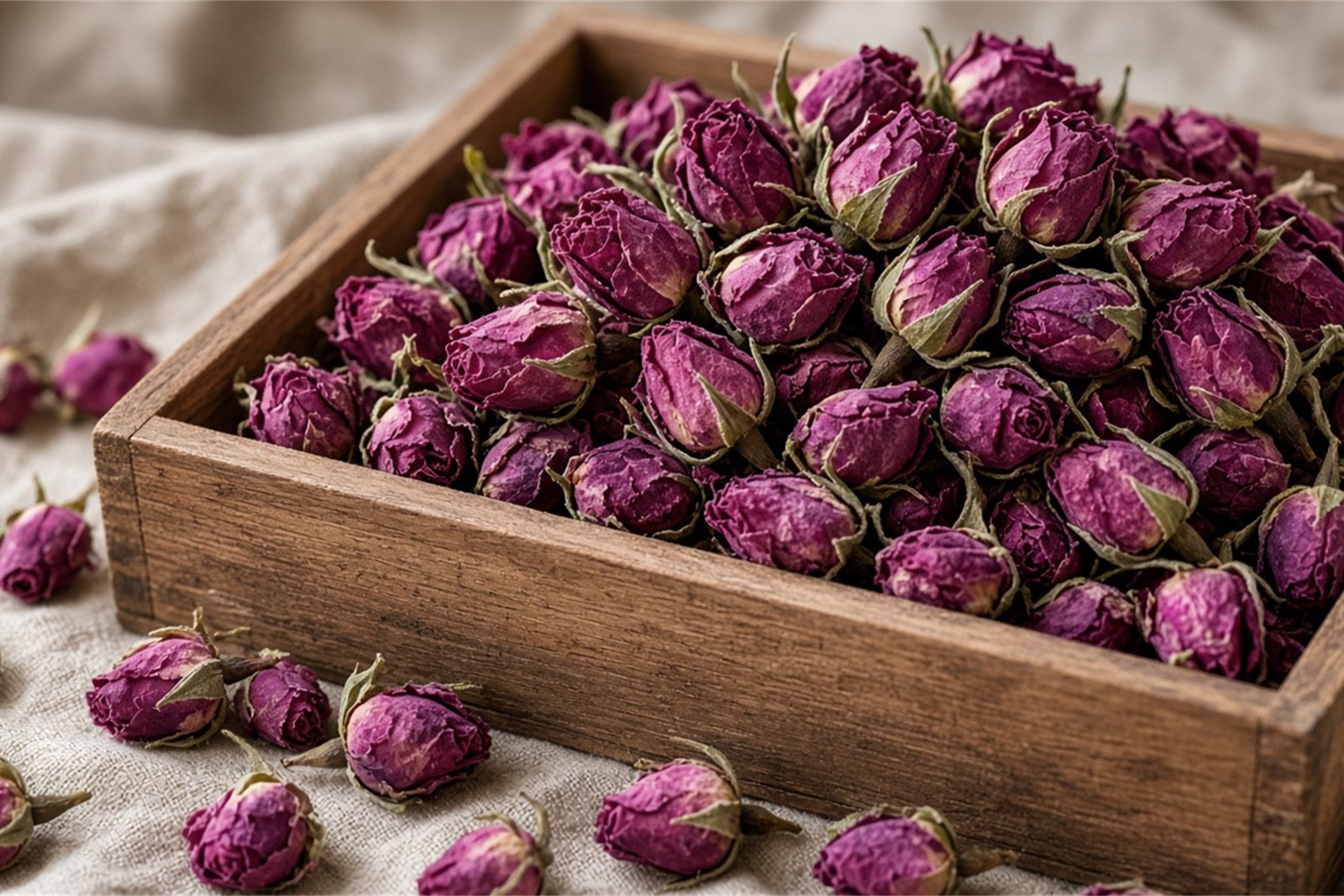
Dried damask rose buds are the closed or semi-closed buds of the damask rose, harvested in the early morning before the petals fully open and then dried under controlled conditions. At this stage most of the aromatic compounds are still locked inside the closed bud structure, which is why buds deliver a longer-lasting fragrance and a more attractive commercial appearance than loose petals.
The commercial value of rose buds comes from several characteristics: low weight relative to high value, long shelf life when packed correctly, multiple uses across industries, and steady demand in East Asia, Europe and the Middle East. In many markets, Iranian damask rose buds are regarded as the quality benchmark for aroma.
2. Production Geography: Darab, Lalehzar and Kashan
Bud quality depends heavily on climate, altitude and harvest timing. Iran’s three main damask rose growing regions offer distinct quality profiles:
| Region | Climate | Harvest period | Commercial profile |
|---|---|---|---|
| Darab (Fars) | Warm and sunny, medium altitude | Early season (mid-April to May) | High volume, light pink colour, suited to infusions and industry |
| Lalehzar (Kerman) | Mountainous, high altitude, cool nights | Late season (late May to early July) | Strong aroma, deeper colour, suited to premium grades |
| Kashan and Qamsar (Isfahan) | Semi-arid, long rosewater distilling tradition | Late April to May | Historic reputation, signature fragrance, crop split between rosewater and buds |
For a professional buyer, stating the region of origin in the contract and accompanying documents matters: it supports batch traceability and provides a fair basis for comparing prices. Buds from two different regions, even under the same nominal grade, can differ noticeably in colour and aroma.
3. Commercial Grading of Damask Rose Buds
On the wholesale market, damask rose buds are usually offered in four commercial grades. There is no single official global standard for these grades and definitions vary between suppliers; the limits for each grade should therefore be defined in the contract and against a reference sample.
| Grade | Appearance and size | Colour | Breakage and impurities | Main use |
|---|---|---|---|---|
| Super Select | Whole, closed, uniform and large buds | Even pink to light purple | Minimal breakage, no stems or foreign matter | Luxury packaging, premium infusions, gifting |
| Grade A | Whole buds with slight size variation | Pink with minor variation | Low breakage, very limited stems | Retail infusions, general export |
| Grade 2 | Mix of whole and half-open buds | Pink to light brown | More breakage and loose sepals | Infusion blends, economy packs |
| Industrial | Irregular, open or broken buds | Uneven, may be dark | High breakage; foreign matter within agreed limits | Extraction, milling, powder and industrial uses |
Super Select is not necessarily the best choice for every buyer. A factory that mills or extracts rose buds can reduce its landed cost significantly by buying an industrial grade with good aroma. Grade selection should be driven by the end use, not simply by the highest quality label.
4. Pigments and Drying Methods: Why Does Bud Colour Change?
The pink to purple colour of damask rose buds comes mainly from anthocyanins — pigments that are sensitive to light, heat, oxygen and pH. Any error in harvest timing, the delay before drying, drying temperature or storage conditions shows up directly in the colour and marketability of the product.
| Method | Effect on colour | Effect on aroma | Considerations |
|---|---|---|---|
| Shade drying | Relatively good colour retention | Good aroma retention | Time-consuming; risk of dust and environmental contamination |
| Direct sun drying | Fading and browning | Significant loss of volatile compounds | Cheap but unsuitable for export grades |
| Controlled hot-air dryer | Uniform at the right temperature | Good retention at low temperature | More hygienic, repeatable and suited to export |
| Freeze-drying | Best colour retention | Best aroma retention | High cost; suited to luxury markets |
A brighter colour is not always a sign of higher quality. An unnatural, overly vivid colour can be a red flag for artificial colouring or the use of unauthorised preservatives. Alongside colour, natural aroma, uniformity and laboratory results should be assessed together.
5. Aroma Analysis and Aromatic Compounds
The signature fragrance of damask rose results from a blend of several volatile compounds. Citronellol, geraniol, nerol and phenylethyl alcohol are the most important, and in high-quality essential oils they together make up more than half of the composition. These compounds are better preserved in closed buds and decline as the flower opens, under excessive heat or during prolonged storage.
- Sensory assessment: smell the sample after crushing a few buds; the aroma should be floral and sweet, with no damp, smoky or mouldy notes.
- Trial brewing: check infusion colour, clarity and how long the fragrance persists after a few minutes.
- Instrumental analysis: for industrial buyers, GC-MS testing of the extracted essential oil establishes the compound profile.
6. Laboratory Specifications for Export-Grade Buds
The technical specifications of dried buds should be defined in a Specification Sheet and a Certificate of Analysis (COA). The Iranian national standard (ISIRI 168) and the requirements of the destination country form the basis of these specifications. The table below shows typical export values:
| Parameter | Typical value | Significance |
|---|---|---|
| Moisture | 8–10% | Shelf life and mould prevention |
| Water activity (aw) | aw < 0.60 | More precise indicator of microbial growth risk |
| Foreign matter | Less than 1% (premium grade) | Cleanliness and net usable weight |
| Total ash | Within national standard and contract limits | Indicator of soil and dust contamination |
| Total plate count (TPC) | Less than 105 CFU/g | Processing and storage hygiene |
| Yeasts and moulds | Less than 103 CFU/g | Spoilage and mycotoxin risk |
| E. coli and Salmonella | Negative | Food safety |
| Pesticide residues | Per destination-country MRLs | Customs clearance and buyer acceptance |
| Heavy metals (lead, cadmium, arsenic, mercury) | Per destination-country limits | Product safety |
| Live insects | Absent | Quarantine and shipment integrity |
Microbial and pesticide residue limits vary by destination country. To learn how a pesticide testing panel is defined, read our article MRL Laboratory Analysis for Agricultural Exports.
7. Common Defects and Adulteration in the Rose Bud Market
Because of its high value, the damask rose bud market is exposed to a range of processing defects and, at times, deliberate adulteration. Knowing these issues helps buyers detect them at the sampling and pre-shipment inspection stages.
| Defect / adulteration | Cause or purpose | Detection method |
|---|---|---|
| Artificial colouring | Masking faded colour | Unnatural colour release into cold water; synthetic dye testing |
| Added essential oil or synthetic fragrance | Compensating for weak aroma in old stock | Sharp surface scent that fades quickly after brewing; GC-MS |
| Blending with other rose species | Reducing sourcing cost | Differences in bud and sepal shape; botanical identification testing |
| Deliberate moistening | Increasing weight | On-site moisture and aw measurement |
| Excessive stems and sepals | Poor cleaning or weight padding | Sorting and weighing a sample |
| Blending with previous-season stock | Offloading old inventory | Darkening, brittleness and loss of aroma |
| Stored-product insect infestation | Poor storage | Visual inspection, holes in buds, fine powder at the bottom of the pack |
A simple on-site test: place a few buds in a glass of cold water. Natural buds release a mild colour into the water in the first few minutes; rapid and intense colouring of cold water may indicate added dye and calls for laboratory testing.
8. Export Markets and What Each Market Expects
Each destination market has its own quality priorities and legal requirements. Understanding these differences before pricing prevents many later disputes.
| Market | Dominant use | Quality priority | Key regulatory point |
|---|---|---|---|
| China | Flower infusions, blended teas | Appearance, uniformity, whole buds | Botanical species identity, GB 2763, producer registration with China Customs |
| Germany and France | Herbal teas, organic, cosmetics | Very low pesticide residues, organic | EU MRLs, pyrrolizidine alkaloids, organic certification |
| UAE | Re-export hub, confectionery, herbal retail | Aroma, packaging suited to redistribution | Arabic/English labelling, halal requirements for some uses |
| India | Gulkand, Ayurveda, sweets | Competitive price, aroma | FSSAI and plant quarantine requirements |
The Chinese market is particularly sensitive because of the legal distinction between Rosa damascena and Rosa rugosa. This topic is covered in full in our article Exporting Dried Damask Rose Buds to China.
9. Tariff Codes (HS) and Export Documents
Choosing the correct tariff code affects import duties, health requirements and the clearance process. Depending on the declared use, dried damask rose buds are usually classified under one of the following two codes:
| HS code | Description | Typical use |
|---|---|---|
| 12119091 | Plants and parts of plants used primarily in perfumery, pharmacy or similar purposes (dried) | Infusions, food industry, perfumery and cosmetics |
| 060390 | Cut flowers and flower buds, dried, for bouquets or ornamental purposes | Ornamental and decorative uses |
Digits beyond the first six may differ from country to country. The final code should be confirmed with a customs broker in the destination country before the proforma invoice is issued.
Typical Shipping Documents
- Commercial invoice and Packing List
- Ocean or air bill of lading / air waybill
- Certificate of Origin (preferential form where required)
- Phytosanitary Certificate
- Certificate of Analysis (COA) covering moisture, microbiology, pesticides and heavy metals
- Organic or halal certificate if requested by the buyer
- Producer registration number for countries that require it (such as China)
10. Packaging Engineering for Dried Rose Buds
Dried buds are sensitive to moisture, light, oxygen, mechanical pressure and foreign odours all at once. Packaging must control all five factors; otherwise, a product that was excellent at origin will arrive at destination with dark colour, weak aroma and crushed buds.
| Packaging type | Typical weight | Advantage | Limitation |
|---|---|---|---|
| Food-grade polyethylene bag + 5-ply carton | 5–10 kg | Balance of cost and protection | Limited barrier against oxygen and odours |
| Multi-layer aluminium bag + carton | 5–10 kg | Excellent barrier against light, moisture and odours | Higher cost |
| Vacuum or nitrogen-flushed packaging | 1–5 kg | Maximum colour and aroma retention | Risk of crushing buds under full vacuum |
| Jute or polypropylene sack | 10–25 kg | Low cost, suitable for industrial grade | Poor protection; unsuitable for premium grades |
- After drying, the product must cool completely before packing to prevent condensation inside the pack.
- Cartons should not be overfilled; excessive pressure crushes buds in the lower layers.
- Food-grade desiccants are recommended for long transit routes.
- Batch number, production date, region and grade should be marked on every carton.
11. Logistics and Container Capacity
Dried rose buds are light and bulky; in sea freight, therefore, volume rather than weight is the limiting factor for container capacity. Exact capacity depends on grade, packaging type and degree of compression.
| Shipping mode | Approximate capacity | Best suited to | Considerations |
|---|---|---|---|
| Air Cargo | 2–5 days · 100–500 kg | Luxury super-premium and urgent orders | Minimal heat-spoilage risk; airport handling shocks |
| Refrigerated sea container (Reefer FCL) | 20–35 days · 15–18°C | High tonnage, distant destinations in Asia and Africa | Humidity monitoring and temperature data logger are mandatory |
| 20ft dry container | Approx. 2.5–3.5 tonnes | Medium orders and trial shipments | Insulating liner and desiccants are essential |
| 40ft High Cube dry container | Approx. 6–9 tonnes | Bulk importers and factories | Prevent container sweat on tropical routes |
| Road truck (TIR) | 5–10 days | Turkey, Russia, Armenia and Iraq | Refrigerated trailer or insulated curtain-sider |
| Less than Container Load (LCL) | Less than a full container | Small orders and initial market entry | Risk of odour absorption from adjacent cargo |
The container must be dry, clean and free of odours from previous cargo. On long routes or when passing through hot and humid regions, container desiccants and avoiding prolonged sun exposure of the container at port are important.
12. Factors That Determine Damask Rose Bud Prices
Wholesale prices for damask rose buds are not fixed and change from season to season. Comparing two price offers is only meaningful when the technical specifications and delivery terms are identical. The most important price drivers are:
- Grade and percentage of whole buds: the price gap between industrial grade and Super Select can be several-fold.
- Region and harvest season: rainfall, late spring frost and demand from rosewater distillers all affect bud supply.
- Drying method: controlled dryers and freeze-drying raise the landed cost.
- Level of laboratory control: multi-residue pesticide, microbiological and heavy metal tests add cost but reduce the risk of shipment rejection.
- Certifications: organic, halal, HACCP and ISO 22000.
- Packaging and private label: small retail packs and custom printing increase unit cost.
- Order volume and delivery terms: the difference between EXW, FOB and CIF accounts for a significant share of the final price.
- Exchange rates and payment terms: currency fluctuations and payment method directly affect the quoted price.
The cheapest offer is not necessarily the most economical. The cost of a container rejected at destination customs, or of end-customer dissatisfaction with quality, is usually many times the initial saving.
13. Iran Versus Competitors
In international trade, few countries have the geographic and climatic capacity to grow roses on an industrial scale. Comparing the commercial indicators of the key producers clarifies the position and advantages of Iranian rose buds.
| Country | Competitive advantages | Challenges | Price level | Dominant markets |
|---|---|---|---|---|
| Iran | Largest cultivated area, pesticide-free rain-fed cultivation, lasting colour and aroma | Needs modernised sorting and harmonised certifications | Competitive and cost-effective | China, Persian Gulf, Germany, India |
| Turkey (Isparta) | Advanced sorting and drying machinery; close access to Europe | High land and labour costs; most flowers allocated to essential oil | High | EU and USA |
| Bulgaria (Rose Valley) | Strong cosmetics branding; European pharmaceutical standards | Negligible dried bud output; focus on essential oil distillation first | Top tier | Luxury perfume brands in France and Switzerland |
| China (Shandong) | Huge industrial packing and sorting network; domestic supply scale | Cultivates native species different from Rosa damascena | Low to medium | East Asian domestic market and regional exports |
Grown in high-altitude climates with abundant sunlight, Iranian damask rose buds hold a distinctive position among global suppliers for their red pigmentation and aroma retention after drying. The core competitive advantage is the combination of volume, aroma and price, which — backed by quality documentation and batch consistency — translates into sustainable contracts.
14. Industrial Applications of Damask Rose Buds
Understanding the end use helps with correct grade selection and cost reduction:
- Herbal infusions and teas: highest demand for Super Select and Grade A; appearance and aroma are decisive.
- Food and confectionery: sweets, ice cream, chocolate, jam and gulkand; sometimes as powder or separated petals.
- Cosmetics and personal care: extraction for creams, toners, soaps and face masks.
- Perfumery and aromatherapy: extraction of aromatic compounds and production of botanical extracts.
- Supplements and traditional medicine: herbal preparations for markets in India, the Middle East and East Asia.
- Decoration and gifting: potpourri, scented candles, gift boxes and ceremonies.
15. Importer Checklist Before Buying in Bulk (12 Points)
- State the botanical name (Rosa damascena Mill.) and region of origin in the contract.
- Define the end use of the product so the right grade and tests are selected.
- Obtain a sample representative of the actual batch, not a hand-picked sample.
- Put grade limits in writing, including percentage of whole buds, breakage, stems and foreign matter.
- Specify acceptable moisture (8–10%) and water activity (aw).
- Specify microbial limits, including TPC, yeasts and moulds, and pathogens.
- Define the pesticide residue testing panel based on destination-country MRLs.
- Request heavy metal testing and, where necessary, synthetic dye testing.
- Approve the inner pack type, master carton, pack weight and labelling.
- Confirm the HS code and required clearance documents with the destination broker.
- Provide in the contract for pre-shipment inspection and retention of a reference sample.
- Specify delivery terms (Incoterms), payment method and the rejection clause in case of non-conformity.
16. What Information Is Needed for a Request for Quotation (RFQ)?
The more precise the RFQ, the more comparable and realistic the offers you receive. Minimum information required:
- Required grade (Super Select, Grade A, Grade 2 or Industrial)
- Preferred production region and harvest season (if important)
- Maximum moisture, breakage, stems and foreign matter
- Required laboratory tests and the destination country’s reference standard
- Need for organic, halal or other certifications
- Order quantity, pack weight and type, private label or unbranded
- Destination country and port, shipping mode and delivery terms
- Delivery schedule and potential for repeat orders
17. Sourcing Damask Rose Buds with Iranco
In international purchasing of dried rose buds, the difference between two offers is not limited to price per kilo. Grade consistency, drying method, laboratory status, packaging quality and the seller’s ability to supply traceable batches determine the final outcome of the deal.
Iranco enables international buyers to submit their requirements by grade, technical specification, required tests, packaging, order volume and destination, so that sourcing options from Iran’s main production regions can be reviewed. For serious orders, we recommend approving the sample and specification sheet first, before consolidation and shipment preparation begin.
Conclusion
With more than 70% of global production and a signature fragrance, Iranian dried damask rose buds are among the country’s most valuable botanical exports. Yet success in wholesale buying depends on more than price: choosing a grade that fits the end use, controlling colour and aroma, 8–10% moisture, microbial safety and pesticide residues, the correct tariff code and engineered packaging.
A buyer who puts technical specifications in writing, obtains a representative sample and takes pre-shipment inspection seriously minimises the risk of quality disputes and shipment rejection, and can build sustainable, repeat supply relationships with Iranian suppliers.
Frequently Asked Questions
Which damask rose bud grade is best for herbal infusions?
For retail infusions and transparent packaging, Super Select or Grade A is appropriate, because the appearance of the buds is directly visible. For tea-bag infusion blends, Grade 2 can also be economical and sufficient.
What is the right moisture level for export-grade dried buds?
Target moisture is usually 8–10%. Higher moisture increases the risk of mould and quality loss, while very low moisture makes the buds brittle. Water activity (aw) below 0.6 is a useful supplementary indicator.
How can dyed rose buds be detected?
An overly vivid and uniform colour, and rapid, intense colour release into cold water, are warning signs. Final confirmation should be made through laboratory testing for synthetic dyes.
What is the HS code for dried damask rose buds?
For infusion, food and perfumery uses, code 12119091 is usually applied; for ornamental uses, code 060390. The final code should be confirmed against destination-country regulations.
What is the difference between Darab and Lalehzar rose buds?
Darab is earlier-harvested and offers higher production volume with a light pink colour. Thanks to its altitude and cool nights, Lalehzar usually delivers stronger aroma and deeper colour and is favoured for premium grades.
How much dried rose bud fits in a 40ft container?
Because of its low bulk density, a 40ft High Cube container typically holds 6 to a maximum of 9 tonnes of cartoned buds; a 20ft container holds approximately 2.5–3.5 tonnes. The exact quantity depends on grade, packaging type and degree of compression.
What is the shelf life of dried damask rose buds?
With proper packaging and storage in a dry, cool place away from light, shelf life is usually 12–24 months; however, colour and aroma gradually decline over time, and use within the first year is recommended.
How do I request a damask rose bud quotation from Iranco?
Specify grade, quantity, technical specifications, required tests, packaging and destination port, then submit your purchase request (RFQ) through the Iranco contact form so that sourcing options can be reviewed.
Featured Products
Related Articles



