 Iranco Magazine Team
From cocoa type and flavour intensity to texture, consumer segment, packaging, QC, cold chain and bulk-order specs
Procurement Guide · Ice Cream & Cocoa
How to Choose Chocolate and Cocoa Ice Cream for Your Market
From cocoa type and flavour intensity through texture, consumer segment, packaging, quality control, cold chain and bulk-order specifications — a B2B guide for procurement managers, distributors and exporters, published in Iranco Magazine.
Analytical Introduction
Choosing chocolate or cocoa ice cream for a specific market depends on far more than taste alone. Cocoa intensity, fat type, overrun, texture, colour, sweetness level, pack size, target price and storage conditions must align with the sales channel and consumer expectation.
Two products that both show chocolate on the pack may be designed for completely different markets. One may be an economical, sweet, light product suited to high-volume retail; another may be darker, with controlled bitterness, higher fat, denser body and a higher price for consumers who prefer deep cocoa character.
The professional buyer's question should not be simply "which ice cream tastes better?" but "which product specifications best match my customer, price point, channel and distribution conditions?" In frozen dairy, perceived quality is never a single factor: fat content and type, solids, sugar, cocoa powder type, alkalisation degree, particle size, homogenisation, stabilisers, overrun, ice crystal size and storage all shape the final experience.
For procurement managers, distributors, chain retailers, food-service operators and trading companies, a successful choice happens when the product is converted into measurable purchase specifications before a bulk order is placed. Dark colour, strong flavour, creamy texture or high quality are not enough on their own — each must be defined and tested.
1. First Define Exactly What Your Market Needs
There is no universally "best" chocolate ice cream. The best choice is the one whose sensory profile, price, pack format and technical quality match how the product is consumed in the target market. A common bulk-buying mistake is to look at what the factory already makes and then search for a market. Professional practice is the reverse: define the market first, then select or customise the product.
Everyday Retail
In general stores and high-volume sales, acceptable price, familiar taste, balanced sweetness, clear packaging, distribution robustness and batch-to-batch consistency matter greatly. Consumers should not have to work to recognise the flavour; chocolate identity must be immediate.
Premium Segment
Premium buyers notice finer differences and expect more from flavour persistence, creaminess, cocoa intensity and appearance. Darker colour is not automatically higher quality — a very dark product may simply use heavily alkalised cocoa.
Children and Family
Lower bitterness, clear milk-and-chocolate taste, attractive colour, soft texture and family-friendly packs usually matter more. A technically excellent but very bitter or roasted cocoa profile is not necessarily an advantage.
Restaurant, Café and Hotel
Buying here is performance-driven. The product must behave predictably under repeated service, scoop well, not melt too fast and hold its flavour alongside cake, coffee or other dessert components. Price per pack is insufficient; cost per served portion matters more.
Industrial Production and Private Label
For companies selling under their own brand, precise formula definition, net weight, pack design, label, sweetness level and lot acceptance criteria are central. The approved sample must become a reference standard for future production.
| Target market | Desired flavour | Desired texture | Price sensitivity | Suitable format |
|---|---|---|---|---|
| General retail | Familiar, balanced | Soft, creamy | High | Single-serve & family |
| Premium | Deep, complex | Dense, lingering | Lower | Premium pack |
| Children & family | Sweeter, mild | Soft | High | Family & single-serve |
| Café & restaurant | Clear, stable in dessert | Scoopable | Medium | Food-service pack |
| Private label | Buyer-defined | Per spec sheet | Brand-dependent | Custom |
2. How Chocolate Ice Cream Differs from Cocoa Ice Cream
In commercial use, these two labels must not be swapped without checking the formula. Cocoa powder comes from processed cocoa beans with part of the fat removed. Chocolate may contain cocoa solids, cocoa butter, sugar and sometimes dairy. The international Codex standard for chocolate and chocolate products defines chocolate types by cocoa solid content.
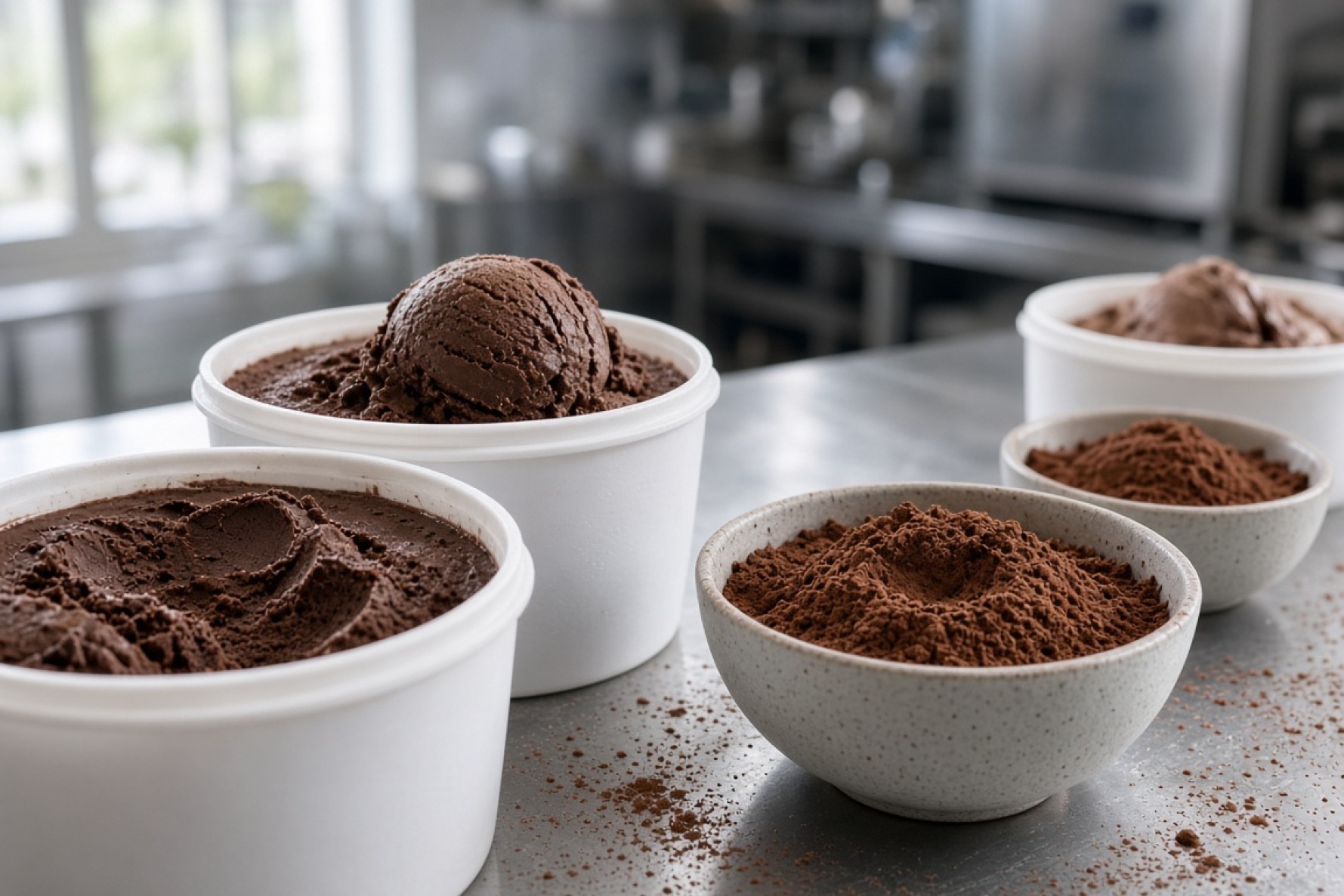
Cocoa-Powder-Based Ice Cream
This approach offers excellent control of colour and flavour intensity and is very common in industrial production. Changing powder type can shift the product from light brown to very dark. Industrial suppliers offer 10/12 fat grades and higher-fat 20/22 or 22/24 grades.
Richer Chocolate-Identity Products
These may use chocolate, cocoa mass, cocoa butter or combinations. Mouthfeel and flavour persistence can improve, but final quality depends on the whole formula and process. Do not separate pack wording from formulation — labelling rules differ by destination market.
3. How Cocoa Powder Type Shapes Product Character
Cocoa powder selection is one of the most important technical decisions in this category. Two powders at similar price can produce markedly different colour, bitterness, aroma and perceived sweetness.
- Natural cocoa: Lighter colour, fruitier and more acidic notes; may clash with expectations of a mild creamy dairy product.
- Alkalised cocoa: Range from balanced brown to very dark; "darker" and "better" are not synonyms — final choice must be tested in the finished ice cream.
- Powder fat grade: Higher-fat powders can improve flavour richness, softer mouthfeel and longer melt; weigh this against raw-material cost and total formula fat.
Important: Dry powder colour is not a reliable predictor of finished ice cream colour. Colour must be checked after mixing with milk, fat, sugar and the real formula matrix.
| Cocoa type | Typical colour | Flavour character | Best use |
|---|---|---|---|
| Natural | Lighter | Fruity, sharper | Natural cocoa identity |
| Lightly alkalised | Balanced brown | Round, balanced | Mass market |
| Medium alkalised | Brown to dark red | Stronger chocolate | Dark chocolate ice cream |
| Heavily alkalised | Very dark | Intense, distinct | Specialty dark products |
| High-fat | Process-dependent | Longer, softer | Premium products |
4. Quality Is Not Defined by Cocoa Percentage Alone
Requesting "more cocoa" does not always yield a better product. A specialist cocoa supplier may suggest around 5% cocoa powder as a development starting point for some ice cream formulas — but that is not a global standard.
- Fat: Affects creaminess, aroma release, melt and mouthfeel; higher fat alone does not guarantee higher acceptance.
- Total solids: Shape body perception; low-body ice cream feels watery or icy.
- Sweetness: Sugar affects freezing point, softness and serving temperature behaviour.
- Overrun: Affects density, lightness, hardness, melt and cost per volume; comparing equal-volume tubs without net weight is misleading.
5. Texture, Melt and Mouthfeel — Where Real Quality Shows
Consumers may not explain ice crystal size or fat destabilisation, but they feel the result immediately. Quality ice cream should have uniform texture at the moment of eating, without coarse ice crystals.
Finer cocoa usually gives more uniform texture. Melt testing is not laboratory-only work — buyers can compare competitors under identical freezer conditions and observe softening, weeping and phase separation.
6. Technical Specifications to Define Before Purchase
For repeat orders, private label or bulk supply, verbal description is not enough. The buyer needs a product specification sheet.
| Parameter | What to define | Why it matters |
|---|---|---|
| Product type | Dairy, plant-based or other | Defines formula base |
| Flavour identity | Cocoa, chocolate, bitter, dark | Avoids sensory disputes |
| Cocoa powder type | Natural or alkalised | Colour and flavour impact |
| Powder fat grade | 10/12 to 22/24 | Mouthfeel and cost |
| Total fat | Per market and regulation | Body index |
| Overrun | Measurable criterion | Real volume vs weight comparison |
| Net weight | Contractual amount | Avoids volume-only comparison |
| Storage temperature | Agreed cold chain | Quality preservation |
| Allergens | Milk, soy, nuts | Labelling and safety |
7. Quality Control for Chocolate and Cocoa Ice Cream
Quality control must start at raw material and continue through finished product. Tasting one tub before signing a contract is not enough.
Cocoa Powder Control
- Colour, odour and taste, fat content, moisture, particle size
- Microbial status, alkalisation degree, batch consistency
Ice Cream Mix Control
Before freezing, formula composition, viscosity, fat and solids are checked. Professional production relies on HACCP and ISO 22000:2018 food safety management.
Finished Product and Allergens
Finished-product control covers net weight, microbiology, texture, hardness, melt rate, colour, sensory testing and label accuracy. These products usually contain milk; the 2024 Codex revision of prepackaged food labelling updated allergen declaration requirements.
8. Choose Packaging by Use Case
Good packaging is not just appearance — it is part of product performance. Ice cream is sensitive to temperature rise and freeze–thaw cycles.
- Single-serve: Suited to impulse sales; pack shape, opening ease and freezer space matter.
- Family pack: Lid must reseal after repeated opening.
- Food-service pack: Container dimensions must match freezer, service area and scoop tools.
- Private label: Artwork, legal name, ingredient list, allergens, net weight and label language must be approved before mass production.
9. Cold Chain — What Can Ruin the Best Formula
One of the biggest success factors is not in the formula at all: temperature stability in distribution. The USDA frozen food transport guide recommends storage at 0°F, approximately −18°C or lower. Temperature fluctuation reduces marketable quality and can cause frost, dehydration and texture breakdown.
- Abnormal frost inside the pack
- Surface deformation, shrinkage, icy or grainy texture
- Water separation after melt
- Clear deviation from factory reference sample
For intercity trade or export, transport equipment must suit frozen goods and temperature monitoring or logging must be possible.
10. How to Compare Chocolate Ice Cream Prices
Comparing price per tub alone can distort the decision. Two equal-volume products may differ in weight, overrun, fat and cocoa type. Converting price to net weight is one of the most useful steps.
| Factor | Likely price impact |
|---|---|
| Cocoa type and grade | Specialty or high-fat powders change cost structure |
| Cocoa content | Higher raw-material use raises formula cost |
| Fat type and solids | Denser products may carry higher material cost |
| Overrun | Direct effect on weight at equal volume |
| Packaging and order volume | Container, print, case and run length matter |
| Private label | Design, print and minimum run costs |
| Frozen transport | Distance and cold chain are major delivered-price components |
11. Bulk Buyer Checklist Before Placing an Order
- Exact product type: dairy, non-dairy or frozen dessert.
- Define flavour identity: cocoa, chocolate, bitter or milky.
- Define consumer segment and target price level.
- Obtain several comparable samples.
- Test samples under identical conditions, preferably blind-coded.
- Review cocoa powder type and fat grade.
- Review fat type and main formula ingredients.
- Obtain product specification sheet.
- Obtain allergen information.
- Define net weight; do not rely on container volume alone.
- Review density or overrun if commercially important.
- Define acceptance criteria for colour, flavour and texture.
- Review relevant quality-control results.
- Define primary packaging type.
- Confirm outer-case strength for frozen transport.
- Review storage and transport conditions.
- Define required shelf life for the distribution route.
- Review supplier's sustained production capacity.
- Define minimum order quantity and lead time.
- Approve label artwork before printing.
- Align product name and ingredients with destination-market rules.
- Define delivery terms and delivery location.
- Assign responsibility for temperature control in transit.
- Retain reference sample from approved production.
- Include dispute criteria for sample vs shipment mismatch in the contract.
12. Information Needed for an Accurate Quote
"What is the bulk price of chocolate ice cream?" is not enough for a comparable offer. A professional request should include:
- Product type, destination market or country, consumer segment
- Desired flavour, darkness and cocoa intensity, dairy or non-dairy
- Fat type, inclusion of chips or chocolate pieces
- Net weight, packaging type, approximate order volume
- Private-label need, label language, required standard or certificate
- Delivery city or location, transport conditions, expected purchase timing
If a reference product exists in the target market, naming it is extremely helpful.
Professional Comparison of Multiple Supplier Samples
Sensory evaluation should be as blind as possible — the assessor should not know brand or price at first. Technical data and price are added only after sensory scoring.
| Criterion | Evaluation question |
|---|---|
| Colour | Does it fit the product positioning? |
| Aroma | Is chocolate identity clear or weak? |
| Sweetness | Low, balanced or dominant? |
| Bitterness | Acceptable for the target customer? |
| Creaminess | How soft and uniform does it feel? |
| Icy character | Are ice crystals detectable? |
| Flavour intensity | How strong is the cocoa flavour? |
| Persistence | How long does flavour last after swallowing? |
| Melt | Does it collapse too quickly? |
| Aftertaste | Clean or off-note? |
Sourcing Market-Matched Chocolate and Cocoa Ice Cream from Iran
In bulk ice cream buying, the difference between two offers is not price alone. Cocoa powder type, fat source, net weight, overrun, flavour intensity, packaging, shelf life, supply capacity and cold-chain conditions all change the economic outcome.
On Iranco (iranco.com), purchase requests can be defined by real market need — ice cream type, desired flavour profile, pack weight, order volume, destination country and private-label requirement — so available supply options are screened on that basis.
Conclusion
Choosing the right chocolate or cocoa ice cream for a market is more complex than picking a popular flavour. The starting point must be customer understanding. The product must then become a set of controllable specifications. Cocoa percentage alone is not a reliable quality index.
The best professional decision separates three stages: define market need, evaluate samples sensorially and technically, then compare offers economically.
Frequently Asked Questions
Is chocolate ice cream always higher quality than cocoa ice cream?
No. Product name alone is not a quality indicator. Well-formulated cocoa-powder ice cream can have excellent colour, flavour and texture. Evaluation must be based on formula, sensory sample and technical specifications.
For ice cream, is natural or alkalised cocoa better?
Neither is best for every product. Natural cocoa is usually lighter with more acidic, fruitier notes. Alkalised cocoa can give darker colour and a different chocolate profile. Final choice must be made in the real product formula.
Does darker ice cream always mean more cocoa?
No. Alkalisation degree and powder type strongly affect colour. Colour must not be treated as equivalent to cocoa percentage or quality.
How do we compare several chocolate ice creams?
Evaluate samples at the same temperature, preferably blind to brand. Then add net weight, formula, QC results and price.
What is the correct storage temperature for ice cream?
For frozen foods, −18°C or lower is a recognised storage reference. More important than the nominal freezer reading is temperature stability across the whole distribution chain.
Is price per litre a valid comparison metric?
Not on its own. Compare on net weight; in food service, compare cost per served portion.
Which ice cream suits café and restaurant markets?
The product needs scoopability, reasonable melt resistance, sufficient flavour alongside other dessert components and acceptable cost per portion.
How can chocolate ice cream be sourced from Iranian producers?
First define purchase specifications: product type, flavour, pack weight, order volume, destination market and private-label need. These can be submitted as an Iranco purchase request.
Featured Products
Related Articles



