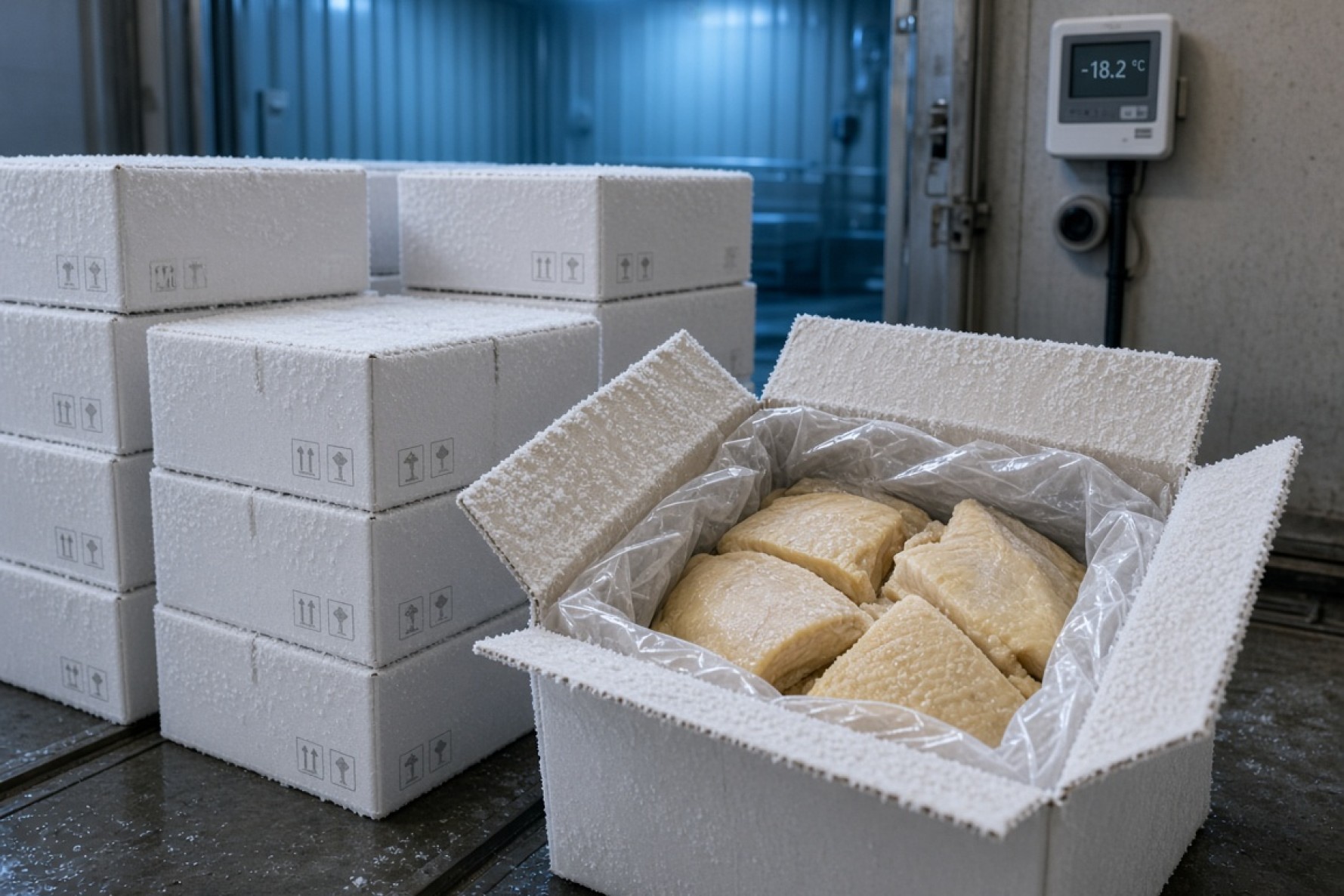
 Iranco Magazine Team
From frozen chicken skin specs and quality control to veterinary quarantine, tariff codes, cold chain and fat-extraction unit needs in Vietnam
Export Guide · Chicken Skin · Vietnam
Guide to Exporting Chicken Skin to Vietnam — Clearance Conditions and Industrial Rendering Markets
From frozen chicken skin specifications and quality control to veterinary quarantine, tariff codes, the cold chain and the needs of fat-extraction and processing units in Vietnam — published in the Iranco Magazine.
Key Trade and Processing Indicators
Actual Vietnam import records classify frozen chicken skin under HS 02071499, with documented shipments in 10 kg and 15 kg cartons. In processing research, homogenisation and extraction at 80°C recovered up to 89.6% of the fat present in the tissue. Under Vietnam's 2026 quarantine regulations, import quarantine certificates for consignments requiring testing may be issued within five business days once all conditions are met.
Exporting chicken skin to Vietnam is not the same as exporting a standard chicken cut. A buyer may need the product for sausage and meat-product formulation, for chicken fat separation, as animal feed raw material or for other processing lines. That difference in end use changes the expected technical specifications, the level of hygiene control, the documentation and even the commercial value of each tonne.
Chicken skin is economically attractive because the tissue has significant fat-recovery potential. Processing research shows that actual extraction yield depends heavily on grinding, heating method and separation technique. A rendering plant buying chicken skin therefore does not look at shipment weight alone. Fat ratio, attached meat tissue, free water, ice, oxidation, microbial contamination, raw-material uniformity and cold-chain history can all directly change the production cost per kilogram of final fat.
Vietnam also operates a defined quarantine system for products of animal origin. Current 2026 regulations provide for quarantine registration, consignment inspection, document verification, sampling where required and issuance of import quarantine certificates for imported animal products. Poultry products are on the list of items under veterinary control, and in some cases a new import origin must undergo risk analysis before trade begins.
For an Iranian exporter, the conclusion is clear: before pricing, it must be known what product, from which abattoir, for what end use, with what certificate and under what contractual specifications will enter Vietnam. A deal that does not answer these four questions can fail at veterinary acceptance, quality control or clearance even at an attractive price.
1. What Market Does Chicken Skin Have in Vietnam?
The chicken skin market should not be treated simply as part of the "chicken meat" market. In practice this commodity sits at the boundary between an abattoir by-product and an industrial raw material. Its value to the buyer comes from its ability to be converted into fat, used in meat-product formulation or consumed in other derivative industries.
Vietnam's trade records show that frozen chicken skin has actually been imported. For example, shipments from Brazil at around 27 tonnes with 15 kg packaging and European consignments in 10 kg cartons appear in import data. Talk of chicken skin in the Vietnam market is therefore not merely a theoretical potential market — the commodity has a history of commercial entry.
Who Are the Likely Buyers?
The main commercial user groups can be divided as follows:
- Meat-product manufacturers using chicken skin and fat in formulation;
- Animal rendering and fat-extraction units;
- Plants producing refined or semi-refined chicken fat;
- Pet food and some processed feed manufacturers;
- Trading companies importing frozen raw materials;
- Export-processing units that import animal raw materials and re-export after processing.
An Iranian seller should therefore not offer one single specification to all customers. Chicken skin needed by a sausage factory is not necessarily the same raw material required by a rendering unit.
Actual Market vs Potential Market
The actual market consists of importers currently buying frozen chicken and chicken skin from countries such as Brazil and some European producers. The potential market includes plants that now use ready-made fat, other animal fats or substitute raw materials but could evaluate chicken skin as feedstock for their production line if rendering is economically viable.
Entering the second group is harder, because the exporter must do more than offer skin price — it must show that its raw material is competitive in fat yield, quality stability and processing cost.
2. What Specifications Suit Chicken Skin for Rendering?
For industrial rendering, visual appearance is not the first priority. The main criterion is how much usable fat of what quality the buyer obtains from each tonne of raw material.
Scientific research shows that chicken skin fat extraction yield depends on process design. In one study, ground or homogenised skin was processed at 50°C and 80°C. The highest recovery — equivalent to 89.6% of the fat present in the skin — came from homogenised skin at 80°C; extraction from merely ground skin at 50°C gave much lower recovery. These figures refer to recovery of fat present in the raw material, not conversion of 89.6% of skin weight into oil.
Another study on wet rendering of chicken skin reported fat yield relative to raw-material weight at around 24 to 28% under tested conditions. The difference between this figure and "percentage of fat recovered" is important: the first is extracted oil relative to total raw-material weight; the second shows what share of the fat present in the skin was recovered.
Recommended Purchase Specification Table
| Parameter | What Must Be Specified | Importance to Buyer |
|---|---|---|
| Species | Domestic fowl | Alignment with documents and tariff |
| State | Frozen | Quality retention and sea transport feasibility |
| Skin source | Breast, other parts or mixed | Effect on uniformity and fat level |
| Attached meat tissue | Contractual limit | Effect on yield and price |
| Fat | Test result or agreed specification | Primary rendering indicator |
| Free water and ice | Contractual limit | Avoid paying for water instead of raw material |
| Blood and clots | Acceptance criterion | Effect on quality and spoilage |
| Bone and cartilage residue | Contractual limit | Effect on equipment and yield |
| Odour | Natural, without sour smell | Indicator of spoilage and oxidation |
| Net weight | Accurate and inspectable | Real price calculation |
| Packaging | Inner bag and master carton | Protection in cold chain |
| End use | Food, rendering, animal feed or other use | Determines technical and regulatory path |
Food-Processing Skin vs Rendering Skin
A meat-product factory usually pays more attention to texture uniformity, colour, attached meat level and sensory characteristics. For a rendering unit, recoverable fat percentage and processing cost become more important.
However, "industrial" use does not mean hygiene quality can be ignored. If an animal raw material enters a food, feed or veterinary-controlled production chain, origin, health status and storage conditions remain fundamental.
3. Economics of Chicken Skin Rendering
Comparing two chicken skin offers on price per tonne alone can be misleading. A rendering plant should compare price on the basis of raw-material cost per unit of recoverable fat.
A simple commercial equation is:
Raw-material purchase cost + transport + freezing and storage + grinding + heating + separation + refining + waste management
versus:
Saleable fat + value of remaining protein or other by-products
Without knowing fat level and process yield, a cheaper offer is not necessarily more economical.
Why Shipment Uniformity Matters
If one container is assembled from several different production streams, the ratio of skin, meat, connective tissue and fat changes across the load. Production-line adjustment then becomes harder and the plant may receive different yields batch by batch.
For industrial purchase, a representative sample should not be taken from one carton alone. The contract should define sampling from different points in the shipment.
Role of Processing Temperature
Research on chicken skin shows that processing at 80°C, under specified test conditions, both increased fat recovery and reduced microbial load far more than processing at 50°C. In a microbiology study, processing at 80°C caused near-complete inactivation of inoculated and natural flora, while at 50°C a significant number of micro-organisms remained.
This does not mean one legal temperature applies to all plants; it shows that rendering process design must consider yield, safety and oxidative quality together.
Comparison of Reported Fat Extraction Methods
| Research Method | Sample Conditions | Key Result |
|---|---|---|
| Homogenisation and heating | 80°C | Recovery up to 89.6% of fat present |
| Homogenisation or grinding at lower temperature | 50°C | Lower recovery and higher microbial risk |
| Wet rendering | Various time and temperature conditions | Fat yield around 24 to 28% of raw-material weight |
| Microwave rendering | Controlled laboratory conditions | In some studies higher yield than water cooking |
Another comparative study on breast skin reported 47.5% yield for microwave rendering under tested conditions versus 24.8% for water cooking. These figures should not be applied directly to commercial plant capacity, but they show that processing technology has a significant effect on feedstock economics.
4. Chicken Skin Quality — What Should the Buyer Check Before Ordering?
The first principle is that measurable specifications should replace phrases such as "good quality".
Important Defects
Poor frozen chicken skin may show one or more of the following:
- Abnormal ice or free water;
- Severe colour change;
- Off or oxidised odour after controlled thawing;
- High blood and clot content;
- Bone, cartilage or foreign-material residue;
- High meat content in product bought as high-fat skin;
- Extensive freezer burn;
- Open or torn packs;
- Signs of thaw and refreeze;
- Clear difference between approved sample and final shipment.
Suitable Laboratory Parameters
Tests should be selected by end use. For rendering feedstock, fat analysis is primary. For evaluating extracted fat, indicators such as free fatty acids and peroxide value can show hydrolysis and oxidation status.
In wet-rendering research on chicken skin, moisture in extracted fat was reported at around 0.10 to 0.15%, free fatty acids at around 0.48 to 0.55% and peroxide value in various samples at around 4.66 to 9.84 milliequivalents per kilogram. These are results from that study and should not be used as commercial acceptance limits without buyer agreement.
Pre-Acceptance Quality Control Table
| Subject | Control Method | Commercial Decision |
|---|---|---|
| Fat percentage | Laboratory test | Estimate rendering economics |
| Free water | Measurement and inspection | Avoid paying for useless weight |
| Uniformity | Multi-point sampling | Assess supply stability |
| Odour after thawing | Controlled sensory evaluation | Detect spoilage or oxidation |
| Foreign material | Physical inspection | Protect production line |
| Pack condition | Count of damaged cartons | Assess cold chain |
| Product temperature | Recording at delivery | Detect transport deviation |
| Microbiological indicators | Tests suited to end use | Hygiene acceptance |
| Origin documents | Abattoir and plant match | Clearance and traceability |
For a professional buyer, the pre-contract sample should come with laboratory specifications, and the contract should define how the reference sample is retained.
5. Regulations for Entry of Chicken Skin into Vietnam
Export of chicken skin to Vietnam should be designed from the outset as trade in a veterinary-controlled product of animal origin.
Vietnam's terrestrial quarantine regulations were revised at the start of 2026 under Circular 01/2026/TT-BNNMT. This circular sets out quarantine registration before import, document review, physical inspection, sampling where required and issuance of import quarantine certificates for imported animal products.
First Question: Can the Origin and Product Enter?
For countries or territories from which a product group subject to risk analysis is imported into Vietnam for the first time, the new regulations provide for mandatory risk analysis. Fresh, chilled and frozen meat of livestock and poultry are among the groups linked to risk analysis.
An Iranian exporter should therefore not conclude from the tariff code alone that a shipment from any Iranian plant can be sent.
Before contracting, at minimum the following should be clarified by the importer and responsible veterinary authority:
- Origin-country acceptance status;
- Acceptance status of the producing plant or abattoir;
- Accepted health-certificate format;
- Final product end use;
- Need or absence of need for risk assessment;
- Poultry disease conditions in the production region;
- Consignment quarantine registration conditions.
Quarantine Registration
Under 2026 regulations, the owner or importer must submit a quarantine registration file to Vietnam's veterinary authority before import. This may be done through the national single window, public services or other designated methods.
After arrival, the border quarantine authority inspects the goods and matches consignment information with the file. Sampling is performed where required.
Disease Control and Testing
The 2026 regulation annex lists highly pathogenic avian influenza and Newcastle disease among veterinary control factors for products of poultry origin. For some groups of frozen, chilled or primary-processed poultry meat, offal and products, microbiological controls also apply.
This matters to the seller because flock health history, abattoir veterinary supervision and ability to issue valid certificates must be verified before production, not when the container reaches the destination port.
6. Customs Clearance of Chicken Skin in Vietnam and the Tariff Code
Actual Vietnam declaration records show frozen chicken skin under HS 02071499. In Vietnam's tariff structure this line falls under frozen edible cuts and offal of domestic fowl and has been used in import records for frozen chicken skin.
However, the tariff code must be finalised according to the exact nature of the goods actually shipped. Converting raw frozen skin into extracted fat, processed product, powder or raw material with a different use can change classification.
Important Commercial and Operational Documents
For a standard frozen chicken skin transaction, the document set usually centres on:
- Contract or purchase order;
- Commercial invoice;
- Packing list;
- Transport document;
- Certificate of origin if required;
- Veterinary or health certificate in the format accepted by the destination;
- Import quarantine registration and permit documents;
- Producer and abattoir specifications;
- Production and expiry date information;
- Test results if requested;
- Cold-chain and transport-related documents.
The veterinary certificate is the most important specialist document in this file. Discrepancies in plant name, plant code, weight, pack count, production date or product description between the health certificate, invoice, bill of lading and declaration can complicate clearance.
Recommended Low-Risk Operational Path
A lower-risk path for such a transaction is:
- Importer verifies product and origin acceptance status.
- Exact product description and tariff code are finalised before production.
- Approved veterinary certificate format is agreed.
- Product specifications are fixed in the contract.
- Production and freezing are carried out under a traceability system.
- Consignment documents are sent to the importer before loading.
- Import quarantine registration is completed.
- After arrival, required inspection and sampling are performed.
- After acceptable results, quarantine certificate is issued and customs steps are completed.
Under 2026 regulations, for an animal-product consignment meeting documentary, packaging, storage and test-result conditions, import quarantine certificate issuance for consignments requiring testing is envisaged within five business days from the time quarantine is performed.
7. Packaging and the Cold Chain
Chicken skin is a high-fat, spoilage-sensitive material. Its two main risks in international trade are microbial growth if the cold chain fails and fat oxidation.
Actual Vietnam import data shows that 10 kg and 15 kg cartons are used in commercial trade for frozen chicken skin. Examples of 20 kg packaging also appear in trade records for this commodity group.
Packaging Option Comparison
| Structure | Advantage | Limitation |
|---|---|---|
| 10 kg per carton | Easy handling, suited to staged use | More cartons and packing operations |
| 15 kg per carton | Common in recorded industrial shipments | Heavier for manual handling |
| 20 kg per carton | Fewer packs | Greater need to control frozen block integrity |
| Inner bag + carton | Better protection against contact and leakage | Higher cost than simple pack |
| Uniform frozen block | Suited to stacking and transport | Longer thaw time |
Packaging Suited to Rendering
A rendering plant does not need consumer packaging. Bulk industrial packs are preferred, but they must meet several conditions:
- Inner layer resistant to fat and moisture;
- Carton retaining strength at freezing temperature;
- Actual net weight marked on each carton;
- Batch number enabling traceability;
- Production date and other required information remaining legible;
- Packs frozen so cartons do not deform severely.
Palletising
Over-compressed stacking or weak cartons can cause lower rows to collapse. If transport is on pallets, carton dimensions should be aligned with pallet pattern and container capacity before production.
For export orders, cartons per pallet, net weight, gross weight and total pallet count should be calculable from the packing list from the outset.
8. Sea Transport and Frozen Consignment Risk Management
For commercial volumes, sea transport in a reefer container is the logical route for frozen chicken skin. However, a reefer container does not replace initial freezing; product must reach appropriate frozen storage condition before loading.
Main Risks
Cold Chain Break
Partial thaw and refreeze can change product structure and create more free water.
Loading Warm Product
If goods are not sufficiently frozen before loading, the container system must compensate for abnormal heat load.
Container Air vs Product Core Temperature
Display temperature alone does not prove quality across the whole load.
Damaged Packaging
Chicken skin is fatty and leakage can contaminate adjacent cartons and the container floor.
Port Delay
If container power supply is not maintained correctly during port stops, temperature-fluctuation risk increases.
Temperature Logging
In professional transactions, temperature loggers help make transport-related disputes reviewable. The contract should preferably define:
- Who is responsible for placing the logger;
- Where in the container the device is placed;
- Who owns the data after delivery;
- What deviation requires additional inspection.
Pre-Loading Control Table
| Item | Required Control |
|---|---|
| Product temperature | Actual measurement at several points |
| Batch number | Match with documents |
| Net weight | Sample or full check as agreed |
| Packaging | No tears or leakage |
| Carton integrity | Suitable for freezing and stacking |
| Container | Clean, odour-free and food-ready if food use |
| Temperature logger | Active and installation location recorded |
| Seal | Number matching transport document |
| Veterinary certificate | Details matching the load |
| Production date | Matching contract |
9. Competition in the Vietnam Market — What Does an Iranian Exporter Face?
Import records for chicken skin into Vietnam show that Brazilian and European suppliers have been present in this market. Recorded shipments from Brazil and Poland indicate that Vietnamese buyers have access to established international supply chains.
An Iranian seller's advantage therefore cannot be merely "geographic proximity" or a nominally lower price.
Real Competition Criteria
| Factor | Importance to Importer |
|---|---|
| Legal market access | Basic condition for any deal |
| Price per tonne | Important but not sufficient |
| Recoverable fat | Very important for rendering |
| Batch uniformity | Reduces production fluctuation |
| Packaging | Effect on warehouse and line use |
| Cold chain | Direct effect on quality |
| Traceability | Essential for animal product |
| Supply history | Reduces purchase risk |
| Specification flexibility | Advantage in industrial orders |
| Volume stability | Important for continuous plants |
Where Is Iran's Opportunity?
The main opportunity may lie in adding value to a poultry-industry by-product. If an Iranian abattoir or processor can supply chicken skin that is separated, clean, frozen, traceable and offered with stable specifications, the product moves from low-value waste to industrial raw material.
This path becomes sustainable export only when veterinary access to the destination market and origin acceptance are also established. Market development and product development must therefore proceed in parallel.
10. How Is Export Chicken Skin Price Evaluated?
For frozen chicken skin there is no single general price suitable as the basis of a professional transaction. Price is a function of raw-material value, fat level, separation quality, freezing cost, packaging, transport route and delivery terms combined.
Main Price Factors
- Fat level: For rendering purchase, higher-fat raw material can have higher value, provided water and impurities are controlled.
- Attached meat: Depending on use, meat presence may be an advantage or an economic loss.
- Separation quality: Skin with bone, cartilage or foreign material raises processing cost.
- Freezing status: Product with traceable cold chain carries lower risk.
- Pack weight and structure: Packs suited to the production line reduce labour and packaging waste.
- Order volume: Container orders have a different cost structure from sample or trial shipments.
- Delivery terms: Ex-plant price is not directly comparable with port or destination delivery.
- Testing and certificates: Each additional control requirement beyond standard can add cost.
Better Method for Comparing Offers
For a rendering plant, offers are better compared on:
Delivered cost per tonne of skin ÷ recoverable fat quantity
This analysis should be done together with fat quality and remaining processing value. A cheap shipment with high water, low fat or heterogeneous composition may create higher real production cost than a more expensive but high-fat, uniform load.
11. Importer Checklist Before Placing an Order
A Vietnamese importer or trading company planning to buy frozen chicken skin should finalise at least the following before issuing a purchase order:
- Define exact product end use: food, rendering, animal feed or other industrial use.
- Verify legal import status from the country of origin.
- Confirm acceptance of the producing plant and abattoir.
- Finalise tariff code based on exact product description.
- Obtain a representative sample.
- Measure sample fat percentage.
- Assess free water and freezing condition.
- Include limits for meat, bone, cartilage and other impurities in the contract.
- Define microbiological requirements suited to end use.
- Review veterinary certificate format before loading.
- Define net weight per carton.
- Confirm inner bag and master carton structure.
- Specify acceptable production date.
- Write destination acceptance criteria.
- Define sampling method at delivery.
- Record refrigerated transport and temperature-logging conditions in the contract.
- Specify responsibility for cold-chain failure damage.
- Allow time for quarantine registration in the import plan.
- Obtain batch numbers and traceability system before shipment.
- Retain a reference sample approved by both parties.
This level of detail significantly reduces buyer–seller dispute, because "quality" moves from personal interpretation to reviewable indicators.
12. What Information Should Be Sent to Obtain an Accurate Price?
A chicken skin price request without technical specifications has limited comparative value. The buyer should include at least:
- Frozen chicken skin;
- Skin source if relevant;
- Final end use;
- Expected fat percentage or need for analysis;
- Maximum attached meat level;
- Requirements for free water and ice;
- Foreign-material criteria;
- Weight per pack;
- Inner bag type;
- Master carton type;
- Trial and commercial order volume;
- Destination port in Vietnam;
- Delivery terms;
- Required veterinary documents;
- Requested tests;
- Acceptable production date;
- Need for pre-order sample;
- Approximate monthly or periodic purchase plan.
For buyers evaluating supply of this product from Iran, these specifications can form the basis of a professional purchase request through Iranco. Offer comparison becomes meaningful only when suppliers quote against one common specification.
Supply Path for Frozen Chicken Skin from Iran
In chicken skin trade, the difference between two offers is usually more than price per tonne. Abattoir origin, fat level, attached meat ratio, freezing method, pack weight, veterinary documents and origin access to the Vietnam market can all change the outcome of a deal.
To design supply from Iran, the buyer should first define product specifications and final use. Producer capacity, traceability, ability to provide samples and capacity to issue required documents should then be reviewed. The next step is for the Vietnamese importer to verify product and plant acceptance status. Only after that do delivered price and loading schedule become meaningful.
Iranco (iranco.com) can receive purchase requests and review available supply options in Iran based on specifications such as product type, desired fat level, pack weight, order volume and destination. For industrial orders, the request should include a short technical specification sheet rather than the general phrase "export chicken skin" so producers are evaluated against one common standard.
If your goal is rendering in Vietnam, specify final use, approximate consumption volume, pack weight, quality indicators and destination port in the purchase request so supply review is based on real production-line need.
Contact Iranco — Chicken Skin SourcingSummary
Export of chicken skin to Vietnam becomes a real opportunity when the product moves out of the category of an unspecified abattoir by-product and becomes a standardised industrial raw material.
For a rendering plant, the main question is not price per tonne of skin. More important is how much recoverable fat the shipment contains, how much water and useless material enters the line, how stable quality is from batch to batch and at what cost extracted fat reaches required specifications. Research clearly shows that grinding and extraction method can change fat-recovery yield; feedstock specifications are therefore directly linked to plant economics.
From an export perspective, veterinary control is decisive. In 2026 Vietnam has a defined framework for quarantine registration, review of products of animal origin, sampling and issuance of import certificates. For an origin where entry of a product group requires risk assessment, that step must be resolved before a commercial plan is formed.
A professional transaction should therefore follow this sequence: first verify product and plant entry feasibility; then finalise technical specifications, sample and testing; then design packaging and cold chain; and only at the last stage compare commercial price.
For an Iranian exporter, sustainable advantage does not come from selling cheaply. Advantage forms when frozen chicken skin can be supplied with traceable origin, stable quality, defensible analysis, plant-appropriate packaging and documents aligned with Vietnam import requirements.
Frequently Asked Questions
Does Vietnam import frozen chicken skin?
Yes. Available trade records show frozen chicken skin shipments from countries including Brazil and Poland have entered Vietnam. In these records chicken skin was declared under HS 02071499, and industrial packaging of 10 and 15 kg was also observed. Prior trade does not mean automatic approval for all countries or all plants, and origin status must be checked separately.
What is the tariff code for frozen chicken skin in Vietnam?
In actual Vietnam import records, frozen chicken skin has been registered under HS 02071499. This line falls under frozen edible cuts and offal of domestic fowl. If the goods are further processed or converted into extracted fat, classification may differ; exact product description should therefore be aligned with the importer and customs broker before declaration.
What fat percentage should chicken skin have for rendering?
There is no single global limit for all contracts, and acceptable percentage should be set according to the buyer's production-line economics. Various studies report different extraction yields from chicken skin. The buyer should therefore test raw-material fat percentage rather than accept a general claim, and measure actual line yield with an industrial sample.
Can any Iranian abattoir export chicken skin to Vietnam?
No, such an assumption is not appropriate. Animal product must meet destination veterinary requirements, and origin acceptance status, plant status, health certificate and, where required, risk analysis must be verified before contracting. Vietnam's 2026 regulations provide for risk analysis for some imported animal products from a new origin.
Which certificate is most important for importing chicken skin into Vietnam?
A veterinary or health certificate issued by the competent authority in the exporting country is one of the key documents. Its information must match the invoice, packing list, producer, weight, product description and other consignment documents. The importer must also complete import quarantine registration according to Vietnam regulations.
Why must final end use be declared from the outset?
Because chicken skin can be raw material for food products, rendering, animal feed or other industrial lines, and quality and regulatory requirements for these uses are not identical. Correct declaration helps the seller propose suitable product, testing, certificate and packaging and prevents mismatch between commercial description and actual use.
What is suitable export packaging for chicken skin?
For industrial use, cartons with an inner bag are one suitable structure. Vietnam import records show 10 and 15 kg packs. Final weight should be chosen according to unloading method, warehouse capacity and how raw material enters the production line, not merely to reduce carton cost.
How should two chicken skin shipments be compared for rendering?
Do not compare price per tonne alone. Include fat percentage, free water, attached meat, uniformity, impurities, transport cost and actual line yield in the calculation. The goal should be finding the lowest cost to produce a defined quantity of saleable fat. A cheap but low-fat or high-water shipment may create higher real production cost in practice.
How can a purchase request for chicken skin supply from Iran be submitted?
First define final use, volume, fat specifications, pack weight, quality criteria, destination and required documents. Then review sample and veterinary access status for the origin. Buyers can submit this information as a purchase request through Iranco so available supply options from Iran are reviewed against the stated specifications.
What is the main risk in a frozen chicken skin shipment?
Risk should be viewed in three groups: regulatory risk, quality risk and cold-chain risk. A shipment with suitable product but invalid documents may not clear; a shipment with complete documents but low fat may be loss-making for the plant; and product that thawed en route may lose quality value.
Featured Products
Related Articles



