 Iranco Magazine Team
Vietnam market analysis, feet vs paws differences, Grade A commercial specs, sanitary control, entry documents, frozen packaging and reefer container management
Export Guide · Chicken Feet & Paws · Vietnam
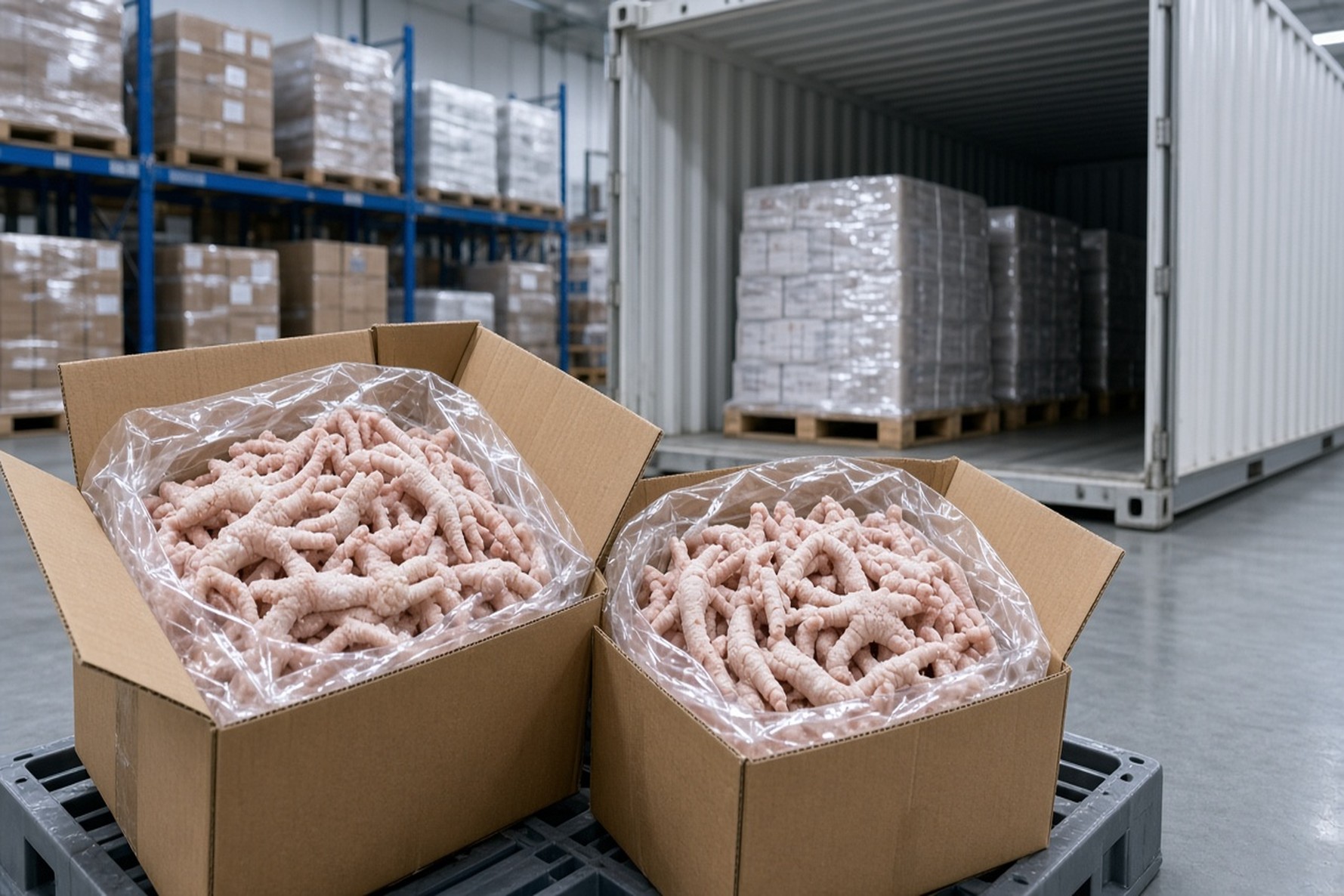
Exporting Chicken Feet and Paws to Vietnam — Grade A Quality Analysis and Reefer Container Shipping
Vietnam market analysis, feet vs paws differences, Grade A commercial specifications, hygiene control, entry documents, frozen packaging and reefer container management — a technical guide for exporters, abattoirs and importers, published in the Iranco Magazine.
Four Key Indicators — Vietnam Market
Vietnam import statistics for 2023 show approximately 122,500 tons of frozen chicken parts imported, valued at nearly USD 212.5 million. Frozen products must be kept at -18°C throughout the cold chain. Under Vietnam's 2026 quarantine regulations, import quarantine certificates for consignments requiring testing may be issued within five business days once all conditions are met.
Exporting chicken feet and paws to Vietnam is an attractive trade route in the Southeast Asian protein market. In many producing countries these are abattoir by-products, but in Vietnam and regional consumption markets they have significant food and processing demand.
However, entering this market is not possible with product and competitive price alone. Frozen chicken feet and paws are veterinary-sensitive goods and Vietnam manages their entry through quarantine, hygiene control, import registration and document verification.
For an Iranian exporter, the first question should not be "what is the price of chicken paws in Vietnam?" The correct question is: are the product, facility and documents compatible with Vietnam import requirements, and is the expected Grade A defined in contractual specifications?
This guide follows that logic: first market and distribution channels, then product differences, Grade A specifications, quality control, entry regulations, logistics and finally pricing and supply from Iran.
1. Vietnam Market Channels for Chicken Feet and Paws
The Vietnam market for chicken feet and paws should not be treated as retail only. The product is supplied and consumed through diverse channels, each with different specifications and prices.
2023 import statistics show Vietnam as an active importer of frozen chicken parts. International supply from the United States, Brazil, the European Union and South Korea has been present in this market.
Main Distribution Channels
The main buyers and channels can be divided as follows:
- Cold-storage wholesalers and frozen distributors;
- Food processing and seasoning units;
- Restaurants and food service businesses;
- Wholesale protein markets;
- Import trading companies;
- Re-export units to regional markets.
Actual Market vs Potential Market
The actual market consists of importers currently buying feet and paws from established international suppliers. The potential market includes units that could evaluate a new origin such as Iran if economics are favourable.
Entering the potential market is harder because the exporter must prove Grade A quality, supply stability and regulatory compliance as well as price.
2. Difference Between Chicken Paws and Chicken Feet
International trade usually distinguishes commercially between paws and full feet. This is not just terminology; it directly affects price, weight, appearance and market acceptance.
A paw is typically the lower part of the limb with a shorter cut and lower weight. A full foot includes more of the limb and may command higher value in some markets.
Chicken Paw
Shorter cut, weight usually 35–50 g, more compact appearance. Popular for food and processing in some Asian markets.
Chicken Feet
Longer cut including more of the upper joint, weight usually 50–80 g. Higher demand in markets such as China and parts of Vietnam.
- Cut style must be identical in sample and contract;
- Product name translation on proforma must not replace technical specifications;
- Price per tonne differs between paws and full feet;
- Size uniformity within each pack matters.
The buyer should confirm photos, samples and cut specifications before ordering. The seller should not offer product as merely "chicken paws" without precise definition.
3. Grade A Commercial Specifications
Grade A is the highest quality level in a given contract. But the term has limited value without a tolerance table and measurable criteria.
In B2B trade the buyer must define specifications in measurable form. Two consignments labelled "Grade A" can differ greatly in commercial value.
Suggested Grade A Specification Table
| Parameter | Grade A Specification | Importance |
|---|---|---|
| Cut shape | Precise cut point and length defined | Avoids dispute over paw vs full foot |
| Unit weight | Agreed gram range per piece | Sales uniformity and grading |
| Colour | Light yellow to yellowish white | Market acceptance and Grade A |
| Skin condition | No severe tears or adverse damage | Visual quality |
| Nails | Removed or retained per order | Varies by buyer |
| Stains and bruising | Contractual acceptance limit | Grade determination |
| Breakage | Maximum contractual tolerance | Product quality |
| Visible contamination | No foreign matter | Safety and acceptance |
| Freezing method | IQF or block per agreement | Texture and appearance |
| Storage temperature | Maximum -18°C | Cold-chain integrity |
| Pack weight | 10–20 kg or per order | Warehouse and distribution |
| Traceability | Batch code and production date | QC and clearance |
In a professional contract, "percentage out of specification" should be defined from the sampling stage. Terms like "premium quality" without quantitative criteria have limited value in international contracts.
4. Quality Defects and Acceptance Limits
An unsuitable consignment may have one or more of the following:
- Severe skin tears;
- Bone breakage above allowed limit;
- Stains and bruising;
- Remaining nails when removal was ordered;
- Foreign matter;
- Freezer burn;
- Severe discolouration;
- Off odour;
- Signs of thaw and refreeze;
- Evidence of improper storage.
Suggested Defect Tolerance Table
| Defect | Contractual Acceptance Limit |
|---|---|
| Skin tear | Maximum 5% of units in sample |
| Bone breakage | Maximum 3% |
| Stain and bruising | Maximum 2% |
| Remaining nails | Zero if removal ordered |
| Foreign matter | Zero |
| Freezer burn | Maximum 1% |
| Severe discolouration | Full rejection |
| Off odour | Full rejection |
The above limits are sample contractual figures and must be agreed between buyer and seller. Sampling and defect counting methods should also be specified in the contract.
5. Microbial Control and Veterinary Requirements
Chicken feet and paws are food products of animal origin. Hygiene control starts at slaughter and continues until delivery at destination.
Vietnam's quarantine regulations were updated from early 2026 under Circular 01/2026/TT-BNNMT. Poultry products are on the list of items under veterinary control.
Main Control Topics
- Highly pathogenic avian influenza (HPAI);
- Newcastle disease;
- Relevant microbial agents (e.g. Salmonella);
- Veterinary drug residues;
- Flock health and abattoir status;
- Valid veterinary certificate;
- Import quarantine registration.
Typical Tests
The testing programme should be set according to Vietnam regulations, the exporting country's veterinary protocol and the buyer's contract. Results must align with the health certificate and contract specifications.
For the seller, flock health history, abattoir veterinary supervision and ability to issue a valid certificate should be verified before production — not when the container reaches a Vietnam port.
6. Market Access and Origin Acceptance
Vietnam operates a defined quarantine system for products of animal origin. Exporting feet and paws must be designed from the start as trade in a veterinary-controlled product.
For countries from which a product group is imported into Vietnam for the first time, the new regulations allow mandatory risk analysis.
Questions to Clarify Before Contract
- Is the country of origin accepted for this product group?
- Is the producing abattoir or plant approved?
- What health certificate format is accepted?
- Is risk analysis required for a new origin?
- What is the poultry disease status in the production region?
- How is import quarantine registration completed?
An Iranian exporter should not assume that any Iranian plant can ship based on tariff code alone. Acceptance status must be verified by the importer and competent veterinary authority.
7. Tariff Code HS 0207.14.99 and Classification
Frozen chicken feet and paws generally fall in Chapter 02 and group 0207 for edible poultry meat and offal. Vietnam import records show frozen chicken parts under HS 02071499.
The tariff code must be finalised according to the exact nature of the goods actually shipped. Differences between paws, feet and other cuts may appear in different national subcodes.
Why Should the Tariff Code Be Fixed Before Final Pricing?
- Import duty and tax rates;
- Required documents;
- Import licences;
- Quarantine control;
- Customs declaration;
- Market statistics analysis;
- Competitor price comparison.
The Vietnamese importer should determine the exact subcode used in declaration for that specific product based on actual specifications.
8. Entry Documents for Vietnam
For a standard frozen feet and paws transaction, the document set typically includes:
- Purchase contract or order;
- Commercial invoice;
- Packing list;
- Bill of lading;
- Certificate of origin if required;
- Veterinary or health certificate in accepted format;
- Import quarantine registration and permit;
- Producer and abattoir details;
- Production and expiry dates;
- Test results if required;
- Cold-chain and transport documents.
The veterinary certificate is the most important specialist document. Discrepancies in plant name, weight, package count or product description across documents can complicate clearance.
Suggested Operational Process — 9 Steps
- Importer verifies product and origin acceptance status.
- Exact product description and tariff code are fixed before final production.
- Accepted veterinary certificate format is confirmed.
- Grade A specifications are locked in the contract.
- Production and freezing are carried out under traceability.
- Shipment documents are sent to the importer before loading.
- Import quarantine registration is completed.
- After arrival, required inspection and sampling are performed.
- After acceptable results, quarantine certificate is issued and clearance completed.
9. Labelling to Meet Vietnam Requirements
Pack labels must provide traceable information consistent with Vietnam regulations. The importer should confirm current labelling requirements before final production.
- Product name in accepted language (Vietnamese and/or English);
- Producer name and address;
- Country of origin;
- Production and expiry dates;
- Net weight;
- Batch or traceability code;
- Storage conditions (frozen, -18°C);
- Importer information if required.
Label information inconsistent with the veterinary certificate and invoice can delay clearance. Label format should be approved before bulk production.
10. Frozen Export Packaging
Exported feet and paws are mainly frozen goods. Packaging is part of the quality preservation system.
Export Pack Requirements
- Food-contact suitable;
- Resistant at freezing temperature;
- Protection against secondary contamination;
- Ability to print traceability information;
- Resistance to cold-store humidity;
- Stability in palletising and sea transport.
Pack Weight
10–20 kg packs are common in international trade. Final weight should be chosen according to the buyer's distribution network, not only to minimise carton cost.
11. Reefer Container Shipping
Sea transport of frozen feet and paws to Vietnam is usually in reefer containers. Cold-chain management on this route determines product quality at destination.
Target temperature is -18°C. Any temperature deviation can reduce texture, appearance and commercial value.
Operational Reefer Points
- Pre-cool container before loading;
- Set temperature to -18°C;
- Pallet layout with adequate airflow;
- Record temperature at loading and discharge;
- Check seal integrity;
- Coordinate loading time with shipping schedule;
- Cargo insurance with cold-chain cover.
Consignment Capacity
Actual capacity depends on carton weight, pallet pattern and container weight limits. Real trade sees loads around 25–28 tonnes, but permitted weight must be set per container and route.
12. Price Determination Factors
Export feet and paw prices should not be compared on a single "per tonne" figure alone. Multiple factors affect the final price:
| Factor | Impact |
|---|---|
| Grade and visual quality | Direct effect on price per kg |
| Cut shape (paw or foot) | Price difference between products |
| Order volume | Volume discount on large orders |
| Abattoir raw material cost | Pricing base |
| Packaging and labelling | Custom order extra cost |
| Freezing and cold storage | Holding cost |
| Testing and certificates | QC cost |
| Domestic haulage and port | Origin logistics cost |
| Reefer freight | Major transport cost |
| Delivery terms (FOB/CIF) | Risk and cost allocation |
To compare two offers, all specifications must match. A lower price per tonne is not necessarily the better offer.
13. Competitors in the Vietnam Market
Vietnam's market for frozen feet and paws has multiple international suppliers. An Iranian exporter should assess its position against these players:
| Origin | Position | Competitive Feature |
|---|---|---|
| United States | Large supplier | High production volume and industrial standards |
| European Union | Quality supplier | Strict hygiene control |
| South Korea | Regional market | Geographic proximity to Vietnam |
| Brazil | Major supplier | Production scale and competitive price |
| Turkey | Emerging supplier | Geographic position and pricing |
Sustainable advantage does not come from cheap selling. It comes from offering Grade A product with traceable origin, stable quality and documents aligned with Vietnam import requirements.
14. 20-Point Importer Checklist
A Vietnamese importer or trading company planning to buy frozen feet and paws should finalise the following before placing an order:
- Specify product: chicken paws, feet or both.
- Define required grade (A or equivalent).
- Write exact cut shape and product length.
- Set weight or size range per unit.
- Specify nail status (removed or retained).
- Include breakage and skin-tear tolerance in the contract.
- Define maximum acceptable visual defects.
- Set inner pack weight.
- Set master carton weight.
- State need for private label if any.
- State trial and monthly order volumes.
- Specify destination port in Vietnam.
- Set delivery terms (FOB/CIF etc.).
- List required tests.
- Specify label language and information.
- Confirm veterinary certificate format before production.
- Record reefer terms and -18°C requirement.
- Write destination acceptance criteria.
- Specify purchase and payment schedule.
- Retain mutually approved reference sample.
This level of detail significantly reduces disputes because "quality" moves from personal judgment to verifiable indicators.
15. Information Needed for a Price Request
A price request without technical specifications has limited comparative value. The buyer should include:
- Product: frozen chicken paws or feet;
- Grade: A or equivalent technical spec;
- Exact cut shape and length;
- Weight range per unit;
- Nail status;
- Breakage and tear tolerance;
- Maximum visual defects;
- Inner pack and carton weight;
- Trial and monthly volumes;
- Destination port: Vietnam;
- Delivery terms;
- Required tests;
- Label language;
- Payment terms.
Buyers wishing to evaluate supply from Iran can submit these specifications in a purchase request to Iranco so sourcing options can be reviewed against defined needs.
16. Supply Path for Feet and Paws from Iran
In international trade, finding product is only one step. The seller must clarify origin, facility, veterinary status, production capacity, Grade A specifications and ability to meet the buyer's packaging requirements.
For Vietnam, another step is added: confirming product entry eligibility and origin acceptance. Before finalising a deal, Iran's access status for the product group and required documents for that consignment must be checked.
Iranco can provide a platform for buyers seeking to evaluate feet and paw supply from Iran to submit purchase requests based on technical specifications. The request should include product shape, grade, size, nail status, pack weight, approximate volume, destination port and expected standards.
A precise request enables more rational comparison of supply options. Two sellers are comparable only when they quote the same product to the same specification.
Summary
Exporting chicken feet and paws to Vietnam is economically attractive because these products have significant food and commercial value in Vietnam and the region.
But market size should not distract from the key reality: for animal products, regulatory compliance and Grade A quality matter more than finding a customer.
A professional deal should proceed in this order: first verify product and origin entry; then finalise Grade A specs, samples and tests; then design packaging and cold chain; finally compare commercial price.
For an Iranian exporter, sustainable advantage does not come from cheap selling. It comes from offering frozen feet and paws with traceable origin, stable quality, defensible Grade A specifications and documents aligned with Vietnam import requirements.
Frequently Asked Questions
What does Grade A mean in exporting chicken feet and paws to Vietnam?
Grade A means the highest visual and hygiene level in a given contract — typically intact skin, uniform colour, minimum breakage, minimum staining and bruising, nails removed if ordered, and proper freezing. But "Grade A" has limited value without a contractual tolerance table; the buyer should document countable defects and acceptance limits.
What is the difference between chicken paws and chicken feet in international trade?
A paw is usually the lower part of the limb with a shorter cut; a foot is the fuller limb with greater length. Cut style, weight, appearance and price differ. Contract photos, samples and cut specs must match exactly; product name on a proforma does not replace technical specification.
What temperature is required for shipping frozen feet and paws to Vietnam?
Frozen product must be held at maximum -18°C throughout the cold chain until delivery. The reefer container should be pre-cooled, set to -18°C, and temperature recorded in transit. Any deviation can reduce quality and commercial value.
Which quality defects usually cause consignment rejection?
Severe discolouration, off odour, visible contamination, foreign matter, extensive freezer burn, severe skin tears, excessive breakage and signs of thaw and refreeze commonly cause rejection or downgrade. Each defect should have a numeric tolerance in the contract.
What tests are required for chicken paws entering Vietnam?
The programme should follow Vietnam rules, veterinary protocol and the buyer contract. Typical topics include microbial agents (e.g. Salmonella), veterinary residues, poultry disease control (HPAI and Newcastle) and sensory/visual evaluation. Results must match the health certificate and contract.
Can any Iranian plant export chicken paws to Vietnam?
No. Animal-origin products are under Vietnam veterinary control. Origin acceptance, producing plant status, health certificate format and possible risk analysis must be verified before contract. Production capacity in Iran alone does not authorise entry to Vietnam.
What information is needed for an accurate price quote?
The buyer should specify product type (paw or foot), grade, cut shape, weight range, nail status, defect tolerance, pack weight, order volume, destination port, delivery terms and required tests. "Price for 25 tonnes of paws to Vietnam" without detail is not a complete request.
What packaging is suitable for exporting chicken paws?
Bulk frozen packs should resist moisture and low temperature, be food-contact suitable and traceable. Typical structure is a food-grade inner bag and strong master carton. 10–20 kg packs are common, but weight should follow the buyer's distribution network.
How is the export price of chicken paws determined?
Price depends on grade, visual quality, cut shape, order volume, raw material cost, packaging, freezing, cold storage, testing, domestic haulage, reefer freight and delivery terms. To compare offers, all specs must match; lower price per tonne is not automatically better.
What does reefer container inspection before delivery include?
Inspection should cover set and actual temperature, reefer unit condition, pre-cooling, pallet stowage and airflow, seal integrity, document match with cargo and random carton sampling. Recording container temperatures at in and out is important to prove the cold chain if disputes arise.
Featured Products
Related Articles



