 Iranco Magazine Team
Hong Kong market overview, frozen chicken feet import requirements, buyer quality specs, export packaging, cold chain and shipping/transit route selection
Export Guide · Chicken Feet · Hong Kong
Exporting Frozen Chicken Feet to Hong Kong: Packaging and Transit Routes
Hong Kong market overview, frozen chicken feet import requirements, buyer quality specs, export packaging, cold chain and shipping/transit route selection
Four Key Indicators
Hong Kong's official trade classification assigns code 02071410 specifically to frozen domestic chicken feet. As a free port, Hong Kong applies no general import tariff on such goods; however, permit, hygiene and customs declaration requirements still apply.
Chicken feet are often low-value compared with breast and leg meat in many markets, but in parts of East Asia they hold distinct commercial importance. Texture, skin and collagen make feet an independent product with precise buying specifications in wholesale, foodservice, ready meals and processing channels.
Hong Kong is not only a consumption market. Its port structure, frozen food importers, cold stores, wholesalers and regional re-export history give it special importance for poultry exporters.
For an Iranian exporter, the priority before finding a buyer is to verify legal entry eligibility for the Iranian origin and the intended production facility before any firm contract. Hong Kong rules tie poultry meat and edible parts imports to approved origin protocols and acceptable establishments.
This separates a professional deal from a high-risk contract. A Hong Kong buyer typically needs product that is defensible on origin, slaughter, processing, freezing, veterinary certificate, establishment number, traceability and cold-chain integrity — not just appearance.
1. How does the Hong Kong chicken feet market work?
Enter the Hong Kong market by treating chicken feet as a frozen food commodity with its own commercial specs — not merely a slaughterhouse by-product. In professional trade, buyers may specify cut position, nail on/off, piece weight and size, uniformity, skin colour, breakage, freezer burn and packaging.
Buyer type matters. An importer serving local Hong Kong consumption may be stricter on grade uniformity and packaging than a trading company setting specs for a downstream market.
Main buyer groups
- Specialist frozen food importers
- Meat and poultry distributors
- Restaurant supply wholesalers
- Food processing and preparation units
- Asian product distribution networks
- Regional re-export trading companies
Why price alone is not decisive
Comparing two offers on "price per tonne" without a specification sheet is almost meaningless. At minimum, product definition, grade, weight range, nail status, cut, defect limits, freezing method, glaze, net weight, packaging and origin must match.
- Exact product definition
- Grade and weight/size range
- Nail status and cut position
- Acceptable defect percentage
- Freezing method and surface ice
- True net weight and pack materials
- Origin and establishment number
2. Product definition: what specs must export feet meet?
A common mistake is vague terms like "Grade 1" or "export quality" without measurable criteria.
The buyer should define measurable, inspectable specifications:
| Parameter | Contract specification | Buyer importance |
|---|---|---|
| Product form | Whole foot, defined cut line | Avoid delivery disputes |
| Nails | With or without nails | Depends on end use |
| Size | Agreed weight or dimension range | Pack and portion uniformity |
| Colour | Approved sample appearance range | Processing quality signal |
| Breakage | Contract ceiling | Waste reduction |
| Bruising | Contract acceptance limit | Visual quality |
| Skin damage | Acceptance ceiling | Grade impact |
| Foreign matter | Not acceptable | Safety and quality |
| Freezing | Fast and uniform | Texture protection |
| Surface ice | Per agreement and net weight | Weight dispute prevention |
| Pack weight | Fixed contractual weight | Inventory control |
| Batch number | Mandatory | Traceability |
Grade terminology
There is no single global system defining "premium" or "Grade 1" for all chicken feet trades. Contract terms must translate labels into real measurable specs.
Instead of "premium grade", write: "Whole feet, sound, free of foreign contamination, colour per approved sample, uniform cut, no significant freezer burn, with defined limits for breakage and bruising."
Reference sample
Before bulk production, an approved sample should serve as the reference. Photos, sample weights, cut type, nail status and acceptable defects should be documented with sample approval.
3. Export chicken feet quality control
Quality starts at the slaughter line, not at packing. Skin damage, breakage, bruising, cooling delay and poor freezing cannot be fixed later by better packaging.
Pre-loading inspection should cover breakage, irregular cuts, excessive skin loss, bruising, stains, contamination, feathers or debris, freezer burn, surface dryness, excess ice, sticking and off odour after controlled thaw.
- Toe or shank breakage
- Irregular cuts and excessive skin loss
- Bruising and abnormal stains
- Physical contamination and debris
- Freezer burn and surface dryness
- Excess ice build-up and severe sticking
- Abnormal odour after controlled thaw
| Defect | Likely cause | Commercial effect |
|---|---|---|
| High breakage | Rough handling or poor processing | Grade downgrade |
| Discolouration and bruising | Pre- or at-slaughter damage | Reduced visual appeal |
| Freezer burn | Air exposure or temperature swings | Texture and appearance loss |
| Excess ice | Weak water or pack control | Net weight disputes |
| Stuck pieces | Poor freezing or packing | Processing difficulty |
| Irregular cut | Weak line control | Non-uniform product |
| Off odour | Spoilage or poor storage | Rejection risk |
Microbiological control
Freezing is not sterilisation. Low temperature slows or stops many organisms but does not necessarily eliminate all microbes present in raw material.
Professional buyers may request microbiological, residue and related test reports. Acceptance limits should follow valid destination market rules and agreed specifications.
4. Critical condition: origin and plant must be acceptable
Hong Kong does not accept poultry meat and edible parts from any origin on invoice and routine commercial certificate alone. A relevant protocol must exist between Hong Kong and the country of origin, with health certificates from a recognised competent authority.
The correct sequence is:
- Check current origin status under Hong Kong food import protocols
- Confirm eligibility to export chicken and parts from the origin country
- Verify approved slaughter and processing establishments
- Match authorised plant activity to the intended product
- Align health certificate format
- Then negotiate firm price and shipment
If origin or plant is not yet approved, transit through a third country does not solve the problem. Veterinary origin and production site do not change because a container passes through another port.
5. Permits and documents for Hong Kong importers
Chicken feet are legally part of edible poultry carcass and frozen chicken imports are permit-controlled. Each consignment needs a relevant import permit.
The importer must also be registered under Hong Kong's food importer/distributor registration system or qualify for a legal exemption.
Typical consignment document set
- Commercial invoice and packing list
- Bill of lading and certificate of origin if required
- Official veterinary or health certificate as accepted
- Hong Kong import permit
- Slaughter or processing establishment details
- Batch number and traceability data
- Reefer container documents and agreed test results
- Halal certificate if requested
Under official Hong Kong guidance, frozen meat or poultry import permits are usually issued for one consignment and remain valid for six weeks from issue.
6. Tariff code and import costs in Hong Kong
Frozen chicken feet are classified under HKHS 02071410 — frozen domestic chicken feet within frozen edible poultry parts and offal.
Hong Kong is a free port and charges no general import tariff. But "zero tariff" does not mean "zero import cost".
- Ocean freight and reefer container charges
- Container power at port and terminal fees
- Inspection, clearance and cold storage
- Local haulage and demurrage if delayed
- Sampling or testing costs
- Banking and documentation fees
Commercial food imports still require customs declaration. Zero tariff must not be confused with exemption from import formalities.
7. Suitable export packaging for Hong Kong
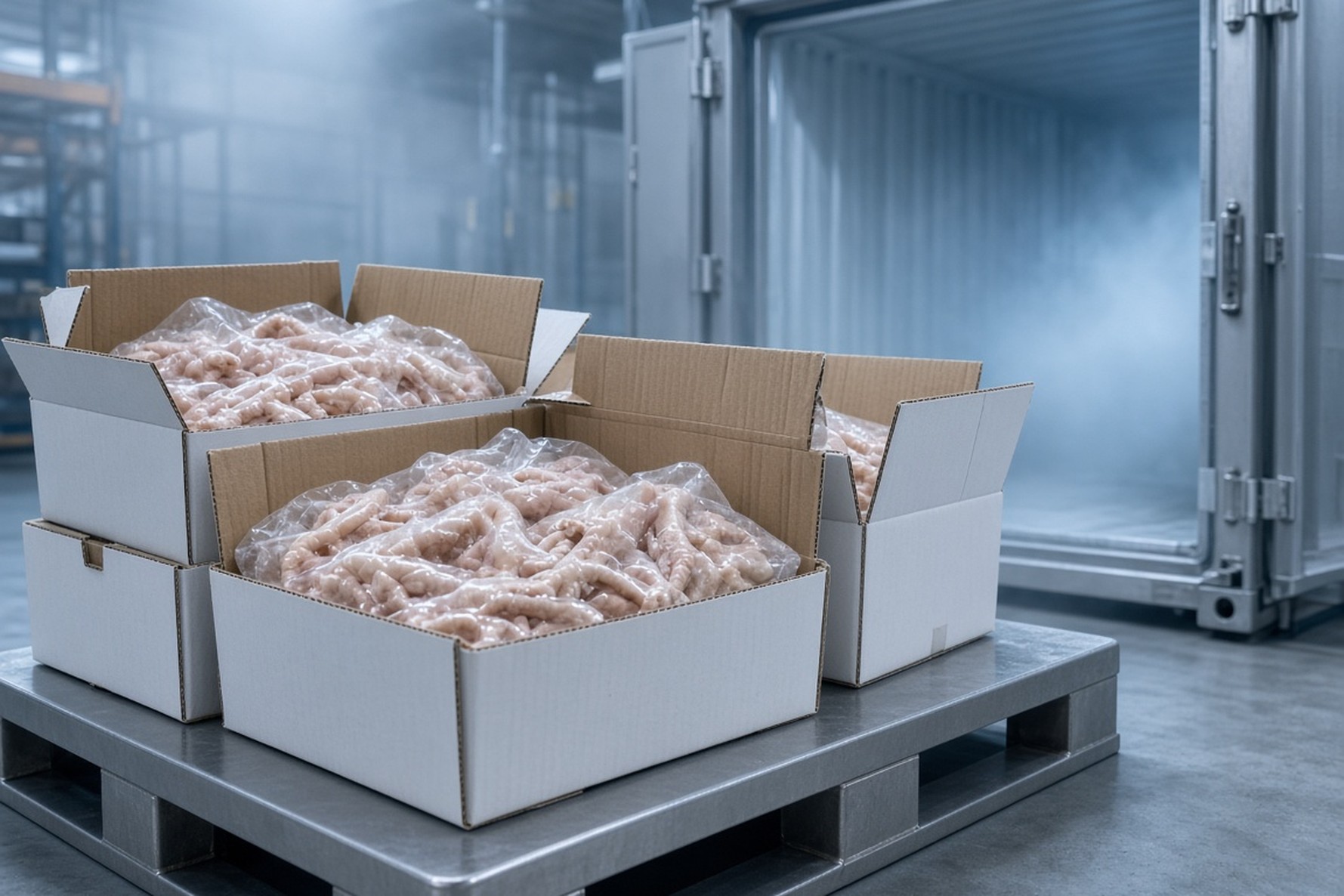
Packaging must simultaneously protect product, reduce dehydration and contamination, and create a countable, traceable commercial unit.
Inner layer
- Food-contact suitable and freeze-resistant
- Adequate seal and thickness to retain moisture
- Prevent direct contact between product and raw carton
Master carton
- Adequate crush resistance in cold humid logistics
- Pallet-friendly dimensions
- Clear batch marking and uniform closure
Net weight
Product weight must be separable from packaging and any ice glaze. Net weight calculation method must be defined in the contract from the outset.
Pack labelling
- Product name and frozen status
- Net weight, country of origin and producer
- Production date, batch and storage conditions
- Establishment number and shipment trace marks
8. Cold chain: where deal margin can disappear
For quick-frozen food, international guidance recommends product temperature at -18°C or below. The transport unit must be pre-cooled and ready before loading.
Product temperature ≠ container air temperature
A reefer container is not designed to freeze large volumes of warm product; its main job is to maintain properly pre-frozen cargo.
- Check core temperature of sample cartons before loading
- Inspect reefer technically and record temperature settings
- Keep airflow clear and door open time minimal
Temperature logger
Temperature data loggers are highly useful in export consignments. Sensitive orders may use multiple probe positions recorded in the loading report.
Cold chain failure signs
- Wet and deformed cartons
- Re-freeze on surface and large ice crystals
- Abnormal sticking and frozen water in pack base
- Significant temperature variation and severe freezer burn
9. Shipping and transit routes from Iran to Hong Kong
For frozen chicken feet, ocean reefer container is the main option for commercial volume. Air freight is possible but value-to-weight ratio usually limits wide use.
- Number of container transhipments
- Total port-to-port transit time
- Power availability in transit
- Shipping schedule reliability
A typical structure is Iran port → transit hub → Hong Kong, but the exporter should not choose solely on the shortest quoted transit time.
| Factor | Less transhipment | More transhipment |
|---|---|---|
| Delay risk | Lower | Higher |
| Container handling | Less | More |
| Reefer power interruption risk | Lower | Higher |
| Vessel choice flexibility | More limited | Greater |
| Schedule change likelihood | Lower | Higher |
| Cold chain control | Simpler | Harder |
How to evaluate transit time
Contracts should distinguish scheduled sailing time, total origin-to-destination port time, and actual availability after import clearance.
Transit does not change origin
If cargo loads in Iran and is only transferred ship-to-ship at a third port, veterinary origin remains Iran. Hong Kong health restrictions relate to country of origin, certificate authority and establishment.
Transit with unloading or cold storage
- Does ownership of goods change?
- Is the seal broken?
- Is a new certificate required?
- What origin-chain documents does Hong Kong accept?
- How are transit country hygiene rules applied?
10. Sea entry and inspection in Hong Kong
Imported poultry consignments may be subject to inspection or sampling on arrival. For sea imports, the importer may need to move product to the food examination facility at Kwai Chung customs complex or hold it in an approved cold store pending inspection.
The buyer must be ready with cold storage and clearance before the vessel arrives. Incomplete documents leaving the container in port can erase a significant share of margin through power, detention and storage charges.
11. How is export chicken feet price to Hong Kong determined?
A single "global price" is not realistic. Two seemingly similar loads can differ sharply on quality, origin and delivery terms.
| Factor | Price impact |
|---|---|
| Foot size and uniformity | Higher grade usually commands more value |
| Breakage and defect rate | More defects reduce price |
| Nail status and processing | More operations raise production cost |
| True net weight | Directly affects offer comparison |
| Freezing type | Affects appearance and texture |
| Carton and bag quality | Changes pack cost and transit damage risk |
| Order volume | Affects production and logistics cost |
| Delivery port | Freight and ancillary costs differ |
| Incoterms | Changes seller responsibility scope |
| Reefer container cost | Major delivery cost component |
| Testing and certificates | Depends on deal requirements |
Compare price on net weight
Two sellers may quote similar prices but one bases weight on net product and the other on glazed or packed weight.
Price shall be calculated on edible net weight.
Ex-works price ≠ delivered Hong Kong price
To compare offers fairly, Incoterms must match. Ex-plant price cannot be compared directly with CFR/CIF Hong Kong including freight and insurance.
Importer checklist before placing order
Before issuing a chicken feet purchase order, close these items:
- Exact foot definition and cut position
- Nail status
- Commercial grade and real criteria per grade
- Size or weight range
- Breakage ceiling
- Bruising and skin defect criteria
- Reference sample approval
- Freezing method
- Net weight and glaze conditions
- Inner pack and carton weight
- Label artwork
- Slaughterhouse and processing establishment numbers
- Verify Hong Kong origin acceptance
- Verify establishment acceptance
- Health certificate format
- Pre-shipment tests
- Product temperature at loading
- Reefer container settings
- Use of temperature logger
- Origin and destination ports
- Transit route
- Incoterms
- Order lead time
- Accept/reject criteria
- Quality dispute resolution method
Including all items in a purchase request enables supplier comparison on real specs. Buyers evaluating supply from Iran can submit the same details in an Iranco purchase request.
What information is needed for an accurate price quote?
A request for "export chicken feet price" without product specs does not produce comparable answers.
- Frozen chicken feet; shape and cut
- With or without nails; required grade
- Size/weight range and max acceptable defects
- Freezing form and net weight per carton
- Inner bag and carton type
- Total order volume and destination port
- Incoterms, private label and halal needs
- Requested tests and loading timeline
On Iranco, price requests can be filed on the same basis; more precise specs make supply comparison easier.
Supply path for export chicken feet from Iran
For Hong Kong exports, price should not be the first question. First confirm whether Iranian origin and the intended slaughter/processing unit can fit Hong Kong import framework at deal time.
After that, evaluate suppliers on real production capacity, grade uniformity, traceability, freezing quality, packaging and ability to issue documents and plan reefer containers.
Iranco lets buyers and trading companies register purchase requests with exact product specifications so available Iranian supply can be reviewed on the same basis.
The sample stage must not be skipped. Reference sample, written specs and approved photos must align before bulk production.
Summary
Exporting chicken feet to Hong Kong is a controlled frozen food operation — not a simple by-product sale.
In Hong Kong, frozen chicken feet carry code HKHS 02071410 with zero general import tariff. Frozen poultry imports remain permit-controlled.
Commercially, terms like "Grade 1" or "export quality" are insufficient. Size range, nail status, defect ceilings, net weight, freezing and packaging must become contractual metrics.
In logistics, the shortest route is not always best. Fewer transhipments, reliable schedule, assured reefer power and temperature tracking usually beat a few nominal days saved.
Professional decision order: legal entry eligibility first, then supplier and sample, then technical specs and documents, then price and finally shipment.
Frequently Asked Questions
Does Hong Kong charge import duty on chicken feet?
Hong Kong is a free port and does not levy general import duty on normal goods including poultry products. However, freight, port services, reefer container, cold store, clearance and possible inspection costs remain. Chicken feet are also permit-controlled as frozen poultry.
What is the tariff code for frozen chicken feet in Hong Kong?
Under Hong Kong commodity classification, frozen domestic chicken feet are identified by HKHS 02071410, specifically separating "feet" from other frozen poultry parts and offal.
What temperature is required for shipping frozen chicken feet?
For quick-frozen food, -18°C or below is the reference cold-chain temperature. Product must reach required temperature before loading; a reefer is not the primary tool to freeze warm cargo.
What is the best export packaging for chicken feet?
Suitable packaging usually combines food-grade inner bags and cold-resistant master cartons. Packs must prevent dehydration, contamination and physical damage and enable batch traceability.
How should chicken feet grade be defined in contract?
Do not rely on "Grade 1" alone. Define size, cut, nail status, colour, breakage, bruising, skin damage, surface ice and freezer burn with measurable limits and keep an approved reference sample.
Can chicken feet be transhipped via a third country to Hong Kong?
Ocean transhipment is logistically possible, but passing through a third country does not change veterinary origin. Origin, health certificate and establishment must still meet Hong Kong import conditions.
Can any Iranian plant export chicken feet to Hong Kong?
No. Importers must verify current origin protocol status and slaughter/processing establishment acceptance. Hong Kong requires health certificates from recognised authorities and establishment information.
What information is needed for a chicken feet price from Iran?
Grade, size range, nail status, cut, acceptable defect rate, carton weight, packaging form, order volume, destination, delivery terms and required tests must be specified.
Does freezing eliminate microbiological contamination?
No. Freezing controls growth and preserves product; it does not replace hygienic slaughter and processing. Line hygiene, water, equipment, staff and cross-contamination control remain essential.
What is the main risk in ocean shipping of chicken feet?
Cold chain failure alongside transit delay. Reefer power loss in transit, wrong settings, loading warm product, blocked airflow and long port stays can all reduce quality. Route choice should consider service reliability and temperature control, not freight alone.
Featured Products
Related Articles



