 Iranco Magazine Team
Technical specs, commercial varieties, quality standards, market dynamics and southern grain export opportunities to the Persian Gulf
Export Guide · Champa Rice
What Is Champa Rice? Types, Wholesale Market and Southern Iran Export Capacity
A full analysis of technical specs, commercial varieties, quality standards, market dynamics and southern grain export opportunities to Persian Gulf countries
This strategic report examines the physicochemical structure of Champa rice, the distinctions among southern varieties such as Anbarboo, Lenjan and Kamfiroozi, the technical requirements of Iranian National Standard 127 and Codex 198, modern milling lines, wholesale pricing patterns, and transit and export capacity toward regional markets—especially Iraq and GCC countries—while offering operational guidance for trade managers and rice importers.
Understanding Iran’s grain production without non-northern ecosystems yields an incomplete picture. While traditional rice trade has long focused on the Caspian plain and slender long-grain types, climate change, shifting diets and southern logistics advantages are drawing traders, wholesalers and international buyers toward the Karun, Karkheh and Zayandeh-Rud basins and the plains of Fars. The Champa rice family—an agricultural identity of Iran’s central plateau and south—plays a fundamental role in domestic supply and border trade.
Champa is a native medium-grain aromatic cereal grown in tropical and semi-arid climates. Genetic adaptation to sharp heat swings and sedimentary soils has produced distinctive biological traits. Natural volatile aromatics such as 2-acetyl-1-pyrroline, a warm temperament in traditional nutrition, a soft cooked texture and retained body after long holding make Champa superior to many imported long-grain options.
Proximity of main harvest zones to Persian Gulf ports and western/south-western land export terminals enables fast, low-cost access to Iraq, Kuwait, the UAE, Qatar and Oman. Sustainable market share and successful contracts still depend on separating Champa ecotypes, knowing milling and sorting equipment, mastering cargo inspection standards and understanding legal and customs rules. This article covers the indicators buyers need before commercial ordering.
1. Genealogy, grain structure and physicochemical profile of Champa rice
The Champa grain family is a native, long-standing branch of the Indica subspecies that has ecologically converged with Iran’s warm latitudes over centuries. Southern summer heat stress and intense sunlight during grain filling steer starch enzyme synthesis and aromatic compounds in the endosperm, producing grains rich in easily digested carbohydrates with minimal digestive irritation.
Starch polymers and rheological behaviour
Champa starch balances amylose and amylopectin. Amylose across Champa ecotypes ranges from 19% to 22%, placing it in the medium-to-low starch class. That ratio prevents the grain from drying and turning brittle after the meal cools. Unlike high-yield long-grain types that become dry and unpleasant within hours, Champa keeps sensory softness and fat mouthfeel for hours after cooking. Gelatinization temperature sits at 70–74°C, enabling faster hydration and cooking than late-cooking varieties.
Raw grain geometry and expansion in cooking
Raw white Champa grain measures about 5.0–5.6 mm in length and 2.2–2.6 mm in width. Length-to-width ratio of 1.9–2.2 places it in Codex medium / oval-round rice classes. During boiling it expands evenly axially and radially, delivering high cooked yield for household and institutional catering.
2. Major Champa types and commercial landraces in Iran
The Champa family includes many species and ecotypes shaped by water, soil and cultivation method. Precise identification prevents mismatch with the target market.
Anbarboo rice (Khuzestan and Ilam)
Anbarboo is the best-known and best-selling Champa branch today. Core origins include Shushtar, Dezful, Shadegan, Bavi and Ahvaz in Khuzestan, plus Sirvan and Chardavol valleys in Ilam. Grains are plump, matte white to milky. Its defining trait is a pervasive, sharp, lasting aroma from plant defence metabolism under hot summer sun. Sirvan Anbarboo is milder and slightly narrower; Shushtar Anbarboo is much denser in aroma with a resilient cooking glaze.
Local Shushtar Champa and Midavood Champa
Local Khuzestan Champa from foothill areas such as Midavood (Baghmalek) and Shushtar lands is the older, genetically stable form—rounder and denser. Midavood Champa, irrigated by mountain springs, resists breakage and does not over-split in long cooking; preferred for traditional moist dishes such as dami and tahchin.
Lenjan rice (Isfahan)
Along the Zayandeh-Rud in Falavarjan, Zarrinshahr and Pir Bakran, Lenjan rice has centuries of history. From Champa stock but shaped by cooler river water and semi-mountain climate into a denser ivory grain with high soluble starch and pleasant stickiness. Limited water and acreage make it scarce and premium-priced in Tehran and central luxury markets.
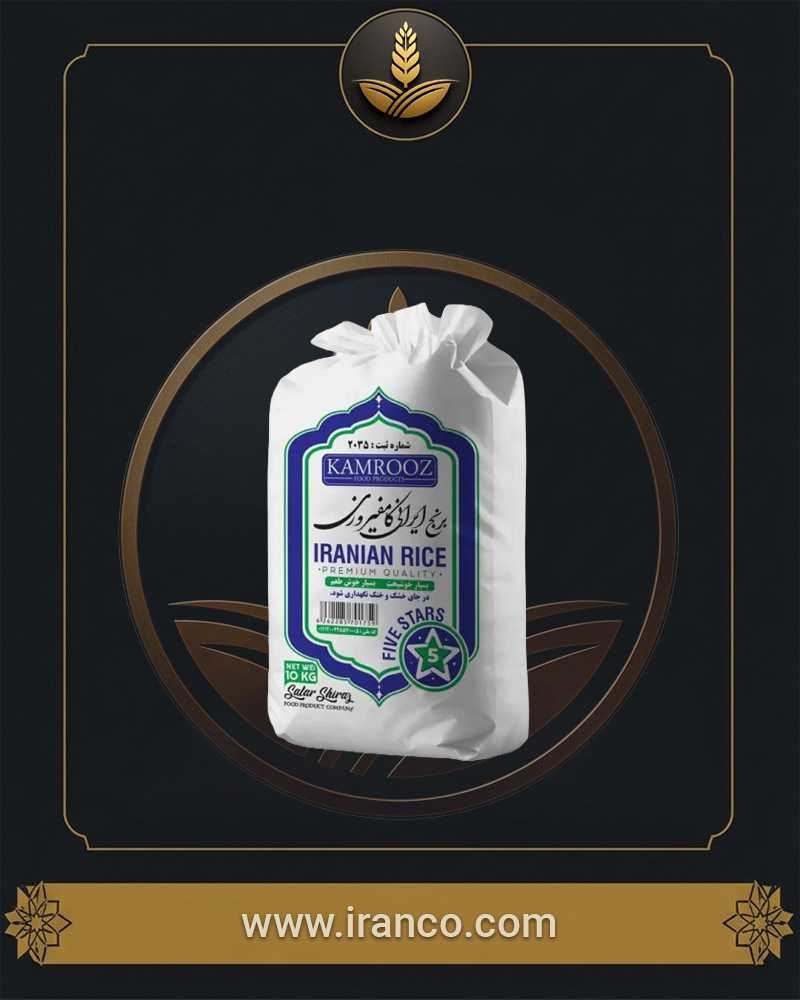
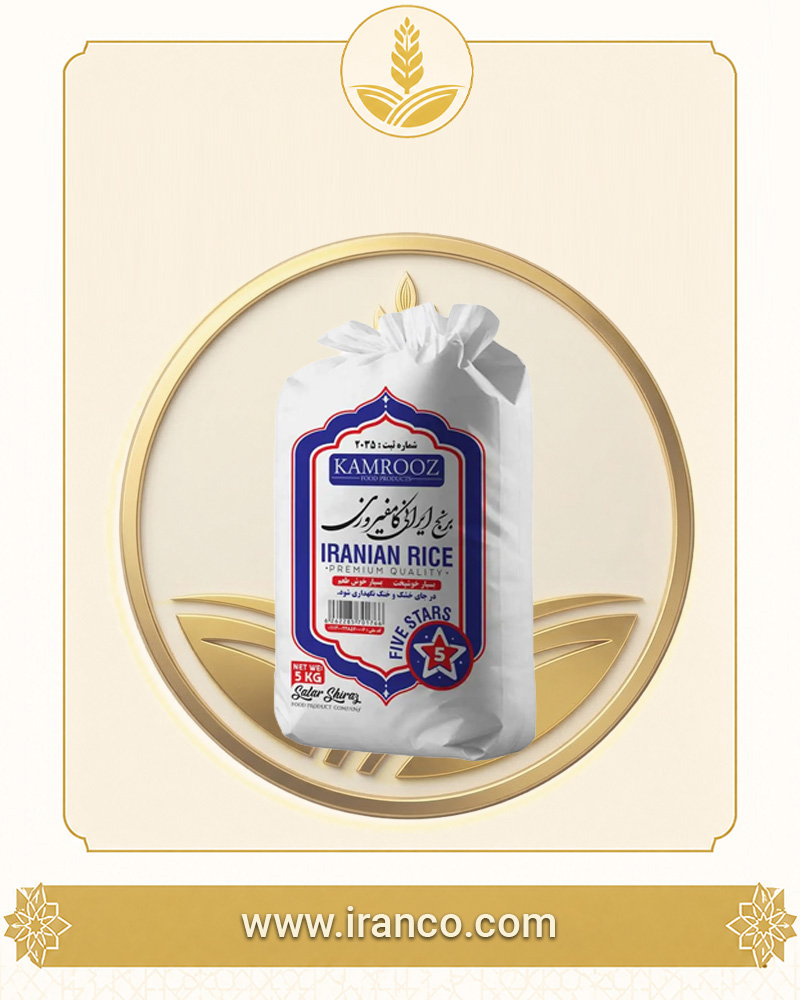
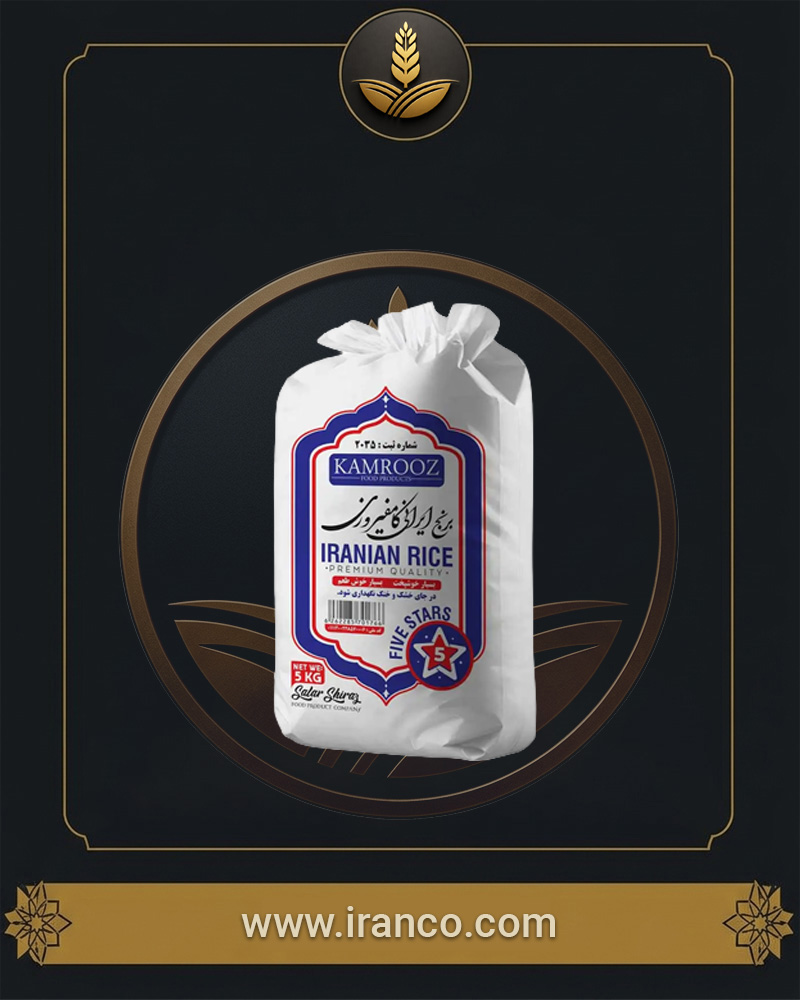
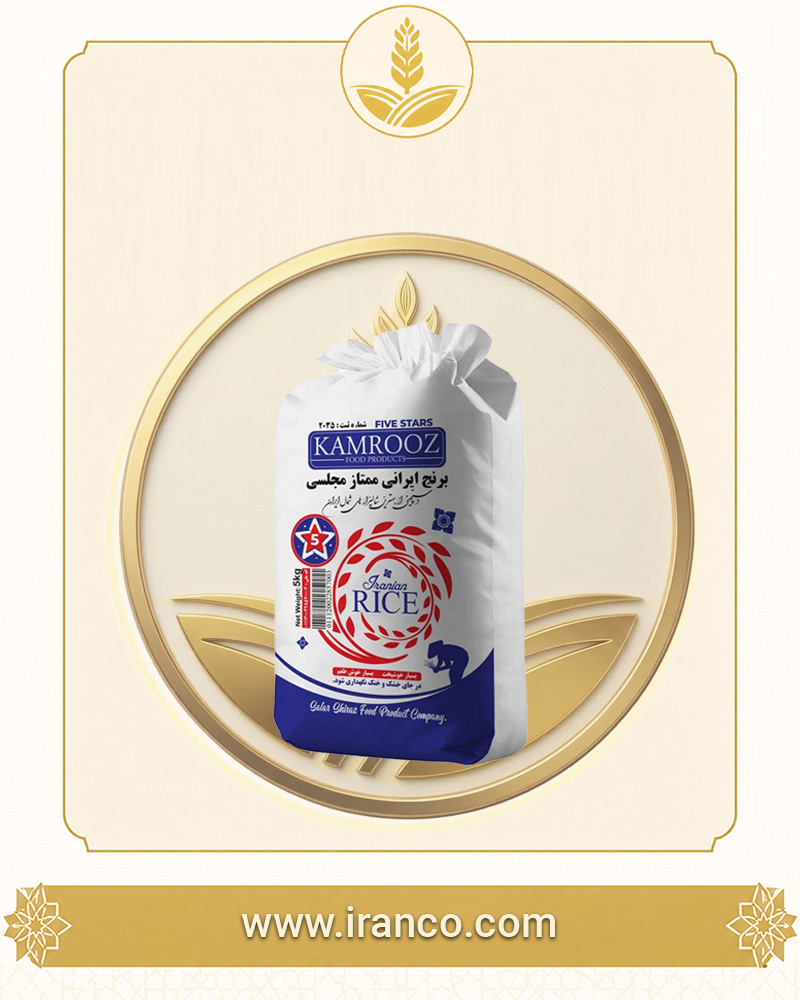
Kamfiroozi rice (Fars)
The Kamfiruz plain and Marvdasht areas of Fars grow Kamfiroozi (Qasrodashti) Champa—longer and clearer than Khuzestan types. High mineral content of the Kor River yields a distinctive taste and glassy grain. Among Champa types it performs best for drained ceremonial pilaf, holding upright separate grains after draining.
Table 1: Analytical comparison of southern Champa types
| Metric | Shushtar Anbarboo | Sirvan Anbarboo | Midavood Champa | Lenjan Isfahan | Kamfiroozi Marvdasht |
|---|---|---|---|---|---|
| Raw length (mm) | 5.2–5.5 | 5.1–5.4 | 5.0–5.3 | 5.0–5.4 | 5.5–5.8 |
| Cooked length (mm) | 7.5–8.4 | 7.6–8.3 | 7.1–7.9 | 7.0–8.0 | 8.1–9.2 |
| L/W ratio | 2.1 (medium) | 2.0 (medium) | 1.9 (oval-round) | 1.9 (round) | 2.3 (medium-long) |
| Amylose (%) | 20.0–21.5 | 19.5–21.0 | 19.0–20.5 | 18.5–20.0 | 21.0–22.5 |
| Aroma intensity | Extremely strong | Very aromatic | Pleasant aromatic | Lasting, penetrating | Mild aromatic |
| Appearance | Matte milky | Light milky | Opaque yellowish | Ivory opaque | Semi-crystalline clear |
| Cooked texture | Soft, very light | Delicate, separable | Dense, cohesive | Glazy, sticky | Ceremonial, separate |
| Key demand hubs | Iraq, Khuzestan, Tehran | Western luxury home | Local Khuzestan | Central affluent | Restaurants & Fars |
3. Quality requirements, technical standards and commercial acceptance
Bulk commercial rice buying needs laboratory measurement against Iranian National Standard 127 and Codex Alimentarius 198. Purely sensory checks without lab parameters are a leading cause of buyer–supplier disputes at clearance.
Breakage and impurity thresholds
Broken kernels are endosperm pieces shorter than three-quarters of a sound mature grain. Uncleaned traditional Champa lots may show up to 20% breakage; commercial lots must be graded. Super-premium export lots allow max 2% breakage; grade one up to 8%; above 15% trades as grade two / industrial.
Chalky, damaged and red-streaked grains
Chalky grains come from incomplete filling, heat shock or early harvest; they cook too fast, mash before main grains elongate and ruin plate texture. Moisture-, insect- or dryer-damaged kernels are QC-tested so the final lot stays physically uniform.
Table 2: Physicochemical acceptance limits for Champa (ISIRI 127 & Codex 198)
| Property | Export premium | Commercial grade 1 | ISIRI 127 max | Commercial impact |
|---|---|---|---|---|
| Free moisture (%) | 12.0–12.8 | 12.8–13.5 | ≤ 13.5 | Prevents mould and pests |
| Broken grains | < 2.0% | < 8.0% | Per declared grade | Appearance; less mushiness |
| Chalky grains | ≤ 3.0% | ≤ 5.0% | ≤ 6.0% | Cooking uniformity |
| Heat damage | Zero | ≤ 0.5% | ≤ 1.0% | Avoids stale flavour |
| Red streaks | ≤ 0.2% | ≤ 1.0% | ≤ 2.0% | Hulling/polish quality |
| Mineral foreign matter | Zero | ≤ 0.05% | ≤ 0.1% | Consumer & machine safety |
| Live insects | Absolute zero | Absolute zero | Reject all grades | Phytosanitary certificate |
| Cadmium (ppm) | < 0.06 | < 0.1 | ≤ 0.15 | Destination port safety |
| Lead (ppm) | < 0.08 | < 0.15 | ≤ 0.2 | International health protocols |
4. Modern milling and physical loss control
Final plate quality fuses farm authenticity with milling precision. Champa’s dense oval grain cracks under worn blade mills and friction, pushing breakage above 25%. Efficient conversion needs modern protocols.
Ten-step paddy-to-sorted grain process
- Receive farm paddy at 20–24% moisture; weigh on digital weighbridge.
- Pre-clean, cyclone dust removal and vibrating screens for coarse trash, straw and stems.
- 3D destoning by specific gravity versus field grit.
- Staged drying on moving-bed dryers with mild air (max inlet 40–42°C) over 48–72 hours down to under 13% moisture.
- Continuous moisture checks and 48-hour rest in aerated intermediate silos to equalise internal stress.
- Rubber-roll husking to strip husk without shocking the endosperm.
- Paddy separator screens (unhusked vs brown rice).
- Soft multi-stage whitening/polishing with abrasive and friction cylinders plus controlled water spray to remove aleurone and bran dust.
- Rotary trommels and two-deck flat screens to remove half-grains and tips.
- Colour optoelectronic sorting (Sortex) to reject yellow, opaque, spotted and black-tip grains; auto bagging.
Dryer temperature control is critical. High-heat furnaces crack starch crystals so grains shatter in whitening. Lines with online moisture sensors protect Champa structure. Buyers sourcing from Iran can use Iranco to review options and submit purchase requests by specification.
5. Wholesale market dynamics, hubs and price swings
Annual rice trade turnover in Khuzestan and neighbouring provinces ranks among the south’s largest agricultural cash flows. Price discovery and bulk supply centre on Shushtar, Dezful, Ahvaz and Marvdasht.
Seasonal calendar and rate patterns
- Spring: land rest, gradual warehouse drawdown, secondary moisture drop, slow price rise on tight stocks.
- Summer: field prep, July transplanting, sharp drop in bulk deals as prior crop ends; year’s highest prices.
- Autumn (Aban–Azar): peak harvest, new paddy into mills, 20–30% price drop on farmer cash supply—best window for large tonnage and annual contracts.
- Winter (Dey–Bahman): cleaned-lot prices stabilize, grain rests and aroma finishes, border export and national retail delivery rise.
Table 3: Quality, technology and timing factors vs wholesale cost
| Factor | Market target | Base price delta | Economic rationale |
|---|---|---|---|
| Full optical Sortex (double screen) | < 2% breakage | +15% to +25% | Even cook, visual yield |
| Genetic purity | > 98% uniform | +10% to +20% | Same cook time in large pots |
| Storage ageing | 4–6 months post-harvest | +8% to +15% | Texture strength, volume |
| Vacuum packing | 3-layer gas-flushed pouch | +6% to +10% | Aroma retention, pest control |
| Lab health certificates | No pesticide residues | +5% to +8% | Hypermarket & clearance |
6. Export target markets and regional buyer preferences
Most output stays domestic, yet Champa’s aroma and texture open a distinct niche in nearby international markets—luxury segments, specialty stores and high-end restaurants.
Iraq and Kurdistan Region demand
Iraq is the historic primary market for Khuzestan Anbarboo and Champa. Cultural taste affinity in Basra, Najaf, Karbala and Baghdad favours soft pilaf with stews—exactly what Champa’s gelatinous glaze delivers. Shalamcheh and Chazabeh border terminals keep road freight cost and time low.
GCC markets (UAE, Kuwait, Qatar, Oman)
- UAE: Dubai demand centres on luxury packs, hypermarkets and Middle Eastern hotel/restaurant supply; genetic purity and near-zero broken rice are non-negotiable.
- Kuwait: traditional preference for warm-temperament aromatic rice; communities pay premiums for authentic Shushtar and Ilam rice.
- Oman & Qatar: growing demand for specialty and organic Iranian rice via active transit and exchange ports. Importers can send grade, pack weight, volume and destination via Iranco for matched supply options.
Table 4: Demand, preferences and trade conditions by destination
| Destination | Demand | Priority types | Preferred pack | Channels | Logistics edge |
|---|---|---|---|---|---|
| Iraq | High, continuous | Shushtar Anbarboo, Midavood | Laminate 10 & 20 kg | Wholesalers, hotels | <24h road via Shalamcheh |
| UAE | Medium, quality-led | Double-sorted Anbarboo, Kamfiruz | Vacuum 1, 2, 5 kg | Hypermarkets, luxury F&B | Regular Gulf container lines |
| Kuwait | High, value-added | Ilam & Khuzestan aromatic | Spunbond 5 & 10 kg | Catering, specialty retail | Direct short sea |
| Oman | Expanding | Kamfiroozi, premium Anbarboo | Handled 10 kg bags | Chains, co-ops | Bandar Abbas / Jask sailings |
| Qatar | Niche, limited | Shushtar premium Champa | Gift boxes 1–5 kg | 5-star hotel supply | Short haul from Bushehr/Dayyer |
7. Customs requirements, tariff codes and trade documents
Formal rice export needs coordination among Plant Protection, Food & Drug and Iran Customs. Accurate HS declaration prevents assessment delays and unrelated duties.
Harmonized System (HS) codes
- 10061000: paddy / rice in the husk.
- 10062000: brown / husked rice only.
- 10063000: semi- or wholly milled rice, whether or not polished/glazed.
- 10063020: standard declaration for premium aromatic fully milled white rice—most precise class for export Anbarboo and processed Champa.
- 10064000: broken rice from sorting lines.
Export clearance document pack
- Phytosanitary certificate (Plant Protection) confirming freedom from nematodes, fungal disease and storage insects.
- Human-consumption health certificate from Food & Drug and accredited labs.
- Physicochemical COA: moisture, breakage, chalky grains, heavy metals.
- Road CMR or ocean Bill of Lading.
- Commercial invoice with product specs, packs, gross/net weight and pallet numbers.
- Detailed packing list for cartons and pallets.
- Certificate of Origin from Iran Chamber of Commerce.
8. Packaging technology, warehousing and container logistics
Rice is hygroscopic—it rapidly absorbs ambient moisture and odours. In hot humid southern Iran and Gulf destinations, non-standard packs lose aroma and invite storage pests within weeks.
Export packaging engineering
- Multi-layer laminated BOPP: standard for 10 and 20 kg; polymer barrier blocks moisture and dust.
- Vacuum polyamide multi-layer: best for 1–5 kg export; oxygen removal and nitrogen flush keep Anbarboo aroma fresh up to two years.
- Export master cartons: vacuum packs must sit in five-ply high-compression cartons under pallet weight.
Warehouse standards and quarantine fumigation
Central warehouses should hold 15–21°C and 50–55% RH year-round. Plastic pallets at least 15 cm off the floor and ≥0.5 m from walls keep airflow open. Biological cleaning uses aluminium phosphide tablets under gas-tight tarps for the standard exposure to kill eggs, larvae and adults.
Container logistics and moisture “rain”
Dry 20-ft containers carrying 22–25 tonnes serve UAE and Oman sea lifts. Day–night temperature swings cause ceiling condensation (container rain). Industrial silica-gel hangers in corners and kraft moisture-absorbing wraps over pallets are mandatory. On Iranco, buyers can register product, pack and destination details for supplier matching.
Table 5: Commercial packaging comparison for Champa rice
| Material | Weight range | Aroma life | Moisture risk | Impact resistance | Export fit |
|---|---|---|---|---|---|
| Traditional jute | 50 kg | 1–2 months | Very high | Very low | Rejected for export |
| Plain woven PP | 20–50 kg | 2–3 months | High at sea | Medium | Local bulk only |
| Laminated BOPP | 10 & 20 kg | 8–12 months | Very low | Excellent | Optimal branded bulk |
| Vacuum in master carton | 1, 2, 5 kg | 18–24 months | Zero | Protected in carton | Max premium value |
| Stand-up zip kraft | 1–2.5 kg | 6–9 months | Low with liner | Needs careful storage | Organic / urban retail |
9. Competitive position of Champa versus global players
Regional entry requires clear advantages and limits versus global grain flows. Champa should not compete as a cheap commodity against Indian or Thai bulk—position it as an organoleptic, natural, healthy product.
Table 6: Southern Iranian Champa vs competing Middle East grains
| Origin / type | Cook behaviour | Price tier | Core advantage | Supply challenge | Dominant markets |
|---|---|---|---|---|---|
| Iran (Champa / Anbarboo) | Medium, soft, warm, strong aroma | Mid-to-high | Authentic taste, light digestion, short transit | Lower volume vs giants | Iraq, Kuwait, UAE, domestic luxury |
| India (Basmati 1121) | Extra-long linear elongation | Medium | Huge scale, global brand | Firms / dries after cooling | Gulf, Europe, USA |
| Pakistan (Super Kernel) | Long needle, mild aroma | Competitive, variable | Flexible chain, competitive rates | Grade inconsistency | Gulf & Middle East |
| Thailand (Jasmine Hom Mali) | Long, very soft sticky | High | Industrial sorting, pack stability | Mismatch with traditional pilaf | East Asia / Asian segments |
| Vietnam (5451 medium) | Medium, neutral, no aroma | Cheap / economic | Very low cost, unlimited tonnage | Weak quality home/hotel pull | Industrial catering, tenders |
10. Operational checklist for bulk buyers and importers
- Specify exact variety and growing origin (e.g. premium Shushtar Anbarboo, Midavood Champa, Fars Kamfiroozi).
- Cap breakage: <2% premium, <8% grade one.
- Moisture ≤13.0% for sea transit and storage resilience.
- Require colour optical Sortex and two-stage screening in the contract.
- Verify crop year and ≥3 months silo rest—avoid soft-cooking new rice.
- Take sealed composite reference samples; keep half until discharge.
- Define bag laminate micron, print quality, handles and top stitch.
- Third-party inspection certificate for weight, quantity and quality before container seal.
- Label compliance with destination (Gregorian/Hijri dates, Arabic & English, nutrition panel).
- Tie final payment to verified B/L and phytosanitary / origin certificates.
- Inspect container/truck isolation: no holes, damp, diesel smell or prior chemical residue.
11. Mandatory RFQ / formal price-request data
A precise RFQ prevents financial misunderstanding and wasted time. Bulk buyers should state:
- Exact variety/ecotype: Anbarboo, local Champa, Lenjan or Kamfiroozi.
- Quality grade and breakage limit (e.g. double-screened, max 2%, laser colour sort).
- Chalky / discoloured grain tolerance per standard.
- Pack type, size and material (1/5/10/20 kg; BOPP, spunbond or vacuum in master carton).
- Total tonnage and weekly/monthly delivery schedule.
- Incoterms 2020 delivery point (EXW mill, FOB Khorramshahr/Bushehr, CIF border/port).
- Private-label needs and destination registration codes.
- Required labs: heavy metals, pesticide residues, halal certificate.
12. Sourcing southern Champa through Iranco
Southern Iran’s grain chain spans vast farms and hundreds of traditional/semi-industrial mills, often with many intermediary layers. On large tonnage, whitener calibration differences, lot inconsistency and moisture swings create serious financial and quality risk.
Iranco gives procurement managers, wholesalers and international importers direct access to a vetted network of modern Champa and Anbarboo producers in the south. Iranco oversees sample-to-cargo match, certificate verification, sorted-lot coordination and document facilitation so supply stays transparent, on-spec and on schedule. Buyers can register quality criteria for evaluated supply options.
If you need stable, uniform, documented southern Champa and Anbarboo for local markets, national wholesale or export baskets, register technical specs, tonnage and delivery destination on Iranco for credible options and commercial terms.
Analytical summary
Champa rice and flagship branches such as Khuzestan Anbarboo and Fars Kamfiroozi are rare regional grain-trade opportunities. Unique organoleptic traits, lasting aroma, balanced amylose, soft cook and warm temperament differentiate this native grain from common imports and create a secure commercial base in neighbouring markets.
Trade growth needs advanced optical sorting, breakage under 2%, climate-controlled storage and modern laminate/vacuum packs. Proximity to land corridors and warm-water Gulf ports, plus ISIRI 127 and Codex 198 compliance, underpins lasting premium-segment penetration. Spec-driven decisions enable high-yield national and regional trade.
Frequently asked questions
How does Champa differ from northern long-grain rice?
Champa is medium / oval-round; northern Sadri and Tarom are slender long grains. Lower amylose means softer, glazier cook that stays soft when cold. Physiologically it has a warm temperament and very easy digestion.
What is the difference between Anbarboo and Champa?
Champa is the historic umbrella family of tropical Iranian landraces; Anbarboo is a highly aromatic, tasty branch evolved in Khuzestan and Ilam. Traditional Midavood Champa is rounder, less aromatic and more breakage-resistant in long cooking.
How long does Anbarboo aroma and quality last?
Laminated PP in cool ventilated storage: 8–12 months useful life. Vacuum or nitrogen multi-layer packs: aroma, taste and softness up to 24 months without spoilage or infestation.
How can buyers source Champa directly from southern mills?
Start with exact physical grade, breakage allowance, pack type and delivery timing. Register specs on Iranco so matching options from reputable Khuzestan and Fars mills can be identified for contracting.
What data is needed for an accurate export price?
Variety (Shushtar, Kamfiruz, Midavood), sorting grade (double-screen Sortex), breakage tolerance, bag material/weight, Incoterms and tonnage. Iranco price requests use the same fields.
Which Champa type suits ceremonial and restaurant use?
Fars Kamfiroozi for ceremonial drained pilaf (clearer, glassy elongation). Shushtar Anbarboo for traditional stew restaurants—dense aroma and very light cook.
Which lab tests are mandatory for export health?
Moisture, broken/damaged grains, heavy metals (Pb, Cd, As), organophosphate/organochlorine residues, total aflatoxin and microbial/mould counts per ISIRI 127 and Codex 198.
Featured Products


Related Articles



