 Iranco Magazine Team
Australia food import market analysis — high-demand groups, Iranian product opportunities, main ports, BICON and IFIS requirements, tariffs, labelling, quality control and entry costs
Market Report · Australia
Food Imports to Australia: Market, Rules and Costs
Analysis of Australia's food import market — high-demand product groups, Iranian product opportunities, main entry ports, BICON and IFIS requirements, tariffs, labelling, quality control and entry costs.
Analytical introduction
Australia's food market should not be assessed by population alone. Modern retail structure, relatively high purchasing power, a multicultural society, strong demand for Asian and Middle Eastern foods, premium imported products and food-industry need for specialist raw materials mean imports remain a significant part of the national food supply chain.
In financial year 2023–24, food imported by Australian businesses reached AUD 27.6 billion. Official data show fruit and vegetables and processed foods among the largest import groups. New Zealand held 14.5% of import value as the top origin; the United States, China and Singapore followed.
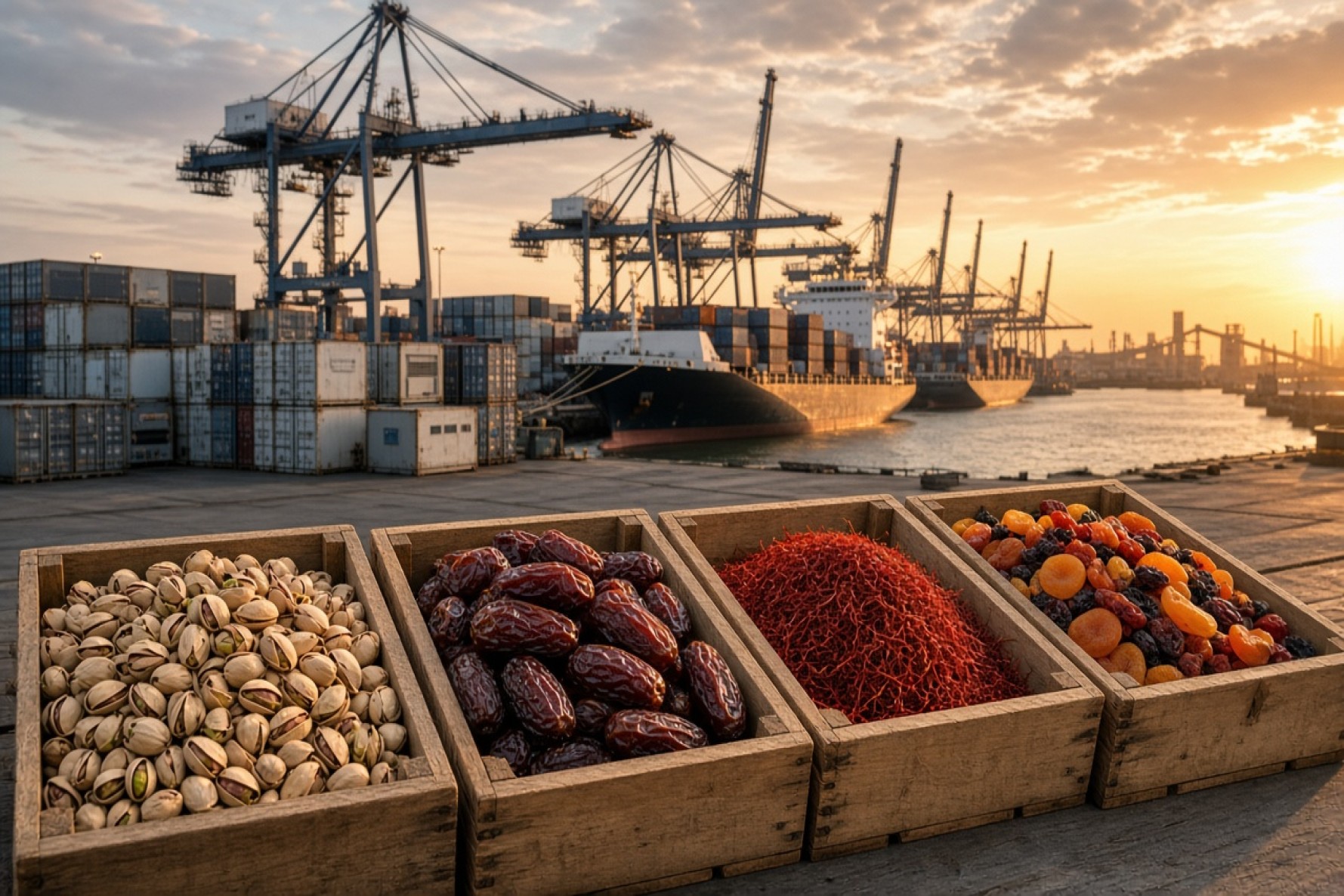
For Iranian exporters, Australia's importance lies mainly in products where Iran has recognised supply capability and the goods can tolerate long transit, carry adequate added value and meet Australia's strict regulatory framework. Pistachio, dates, saffron, raisins, dried fruit, some spices and dried herbs, fruit and vegetable preparations and certain food-industry inputs fall in this group. In 2024–25 bilateral trade data, "fruit and nuts" at AUD 10.1 million was among Australia's notable imports from Iran.
Successful sales to Australia depend less on finding a single buyer and more on designing the full transaction chain correctly: accurate classification, BICON review, pest and quarantine requirements, residue and contaminant control, Australian-standard labelling, correct customs declaration, appropriate port choice, inspection and testing cost planning, and coordination with an Australian importer. These details determine whether a commercial offer is genuinely executable or only attractive on paper.
1. The Real Picture of Australia's Food Import Market
Australia is a major agricultural exporter, but that does not mean its food import market is small. Seasonal production gaps, consumer preferences, ethnic foods, processed products, specialist raw materials and goods where domestic production is limited or economically uncompetitive all create substantial import demand.
Official import reports show that in financial year 2023–24, fruit and vegetables and then processed foods held the highest shares in the import mix. Non-alcoholic beverages, seafood, dairy, cereal products, bakery goods, meat, confectionery and chocolate, and oils and fats also feature in imports.
For commercial analysis, distinguish between a "large market" and a "market suited to an Iranian exporter". High seafood import volume does not necessarily mean an Iranian export advantage in that group. A smaller segment such as saffron may have limited trade weight but be more attractive per kilogram for a specialist exporter.
| Product group | Import demand | Iran supply appeal | Main buyer concern |
|---|---|---|---|
| Fruit, vegetables & preparations | Very important in import mix | High for dried and processed | Quarantine, MRL, packaging |
| Tree nuts | Established market | High, especially pistachio | Aflatoxin and consignment integrity |
| Dried fruit | Retail and wholesale fit | High | Stored-product pests, residues, moisture |
| Saffron & spices | High value per weight | High for premium goods | Authenticity, contamination, packaging |
| Processed foods | Large import share | Medium to high | Formulation and labelling |
| Food-industry inputs | B2B demand | Product-dependent | Technical specs and COA |
| Fresh produce | Large but complex entry | Product-specific | Quarantine access and phytosanitary certs |
A professional Australian importer usually does not first ask "Is this product made in Iran?". The core question is whether the product can be supplied with stable specifications, acceptable documents, a quality-control track record, suitable packaging and a lawful entry path. That is why a dry or processed product with standard specifications often has a more predictable commercial route in early deals than fresh fruit or vegetables.
2. Which Food Products Attract Australian Importers Most?
Australian import demand can be grouped into several main clusters.
Fruit, vegetables and plant products
This group is one of the largest in official import data. Distinguish fresh, frozen, dried, canned, purée, concentrate and other processed forms — quarantine conditions are not identical. For exporters outside established Australian supply networks, dry, processed and longer-shelf-life goods usually have a planning advantage. For fresh product, country–product access in BICON must be confirmed in addition to commercial quality.
Tree nuts and dried fruit
Nuts, dates, raisins and other dried fruit fit retail, confectionery and bakery, food service and specialist stores. This group is especially important for Iran, as part of actual Iran–Australia food trade appears under fruit and nuts. Dry product must not be confused with simple regulation: stored-product pests, pesticide residues, mould, moisture, preservatives and, for some nuts, aflatoxin are core control topics.
Spices and premium inputs
Saffron is a clear example of high value per weight. That can make air freight logical for limited orders, commercial samples or premium consignments. The Australian tariff code for saffron is 0910.20.00 and the current general rate is Free. Spices, dried herbs and flavouring materials can appeal to specialist importers, food manufacturers and ethnic retailers — but microbial contamination, foreign matter, residues and label accuracy must be checked before shipment.
Processed and shelf-ready foods
Canned goods, pickles, sauces, tomato paste, fruit preparations, confectionery and some ready meals can enter ethnic and mainstream channels if formulation and labelling comply with the Food Standards Code. Here the main risk is not always quarantine — permitted additives, usage levels, nutrition panel, allergens, nutrition claims, correct product name and Australian importer details can be decisive.
3. Real Opportunities for Iranian Food Products in Australia
When reviewing Australia, split Iran's opportunities into existing trade and developable potential. AUD 10.1 million of "fruit and nuts" among Australia's imports from Iran in 2024–25 shows this is not purely theoretical — a commercial path already exists.
Pistachio
Pistachio best illustrates both opportunity and market strictness. In-shell pistachio under HS 0802.51.00 and pistachio kernels under 0802.52.00 carry a Free rate in Australia's current tariff schedule. However, pistachio and pistachio products are high-risk for aflatoxin. The maximum level for pistachio is 0.015 mg/kg. In composite foods with more than 30% pistachio or peanut, the applicable limit is calculated from the nut share in the product.
This is not theoretical. In a January 2026 report, an Iranian pistachio cream with 70% pistachio failed at 0.014 mg/kg aflatoxin against a calculated limit of 0.011 mg/kg. Reports from the same period also recorded pistachio failures from other origins including China and Italy — the issue is real pistachio-chain control, not origin alone.
Dates
Fresh or dried dates under 0804.10.00 are Free in the current tariff schedule. For Iranian exporters, visual quality, uniformity, insect control, pack cleanliness, appropriate moisture, batch traceability and precise BICON condition matching matter more than duty rate alone.
Saffron
Saffron suits specialist importers because of high value, small shipment size and Iran's global recognition in this chain. In a professional deal, product form, purity, chemical specifications, test results, net weight, packaging, production batch and storage conditions must be defined precisely. The current tariff for HS 0910.20.00 is Free.
Raisins and dried fruit
Not all dried fruit enters duty-free. Dried grapes under 0806.20.00 carry a general 5% rate in the current schedule. Dried apricots under 0813.10.00 and many other dried fruits under 0813.40.00 also carry 5%. Pesticide residues are taken seriously — in 2024 inspection reports, residue screening in fruit and vegetables was among the most frequent tests.
| Iranian product | Sample HS code | Current schedule rate | Main commercial risk |
|---|---|---|---|
| In-shell pistachio | 0802.51.00 | Free | Aflatoxin, pests, uniformity |
| Pistachio kernels | 0802.52.00 | Free | Aflatoxin, oxidation |
| Dates | 0804.10.00 | Free | Quarantine, stored-product pests |
| Raisins | 0806.20.00 | 5% | MRL, pests, moisture |
| Saffron | 0910.20.00 | Free | Purity, authenticity, packaging |
| Dried apricots | 0813.10.00 | 5% | MRL, additives, moisture |
| Other dried fruit (0813.40.00) | 0813.40.00 | 5% | Classification, residues, pests |
Final classification must reflect exact product form, processing level, composition and pack status. Raw pistachio, pistachio cream and pistachio confectionery do not necessarily share one tariff code.
Iran-related transaction constraints
Beyond food regulation, trade with Iran must be checked against Australia's sanctions framework. The current framework restricts certain goods, services, business activity and dealings with listed persons and entities. Ordinary food is not generally prohibited as an import category, but the Australian importer must screen counterparties, payment routes and other involved parties. Australia's consolidated sanctions list was updated on 16 September 2026. Commercially, "product is importable" and "transaction and payment are feasible" are two separate reviews.
4. Through Which Routes and Borders Does Food Enter Australia?
Australia has no land border with another country. Food imports therefore enter mainly through seaports and international airports into the customs territory.
In financial year 2024–25, the container ports of Brisbane, Sydney, Melbourne, Fremantle and Adelaide handled 9.1 million TEU combined.
Port of Melbourne
Melbourne is one of Australia's most important container gateways. Container throughput reached 3.39 million TEU in 2024–25, up 3.7% on the prior year; full import container volume rose 4.3%. For importers whose warehouse, customer or distribution network sits in Victoria and south-east Australia, Melbourne is a natural choice.
Port Botany, Sydney
Port Botany is New South Wales' main container hub and handles 99.6% of the state's container volume. Published throughput is about 2.8 million TEU per year, and a large share of import containers is consumed or distributed in the Sydney area. This port suits importers whose main market is Sydney and NSW.
Port of Brisbane
Brisbane is Queensland's main commercial gateway. In 2024–25 it recorded a record 1.62 million TEU.
Fremantle and Adelaide
Fremantle serves Western Australia; Adelaide serves South Australia. These ports make sense when the importer's main customers or warehouse sit in those regions. Moving a container from an east-coast discharge to Western Australia after unloading can add substantial inland cost.
| Entry route | Best for | Main advantage | Decision factor |
|---|---|---|---|
| Sea to Melbourne | Commercial cargo, Victoria market | Large container network | Final warehouse location |
| Sea to Port Botany | Sydney and NSW market | Direct access to largest city market | Inland haul cost |
| Sea to Brisbane | Queensland market | Direct north-east gateway | Customer destination |
| Sea to Fremantle | Western Australia market | Less east-to-west inland haul | Order volume |
| Sea to Adelaide | South Australia market | Regional destination proximity | Service frequency |
| Air freight | Saffron, samples, premium low-weight orders | Speed and lower tied-up capital | Freight cost per kg |
Iranian sea shipments may involve one or more transshipment stages. Hub port and transfer count should be set from the actual shipping-line service at booking time. For purchase planning, record final port, transshipment count, container free time and cost responsibility in the carriage contract — not an assumed fixed route. In FCL, the importer's final destination matters greatly. In LCL, consolidation and deconsolidation location, risk of mixing with higher biosecurity-risk cargo and destination warehouse charges must be reviewed.
5. BICON, Biosecurity Quarantine and Special Conditions for Iranian Goods
For many food imports into Australia, the hardest part is not tariff — it is biosecurity.
The base laws are the Biosecurity Act 2015 and the Imported Food Control Act 1992. The Imported Food Control Regulations 2019 and Imported Food Control Order 2019 set the inspection and control framework for imported food.
The BICON system is the practical reference for answering:
- Is the product allowed to enter at all?
- Is an import permit required?
- Is a government or quarantine certificate needed?
- Is pre-export treatment mandatory?
- What packaging, container and transport conditions apply?
- What post-entry food-safety requirements apply?
From June 2025, food-safety requirements are also integrated in BICON. Review order matters: biosecurity conditions must be confirmed first, then imported food-safety requirements.
Khapra beetle risk for Iranian consignments
Iran is on the list of target countries for khapra beetle risk. The current official list amended in April 2026 still includes Iran among target countries. This matters especially for cereals, seeds, nuts, dried plant products and some container routes. Being on the target list does not mean every Iranian container faces identical requirements — conditions depend on product type, cargo route, packaging form, entry method and even where some containers are opened. For some sea routes, high-risk plant goods or containers to be opened in specified rural-risk areas may face special pre-export actions or inspection. The correct decision must come from the BICON case file for that exact product and route.
Fresh, dry or processed?
This distinction is critical. Fresh fruit and the same fruit dried or processed can have completely different entry conditions. Fresh fruit may need country–product access, phytosanitary certificate, treatment or special quarantine conditions. Industrially processed product may carry lower biosecurity risk but must still meet food composition and labelling rules. Before sending a commercial sample, define exact product form. "Dates", "pistachio" or "dried herb" is not enough — specify raw or processed, in-shell or kernel, bulk or consumer pack, and any other ingredients present.
6. Food Safety Law, IFIS and Labelling — Where Many Consignments Fail
All imported food for sale in Australia must comply with the Australia New Zealand Food Standards Code and country-of-origin requirements. Border control under the Imported Food Inspection Scheme (IFIS) is risk-based.
Risk food
For food classified as risk food, the initial referral rate for inspection is 100%. After five consecutive successful consignments this can reduce to 25%, and after a further 20 successful results to 5%. A failure can push referral back to 100%.
Surveillance food
For surveillance food the random referral rate is 5%. If goods fail, a holding order may apply and later consignments of the same product and manufacturer may be controlled at a higher rate until a compliance record is rebuilt. Exporter history matters — quality is not only one consignment's test result; manufacturer track record and ongoing compliance affect future inspection risk.
Labelling — serious, preventable risk
In 2024, overall compliance for inspected food was 98.5%. Among non-compliant results, 76.3% related to labelling. Of labelling failures: 26.5% concerned incomplete or incorrect nutrition information; 18.5% ingredient lists; 17.7% mandatory warnings; 15.8% importer information; 12.2% country-of-origin labelling. A poor label design can stop a sound consignment at clearance.
| Label element | Main expectation |
|---|---|
| Product name | Correct description of the food's true nature |
| Language | Mandatory information in English, legible |
| Ingredients | Descending order by ingoing weight |
| Allergens | Declared per new PEAL requirements |
| Nutrition panel | NIP format where required |
| Country of origin | Per Country of Origin Food Labelling Information Standard 2016 |
| Supplier details | Name and address of Australian or New Zealand supplier |
| Traceability | Batch or lot identifier |
| Net weight | Correct and per measurement rules |
| Storage | Where needed to maintain product safety |
The Food Standards Code requires mandatory label information in English, legible and with adequate contrast. Other languages may appear alongside English provided they do not contradict mandatory English information.
Nutrition Information Panel (NIP)
For most packaged foods, the NIP includes energy, protein, total fat, saturated fat, carbohydrate, sugars and sodium, shown per serve and per 100 g or 100 ml. Some foods such as plain spices and dried herbs, packaged water, tea and coffee may be exempt in specific cases — but a nutrition claim can create an NIP obligation.
Allergens — PEAL
Plain English Allergen Labelling (PEAL) has been mandatory since 25 February 2024, and the sell-through period for products labelled under the previous system ended on 25 February 2026. New consignments in 2026 must use the new format. Allergens must be declared with specified names and a separate "Contains" statement near the ingredient list. Pistachio is specifically listed among tree-nut allergens.
Country of origin
The Country of Origin Food Labelling Information Standard 2016 applies to most retail food. Imported priority foods must carry country-of-origin text in the prescribed identifiable format. Priority groups include fruit, vegetables, nuts, meat, seafood, bread, milk, juice, sauces, honey and cereals.
7. Tariffs, GST and the Real Cost of Food Import into Australia
Landed cost cannot be calculated from customs duty alone. Real delivered cost includes fixed and variable charges across the chain.
Customs declaration processing
For electronic Import Declaration, current ABF charges are:
- Value over AUD 1,000 and under AUD 10,000: AUD 50
- Value AUD 10,000 and above: AUD 152
- Paper declarations for the same two bands: AUD 90 and AUD 192 respectively
Biosecurity charges from 1 July 2026
In the official 2026–27 fee schedule, the Full Import Declaration biosecurity charge is AUD 48 for air cargo and AUD 71 for sea cargo. An import permit request, where required, costs AUD 135. In-hours departmental services for inspection, document assessment, analysis and similar work are AUD 42 per 15 minutes per person; off-site in-hours service is AUD 70 per 15 minutes per person. Where a permit is needed, initial assessment fees range from AUD 82 to AUD 655 by assessment group, in addition to the AUD 135 request fee.
Laboratory testing
If the Food Control Certificate (FCC) requires analytical testing, the importer must nominate an appointed laboratory and pay that laboratory directly — there is no single government test fee for all products.
GST
Taxable import GST is 10% of the taxable import value. The base can include customs value, international freight and insurance, and customs duty. Not all food is automatically GST-taxable — if the equivalent domestic supply is GST-free, the import may also be non-taxable. A flat "10% on all food" formula is not reliable for import costing.
| Cost item | Amount or basis |
|---|---|
| Goods price | Per seller contract |
| International freight | Shipping line or airline rate |
| Insurance | Per insurance contract |
| Electronic IPC, AUD 1k–10k | AUD 50 |
| Electronic IPC, AUD 10k+ | AUD 152 |
| Biosecurity FID — air | AUD 48 |
| Biosecurity FID — sea | AUD 71 |
| Permit request if required | AUD 135 + assessment fee |
| DAFF in-hours services | AUD 42 / 15 min / person |
| IFIS laboratory test | Per appointed lab tariff |
| Customs duty | Per HS code |
| GST | Per product tax status |
| Customs broker | Commercial agreement |
| Terminal, storage and discharge | Per port and provider |
| Demurrage and detention | If free time exceeded |
| Inland haul in Australia | Port-to-warehouse distance and cargo type |
In a professional purchase offer, CIF or CFR price alone does not show the importer's final cost. Landed cost should be calculated to warehouse or distribution centre door.
8. Documents and Clearance Process for a Food Consignment in Australia
For goods valued over AUD 1,000 cleared for domestic consumption, an Import Declaration (N10) is required. The declaration covers product details, importer, transport mode, tariff classification and customs value. ABF also requires importers to retain related documents for five years.
The practical commercial process for food can be viewed as follows:
- Define the product precisely — name, composition, processing form, country of origin, manufacturer, packaging and intended use.
- Check biosecurity conditions in BICON — confirm whether entry is allowed and whether permit, treatment or special certificate is needed.
- Review food-safety case file in BICON — risk or surveillance classification, documents and likely tests.
- Prepare label and technical documents — label must align with Australian standard before mass production.
- Ship and lodge Full Import Declaration — consignment details registered through ICS; required documents submitted via COLS.
- Receive Food Control Certificate if referred — if selected for IFIS, the FCC specifies lines to hold, inspection and testing required. Product must not be distributed until release is granted.
- Nominate laboratory if required — appointed laboratory must be nominated and accepted before inspection booking if analytical testing is needed.
- Inspection and sampling — label, visual condition and, where needed, laboratory samples are reviewed.
- Release, rectification or corrective action — compliant product is released. Some label defects may be rectifiable; failed product may require correction, re-export or destruction under prescribed conditions.
Commercial documents usually include sea or air bill of lading, invoice, packing list, permit or approval documents where required, and product-related certificates. For referred FIDs, DAFF also requires clear linkage between declaration lines and invoice or packing-list items and lot information.
9. Quality Control and Packaging for Iranian Products
Repeatable entry into Australia depends on moving quality control from "good sample" to contract specifications.
Pistachio
The buyer should specify at minimum product form, commercial size or grade, defect percentage, in-shell or kernel status, taste and odour, contract moisture, aflatoxin, pack type, net weight, batch code and storage conditions. With Australia's 0.015 mg/kg aflatoxin limit, pre-shipment testing must be part of real export control — not a document prepared after the container is ready.
For kernels, packaging with adequate oxygen and moisture barrier helps reduce oxidation and quality loss. Vacuum or modified atmosphere should match product form, transit time and buyer need.
Saffron
Authenticity, foreign matter, moisture, agreed chemical characteristics and pack condition matter. Consumer packs must protect against light and moisture and allow full mandatory Australian information. For B2B orders, the COA should tie to the actual batch number and the approved sample should match the same contract specifications.
Raisins and dried fruit
Three main axes apply: pesticide residues and compliance with Australian MRLs; stored-product pests and consignment cleanliness; and ingredients or additives used in processing. A substance permitted in the producing country is not automatically permitted in the same use in Australia. Official failure reports include non-permitted additives and residues outside limits.
Processed foods
Formulation must be checked before pack printing. The importer needs full ingredient list, main ingredient percentages, additives, allergens, nutrition information and production process. A small formula change can alter tariff status, allergen declaration, nutrition panel or even BICON classification.
| Parameter | What to specify | Why |
|---|---|---|
| Exact product name | Raw, dry, processed, powder, paste, etc. | Legal classification |
| Manufacturer | Actual producing unit | IFIS history and traceability |
| Composition | Full list and main-ingredient percentages | Additive and allergen control |
| Batch | Traceable code | Recall and inspection |
| Test results | Matched to product risk | Lower failure risk |
| Inner pack | Material and weight | Quality retention |
| Master carton | Unit count and weight | Logistics |
| Pallet | Agreed dimensions and pattern | Warehouse and transport |
| Remaining shelf life | Minimum acceptable to buyer | Sell-through |
| Label | Final approved version | Prevent IFIS hold |
For importers comparing supply options from Iran, these specifications should form the purchase request basis. At Iranco, requests can be registered with product, packaging, quantity and destination details so supply review is based on the actual order need.
10. 30-Point Importer Checklist Before Placing an Order
Before issuing a purchase order or advance payment, the importer should have finalised the following:
- Define commercial name and exact product description.
- Identify actual manufacturer and place of production.
- Review preliminary HS code with customs broker.
- Check the relevant BICON case file for that product and origin country.
- Confirm product is permitted to enter and pre-shipment conditions.
- Check whether an import permit is required.
- Identify khapra or other quarantine risks for Iranian goods.
- Obtain full formulation and ingredient list.
- Match additives and MRLs to the Food Standards Code.
- Define required tests in the contract by product.
- Require COA for the actual batch.
- Approve sample before production or before loading.
- Review final Australian label artwork before printing.
- Place Australian importer information on the label.
- Check allergens per PEAL.
- Review NIP where the product is covered.
- Design country-of-origin statement per product group.
- Fix net weight and units per master carton.
- Write acceptance criteria for defects, breakage, contamination and pack damage.
- State minimum remaining shelf life on arrival in Australia in the contract.
- Select entry port based on warehouse and customer location.
- Decide FCL or LCL based on volume and quarantine risk.
- Compare inland haul cost from port to warehouse before choosing port.
- Budget for possible testing, inspection and container hold.
- Screen banks, companies and other parties against Australian sanctions requirements.
- Clarify Incoterms and cost/risk transfer point in the contract.
- Assign responsibility for origin certificates and documents.
- Check bill of lading, invoice and packing list before final dispatch.
- Match lot numbers to commercial documents.
- Allow extra clearance and IFIS time in the sales plan for the first consignment.
The core principle is to confirm importability of the exact product before purchase — not to research BICON conditions and labelling only after the container reaches an Australian port.
11. What Information Is Needed for an Accurate Quote?
Requests such as "price for pistachio", "price for dates" or "price for saffron to Australia" are not enough for professional comparison.
A proper price request should include at minimum:
- Exact product name and processing form
- Grade and quality specifications
- Trial order quantity and commercial order quantity
- Required test criteria
- Weight per pack
- Bulk or consumer packaging
- Units per master carton
- Buyer brand or unbranded pack requirement
- Expected shelf life
- Intended origin country
- Final destination in Australia
- Preferred port such as Melbourne, Sydney or Brisbane
- Air, LCL or FCL transport
- Requested Incoterms
- Pallet requirement
- Need for sample and pre-order COA
- Special label or formulation requirements
For pistachio, add in-shell or kernel form and aflatoxin test specifications. For saffron, supply form, commercial grade, pack weight and test specifications matter more. For dried fruit, moisture, additives, stone status, size, defect percentage and residue testing may be part of the request.
At Iranco, buyers can register purchase requests in this structure so supply options are compared against one specification set and differences between offers are easier to see.
12. Supply Path for Iranian Food to the Australian Market
In international buying for Australia, the lowest factory price is not necessarily the lowest landed cost. A cheaper product that leads to retesting, label correction, long port storage, demurrage or re-export can create a higher final cost.
Supply should therefore start from product specifications. The buyer first sets product type, quality, packaging, quantity, testing, destination port and delivery conditions. Production and supply options are then compared against those specifications. After sample, document and label approval, the commercial order moves to preparation.
Iranco (iranco.com) can serve international buyers and importers as a platform to submit purchase requests for Iranian food products — product, grade, order volume, packaging, destination and required specifications — so available supply options are reviewed on that basis.
For the Australian market, purchase requests should be framed with regulatory needs from the start. In a pistachio order, do not write only "export pistachio kernels" — specify aflatoxin testing, pack specifications, net weight and sample conditions too.
If you need Iranian pistachio, dates, saffron, dried fruit or processed foods for the Australian market, include product specifications, approximate quantity, packaging type and destination city or port in your purchase request so suitable supply can be reviewed against your commercial need.
Summary
Australia's food import market is large but regulation-driven. AUD 27.6 billion of food imports in 2023–24 and the high share of fruit, vegetables and processed foods show serious import opportunity — but entry is not achieved by finding a buyer or offering a competitive price alone.
For Iranian suppliers, pistachio, dates, saffron, raisins, dried fruit and some plant and food preparations are worth review. Existing fruit-and-nuts trade between Iran and Australia confirms the capacity — yet each product must be assessed separately for BICON, tariff, quarantine, Food Standards Code and IFIS.
Three factors most affect deal success. First, lawful importability — especially for Iranian plant goods and risks such as khapra beetle. Second, pre-shipment quality control and compliance — from pistachio aflatoxin and dried-fruit MRLs to processed-food composition. Third, correct cost and logistics design. Melbourne, Port Botany, Brisbane, Fremantle and Adelaide each suit a different market region; port choice should follow warehouse and end-customer location, not sea freight rate alone.
In trade with Australia, a product has real commercial advantage when, beyond price and quality, it can enter the supply chain with complete documents, suitable packaging, correct labelling and a traceable control record.
Frequently Asked Questions
Which food products matter most in Australia's imports?
In official 2023–24 data, fruit and vegetables and processed foods sit at the top of the import mix. Seafood, dairy, cereals and cereal products, ready meals, nuts and some beverages are also imported. For an Iranian exporter, total market size is not the only criterion — product competitiveness and regulatory compliance matter equally.
Which Iranian products are most worth reviewing for Australia?
Pistachio, dates, saffron, raisins, dried fruit and some fruit and vegetable preparations are review-worthy groups. In 2024–25 Australia–Iran trade, fruit and nuts at AUD 10.1 million were among notable imports from Iran. Fresh product can also offer opportunity, but quarantine access must be checked separately for each product.
Does Iranian pistachio import into Australia carry customs duty?
In-shell pistachio under 0802.51.00 and pistachio kernels under 0802.52.00 are listed as Free in Australia's current tariff schedule. Zero duty does not mean zero import cost. Declaration fees, biosecurity, possible inspection, laboratory testing, broker, port, inland haul and tax where applicable must be calculated separately.
What is the most important test for pistachio exported to Australia?
Aflatoxin is one of the main controls. Pistachio and pistachio products are risk food because of aflatoxin risk, with a maximum level of 0.015 mg/kg for pistachio. In composite foods with more than 30% pistachio or peanut, the limit is calculated from the nut percentage.
Is all imported food inspected in Australia?
No. Referral rate depends on classification and compliance history. Risk food starts at 100% referral and can reduce to 25% and then 5% after successful consignments. Surveillance food is usually referred at a random 5% rate.
How much does food clearance cost in Australia?
There is no single fixed clearance figure. For example, ABF electronic declaration processing for consignments of AUD 10,000 and above is AUD 152. From 1 July 2026, biosecurity FID is AUD 71 for sea and AUD 48 for air. Inspection, laboratory, broker, terminal, storage and inland haul must be added.
Which Australian port suits Iranian food best?
No one port suits every deal. Melbourne suits Victoria distribution; Port Botany suits Sydney and NSW; Brisbane suits Queensland; Fremantle suits Western Australia; Adelaide suits the south. Choice should follow warehouse and customer location, freight rate, transshipment count, inland haul cost and container conditions.
Is a Persian label enough on imported food in Australia?
No. Mandatory Food Standards Code information must be in English, legible and clear. Persian or another language may appear alongside English, but must not contradict mandatory English information.
Can product labelling be corrected after arrival?
In some cases label correction before release is possible — regulations allow incorrect information to be covered with a new label that cannot be removed and does not leave prior information visible. Even so, correct label design before shipment avoids inspection hold, storage cost and delay.
How can I submit a procurement request for Iranian food for the Australian market?
Start by defining the exact product name, quality specifications, quantity, packaging, required tests, Australian destination and delivery terms. Then check BICON entry conditions and Food Standards Code requirements for that product. Buyers can also register these specifications as a purchase request on Iranco so available Iranian supply options are reviewed against the same brief.
Supply via Iranco
Iranco connects Iranian food producers with buyers and importers in Australia and internationally — for pricing, supply and export support aligned with BICON, IFIS and Australian labelling requirements.
- Pistachio, dates, saffron, raisins and dried fruit to Australian market specifications
- Processed foods with Food Standards Code and PEAL-compliant labelling
- Export documents (COO, phytosanitary, COA) and sea/air logistics to Melbourne, Port Botany, Brisbane, Fremantle and Adelaide
- Support coordinating technical specs, aflatoxin testing, packaging and samples before bulk orders
Featured Products








Related Articles



