 Iranco Magazine Team
Specialist guide to confectionery almond slivers, fat oxidation control, purchase specifications, oxygen-barrier packaging and market entry in Iraq
Technical & Commercial Analysis 2026
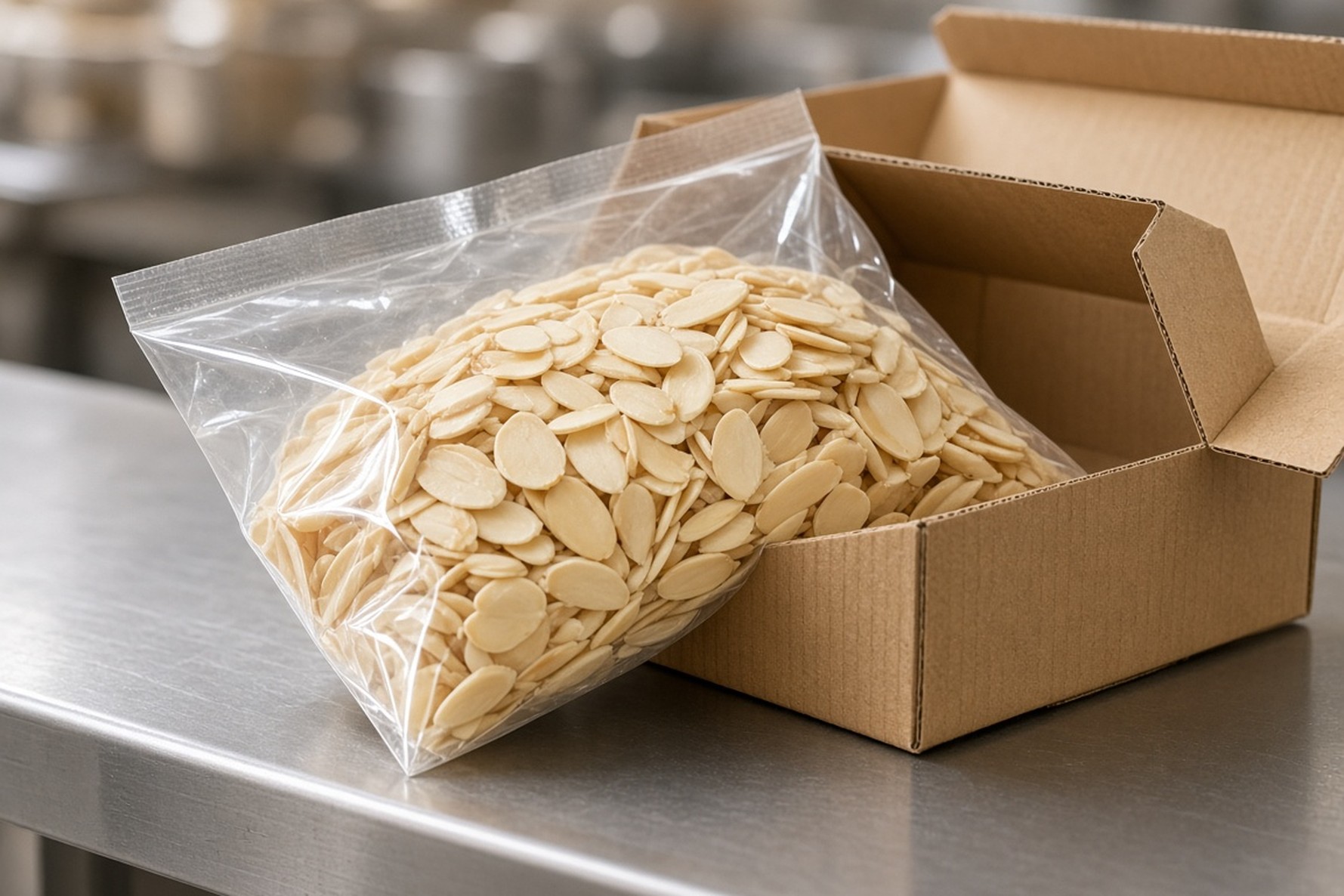
Almond Slivers Export to Iraq: Oxidative-Spoilage-Resistant Packaging for Confectionery
A specialist guide to selecting confectionery almond slivers, controlling fat oxidation, defining purchase specifications, oxygen-barrier packaging and market entry in Iraq.
Almond slivers are a quality-sensitive raw material for Iraqi confectioneries, pastry workshops, baklava producers and dessert manufacturers. Slicing the kernel increases surface exposure to oxygen and accelerates oxidative spoilage. This guide covers the Iraqi market, product specifications, quality control, packaging, storage conditions, export documentation and professional ordering criteria.
The 2024 trade figures relate to HS 080212 — fresh or dried shelled almonds. Almond slivers produced solely by mechanical slicing of raw kernels may fall within this commodity group in nature, but the final tariff classification must be determined from the exact degree of processing and customs declaration.
Introduction
Exporting almond slivers to Iraq appears simpler than many processed food products: kernels are blanched or peeled, sliced into strips, packed and shipped to a confectionery customer. The real issue begins after slicing. The greater the almond surface exposed to air, the more unsaturated fats contact oxygen — and the faster aroma declines, stale flavours develop and oxidation compounds form.
This matters greatly for Iraqi buyers. A confectionery or biscuit plant may not consume the product immediately but over several weeks or months. If slivers look bright on delivery yet develop a stale oil odour soon after the carton is opened, the problem is not merely raw-material quality loss; the flavour of baklava, dry sweets, cookies or finished desserts is affected as well.
Iraq is a genuine market for imported almonds. Registered 2024 trade data shows more than 1,200 tonnes of shelled almond imports. The United States, China, Peru and Spain appear among registered suppliers in this commodity group. Iranian exporters therefore enter a market where border price alone is not the only factor; competitors with standardised supply chains, defined grading and industrial packaging are also present.
Iran's opportunity in this market depends less on geographic proximity than on the ability to supply product suited to industrial use: uniform slivers, controlled breakage, appropriate colour, fresh flavour, stable moisture and packaging that does not allow rapid oxidation during transport and storage in Iraq. For a professional buyer, these specifications determine whether a cheap offer is truly economical or becomes waste within weeks.
1. How Has the Iraqi Market for Almonds and Slivers Developed?
Iraq consumes almonds through several channels, but for almond slivers the strongest demand comes from confectionery and pastry industries. Retail use of whole kernels differs fundamentally from industrial use of slivers. An industrial customer wants product that enters the production line directly, reducing the need for peeling, slicing, separation and re-sorting.
In 2024 Iraq registered approximately 1,238,990 kg of fresh or dried shelled almond imports under HS 080212, valued at roughly USD 6.37 million. In the same dataset the United States supplied about 902,000 kg of the registered volume. These figures show that Iraq is familiar with imported almond kernels and that industrial supply of this raw material has a defined commercial structure.
An important analytical note: mirror export statistics from partner countries to Iraq for the same year differ materially from Iraq's own registered imports. Market size should not be assessed by adding both sides of the trade. This article relies on Iraq's registered import data.
Confectionery demand: why slivers differ from whole kernels
A plant or confectionery evaluating almond slivers typically weighs four factors together: price per kilo of usable product, uniformity of slice thickness and length, percentage of fines and powder, and stability of aroma and flavour until use. If a cheap shipment has 8% powder and very small pieces while a more expensive lot has only 2% unsuitable material, nominal price per kilo is insufficient. True cost must be calculated on usable quantity in decoration or formulation.
This is especially important in baklava, decorated sweets, dairy desserts and packaged products, where sliver appearance is part of finished-product quality.
| Criterion | Confectionery buyer (slivers) | Whole-kernel buyer |
|---|---|---|
| Primary use | Production line, decoration, formulation | Retail, snacking, direct packing |
| Processing required | Minimal; ready to use | May peel or slice at destination |
| Breakage sensitivity | Very high | Medium to high |
| Fines and powder sensitivity | Very high | Lower |
| Slice uniformity | Critical | Usually not applicable |
| Oxidation risk | Very high (exposed surface) | High but lower than slivers |
| Packaging | Oxygen and moisture barrier essential | Protective; less strict O₂ barrier |
| Price basis | Per kilo of usable product | Grade, size, whole-kernel percentage |
| Pre-purchase sample | Essential | Important |
Main buyer groups
| Buyer group | Primary sensitivity |
|---|---|
| Medium and large confectioneries | Colour, freshness, slice appearance and price |
| Baklava and layered pastry producers | Sliver length, crispness and flavour |
| Biscuit and cookie plants | Uniformity, stable specs and continuous supply |
| Ice cream and dessert manufacturers | Fat freshness and piece size |
| Confectionery ingredient wholesalers | Shelf life, packaging and divisibility |
| Nut repackers | Appearance, cleanliness and repack potential |
Successful export marketing must specify which of these end users the product is designed for. The generic phrase "export almond slivers" is not enough for a professional purchasing manager.
2. What Specifications Should Confectionery Almond Slivers Meet?
Almond slivers are not a single product with fixed quality. Even when all lots use almond kernels, blanching method, pre-slice moisture, machine settings, blade thickness, pressure and final sorting can produce very different outcomes. For confectionery, three general forms matter most.
Blanched (white) slivers
Produced from kernels whose brown skin has been removed. Lighter colour suits decoration on cakes, sweets, desserts and some baklava. However, skin removal and slicing reduce the kernel's natural protective surface, making packaging control more critical.
Slivers with skin
The brown almond skin remains, giving a more natural, darker appearance after slicing. Acceptable in some applications, but usually not the first choice where a uniform white presentation is required.
Custom-cut slivers
Some customers specify width, thickness or length rather than a generic "sliver." In industrial production a physical reference sample or dimensioned image should be attached to the contract to reduce interpretation gaps between seller and buyer.
| Feature | White slivers | With skin | Custom industrial |
|---|---|---|---|
| Appearance | Light and uniform | Brown and cream | Per customer spec |
| Typical use | Decoration and confectionery | Dry mixes and pastries | Defined production lines |
| Oxidation sensitivity | High | High | Depends on cut surface |
| Sorting importance | Very high | High | Very high |
| Pre-purchase sample need | High | Medium to high | Essential |
3. Technical Specifications Expected by Iraqi Buyers
In a professional order, the phrase "grade-one almond slivers" alone should not govern the deal. "Grade one" without numeric limits and a reference sample cannot be measured.
| Parameter | Contract option or criterion | Importance to buyer |
|---|---|---|
| Product form | White or with skin | Defines use and appearance |
| Cut pattern | Strip-cut and uniform | Affects decoration and line use |
| Length | Per approved sample | Finished-product uniformity |
| Thickness | Per sample or tolerance | Appearance and breakage resistance |
| Moisture | Within agreed range | Shelf life and texture |
| Broken pieces (%) | Contract ceiling | True yield |
| Fines and powder (%) | Contract ceiling | Waste reduction |
| Colour | Uniform and matching sample | Visual quality |
| Odour | Natural, no staleness | Fat freshness indicator |
| Foreign matter | Per acceptance criteria | Safety and quality |
| Packaging | Moisture and oxygen barrier | Prevents quality loss |
| Net weight | Fixed per pack | Purchase and warehouse control |
| Production date | Clear and legible | Freshness control |
| Batch number | Traceable | Complaint and QC management |
In sound almonds, shelf stability improves when kernel moisture is low. Industry sources cite moisture below 6% and a range of roughly 3.5–5.5% as suitable for stability. Storage at around 50–60% relative humidity also helps moisture balance. These figures should not be written into contracts as "Iraqi legal limits" without regard to product form; they are technical storage indicators. White slivers, with greater exposed surface and more processing, should be managed more conservatively in practice.
4. Why Is Oxidative Spoilage the Main Quality Risk?
Almonds contain a significant proportion of fat, largely unsaturated fatty acids. Nutritionally desirable, this makes the product sensitive to oxidation in storage. A whole kernel has limited air contact; after slicing, contact area multiplies. Skin removal also eliminates a natural protective layer. Slivers — especially white slivers — therefore need tighter control against oxygen, heat and light than whole kernels.
What does oxidation change?
- Stale oil odour
- Bitter or cardboard-like taste
- Loss of natural almond aroma
- Reduced freshness and gradual colour change
- Increased volatile oxidation compounds
Almond storage studies show that light, higher temperature and oxygen accelerate quality decline. In ground-almond trials, better oxygen-barrier packaging and oxygen scavengers significantly improved stability; some scavenger-packed samples maintained acceptable quality for at least 12 months. This does not automatically mean every almond sliver has a 12-month shelf life. Actual shelf life must be set from raw material, process, microbial load, moisture, pack type, storage temperature and shelf-life testing of that specific product.
Why is nitrogen alone insufficient?
Nitrogen flushing largely displaces headspace air, but if the film has high oxygen permeability, oxygen can re-enter over time. In raw-kernel studies, nitrogen-flushed PET/LDPE packs gained oxygen during storage, while structures with an EVOH layer better retained nitrogen concentration. Oxygen scavengers added further protection.
Package design must therefore address three issues together: low initial in-pack oxygen; limited oxygen transmission through the film wall; and a seal that does not leak after heat sealing.
5. Packaging Design Resistant to Oxidative Spoilage
For almond sliver export to Iraq, packaging is not merely a shipping container; it is part of the quality-preservation system. Industry sources stress that cut forms need more protection against moisture and oxygen than whole kernels.
Inner liner
The inner bag must at minimum: block moisture ingress, limit oxygen transmission, prevent absorption of ambient odours, and withstand reliable heat sealing. A plain polyethylene bag may give acceptable moisture barrier but not necessarily the best oxygen barrier. For orders held in distribution for months, multi-layer films with higher barrier properties are more logical.
Nitrogen and oxygen scavengers
Nitrogen flushing can reduce headspace oxygen. Oxygen scavengers can add a further protective layer for longer shelf-life orders. Industrial scavenger use must be designed from in-pack void volume, residual oxygen, film permeability and scavenger manufacturer specifications. A random small sachet without capacity calculation is not a performance guarantee.
Light protection
Transparent packs expose product to warehouse and shop light. Matte, metallised or outer carton formats can reduce this effect depending on the supply model.
| Packaging approach | Moisture control | Oxygen control | Suitability for slivers |
|---|---|---|---|
| Plain PE bag | Good | Limited | Fast turnover |
| Multi-layer barrier film | Very good | Good to very good | Suitable |
| Barrier film + nitrogen | Very good | Very good | Suitable for export orders |
| Barrier film + O₂ scavenger | Very good | Very good | Longer shelf life |
| Vacuum pack | Good | Very good | Usable; product compression must be checked |
6. Quality Control: How to Distinguish a Good Lot from a Weak One
Almond sliver evaluation cannot rely on colour alone. A sample may look white and clean yet be made from stale almonds; conversely, fresh product may show limited natural colour variation.
Sensory assessment
- Odour: Natural almond aroma required; stale oil, paint, cardboard or rancid notes are unacceptable.
- Taste: Natural flavour without abnormal bitterness.
- Texture: Expected crispness; not soft or moisture-logged.
- Colour: For white slivers, light cream and relatively uniform colour is desirable.
Breakage and moisture measurement
"Low breakage" is not auditable. "Maximum X% by weight per agreed sampling method" is. High moisture can soften texture and weaken stability; very low moisture may increase breakage in transit. The goal is not the lowest possible number but a stable, repeatable range.
Oxidation indicators and related tests
For sensitive industrial customers, oxidation-related tests may be included in the QC programme. Peroxide value is used to assess early oxidation; hexanal and similar volatiles are used in research to track oxidative spoilage progress. Depending on importer requirements, tests may also cover total microbial count, mould and yeast, Salmonella, water activity, aflatoxin, foreign matter, net weight control and seal integrity. No contaminant limit should be copied from another country's standard without aligning to requirements applicable to the Iraqi shipment.
7. Iraq Entry and Labelling Requirements
Imported goods in Iraq are controlled by relevant authorities including the Central Organization for Standardization and Quality Control (COSQC). For packaged foods, the general Iraqi food labelling standard IQS 230 is a primary reference.
- Exact product name and ingredient list if composite
- Net weight, manufacturer details and country of origin
- Batch code, production date and expiry or best-before date
- Storage conditions and importer information where required
Iraqi rules require imported food information to be available in Arabic, clearly and indelibly. Label artwork must be aligned with the Iraqi party before final printing — not at the loading stage.
Remaining shelf life on entry — IQS 1847
Iraqi food shelf-life standard IQS 1847 sets how dates are declared and how much remaining life is acceptable on import. The 2021 revision states that goods which have already passed more than half of their declared shelf life at entry should not be approved for import. Exporters should not ship product that has aged in Iranian warehouse until just before the first half of shelf life expires. Production date, transport, border delay and clearance must be planned from the outset.
8. Tariff Code: Which HS Code for Almond Slivers?
For fresh or dried shelled almonds, the recognised six-digit code is HS 080212. Global trade data and Iraqi import statistics register this group as shelled almonds, fresh or dried.
"Almond slivers" must still be reviewed for degree of processing before declaration. If the product is solely peeled and strip-cut from raw or dried kernel without further processing, its nature aligns with this chapter. If roasting, sweetening or other preparation is involved, classification may move to a different group. The final code must be fixed before commercial documents are issued, with process description available to the Iraqi importer and customs broker.
9. Land Transport to Iraq and In-Transit Quality Management
Iran's practical advantage in trade with Iraq is land transport. Shorter distance does not mean the product is heat-safe. High warehouse and truck temperatures accelerate fat oxidation. Almond industry sources cite storage below about 15°C as more protective conditions.
Ambient or refrigerated transport?
For fresh lots with barrier packaging and a short land route in cool months, clean dry trucks may be workable. In very hot periods or when cargo will remain long in transit, terminals or warehouses, temperature-controlled transport may be justified on quality grounds. The decision should be economic: refrigerated cost versus quality loss prevented.
Loading checklist
- Loaded batch numbers recorded
- Carton count and net/gross weights
- Carton and pallet condition
- No liner tears
- Arabic label compliance
- Production and expiry dates
- Seal number if used
- Product and cargo-space temperature if monitored
- Photo of final stowage
- Retain witness sample from the same batch
10. How Is Export Almond Sliver Price to Iraq Determined?
Sliver price cannot be compared to daily whole-kernel price alone. Slivers are a processed product; true cost spans kernel supply, sorting, blanching, slicing, fines removal, QC, packaging and production waste.
| Price factor | Price effect | Reason |
|---|---|---|
| Raw kernel quality | High | Determines yield and appearance |
| White slivers | Increase | Blanching required |
| Precise sorting | Increase | Reduces fines and breakage |
| Barrier film | Increase | Higher pack cost |
| Nitrogen flushing | Increase | Extra operation and equipment |
| Order volume | Variable | Affects unit production and pack cost |
| Dedicated testing | Increase | Laboratory cost |
| Delivery inside Iraq | Increase | More logistics and handling |
Importer Checklist Before Placing an Order
- Define product form: white, with skin or custom specification.
- Obtain a real sample: from production representative of the commercial lot.
- Confirm cut dimensions: product photos alone are insufficient.
- Set breakage limit: including the measurement method.
- Set fines and powder limit: for true yield calculation.
- Check product odour: any stale or oxidised oil note must be rejected.
- Agree moisture: with test method.
- Specify safety tests: per importer and market requirements.
- Confirm inner pack material: "plastic bag" is not a specification.
- Decide on nitrogen or O₂ scavenger: matched to distribution life.
- Set pack net weight: for daily line or shop use.
- Align Arabic label: before bulk print and production.
- Review production date: export lots should be as fresh as possible.
- Define lot acceptance criteria: sample, tests and tolerances in writing.
- Define sampling method: how many cartons and from which stack positions.
- Confirm tariff code: from exact processing description.
- Check documents: invoice, packing list, origin and quality certificates.
- Specify delivery terms: cost and risk responsibility clear.
- Verify supplier capacity: especially for monthly contracts.
- Retain sealed witness sample: held by both parties.
What Information Should Be Sent for an Accurate Quote?
- White or skin-on slivers
- End use: baklava, pastry, ice cream, dessert or repacking
- Dimensions or reference sample
- Maximum acceptable breakage and fines/powder
- Target moisture and required tests
- Pack net weight and expected pack/barrier level
- Nitrogen and/or oxygen scavenger requirement
- Trial order volume and monthly or seasonal purchase plan
- Destination city in Iraq and delivery terms
- Private-label pack need and label language/content
Industrial Applications in Iraqi Confectionery
Knowing the end application helps select the right product. Slivers suited to baklava topping are not necessarily best for biscuit inclusion or ice cream.
| Application | Key criterion |
|---|---|
| Baklava | Length, colour, low breakage |
| Pastry decoration | Uniform appearance |
| Dough inclusion | Price and flavour |
| Ice cream | Size and freshness |
| Desserts | Aroma and colour |
| Chocolate/coating | Moisture and size |
Iran's Advantages and Limitations in the Iraqi Market
Entering Iraq, Iran competes with suppliers such as the United States, Turkey, Spain and other nut origins. Iran's advantage for almond slivers is not necessarily the lowest price; it can combine shorter land routes, truck shipment, flexibility on medium orders, private-label packing and production to customer reference samples.
| Origin | Potential advantage | Challenge for Iraqi buyer |
|---|---|---|
| Iran | Land route and custom orders | Batch-to-batch consistency control needed |
| United States | Standardisation and large almond chain | Longer shipping distance |
| Turkey | Regional trade access | Quality depends on supplier |
| Spain | Almond production history | Cost and routing |
| China | Supply diversity | Strict specification control required |
This table is not a country quality ranking. Final sliver quality depends on raw material, processing, sorting, packaging and supplier management.
Common Export Mistakes
- Focusing on appearance and ignoring odour: oxidation may appear first as smell and taste change.
- Using ordinary bags for long shelf life: multi-month storage needs real oxygen and moisture barrier assessment.
- Printing labels without importer approval: a small date or origin error can cost more than a price dispute.
- Using one premium sample for contract then shipping lower quality: the reference sample must be sealed and measurable criteria extracted.
- Ignoring powder: in many orders the main quality gap is fines and small broken pieces, not whole slivers.
- Long pre-export storage: shipping near half shelf life conflicts with Iraqi acceptance rules.
- Setting tariff code without process description: raw slivers, roasted slivers and sweetened almonds are not necessarily classified alike.
Pre-Loading Control: A Five-Stage Protocol
To reduce disputes between Iranian sellers and Iraqi customers, final control can follow five stages:
- Random carton selection: do not sample only from the top of the pallet; take cartons from different stack positions.
- Pack inspection: check bags for holes, seals, leaks and physical damage.
- Weight: measure net weight of several packs against agreed tolerance.
- Sliver quality: build a composite sample and measure colour, odour, taste, length, thickness, breakage, powder, foreign matter and moisture.
- Documents: match batch number on COA, label, carton and packing list.
Supplying Export Almond Slivers from Iran to Buyer Specifications
In almond sliver purchasing, two offers usually differ in more than price per kilo. One supplier may use a plain bag; another barrier film with nitrogen flushing. One may have higher breakage; another tighter sorting. Raw-material freshness can change the real value of two shipments.
Purchase requests should therefore be written on measurable specifications: sliver form, skin status, dimensions, breakage percentage, moisture, pack weight, oxygen-protection method, order volume and destination city. Iranco can serve as the place to register these details for buyers and importers evaluating supply options in Iran. For confectionery orders, a trial lot or pilot production should be approved first; the same specifications then become the commercial order benchmark.
Conclusion
Almond sliver export to Iraq is competitive when the product is managed not merely as "sliced almonds" but as a specialist confectionery raw material. The main post-slicing issue is increased oxygen contact and therefore higher oxidative spoilage risk. Raw-material freshness, appropriate moisture, oxygen limitation, heat protection and suitable barrier packaging directly affect delivered quality.
Iraqi buyers should evaluate three criteria before price: true usable percentage, batch-to-batch consistency and stability until use. Contracts must define sliver form, dimensions, moisture, breakage ceiling, powder level, pack weight, liner material, nitrogen or scavenger use, required tests and reference sample before production.
Sustainable advantage for Iranian exporters rests on three factors: uniform slivers, packaging that genuinely resists oxidation, and delivery against measurable contract specifications. These are what turn a generic nut into a reliable raw material for Iraqi confectioneries.
Frequently Asked Questions
Must almond slivers for export to Iraq be shipped refrigerated?
A general refrigerated requirement for raw almond slivers should not be stated without product-standard review. However, lower temperature slows fat oxidation. In very hot months, temperature-controlled transport or at least insulated trucks and reduced sun exposure during stops can help preserve quality. Pack type, transit time and buyer storage period should all inform the transport decision.
What is the best packaging for confectionery almond slivers?
For industrial orders with significant holding time, a multi-layer inner pack with proper oxygen and water-vapour barrier is more reliable than a plain bag. Sensitive orders may also use nitrogen flushing or oxygen scavengers. The final pack must resist tearing and odour uptake and must not increase sliver breakage in transit.
Why do almond slivers go stale faster than whole kernels?
Slicing increases fat surface area exposed to air. If skin is also removed, more tissue is open to oxygen, light and heat — accelerating oxidation and gradual stale odour and flavour. Slivers therefore need more precise packaging than whole kernels.
Which tests matter most when buying almond slivers?
Moisture, sensory evaluation, breakage percentage, fines/powder level, foreign matter and microbiological controls are practical core tests. Aflatoxin and other safety tests may be required by importer or import rules. For specialised shelf-life review, peroxide value or volatile oxidation markers may be used. Test method and acceptance criteria should be fixed before contract.
What is the HS code for almond slivers?
For fresh or dried shelled almonds, HS 080212 applies. If slivers are solely blanched and strip-cut from dried kernel, this heading is the main reference. If the product is roasted, flavoured, sweetened or otherwise further processed, classification may change. Final code must be confirmed from exact process description before declaration.
What factors determine export almond sliver price to Iraq?
Price depends on raw kernel quality, white vs skin-on form, cut dimensions, breakage and powder levels, sorting cost, moisture, packaging, nitrogen or scavenger use, required tests, order volume and delivery point. Comparable quotes require identical purchase specifications from all suppliers.
How can Iranian almond slivers be sourced for the Iraqi market?
Define product form, dimensions, breakage limit, order volume, pack weight, packaging method and destination city first. Obtain and approve a sample, then retain a reference sample for commercial production. International buyers can submit the same details to Iranco as a purchase request for evaluation of matching supply options in Iran.
Does nitrogen flushing alone prevent oxidation?
Nitrogen reduces initial in-pack oxygen, but oxygen can re-enter through a permeable film or weak seal during storage. Best results combine nitrogen with an appropriate barrier film and controlled sealing. Oxygen scavengers can add further protection in some applications.
For confectionery, are white slivers or skin-on slivers better?
It depends on application. For decorating sweets, baklava and products requiring a light appearance, white slivers are usually preferred. Skin-on slivers have a more natural look and may suit dry mixes where skin colour is acceptable. The confectionery's approved formula and reference sample should be the main criterion.
For almond sliver export advice to Iraq and connection with Iranian suppliers
Contact Irancoinfo@iranco.com · WhatsApp: +98 913 104 4182 · Telegram: @irancofood
Featured Products








Related Articles



