 Iranco Magazine Team
From size and ounce grade to taste, shelf life, alternate bearing and target markets — a decision guide for traders and exporters
Wholesale Buying Guide · Pistachio Export · Cultivar Comparison
Akbari or Ahmad Aghaei Pistachio: A Comparison for Wholesale Purchase and Export
Structural differences between Iran's two leading elongated pistachio types — size, ounce count, flavour, shelf life, orchard behaviour and target export markets — for traders, wholesalers and exporters.
Pistachio trade in international markets is among the most profitable and specialised segments of agricultural and dried-nut commerce. As the historic birthplace and one of the world's main hubs for high-quality pistachio production, Iran supplies a wide variety of this product to global markets. Among them, two elongated types — Akbari pistachio and Ahmad Aghaei pistachio — hold a prominent, strategic place in the purchasing portfolios of traders, wholesalers and export operators.
Although both belong to the elongated or almond-shaped pistachio family, they differ markedly in physical dimensions, commercial grade (ounce count), biochemical and flavour properties, warehouse stability, tree behaviour in the orchard and, ultimately, export destinations. Deep knowledge of these variables is decisive for trading companies, exporters and bulk buyers in reducing commercial risk, avoiding cargo rejection at customs origin and maximising return on capital. Choosing between the two is not merely a matter of appearance — it is a fully economic decision grounded in consumer behaviour in the destination market.
Morphology, Dimensions and Visual Characteristics
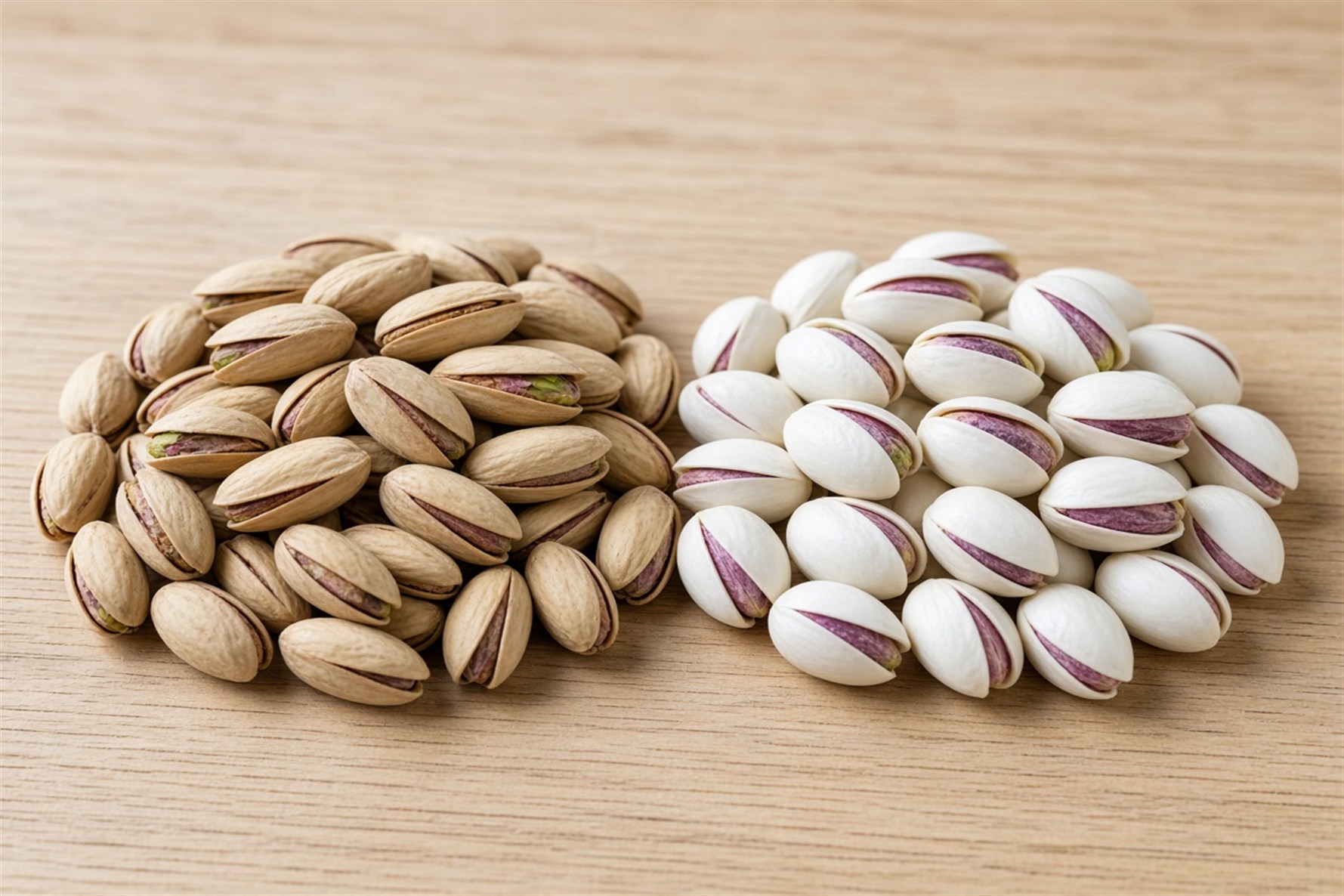
Appearance and morphology are the first factors in dried-nut pricing. Distinguishing Akbari from Ahmad Aghaei requires careful assessment of kernel geometry, shell colour, the thin skin on the kernel and the colour of the kernel flesh.
| Visual indicator | Akbari pistachio | Ahmad Aghaei pistachio |
|---|---|---|
| Kernel geometry | Very elongated, longest type, gentle curve | Elongated and almond-shaped, shorter, more symmetrical |
| Shell colour | Dark cream tending to dull bone | Very bright milky white and clean |
| Fresh hull colour | Bright red to uniform crimson | Cream with soft pink or pale yellow |
| Skin on kernel | Dark purple to burnt brown | Glossy purple-red and bright jujube red |
| Kernel flesh colour | Deep, rich jade green | Clear, bright grass green |
| Natural split | Deep bilateral split, wide opening | Uniform split with good longitudinal symmetry |
Akbari is the most elongated pistachio type in the world. Because of its very high length-to-width ratio, it is known internationally as an extra-long pistachio. This size and visual prominence have long earned it the label of ceremonial or premium pistachio. Akbari shells are dark cream and matte; slight darkening comes from natural accumulation of polyphenolic compounds in the hard shell. The kernel is large, elongated and meaty; its outer skin is dark purple or mild brown, and when cut, the jade-green flesh is evident.
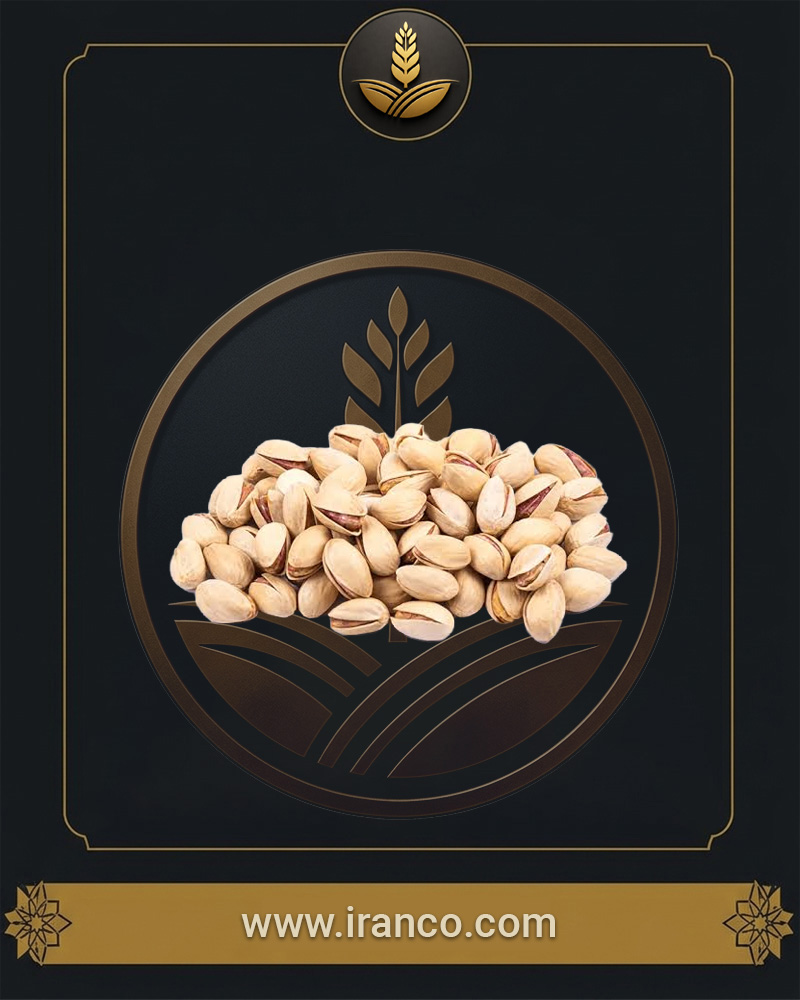
Ahmad Aghaei, by contrast, has an almond-like, symmetrical appearance. It is suitably elongated but shorter than Akbari, with a proportionally slightly wider body. Its striking feature is the pearly, glossy white hard shell, which makes the lot look very attractive, clean and uniform at first glance.
The thin protective skin on the Ahmad Aghaei kernel is purple, bright crimson or vivid red. The visual contrast between white shell, purple-red skin and light green kernel creates one of the most appealing colour combinations in the pistachio category.
Natural splitting on the tree results from kernel growth and lateral pressure on the shell wall. Because of kernel size, Akbari has a very deep longitudinal crack that opens from both sides of the nut, making the shell exceptionally easy to break by hand. Ahmad Aghaei also has a very high split rate, but the edges of the seam open with a gentler curve.
How Ounce Count Works and Commercial Pistachio Grading
Pistachio ounce count is the fundamental index for size, boldness and monetary valuation in domestic and international trade. Contrary to common belief, it is not a unit of weight but a count index: the number of kernels in a defined reference weight. The lower the ounce number, the larger, finer and more expensive the pistachio.
The standard reference weight for grading is 142.5 g, derived from one-tenth of a pound. In practice, a sample of exactly 142.5 g is taken from different points in the lot and the nuts are sorted into groups of five. The number of five-nut bundles counted equals the ounce grade. If the sample does not divide evenly by five, the result is reported as a dual range (e.g. 20–22 or 24–26).
| Indicator | Akbari pistachio | Ahmad Aghaei pistachio |
|---|---|---|
| Standard commercial ounce range | 20–22 (large) and 22–24 (medium lot) | 24–26 (common export) and 26–28 (economy) |
| Ultra-luxury ounce range (hand-picked) | 18–20 (very scarce and high-priced) | 22–24 (premium hand-picked large) |
| Average dry kernel weight | 1.35 to 1.50 g | 1.15 to 1.28 g |
| Kernels per kilogram | Approx. 660 to 740 | Approx. 780 to 880 |
| Typical size-based use | Gift packs, luxury export, premium confectionery | Broad distribution, high-volume export, mixed nuts |
In bulk purchasing, ounce assessment must always be paired with "lot appearance" (visual uniformity). Appearance reflects dimensional consistency and absence of mixing large with small kernels. Sometimes a lot is sold as ounce 24, yet detailed inspection shows a blend of large 20-ounce and small 28-ounce nuts. Such mixes lack commercial homogeneity and lead to rejection abroad. Premium export lots should show flat, uniform calibre, with closed-shell percentage below 3%.
Biochemical Profile, Sensory Traits and Warehouse Storage Dynamics
Beyond appearance, organoleptic properties and oxidative stability are major factors in shelf life and nutritional value. The concentration and type of fatty acids in the kernel determine how pistachio interacts with ambient oxygen and moisture.
| Characteristic | Akbari pistachio | Ahmad Aghaei pistachio |
|---|---|---|
| Natural kernel fat content | Very rich and high (over 53%) | Balanced and standard (around 50%) |
| Eating texture | Meaty, oily and heavy | Crisp, brittle and light |
| Dominant flavour | Buttery, classic, dense and full | Mild nutty with a natural sweet finish |
| Fat oxidation rate | High (sensitive to heat and light) | Moderate, with higher stability |
| Typical warehouse shelf life | Up to 9 to 12 months | 12 to 15 months |
| Recommended sea container | Refrigerated with humidity and ventilation control | Standard dry ventilated container |
Akbari has among the highest proportions of unsaturated fatty acids. That fat concentration produces a distinctive, heavy, oily-buttery mouthfeel. The texture is tender and meaty; gentle warming releases a strong, traditional aroma.
Ahmad Aghaei is widely regarded among dried-nut specialists as one of the most palatable Iranian pistachio types. Its texture is light, crisp and compact, with saturated and unsaturated fats in stable balance. Its hallmark sensory trait is a pleasant sweet finish on the kernel, which many consumers find easier for daily eating without the heaviness of extra fat.
Warehouse behaviour and stability on long sea routes differ: Akbari's wide natural opening and higher fat content increase kernel exposure to air. If warehouse relative humidity exceeds 60% or temperature rises above 20°C, free fatty acids break down and rancidity accelerates. For tonne-scale Akbari storage, cool air circulation and vacuum packaging are often necessary. Ahmad Aghaei's firmer structure and balanced fat give better mechanical and biochemical resistance to oxidation — a reliable choice for distributors with multi-month inventory cycles.
Orchard Economics, Crop Cycles and Supply Volatility
Understanding orchard parameters, bloom timing and alternate-bearing patterns helps traders and exporters forecast supply trends and seasonal price swings.
| Factor | Akbari pistachio | Ahmad Aghaei pistachio |
|---|---|---|
| Spring bloom calendar | Late bloom (20–30 Farvardin / late March–early April) | Mid-season bloom (5–15 Farvardin / early–mid March) |
| Late spring frost risk | Very low, frost-resistant | Moderate to high (climate monitoring needed) |
| Harvest calendar | Late (late Shahrivar to mid Mehr / late Aug.–early Oct.) | Mid-season (early to mid Shahrivar / late August) |
| Alternate-bearing intensity | Severe (sharp on/off years) | Mild to moderate (relatively steady crop) |
| Yield per hectare | Moderate (approx. 1.5 to 2 t dry) | High (approx. 2.5 to 3.5 t dry) |
| Water and fertiliser demand | Very demanding, strict management | More resilient and input-efficient |
Akbari trees are late-blooming, which naturally limits damage from sudden spring cold when flower buds open after the worst frost risk has passed. However, fruit matures late, with full kernel ripeness often extending into late Shahrivar or Mehr. Akbari is strongly alternate-bearing: after a heavy year, the next year's crop may fall by up to 50%. That pattern creates sudden wholesale shortages and sharp, short-lived price spikes.
Ahmad Aghaei is mid-season bloom, with flowering starting in early spring — increasing sensitivity to early spring frost. It ripens earlier than Akbari and is typically harvestable from early Shahrivar, entering processing lines two to three weeks ahead and reaching Asian and Indian subcontinent export channels before later cultivars. More uniform bearing and milder alternation stabilise annual volume, steady factory supply and reduce artificial price excitement.
Processing Technology, Advanced Sorting and Customs Quality Standards
Formal pistachio export to modern markets — especially the EU and East Asia — requires passing rigorous pesticide residue tests, aflatoxin measurement and alignment with international customs codes. Post-harvest processing determines the chemical and physical integrity of the final shipment.
| Indicator | Iran national standard | EU and UK | Codex Alimentarius |
|---|---|---|---|
| Permitted kernel moisture | Maximum 5 to 6% | Maximum 5% | Maximum 5.5% |
| Total aflatoxin | Maximum 10 ppb | Maximum 10 ppb | Maximum 10 ppb |
| Aflatoxin B1 | Maximum 5 ppb | Maximum 5 ppb | Maximum 5 ppb |
| Ochratoxin A | Under general monitoring | Maximum 5 ppb | Under development |
| Maximum closed-shell | Less than 3 to 5% | Less than 1% | Less than 2% |
| Foreign matter and waste | Less than 0.5% by weight | Zero to 0.1% | Less than 0.2% |
Modern pistachio processing lines use laser and multispectral optical sorting. High-resolution cameras, infrared and colour sensors screen each kernel:
- Flotation and hydraulic air separation: Removing semi-kernel, blanks, debris and remaining green hulls via high-pressure fans and vibrating separation tables.
- Mechanical screen sizing: Physical separation by body diameter so lot ounce tolerance stays within an allowed band of about two units.
- Optical sorting and stain rejection: Visible and infrared sensors detect micro colour changes from insect damage, sun scorch and dark spots suggestive of aflatoxin-producing mould; compressed-air ejectors remove defective kernels from the stream.
Mycotoxins — especially aflatoxin from Aspergillus flavus — are a global customs red line. Akbari's deep natural opening and longer on-tree ripening in Shahrivar increase mould sporulation risk if growers face rain or heavy dew. Ahmad Aghaei, with shorter ripening, faster processing and tougher shell mechanics, often shows stronger commercial pass rates on EU aflatoxin and ochratoxin tests.
Export packaging follows two main patterns: for nearby destinations such as neighbouring countries and the Persian Gulf, multi-layer polypropylene bags or laminated 50 kg and 25 kg sacks with detailed labels are common. For distant markets such as China and European ports, pistachio is often vacuum-sealed in robust 10 or 12.5 kg bags with nitrogen flush, then packed in heavy five-layer cartons and strapped to block moisture, off-odours and oxygen ingress.
Akbari Export Target Markets: Strategy for Luxury Channels
Akbari is among the most expensive and luxurious pistachio types in world trade. Its buyers prioritise visual appeal, kernel size and a premium product feel and show relatively low price elasticity.
| Target export market | Buying motive and preference | Preferred grade | Typical packaging |
|---|---|---|---|
| UAE (Dubai) | Re-export, gift nuts, ceremonial hospitality | Ounce 18–20 and 20–22, raw and roasted | Luxury 10 and 15 kg cartons |
| Qatar, Kuwait and Oman | Affluent daily use, formal gatherings | Ounce 20–22 premium saffron hand-picked | Metal tins and wooden gift boxes |
| Russia (Moscow and St Petersburg) | Premium grocery, corporate gifts | Ounce 20–22 naturally split raw | 10 kg vacuum cartons |
| China and Hong Kong | Lunar New Year, executive gifting | Ounce 20–22 and 22–24 roasted salted | 5 and 10 kg vacuum bags |
Gulf countries, especially the UAE and Qatar, are traditional, steady destinations for top Akbari. Arab hospitality culture favours large, eye-catching kernels. Gulf traders buy 18–20 and 20–22 ounce lots for local use and luxury re-export to Europe and the Americas. Saffron-processed Akbari with authentic Iranian saffron commands steady demand and strong added value for exporters.
In Russia and Central Asia, general demand skews toward economy grades, but wealthy metropolitan centres sustain hand-picked Akbari for premium chains and luxury gift packs. In China, despite large US imports, Chinese traders still buy tall Iranian Akbari as a flagship festive item.
Ahmad Aghaei Export Target Markets: Volume and Continuous Trade
If Akbari symbolises exclusivity and selective buying, Ahmad Aghaei symbolises commercial dynamism, high export volume and fast capital turnover worldwide. White shell, red kernel accent and accessible pricing make it Iran's best-selling export pistachio by volume.
| Target export market | Buying motive and preference | Preferred grade | Typical packaging |
|---|---|---|---|
| India | Diwali, traditional sweets, national gifting | Ounce 24–26 and 26–28 naturally split | 25 and 50 kg bags |
| Germany and the EU | Supermarket shelf, health-oriented consumption | Ounce 22–24 and 24–26, aflatoxin-tested | Vacuum cartons with inert gas |
| Greece and Mediterranean | Retail packs, snack mixes | Ounce 24–26 naturally split raw | 10 kg cartons and laminated bags |
| Russia and Belarus (mass market) | Economy snacking, daily mixed nuts | Ounce 26–28 and lots allowing regulated water-split | 50 kg bulk bags |
India is the largest and most strategic Ahmad Aghaei importer worldwide. Import peaks from Shahrivar through Aban, ahead of Diwali. Key reasons Indian traders favour Ahmad Aghaei include:
- Bright white shell: In Indian culture, white signifies purity and health; Ahmad Aghaei's pearly shell is unmatched on retail shelves.
- Purple-red kernel edge: Red skin visible at the split seam adds exceptional visual appeal to festive mixed packs.
- More kernels per kilogram: At ounce 24–26, Ahmad Aghaei yields more nuts per kg than Akbari at 20–22, so gift packs look fuller without an unreasonable rise in landed cost.
Exporters clearing Mumbai and Nhava Sheva must comply with India's food standards and safety protocols. In Europe, Ahmad Aghaei has a large share in Germany, Spain and Greece because consumers get elongated form at a balanced price and the type can compete with US pistachio in chain retail.
Financial Analysis, Margins and Liquidity in Wholesale Buying
Bulk purchasing economics require simultaneous assessment of gross margin, capital recovery speed and product liquidity under changing market conditions.
| Parameter | Akbari pistachio | Ahmad Aghaei pistachio |
|---|---|---|
| Base price level per kg | Very high (15 to 35% above others) | Balanced, rational, aligned with mass purchasing power |
| Initial capital required | Very heavy, needs large liquidity | Moderate, optimised for cash flow |
| Gross margin per deal | High (20 to 35% by grade) | Moderate (10 to 20%) |
| Capital turnover and sales cycle | Slower, focused on peaks and niche buyers | Very fast, dynamic and year-round |
| Demand price elasticity | Inelastic (luxury buyers tolerate high prices) | Elastic (linked to exchange rates and competition) |
| Liquidity risk | Moderate to high in downturns | Very low; steady demand in most conditions |
Akbari is capital-intensive. Scarce large-ounce lots (below 22) require heavy working capital for accumulation and sorting. Margin per kilogram on hand-picked Akbari is high, but the pool of end buyers is limited to affluent segments, so converting stock to cash can take time. Long delays hurt both tied-up capital and product quality because of Akbari's lipid sensitivity.
Ahmad Aghaei is widely seen as the most liquid asset in Iran's dried-nut market. Broad use in the domestic market, confectionery, mixed-nut packers and export hubs east and west keeps it in constant cash demand. Per-tonne margin may be lower than Akbari, but much faster turnover lets traders rotate capital several times a year, often achieving higher annual profit with lower stockpile risk.
Wholesale Inspection Protocol and Checklist at Warehouse and Processing Terminal
To avoid fraud losses or quality downgrade, bulk buyers and quality inspectors should follow these steps in order at delivery:
- Step 1 — Stratified random sampling: Draw from bottom, middle and top layers of bags.
- Step 2 — Ounce test: Use a digital scale and the 142.5 g reference weight at several points in the lot.
- Step 3 — Moisture measurement: Calibrated pin moisture meter (target below 5.5% to limit spoilage risk).
- Step 4 — Physical split assessment: Crack kernels to rule out artificial water-split lots.
- Step 5 — Visual appearance check: Insect traces, moths, rodent contamination and suspicious dark spots.
- Step 6 — Composite sample seal: Send to a reference lab for mycotoxin and microbiological analysis.
Random sampling must represent the whole shipment. Taking only from bag mouths is the most common buyer mistake: dishonest sellers may place large, good-looking nuts on top and fill the lower portion with small, closed-shell or water-split product. From every 10 tonnes, sample deeply from at least 30 bags, then blend all subsamples before testing.
Kernel moisture is critical. Moisture above 5.5% at purchase means the buyer paid for water and the lot may self-heat and sour in transit. In field practice, properly dry kernel should break with a dry, decisive snap when bitten. Soft, chewy or elastic texture signals high moisture and staleness. No export lot should load without an official lab report from an accredited partner of the national standards body. That report must state total aflatoxin, aflatoxin B1, microbiological status and pesticide residues, aligned with the lot's traceability code.
FAQ for Traders and Dried-Nut Professionals
For Gulf markets, is Akbari or Ahmad Aghaei the better fit?
Akbari at very large ounce grades (18–20 and 20–22) is the first choice and has few rivals in the UAE, Qatar, Kuwait and Oman. Consumers there want extra-long, ceremonial pistachio and are not budget-limited. Ahmad Aghaei still has secondary demand for hotels and restaurants.
Why is India the largest Ahmad Aghaei buyer with a smaller Akbari share?
India's market is strongly shaped by Diwali gifting and preference for white shells. Ahmad Aghaei's pearly shell and purple-red kernel symbolise auspicious freshness. At ounce 24–28, more kernels per kilogram than Akbari make gift boxes look fuller without a prohibitive price jump.
Does Akbari have shorter shelf life than Ahmad Aghaei because of higher fat?
Yes. Akbari is among the richest in fatty acids, and its deep split increases kernel exposure to air. Without cooled storage, it oxidises and develops stale odour faster than Ahmad Aghaei, which holds up better in long-term warehousing.
Which is more profitable for domestic mixed-nut packing?
Ahmad Aghaei is usually the better choice. Ounce 24–28 adds more kernels per pack and its sweet finish suits general consumers. Lower cost keeps the final mixed-nut price competitive. Akbari is mainly for very premium or ceremonial packs.
Final Strategy: Portfolio Allocation and Investment
Success in bulk and export pistachio trade depends on aligning product strengths with destination market requirements. Strategic mismatch between product and market invites storage cost and returns.
Akbari should anchor investment for companies targeting affluent Gulf markets, luxury Moscow segments or premium Chinese retail chains. There, emphasis on ounce below 22, distinctive luxury packaging, authentic saffron processing and premium branding supports profitability.
Ahmad Aghaei is the backbone of continuous trade, lower investment risk and steady cash flow in the dried-nut industry. Outstanding appearance, highly acceptable flavour, strong storage stability, lower European contaminant risk and high-volume demand in India, Greece and the full domestic distribution chain make it fully liquid year-round. For most trading firms, optimal capital allocation is Ahmad Aghaei as the main revenue product and Akbari as a high-margin line for select clients.
Featured Products








Related Articles



