 Iranco Magazine Team
Expert guide to grade selection, aflatoxin control, Iranian pistachio EU entry requirements, vacuum packaging and order management for the Greece market
Export Guide · Ahmad Aghaei Pistachio · Greek Market
Exporting Ahmad Aghaei Pistachios to Greece: EU Entry Requirements and Vacuum Packaging
A specialist guide to grade selection, aflatoxin control, EU entry requirements for Iranian pistachios, vacuum packaging, and order management for the Greek market.
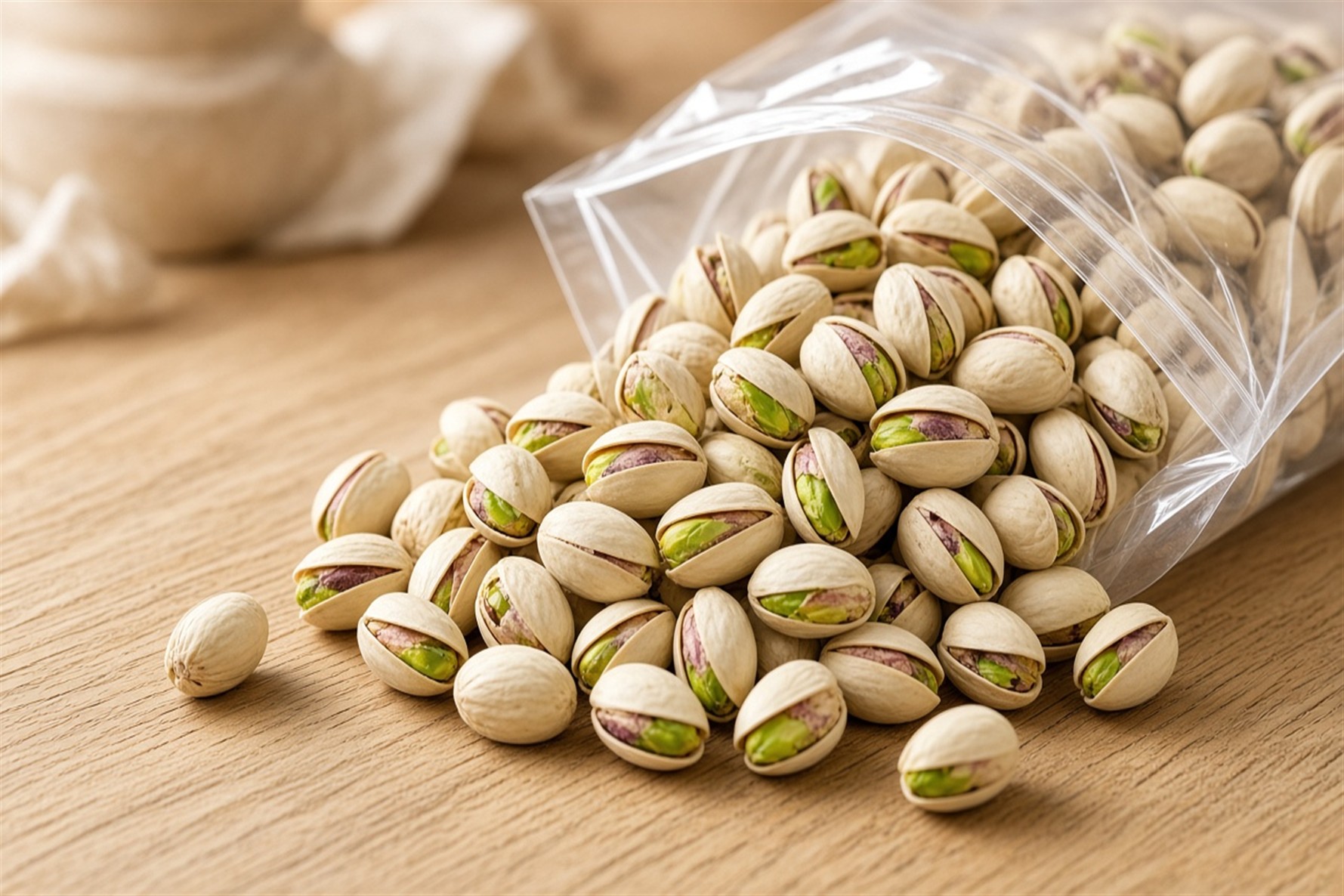
Ahmad Aghaei pistachio is a credible option for Greek dried-fruit importers thanks to its elongated shape, commercial appearance, and availability across multiple grades. Successful export to Greece, however, depends less on variety name alone and more on aflatoxin control, shipment uniformity, traceability, EU entry documentation, appropriate packaging, and a precisely defined purchase specification.
2024 trade data show that Greece imported about 1.36 million kilograms of pistachios valued at nearly USD 14.6 million. The United States, Germany, Iran, Italy, and Turkey were among registered suppliers to this market, while direct Greek imports from Iran totaled about 165,000 kilograms.
Introduction
Exporting Ahmad Aghaei pistachios to Greece matters for two reasons. First, although Greece produces pistachios, its market is not closed or solely dependent on domestic supply; it imports pistachios from several origins to meet commercial demand. Second, entry into Greece means entry under EU food-law rules. Quality control of the shipment must therefore go well beyond appearance, size, or open-shell percentage alone.
In 2024, the European Union imported about 138,000 tonnes of pistachios in total. The United States was the dominant supplier, and Iran supplied about 7,700 tonnes of registered EU imports. These figures show that Europe is a real market for Iranian pistachios, but competition differs fundamentally from price-only destinations. In the EU, the ability to present a shipment with documented contaminant control, reliable laboratory results, and consistent quality matters as much as the product itself.
For Iranian pistachios, aflatoxin remains the principal regulatory issue. Under the current EU import-control framework, Iranian pistachios and certain products containing them are subject to special entry conditions and official controls due to aflatoxin risk, with an identity and physical control rate of 50 percent for this group.
A Greek buyer should therefore not ask only “What is the price of Ahmad Aghaei pistachio?” The more professional question is: at what size, open-shell rate, visual specification, quality limits, aflatoxin test results, pesticide-residue status, packaging type, and delivery terms is the product offered—and are the shipment documents ready for lawful entry into the European Union?
1. The place of Ahmad Aghaei in export orders to Greece
Ahmad Aghaei is a well-known Iranian commercial variety with a relatively elongated nut form. Comparative studies of Iranian cultivars treat Ahmad Aghaei as a distinct commercial type separate from rounder varieties such as Fandoghi and Kaleh Ghouchi, and morphological and chemical differences among Iranian pistachio cultivars are well documented.
For a Greek importer, the name “Ahmad Aghaei” alone is not a purchase specification. Product from one orchard, harvest year, or processing unit can differ substantially from another shipment in size, natural open-shell percentage, shell color, kernel shape, staining, closed-shell share, and defects.
Why elongated form matters
Elongated pistachios create greater visual differentiation than round types in parts of the retail and premium dried-nut market. That advantage has commercial value only when nut length and shape are uniform across the entire shipment.
A lot sold as Ahmad Aghaei but containing a material share of short, round, small, or mixed-variety nuts may be judged by a European buyer as lacking grade uniformity. Variety mixing percentage, shape uniformity, and size should therefore form part of the purchase agreement.
How should size be defined?
In pistachio trade, size is usually expressed as the number of nuts per commercial weight unit, with several grades available. Research on Iranian cultivars reports commercial ranges such as 18–20, 20–22, 22–24, 24–26, 26–28, 28–30, and 30–32. A lower count generally indicates a larger nut; however, the buyer should define the seller’s sizing basis precisely in the contract and not rely on vague terms such as “large” or “super.”
| Attribute | Ahmad Aghaei | Relevance for Greek buyers |
|---|---|---|
| Nut form | Elongated | Suits offers where elongated appearance is part of product value |
| Shell color | Cream to light, lot-dependent | Affects retail pack appeal |
| Size | Must be specified in the contract | Directly affects price and pack uniformity |
| Open shell | Natural and mechanical must be distinguished | Natural open shell is usually preferred |
| Closed-shell share | Must be stated numerically | Affects pack yield and consumer satisfaction |
| Mixing with other varieties | Must be limited and controlled | Important for preserving commercial variety identity |
| Aflatoxin | Within destination legal limits | Essential condition for lawful EU entry |
2. The Greek pistachio market and the position of Iranian product
Greece is both a pistachio producer and an importer. From an Iranian exporter’s perspective, this market should not be viewed merely as a “dried-fruit consuming country.” Domestic Greek production and recognition of local pistachio mean that foreign product needs a clear place in the sales chain to succeed.
International trade data for 2024 show Greek imports from the world of about 1,361,740 kilograms. The United States was the largest registered supplier at about 693,000 kilograms, followed by visible shares from Germany, Iran, Italy, and Turkey. Iran exported about 165,000 kilograms to Greece, valued at approximately USD 2 million.
The presence of Germany and Italy among registered import origins is also important. Imports by one EU member from another do not necessarily mean the product was grown in the transit country; part of Europe’s dried-nut trade moves through import, packaging, storage, and re-distribution hubs.
Potential buyers in Greece
- Dried-fruit importers and wholesalers
- Nut and dried-fruit packing houses
- Specialty dried-fruit retailers
- Hotel and restaurant foodservice suppliers
- Confectioners and pastry producers
- Ice-cream and dessert manufacturers
- Food-ingredient distributors
For direct consumption, shell appearance, size, open-shell rate, flavor freshness, and uniformity matter greatly. For industrial use, attributes such as kernel yield, kernel color, cost per kilogram of usable kernel, and specification stability become more important.
Actual market versus potential market
Direct imports of 165 tonnes from Iran in 2024 show that Greece is not a purely theoretical market for Iranian pistachios. Import volumes from the United States, however, were far larger. Iran’s export strategy therefore cannot rely on reputation alone. Real advantage must be built through a defined elongated variety, sensory quality, suitable grade, consistent delivery capability, packaging matched to the sales channel, and rigorous aflatoxin-risk management.
3. Technical specifications to fix before purchase
In professional Ahmad Aghaei procurement, product specifications should be clear before the final proforma is issued and preferably before the lot is produced or packed. Many commercial disputes arise when both parties use terms such as “first grade,” “premium,” or “export quality” without a shared numerical definition.
| Parameter | Option or definition method | Buyer relevance |
|---|---|---|
| Variety | Ahmad Aghaei | Prevents commercial mixing |
| Product form | In-shell or kernel | Determines use and customs code |
| Raw or roasted | State precisely | Determines process and end market |
| Salted or unsalted | For processed product | Linked to labeling and market taste |
| Size | On an agreed sizing system | Major price driver |
| Open-shell percentage | In contract specifications | Defines visual quality |
| Natural open shell | Separate from mechanical opening | Important quality criterion for some buyers |
| Closed shell | Agreed maximum allowed | Affects consumer satisfaction |
| Empty nuts | Maximum allowed | Reduces real shipment value |
| Shell staining | Contractual acceptance limit | Important for transparent packs |
| Moisture | Per agreed specs and testing | Linked to storage stability |
| Aflatoxin | Laboratory testing | Safety and import requirement |
| Pesticide residues | Within EU limits | Legal compliance condition |
| Packaging | Bulk or consumer | Affects shelf life and cost |
| Package vacuum | If vacuum packing is used | Oxygen control and quality retention |
| Net weight | Per pack unit | Commercial and labeling basis |
| Harvest or production date | Recorded in batch documents | Useful for traceability and freshness |
A precise purchase request should also state whether an approved sample, or the contract’s numerical specifications, will govern shipment quality. Best practice is to use both sample and numerical specs as acceptance criteria. For export orders, buyers can enter these details in an Iranco purchase request so supply options are reviewed against the actual product specification.
4. Aflatoxin: the critical control point for Iranian pistachio exports to Greece
For Iranian pistachio exports to Greece, aflatoxin is not a secondary laboratory topic; it is one of the main commercial and customs decision points. EU rules distinguish two situations for pistachios: product that must undergo further sorting or physical treatment before being placed on the market for final consumers or used as a food ingredient, and product placed directly on the market for final consumers or used as a food ingredient.
Under current EU rules, for almonds, pistachios, and apricot kernels intended for sorting or physical treatment before final placing on the market, the aflatoxin B1 limit is 12 µg/kg and the sum of B1, B2, G1, and G2 is 15 µg/kg. For product intended for direct final-consumer marketing or use as a food ingredient, the limits are 8 and 10 µg/kg respectively.
| Product status | Aflatoxin B1 | Sum of four aflatoxins |
|---|---|---|
| Pistachios for sorting or physical treatment before final placing on the market | 12 µg/kg | 15 µg/kg |
| Pistachios for direct placing on the market or use as a food ingredient | 8 µg/kg | 10 µg/kg |
Do not overlook ochratoxin A
EU contaminant rules also set specific ochratoxin A limits for pistachios. For pistachios intended for sorting or physical treatment before final placing on the market, the limit is 10 µg/kg; for pistachios ready for final-consumer marketing or use as a food ingredient, the limit is 5 µg/kg. A European shipment quality-control plan should not stop at a single aflatoxin certificate.
Why sampling matters as much as the test itself
Fungal contamination and aflatoxin in nuts are not necessarily distributed evenly across every nut in a shipment. A small fraction of the product may carry much higher contamination. Laboratory results therefore have real value only when sampling, sample preparation, and the test method are valid. The lab report must be traceable to a defined batch or shipment.
Vacuum packing does not “fix” aflatoxin
A common mistake is to treat vacuum packaging as an aflatoxin solution. Vacuum can reduce oxygen in the pack headspace and help manage oxidation and some quality changes, but it does not turn contaminated product into sound product. Aflatoxin control must begin in the orchard, with timely harvest, green-hull removal, drying, storage, sorting, and removal of high-risk nuts, and finish with sampling and testing of the final batch.
5. Special entry conditions for Iranian pistachios into the EU
Iranian pistachios are subject to enhanced controls under the EU import-control system. In the current regulation on temporary increases of controls and special import conditions, in-shell pistachios under code 0802 51 00 and pistachio kernels under code 0802 52 00 from Iran appear on the relevant list due to aflatoxin risk, with an identity and physical control frequency of 50 percent for this group.
That rate does not mean exporters can rely on shipments that happen not to be selected. Every shipment must be compliant from the outset.
Documentary, identity, and physical checks
The EU official-control framework distinguishes documentary checks, identity checks, and physical checks. Physical checks may include sampling and laboratory testing. For goods listed under special conditions, the importer should also build possible control and sampling time into the logistics plan.
Official certificate and laboratory report
Goods covered by the annex on special conditions must enter with the official certificate required by the regulation. ISO/IEC 17025 is referenced in the rules for the competence of laboratories performing the relevant tests. Commercially, the importer should obtain reviewable copies of documents before loading and verify alignment of the following:
- Exporter and consignee name and address
- Product description, batch or shipment number, and weight
- Container number, where applicable
- Test results and traceable identifiers
- Required official certificate and transport documents
A simple mismatch between the batch number on the test certificate and the product actually loaded can undermine the entire quality-control file.
6. Pesticide residues, traceability, and labeling requirements
Passing an aflatoxin test does not mean full compliance with EU food law. Pesticide residues must also meet the legal limits applicable to pistachios. A vague claim that the product “has a pesticide test” is not enough; the test panel should be chosen according to substances used or likely in the production chain and destination-market requirements.
Labeling for packed product
If pistachios enter Greece in consumer packs, EU food-information rules set specific mandatory particulars: the name of the food, net quantity, date of minimum durability, special storage conditions where needed, details of the food business operator, and a nutrition declaration. Allergen declaration rules must also be followed. The language of mandatory information must be understandable to consumers in the market of sale; for product sold directly in Greek retail, label design must therefore be prepared for the Greek market.
Product name and origin
If the variety “Ahmad Aghaei” appears on the pack, the product must genuinely match that claim. EU food-information rules prohibit misleading information about the nature, identity, properties, composition, quantity, and origin of the food. Controlling variety mixing is therefore not only a marketing issue; the claim on the pack must also be defensible.
7. Choosing the right grade for Greek importers
No single grade is “best” for the entire Greek market. The preferred grade depends on the sales channel and target price. For specialty dried-fruit shops or premium packaging, elongated pistachios with high uniformity, clean shell appearance, a favorable natural open-shell percentage, and a relatively large size can create more advantage. For confectionery or ice-cream producers, paying a premium for a very attractive shell is rarely justified; product should be selected on kernel yield and kernel specifications.
| End-use channel | Purchase priority | Lower-priority parameter |
|---|---|---|
| Premium retail pack | Elongated form, size, open shell, shell color | Lowest-grade cost |
| Dried-fruit retail | Freshness, appearance, flavor, uniformity | Complex industrial packaging |
| Hotel and catering | Quality and price stability | Brand display on master carton |
| Confectionery | Kernel yield, color, and flavor | Shell appearance |
| Ice cream and desserts | Kernel quality and color stability | In-shell open-shell percentage |
| Greek packing house | Uniform, traceable bulk product | Consumer packing at origin |
Natural versus mechanical open shell
This point must be stated expressly in the contract. Naturally opened pistachios are not assessed the same way as product opened by mechanical processes. Buyers offering pistachios as a premium dried nut are usually more sensitive to split uniformity and natural appearance.
Kernel color
Where the end use is industrial kernel consumption, kernel color and the skin on the kernel can matter more than in-shell shape. For such customers, it is often better to compare a defined-grade, defined-color pistachio kernel offer rather than buying in-shell product and paying freight on shell weight.
8. Vacuum packaging for Ahmad Aghaei pistachios: benefits and limits
The main purpose of vacuum packaging for dried pistachios is to reduce product contact with oxygen and limit oxidative reactions. Because pistachios contain fat, prolonged exposure to oxygen, heat, and light can reduce sensory quality and produce rancid notes. Studies show that reducing oxygen through vacuum or modified atmosphere can help control certain oxidation indicators; however, real shelf life depends on initial moisture, microbial load, storage temperature, film permeability, seal quality, vacuum intensity, light, and transport conditions.
Suitable film and the shell-edge risk
A good vacuum bag for pistachios needs an acceptable barrier to oxygen and moisture. Multilayer structures are usually more suitable than simple monolayer films. In-shell pistachio is angular and relatively hard; under vacuum, shell edges can create point pressure and puncture the film. Packaging trials should assess puncture resistance, seal quality after vacuum, and vacuum retention throughout transport.
Full vacuum or nitrogen flush?
| Criterion | Vacuum | Low-oxygen or nitrogen atmosphere |
|---|---|---|
| Reduction of pack air | Highly effective | Highly effective with correct setup |
| Pack compression | Greater | Lower |
| Film pressure on shell | Greater | Lower |
| Retail appearance | Compressed | More voluminous and usually more display-friendly |
| Equipment | Vacuum machine | Requires gas injection and control |
| Quality control | Seal integrity and vacuum retention | Seal integrity and residual gas composition |
For export to an importer that re-packs in Greece, vacuum or barrier packing in bulk formats can be logical. Pack weights should still allow easy handling, inspection, sampling, and re-packing. Master cartons must also withstand pallet stacking pressure and multi-leg sea or road transport.
9. Transport, storage, and quality management through to Greece
Unlike fresh produce, dried pistachios do not require a cold chain comparable to fresh fruit, but heat, humidity, oxygen, light, and environmental contamination can still reduce product quality.
- Moisture control: Temperature swings in a dry container can cause condensation. Before loading, the container must be dry, clean, odor-free, and sound against water ingress.
- Palletization: Vacuum-packed cartons must not be subjected to uncontrolled pressure; carton deformation can damage the inner film.
- Odor and cross-contamination: Pistachio is a fatty commodity and its sensory quality is damaged by unsuitable environments. Sensory inspection inside the container before loading is essential.
- Retain sample: At least one sealed retain sample from the loaded batch should remain with the seller and preferably also with the buyer.
10. Tariff code and product form
| Product form | Code |
|---|---|
| In-shell pistachios | 0802 51 00 |
| Shelled pistachios | 0802 52 00 |
Roasted, salted, pistachio paste, mixed nuts containing pistachio, and other preparations may fall under different tariff lines. From the importer’s perspective, the exact product form should be fixed before tariff and documentation review.
11. How is Ahmad Aghaei pistachio priced for the Greek market?
Real export price cannot be set from variety name alone. The main factors include: harvest year and supply conditions, size, open-shell percentage and natural open shell, closed-shell share, shell staining and other defects, empty-nut percentage, variety uniformity, kernel quality, raw versus processed form, laboratory-control intensity, packaging type and cost, pack weights, order volume, delivery terms, and transport route.
Buyers should not compare only “price per kilo.” It is better to calculate cost per kilogram of sellable product. If a cheaper lot has more closed shells, empty nuts, staining, or off-size product, its real cost after re-sorting can be higher. Credible testing, precise sorting, batch control, official documents, and quality packaging have a cost; an offer that ignores EU requirements is not comparable with goods ready for lawful export to Greece.
In Iranco price requests, destination “Greece” should also be stated expressly so the supplier knows the product must be reviewed against the requirements of this export route.
Importer checklist before placing an order
- Specify the variety expressly as “Ahmad Aghaei.”
- State whether the product is in-shell, kernel, raw, roasted, or salted.
- Write the sizing system and required size into the contract.
- Define open-shell percentage and, where relevant, natural open-shell percentage.
- Set limits for closed, empty, broken, stained, and off-size nuts.
- Obtain a representative sample before the commercial contract.
- Link the approved sample number to the production batch.
- Review aflatoxin test results for that same batch.
- Check compliance with ochratoxin A and EU pesticide-residue limits.
- Clarify whether product will undergo further sorting or is ready for final consumers.
- Review the official certificate and documents required for Iranian pistachio shipments before loading.
- Verify the laboratory and the traceability of the test report.
- Trial the vacuum packaging type and structure before mass production.
- Evaluate a finished pack sample for vacuum retention and puncture resistance.
- Define net weight per unit, packs per carton, and master-carton weight.
- Approve Greek-market label text before final print.
- Ensure the batch number is traceable on packs and documents.
- Inspect the container for dryness, odor, cleanliness, and water ingress before loading.
- State delivery terms, insurance responsibility, and risk-transfer point clearly in the contract.
- Retain a witness sample from the actual loaded shipment.
What information should be sent for an accurate price?
| Required information | Example definition |
|---|---|
| Product | Ahmad Aghaei pistachio |
| Form / processing | In-shell or kernel · raw / roasted / salted |
| Size and open shell | Target grade · open-shell limit · natural open shell if required |
| Defects and aflatoxin | Acceptable limits · per EU regulations |
| Packaging and weight | Vacuum / inert gas / bulk · weight per pack |
| Brand and quantity | Supplier or private label · total order weight |
| Destination and use | Greece · delivery point · retail / re-packing / industry |
12. Sourcing Ahmad Aghaei pistachios from Iran to buyer specifications
In international Ahmad Aghaei procurement, the gap between two offers is not only a price gap. Size, open-shell percentage, closed-nut share, variety uniformity, test results, packaging type, and export destination can make two offers fundamentally different. For the Greek market, product must align with the buyer’s commercial criteria and with the EU food-control system.
Iranco (iranco.com) enables buyers and importers to register purchase requests with details such as variety, grade, size, order quantity, packaging type, end use, and destination country so available supply options in Iran can be reviewed against that need. To explore Ahmad Aghaei supply for the Greek market, include grade specifications, approximate order quantity, packaging type, and delivery destination in your purchase request.
Conclusion
Exporting Ahmad Aghaei pistachios to Greece becomes a sustainable trade only when the product is defined for the EU market from the start. Ahmad Aghaei’s elongated appearance can create advantage in parts of the dried-nut market, but nut shape does not replace food-safety control, shipment uniformity, and valid documentation.
The importer’s main decision point remains aflatoxin control. The EU distinguishes pistachios intended for further sorting before final placing on the market from ready-to-consume product, with separate limits for each group. Iranian pistachios are also subject to special entry conditions and a 50 percent identity and physical control frequency under current rules.
Vacuum packaging can be a useful tool to reduce oxygen contact and better preserve quality, but it is not a substitute for sound production and contaminant control. For a Greek buyer, the preferred offer is not necessarily the lowest price per kilo; it is a shipment whose specifications are clear, whose test results are traceable, whose packaging matches the sales channel, and whose EU market-entry risk has been managed from the outset.
Frequently asked questions (FAQ)
Is Ahmad Aghaei pistachio suitable for the Greek market?
Yes. Ahmad Aghaei can suit parts of the Greek dried-nut market because of its elongated form and clear commercial identity. Final fit still depends on grade, price, size, open-shell percentage, shell appearance, and sales channel. For industrial use, kernel color and yield may matter more than in-shell form.
What are the EU aflatoxin limits for pistachios?
For pistachios intended for sorting or physical treatment before final placing on the market, maximum aflatoxin B1 is 12 µg/kg and the sum of B1, B2, G1, and G2 is 15 µg/kg. For pistachios ready for final consumers or use as a food ingredient, the limits are 8 and 10 µg/kg respectively.
Are all Iranian pistachio shipments tested on entry into the EU?
Iranian pistachios appear on the EU list of goods under special conditions due to aflatoxin risk, with an identity and physical control rate of 50 percent under current rules. Every shipment must still be prepared as fully compliant.
Does vacuum packing prevent aflatoxin?
Vacuum should not be treated as a method for correcting contaminated product. Reducing oxygen can help preserve some quality attributes, but aflatoxin control must take place before packing, from harvest, drying, sorting, and storage onward.
Is vacuum better than nitrogen flush?
The answer depends on pack type and sales channel. Vacuum reduces pack air but presses the film against the hard shell. Nitrogen flush can reduce oxygen while keeping a more voluminous appearance. For retail packs, both options should be compared through shelf-life and transport trials.
What are the tariff codes for in-shell and shelled pistachios?
Under EU nomenclature, in-shell pistachios fall under 0802 51 00 and shelled pistachios under 0802 52 00. Roasted, processed, pistachio paste, or mixtures containing pistachio may be classified under other lines.
What are the most important tests for pistachio exports to Greece?
Aflatoxin is the primary risk-based test for Iranian pistachios. Ochratoxin A and pesticide residues also matter in an EU market-compliance plan. Results must be traceable to the actual export batch.
How can we source Ahmad Aghaei pistachios directly from Iran?
First define size, open-shell percentage, defect limits, order quantity, product form, packaging, required tests, and delivery destination. Then review a representative sample and laboratory documents for that grade. Buyers can register these same specifications as an Iranco purchase request.
Why do two Ahmad Aghaei shipments have different prices?
Variety name is only one price factor. Size, natural open-shell share, closed and empty nut percentages, shell appearance, kernel quality, harvest year, sorting cost, testing intensity, packaging, order volume, and delivery terms all affect price.
Does Greece actually import pistachios from Iran?
Yes. 2024 trade data show Greece imported about 165,000 kilograms of pistachios from Iran, valued at approximately USD 2 million. Total registered Greek imports that year were about 1.36 million kilograms.
Featured Products






Related Articles



