 فريق مجلة إيرانكو
تحليل طلب السوق الجورجي، مبيعات إيرانية مثبتة وإمكانات النمو، متطلبات الجمارك والصحة، التعبئة، مسارات النقل ومعايير الدخول المهني للسوق
Market Report · Export · Georgia · Food
Iran Food Exports to Georgia: Market Conditions and Products with Export Capacity
Analysis of demand in the Georgian market, Iranian products with proven sales and room to grow, customs and sanitary requirements, packaging, transport routes and professional entry criteria — an إيرانكو Magazine B2B guide for exporters and importers.
Analytical introduction
The Georgian market should not be judged on population alone. Three features matter for Iranian food exporters: substantial reliance on imports, an active tourism sector, and a geographic position linking the Caucasus, the Black Sea, Turkey, Russia, Armenia and Azerbaijan.
In 2025 Georgia recorded more than 5.5 million international tourist trips, with total international traveller movements reaching about 7.8 million. That volume directly affects hotels, restaurants, cafés, retailers and food wholesalers. Tourism — especially in Tbilisi, Batumi and seasonal resort areas — makes effective demand larger than a simple headcount suggests.
For Iran, the main advantage is not distance alone. Trade data shows Iranian foods already enter Georgia in several defined groups. In 2025, dairy and related animal-origin products from Iran were worth about USD 22.38 million; fruit and nuts USD 8.54 million; and vegetables and fresh produce USD 5.44 million. “Export capacity” must therefore be separated from products that only look sellable on paper from those already visible in customs statistics.
Competition is not simple either. Turkey, Russia, European countries, Armenia, Azerbaijan and Central Asian suppliers are active across food categories. Iranian exporters can build a stable share only when they manage three topics together: competitive delivered price, consistent quality, and strict compliance with entry and labelling rules.
1. What defines Georgia’s food market?
Georgia’s food market combines household consumption, modern retail, wholesale markets, the restaurant and hotel sector, and tourism-driven demand. For an Iranian exporter, understanding this structure matters more than looking only at total import value.
Small market but import-oriented
Georgia has meaningful domestic production in hazelnuts, wine, some fruit, vegetables, livestock products and agricultural goods. Even so, the consumption basket is much wider than domestic capacity, and a large share of consumer goods and food inputs is sourced abroad.
Goods imports of USD 18.65 billion in 2025 show how deeply Georgia is tied to external supply. That figure covers all goods, not food alone, but it confirms imports as a normal part of the country’s supply chain.
Tourism and food sales
More than 5.5 million tourist trips in one year, for a country with limited population, materially affects food consumption. Hotels and restaurants need predictable supply, food-service packaging and stable quality through the season.
That creates specific openings for industrial dairy, butter and milk fats, nuts and dried fruit, dates, fresh fruit, vegetables, confectionery inputs and some packaged foods. Georgian tourism is not summer-only: Batumi and the Black Sea coast in warm months, Tbilisi year-round, and ski areas in winter each create different consumption patterns. Professional exporters should align supply plans with city, season and sales channel.
Retail and food service are different channels
A product sold through a chain store is not necessarily packed the same way as one bought by a restaurant, hotel or factory.
Retail puts more weight on:
- Pack appearance
- Complete on-pack information
- Household-friendly pack weights
- Shelf life
- Shelf placement and display
- Barcode and importer details
- Design and quality consistency
In wholesale and food service, pack weight, price per kilo, storability, ease of use and load uniformity usually matter more.
2. Iran–Georgia food trade: where is proven capacity?
The first step in evaluating Iranian food exports to Georgia is to identify goods that already have real trade flows.
2025 data highlights three food groups from Iran: dairy and related products, fruit and nuts, and vegetables and fresh produce. These groups differ completely in nature, buyers, transport and quality control.
| Product group | Imports from Iran | Commercial reading |
|---|---|---|
| Dairy, eggs, honey and related | ~USD 22.38M | Proven, substantial market |
| Fruit, nuts, citrus & melon peel | ~USD 8.54M | Established for several subgroups |
| Vegetables, fresh produce & edible roots | ~USD 5.44M | Strong fresh-product potential |
| Cereal products, flour & bakery | ~USD 280K | Limited Iranian presence |
| Coffee, tea & spices | ~USD 146K | Small current market |
| Sugar & confectionery | ~USD 83K | Limited presence |
| Cocoa & cocoa preparations | ~USD 58K | Very intense competition |
Strong production in Iran does not automatically mean a large share in Georgia. Georgia’s chocolate and cocoa market is sizeable, but Iran’s share is very small while Russia, Ukraine, Turkey and the EU dominate. “Iran can produce it” is not enough to choose an export line.
3. Which Iranian foods have the most export capacity for Georgia?
Product selection should weigh four criteria together: proven Georgian imports from Iran, import market size, Iran’s production or price advantage, and ability to deliver acceptable quality.
Milk powder, concentrated milk and selected dairy lines
In 2025 about USD 14.8 million of concentrated or sweetened milk and cream entered Georgia from Iran, plus more than USD 6.3 million of butter and other fats and oils derived from milk. These two subgroups form most of the value in Iran–Georgia food trade group four.
For Iranian producers this is more meaningful than generic claims about dairy potential: buying chains, product acceptance and commercial channels already exist for part of Iran’s dairy exports.
Buyers may include distributors, food industry, industrial bakeries and confectionery, food-service operators or repacking companies. Before pricing, define fat %, dry matter, process type, packaging, net weight, shelf life, storage, microbiological specs, end use, and required health and veterinary documents.
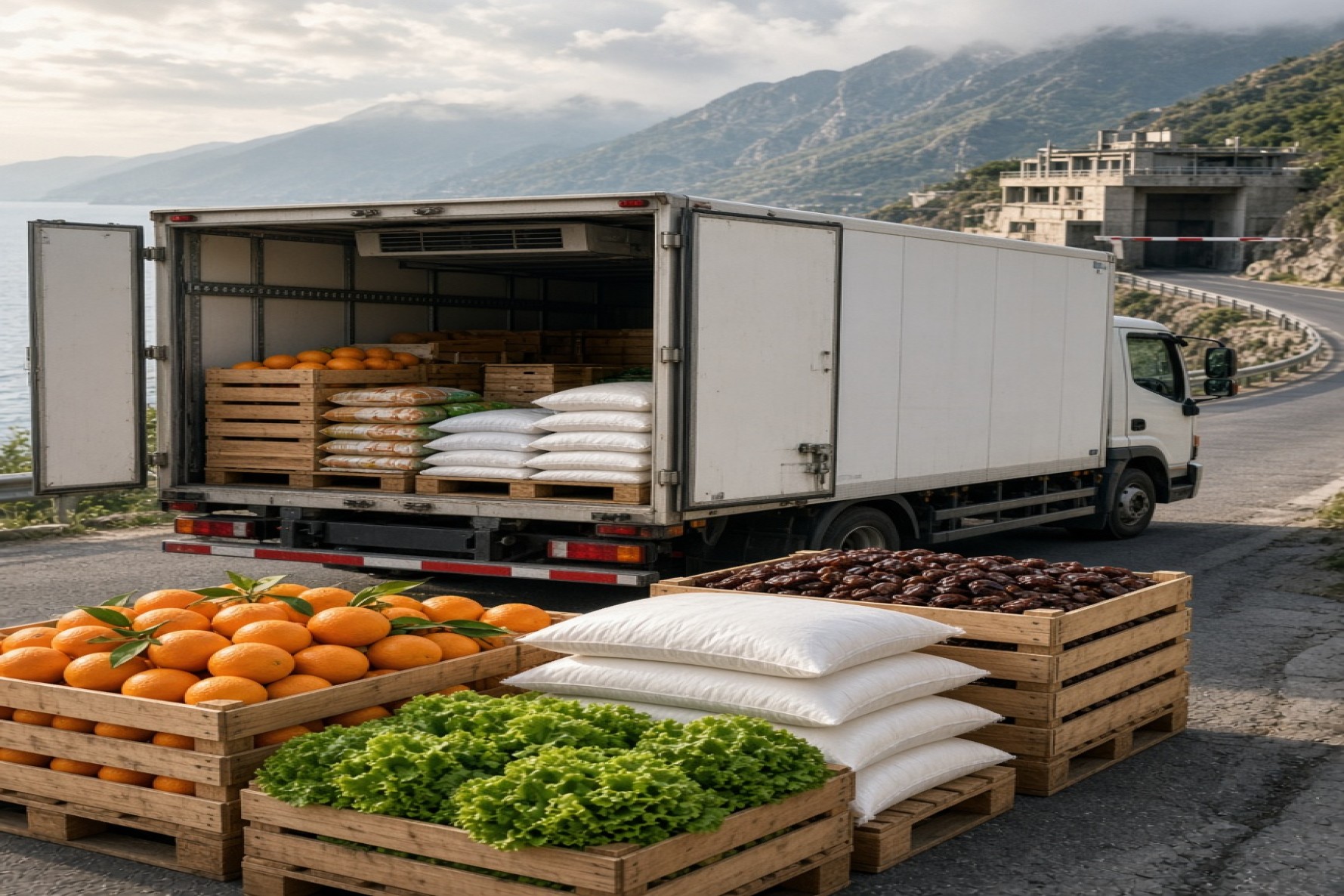
Citrus
Fresh or dried citrus imports from Iran were worth about USD 2.91 million in 2025 — one of the most important Iranian fruit subgroups in this market. Farm price is only part of competition; fruit that arrives with weight loss, mould, bruising or poor appearance is uneconomic even at a low initial quote.
Uniform sorting, removal of damaged fruit, strong cartons, humidity control and correct harvest stage are decisive.
Melons and watermelons
This group from Iran was about USD 1.26 million in 2025. Iran can supply well in defined seasonal windows thanks to production timing, growing regions and land transport. Unit weight, size uniformity, ripeness, sweetness, skin condition and transport tolerance must be fixed in the contract.
Dates and figs
The group including dates, figs and related fruit was about USD 1.23 million from Iran in 2025. Much of Iran’s edge may sit in dates, but contracts must use precise subgroup statistics and HS codes — do not attribute the whole heading to dates alone.
Dates can reach Georgia through chain stores, nut shops, wholesale, hotel breakfast, confectionery and repacking. Success requires exact variety, size, moisture, damage level, pitted or unpitted, and pack type in the contract.
Fresh grapes and raisins
Fresh and dried grapes from Iran were about USD 781,000 in 2025. Georgia is itself a major grape producer, so Iranian grapes should target seasonal gaps, price, quality or a distinct attribute. Supply when local production is abundant can erode margins. Raisins are easier to store and ship but face many regional competitors in the nut and dried-fruit aisle.
Lettuce and leafy vegetables
Lettuce and chicory at about USD 1.75 million were the largest recorded vegetable subgroup from Iran in 2025 — proof that highly perishable lines can work with the right cold chain.
For leafy products, farm-to pre-cool time, product temperature at loading, ventilation, relative humidity and avoiding carton compression matter greatly.
Carrots and edible roots
Roots from Iran were about USD 880,000 in 2025. Fresh cucumbers and gherkins about USD 626,000; cabbage types about USD 601,000; onions, garlic and similar about USD 317,000. These groups are usually price-sensitive per unit, so freight, wastage and turnover speed can matter more than a small farm-gate price gap.
Tomatoes
Iranian tomatoes appear in 2025 statistics at only about USD 143,000 — far below lettuce, carrots, cucumber or cabbage. Do not rank tomatoes first for Georgia simply because Iran produces large volumes; entry should follow specific buyer demand and season.
4. Product priority: proven capacity vs potential capacity
Exporters should distinguish three product states.
| Product status | Definition | Examples to study |
|---|---|---|
| High proven capacity | Material current imports from Iran | Concentrated milk, milk fats, citrus |
| Moderate proven capacity | Trade exists but smaller scale | Lettuce, carrots, cucumber, cabbage, dates, dried fruit |
| Competitive potential | Large Georgian market, low Iranian share | Confectionery, chocolate, bakery, processed foods |
The third group is not automatically the best opportunity. Georgia imported about USD 134 million of cocoa products in 2025, but only about USD 58,000 from Iran. Russia, Ukraine, Turkey and several European countries supply that market.
That means demand is large, but barriers are likely not “no demand” alone — brand competition, price, distribution, packaging, quality and commercial terms all play a role. A “big market” must not be read as an “easy opportunity.”
| Group | Iran advantage | Main risk |
|---|---|---|
| Industrial dairy | Proven export history | Veterinary rules and spec stability |
| Citrus | Season and land access | Wastage and regional competition |
| Dates & nuts | Variety and shelf life | Price competition and grade uniformity |
| Vegetables & fresh produce | Supply in different periods | High perishability |
| Confectionery & chocolate | Industrial capacity in Iran | Established rival brands |
| Specialty Iranian products | Differentiation possible | Limited current market |
| Food industry inputs | Bulk sales potential | Need for stable technical specs |
5. What should a Georgian buyer specify when ordering food?
One of the most common errors is asking for a price using a generic product name. “Price for dates”, “cucumbers”, “milk powder” or “citrus” is not enough for a professional offer.
Specifications must be measurable.
| Parameter | Examples | Why it matters |
|---|---|---|
| Exact product name | Fresh, dried, frozen, processed | HS code and transport mode |
| Variety or commercial type | Named commercial grade | Like-for-like quotes |
| Size | Unit weight or size band | Sales uniformity |
| Quality grade | Premium, commercial or contract spec | Price level |
| Appearance | Colour, condition, shape | Market acceptance |
| Moisture | Nuts and dried goods | Shelf life |
| Fat or dry matter | Dairy lines | Industrial use |
| Pack type | Bag, carton, tub, retail unit | Handling and retail |
| Net weight | Per pack | Cost control |
| Remaining shelf life | At delivery | Inventory planning |
| Storage temperature | Sensitive goods | Quality retention |
| Required tests | Micro, chemical, residues | Load acceptance |
The same parameters should appear in the purchase contract, proforma and acceptance criteria. Verbal agreement on “export quality” or “grade one” is not enough to prevent disputes.
6. Quality, testing and pre-loading control
Quality control for exports to Georgia must match the product. One fixed test list for all foods is not logical.
Fresh fruit and vegetables
Pre-loading checks for fresh products should at minimum cover:
- Visual condition and size uniformity
- Ripeness level
- Rot, mould, mechanical damage
- Heat or cold injury
- Foreign contamination
- Net weight and carton condition
- Product temperature at loading
Pesticide residue review also matters for agricultural goods, by product and market rules.
Nuts and dates
- Moisture, insect infestation, mould
- Foreign matter and damaged percentage
- Size and colour uniformity
- Pack integrity and microbiology where required
- Mycotoxins for susceptible products
For oxidation-sensitive nuts, oxygen and moisture ingress through the pack can reduce quality in storage.
Dairy
Industrial dairy control should follow product type: fat, protein, dry matter, moisture, microbiology, composition and storage must match the contract. An analysis certificate is useful only when it clearly ties to the same production batch, states test methods and laboratory, and is checked against contract acceptance limits.
For repeat shipments, keeping the buyer-approved reference sample and a retained witness sample from the load reduces disputes on colour, size, texture or sensory attributes. The initial sample must not be better than what bulk production can repeat.
7. Food entry regulations in Georgia
Exporting food to Georgia is not completed with an invoice and waybill alone. Product type determines sanitary, veterinary or quarantine controls.
Georgia’s law on food safety, veterinary and plant protection requires controlled goods at the border to meet national rules. Plant quarantine goods and animal products need certificates and, where applicable, import permits.
Plant-origin products
Fresh fruit, vegetables, plants and some plant products may fall under phytosanitary control. Exporters must confirm before loading whether phytosanitary certificates and import permits apply. The Georgian National Food Agency operates an import-permit process for quarantine plant products; the Georgian importer should verify this before the truck moves.
Animal-origin products
Dairy and similar lines are more sensitive under veterinary control. Importers must check permit rules, health or veterinary certificates and plant acceptance for the exact product. A document accepted for one dairy SKU may not cover all dairy items.
Permit timing and fees
The National Food Agency publishes several service levels for veterinary import or transit permits and for phytosanitary import permits: 20 working days at 100 GEL, five working days at 200 GEL, and one working day at 300 GEL. Stated veterinary permits are valid for one month; related plant permits can be issued for up to six months. In professional deals, responsibility for obtaining permits must be agreed before the contract is signed.
Labelling
Georgian food information rules are based on Government Decree No. 301, in force since 2019 with later amendments including a 2026 update. Mandatory information must be clear, legible and visible. Product name, ingredients, allergens, quantity, storage, economic operator details and origin where required are central. Consumer-facing information must be available in Georgian. Final label artwork should be approved by the importer before mass printing.
8. Customs tariff, HS codes and import tax
There is no single duty rate for all “food”. Georgia’s import system may apply 0%, 5%, 12% or special rates depending on the code. Import VAT is 18% for most goods. Saying “food exports to Georgia are 12% duty” is incorrect — the rate must be checked against the exact HS code.
Classification can change with fresh vs dried, frozen vs not frozen, degree of processing, sugar content, pack type, product composition, fat level and raw material type.
Before final price confirmation:
- Prepare a technical product description
- State the seller’s proposed HS code
- Have the importer verify the code with broker or customs
- Calculate duty and tax on that basis
This matters especially for composite and processed foods.
9. Packaging suited to the Georgian market
Packaging choices should start from destination and sales channel, not from whatever pack the producer uses domestically in Iran.
Fresh fruit and vegetables
Packs must provide mechanical protection, ventilation and survive stacked road transport. Cartons that look fine in an Iranian warehouse may fail in humid conditions, under pressure from stacked loads or after several handling steps.
Ventilation design matters for lettuce, cucumber, citrus and fresh fruit. Overfilling cartons to add weight usually backfires through bruising and higher wastage.
Nuts and dried fruit
Dates, raisins, pistachios and similar lines need protection from moisture, oxygen, foreign odours and contamination. Bulk packs may suit repacking in Georgia; retail packs need market-ready design and labels.
Dairy and industrial inputs
Powders and milk fats need packs matched to sensitivity to moisture, light, oxygen and temperature. For industrial buyers, packaging is part of cost and product protection more than marketing.
| Target market | Packaging priority |
|---|---|
| Retail store | Appearance, label language, household weight, barcode |
| Wholesale | Strength, economic weight, easy handling |
| Restaurant & hotel | Larger packs, ease of use |
| Factory | Technical protection, standard weight, storability |
| Repacking | Bulk pack and full batch information |
10. Transport routes from Iran to Georgia
Land transport is the natural option for much Iranian food. Iran and Georgia share no border, so loads must transit a third country.
A well-known corridor enters Armenia from the Iran–Armenia border, then crosses international land gates between Armenia and Georgia, including Sadakhlo or Ninotsminda, listed as official road crossings with Armenia.
Another route runs through Azerbaijan and the Red Bridge border crossing with Georgia, active for international truck freight.
Route choice should reflect transit conditions, haul restrictions, border queues, insurance, product type, cost and real transit time on the shipment date — not map distance alone.
For fresh goods, the shortest line is not always best. More border stops or transloading can hurt quality more than a slightly longer but smoother path. The right metric is controlled time from origin cold store to destination delivery.
Refrigerated trucks
A reefer trailer alone is not enough. Control pre-cooling, product temperature at loading, unit set-point, air circulation, stacking, door seals, temperature records and stops en route. Reefer units are not designed to pull heat quickly out of warm product loaded directly from the field.
Georgia’s customs system expects designated parking and electronic vehicle queue management at major gates such as Sadakhlo, Red Bridge and Ninotsminda — factor that into scheduling.
11. Main competitors in the Georgian market
Iran’s rival is not one country for every product. Turkey is a major competitor thanks to proximity, diverse food industry and strong trade networks. In 2025 Turkey supplied about USD 2.75 billion of Georgia’s goods imports — the largest single origin.
In vegetables, recent trade data shows Turkey’s weight. In 2023 Georgia imported about USD 60.6 million of vegetables and edible roots; Turkey’s share was near USD 27.8 million while Iran was about USD 3.2 million among suppliers.
| Product | Notable competitors | Iran’s competitive issue |
|---|---|---|
| Vegetables & fresh produce | Turkey, regional origins | Delivered cost and freshness |
| Fruit | Turkey, Azerbaijan, seasonal suppliers | Timing and sorting |
| Nuts & dried fruit | Turkey, Central Asia, China | Quality stability and price |
| Chocolate | Russia, Ukraine, Turkey, Europe | Brand and distribution |
| Dairy | Domestic production and imports | Regulation and stable specs |
Iran should not compete only on “being cheaper”. Cheap fresh product with high wastage or industrial loads without stable specifications is not a real advantage. A better benchmark is sellable cost at destination.
12. How export pricing to Georgia is determined
Unit price without defined specs is a poor comparison base. Real export price reflects product type and grade, season, growing region, size, packaging, pack weight, testing, cold storage, domestic haul in Iran, transit freight, insurance, delivery terms, order size, final city in Georgia, labelling requirements, control and document costs, and payment terms.
For fresh product, importers should model likely wastage. Two citrus offers may differ little at origin, but weaker sorting, weak cartons and higher damage on the cheaper line can raise the real cost per sellable kilo in Georgia.
Buyers should state which point the requested price covers. Correct use of Incoterms clarifies freight, insurance, clearance and delivery responsibility, but the chosen term must match the real route and each party’s capability. Comparing only ex-factory Iran prices is insufficient; comparison should be on final cost of sound, sellable product in the destination warehouse.
13. Importer checklist before placing an order
- Define exact product name and processing form.
- Align proposed HS code with importer and customs broker.
- Fix order quantity and delivery schedule.
- Obtain and approve a commercial sample.
- Transfer sample specs into the contract.
- Write appearance criteria and defect tolerances.
- List required laboratory tests.
- Check phytosanitary or veterinary requirements before loading.
- Obtain import permits where required.
- Approve Georgian label artwork before printing.
- State net and gross pack weights.
- Confirm carton, bag, container or wrap type.
- Define units per master carton.
- Agree palletisation method.
- Define remaining shelf life at delivery.
- Set transport temperature requirements.
- Select transit route before loading.
- Clarify who pays border and transit costs.
- Record delivery terms and Incoterms in the contract.
- Verify documents before the truck departs.
- Define quality dispute handling in the contract.
- For fresh goods, set temperature monitoring and unloading procedures.
The more perishable the product, the more this checklist matters. A dispute on dried fruit may end with a financial adjustment; on fresh vegetables it can mean losing much of the load.
14. Information needed for an accurate price quote
A professional RFQ for Iranian food exports to Georgia should include at minimum:
- Exact product name and fresh, dried, frozen or processed status
- Variety or commercial type and quality grade
- Unit size or weight and technical parameters
- Maximum acceptable defects
- Moisture, fat or dry matter where relevant
- Net weight and packaging type
- Producer brand or private label requirement
- Order volume and trial vs recurring schedule
- Destination city in Georgia and delivery terms
- Transport mode and required temperature
- Requested tests and certificates
- Target delivery timing
“One truck of fruit to Tbilisi” is still not enough for precise pricing. On إيرانكو, buyers can submit procurement requests with these details so sourcing options in Iran are screened on a comparable basis.
15. Market entry strategy for Iranian producers
Successful entry to Georgia works best in stages.
Phase one: choose a product with a real reason to buy
Ask why a Georgian importer should buy Iranian product. The answer may be better delivered price, access in a shortage season, suitable technical specs, variety rivals offer less of, private-label capability, reliable volume, appropriate packaging or workable transport — not proximity alone.
Phase two: start with a controllable shipment
For a first entry into a distribution network, a trial load yields real data on transit time, border cost, quality at delivery, pack behaviour, wastage, buyer reaction and sell-through — more valuable than theoretical estimates.
Phase three: standardise quality
Wholesale buyers repeat orders when the next load is predictable — from size and colour on fresh lines to fat or dry matter on an industrial input.
Phase four: start sales in the right city and channel
Tbilisi is the main commercial and consumption hub. Batumi depends more on tourism. Some products fit central wholesale; others fit food industry or food-service networks better. Define the sales channel before investing in wide retail packaging.
16. Sourcing Iranian food for the Georgian market
In international food buying, two offers usually differ in more than price. Product type, grade, weight, packaging, remaining shelf life, transport, testing and documents can change the outcome.
Georgian buyers should start with a precise purchase request. For fresh fruit or vegetables, state variety, size, ripeness, carton weight, volume and destination city. For nuts and dates, moisture, size, defects, packaging and tests matter more. For industrial inputs, physical and chemical specs should drive the request.
إيرانكو lets buyers register requests on those parameters so available supply in Iran is reviewed on the same basis. Where samples, special packs or private labels are needed, state that from the start. Recording exact product name, approximate quantity, pack format, destination, target delivery and quality criteria in one request enables meaningful comparison of supply options.
Summary
Iranian food exports to Georgia are attractive when built on real market data, not geography alone. 2025 statistics show a genuine Iranian presence in several food groups: dairy — especially concentrated milk and milk fats — fruit and nuts, and vegetables and fresh produce.
Citrus, melons, dates and figs, grapes, lettuce, carrots, cucumber, cabbage and other fresh lines show proven trade flows. Confectionery and chocolate have large import markets but Iran’s current share is small and needs a different competitive strategy.
Exporters should sell measurable specifications — quality, size, moisture, composition, packaging, shelf life, testing, transport and acceptance criteria — not a product name alone. Exact HS codes, duties, tax, veterinary or phytosanitary controls and Georgian labels must be checked before shipment. Perishable goods need a cold chain and clear transit planning, not origin price alone.
Georgia is competitive, but for products with stable quality, sensible delivered pricing and a reliable supply chain it can be a repeatable, expandable market in the Caucasus.
Frequently asked questions
Is Georgia a suitable market for Iranian food?
For several groups, yes. Trade data shows Georgia already imports dairy, fruit, nuts, vegetables and fresh produce from Iran, so these are not purely hypothetical markets. Each product still needs separate assessment because competition, duties, rules and seasonality differ.
Which Iranian foods have more capacity in Georgia?
Based on current flows, concentrated milk and cream, some milk fats, citrus, selected fruit, dates and dried fruit, lettuce, carrots, cucumber, cabbage and other fresh lines are worth studying. Final choice depends on season, delivered price, quality and the specific buyer.
Do all imported foods into Georgia pay 12% duty?
No. Georgian import duty depends on the HS code; the structure includes 0%, 5%, 12% and some special rates. The exact rate must be checked after the product code is fixed. Import VAT is 18% for most goods.
Must product labels be in Georgian?
Mandatory consumer information must comply with Georgian food information rules and be understandable for the local market, including Georgian language requirements. Final label artwork should be reviewed and approved by the importer before printing.
What documents matter for fresh fruit and vegetables?
Depending on the product, phytosanitary control, related certificates and import permits may apply. The importer should confirm controls for the exact goods before loading. Commercial documents, certificates of origin and transport papers must match the shipment.
What is the best way to ship food from Iran to Georgia?
For many products, road transport is the most practical option, via Armenia or Azerbaijan. For perishables, route choice should follow real transit time, border stops, temperature control capability and total cost — not map distance alone.
What drives export food prices to Georgia?
Product type and quality, season, order size, packaging, testing, domestic and transit haul, truck type, destination city and delivery terms are the main factors. Fresh goods require wastage modelling. Ex-factory price alone is a weak comparison between two export offers.
How can Iranian food be sourced for the Georgian market?
Define product, quality specs, quantity, packaging and destination first, then compare samples and supply offers on the same basis. Buyers can register these details with إيرانكو as a purchase request to review matching supply options in Iran.
What information is needed for a price from an Iranian producer?
At minimum: exact product name, processing form, quality, size, order quantity, pack weight and type, destination, delivery terms and required tests. For fresh product, delivery season and cold-chain status also matter. Quotes without this detail are usually not precisely comparable.
منتجات مميزة








مقالات ذات صلة



