 Iranco 杂志团队
伊朗出口番茄酱专业指南——从 Brix 与热/冷破碎到目标市场、质控、无菌包装、标准与采购询价规格
出口指南 · 番茄酱
Iran's tomato paste export; target markets, Brix, packaging and standards
Expert guide for choosing Iran's export paste from Brix and processing method to the destination market, quality control, aseptic packaging, standards and setting up purchase requests.
Tomato paste is one of the most important export products of Iran's processing industries, which is traded both in the form of consumer packaging and in the form of industrial concentrate in foreign markets. For a professional importer, product selection is not limited to Brix; Processing method, viscosity, color, acidity, microbial quality, packaging, destination market and contract terms all affect the actual value of the cargo.
The forecast for the 2026 season for Iran's industrial tomatoes was announced in the late August 2026 report as about 1.7 million tons, and the September report of the same year kept this estimate unchanged. In the season of 2025, about 1.8 million tons of tomatoes were processed in Iran's processing industries.
Introduction
Iran's tomato paste export is at the junction of agriculture, food industry and regional trade. Iran is not only a large producer of tomatoes, but also has an extensive network of paste factories, concentrate lines, aseptic filling and consumer packaging units. The same structure has caused Iranian paste to be present in two different markets: the final product market for stores and wholesalers, and the industrial concentrate market for factories that use paste as a raw material for sauces, ketchup, prepared foods, canned goods, meat products and other products.
Iran's export structure also shows that the market of this product is not limited to one or two countries. In the period from 2020 to 2024, two main areas including Eurasia and the Middle East attracted nearly 90% of Iran's paste exports. Iraq, Afghanistan, Turkey, Russia, Armenia, UAE and Oman have played a prominent role in this business network. In the first 11 months of 2025, the total export of Iran's paste was recorded at about 184 thousand tons, and at the same time, the shipment to Iraq and Afghanistan had a significant growth.
For a foreign buyer, however, the term "Iranian tomato paste" is not enough information to receive a price quote. Two products with the same Brix can be completely different in terms of viscosity, color, aroma, amount of burnt particles, mold count, acidity and usability in industrial formulation. Even the Brix number is meaningful when it is clear whether the product is salt-free or has added salt, how the measurement method was done, and what product the buyer is going to use the paste for.
In a professional purchase, it should be clear from the beginning that the product is purchased for direct consumption, packaging with the buyer's brand, sauce and ketchup industries, prepared foods or reprocessing. After that, Brix, processing method, packaging, tests, net weight, documents and shipping conditions can be determined. The difference between a successful contract and a problematic shipment usually starts at this stage.
1. The position of Iranian tomato paste in the export market
Iran's paste industry has been formed based on the availability of industrial tomatoes in several agricultural regions and the possibility of shifting the processing season between hot and cold regions of the country. Industrial tomato production begins in the southern regions and is transferred to the central, western and northwestern regions as the weather warms. This geographic dispersion allows factories to receive raw materials for a longer part of the year, although the actual volume of processing each season depends on water, the price of fresh tomatoes, the cost of energy and the attractiveness of the fresh market.
For the 2026 season, the estimate of Iran's processing industry was about 1.7 million tons of industrial tomatoes. Extreme heat, lack of water and sunburn in some western regions have affected the quality and performance of the product, while the increase in the arrival of tomatoes to factories in some regions has strengthened the supply of the raw material for the production of paste.
From a commercial point of view, Iran's main advantage for surrounding markets is mostly seen in the combination of "regional access, processing capacity, packaging flexibility and the possibility of supplying industrial and retail products". This advantage is very clear in Iraq and Afghanistan; Because there is ground transportation and the possibility of supplying consumer packages, food service cans and industrial bulk paste in a supply chain.
In more distant markets, the situation is different. The Russian, European buyer or the factory that buys 36 to 38 brix concentrate pays more attention to technical indicators and repeatability of quality between production batches. In such transactions, color, Bostwick, breaking method, salt content, mold control, residual toxins, and aseptic packaging can be more important than the manufacturer's brand name.
The paste export market can be divided into three main groups:
| Bazar group | Demand product | The main priority of the buyer |
|---|---|---|
| Neighboring markets | Retail and wholesale paste, concentrate | Price, fast delivery, weight and packaging |
| Food industry of the region | Aseptic paste 28 to 30 or 30 to 32 Brix | Viscosity, color, stability characteristics |
| Large factories and reprocessing | 36 to 38 brix concentrate | High solids, handling cost per dry matter, uniformity |
For the Iranian exporter, entering each of these sectors requires a different product. An 800 gram can suitable for a store cannot be sold with the same commercial logic as an industrial aseptic paste. An industrial buyer buys technical specifications; In addition to the quality, the retail buyer also evaluates the packaging, label, shelf life and suitability of the product with the market's taste.
2. What is brix tomato paste and why is it important for export?
Brix is one of the first indicators that is mentioned in tomato paste trading. This index is used in practice to express the concentration of dissolved solids of the product. As more water is removed from the tomato broth, the concentration increases and the product becomes denser.
In Codex CXS 57-1981, tomato concentrate is defined as having at least 7% natural soluble solids. A product with 7 to less than 24% natural soluble solids is placed in the puree group, and a product with at least 24% can be sold as tomato paste. This measurement is done to define the standard, based on natural solids without the effect of added salt. The standard version has also been revised in recent years, and its latest revision has lasted until 2023.
In the industrial trade, a few Brix ranges are seen more than others:
| brix | Common commercial use | Purchase feature |
|---|---|---|
| 28 to 30 | Sauce, ketchup, prepared and processed foods | The right balance of concentration and pumpability |
| 30 to 32 | Industrial uses requiring more solid material | A relative reduction in the cost of transporting dry matter |
| 36 to 38 | Very concentrated concentrate for factories | More efficient transportation and suitable for reprocessing |
Higher Brix alone does not mean higher quality. A 36-38 Brix concentrate is not necessarily better than a 28-30 Brix product if the color is darkened by improper heating, a burnt taste develops, or the raw material is of poor quality.
For the industrial buyer, the right question is not, "What is the highest Brix?" Rather, it should specify how much solid material is needed for the final formulation, and what viscosity, color and taste are required.
Another important point is how to compare prices. If the first seller offers 28 to 30 and the second seller offers 36 to 38, it is not reasonable to compare the price per ton without considering the concentration. The industrial buyer should calculate the cost based on the amount of solids that can be used, the cost of transportation and the amount of dilution required.
3. Heat breaking and cold breaking; The difference that affects viscosity and application
In the industrial production of paste, the temperature that the tomato pulp receives in the initial stage of processing plays an important role in the behavior of pectin and, as a result, the consistency of the product. For this reason, the two main methods of hot breaking and cold breaking are seen in the commercial specifications of the paste.
thermal break
In the heat breaking method, chopped tomatoes are quickly heated at a relatively high temperature. The main goal is to quickly inactivate pectin-degrading enzymes. Maintaining more pectin structure results in higher consistency in the reconstituted product.
This product is suitable for applications such as ketchup, thick sauces, some ready meals and products where texture and consistency are very important.
cold break
In cold breaking, the initial stage temperature is lower. More activity of natural tomato enzymes causes more decomposition of pectin and creates a product with lower viscosity. On the other hand, it is possible to better preserve some color and taste characteristics.
36 to 38 Brix concentrates in the world trade are often supplied with cold breaking specifications because the product is suitable for high solids transfer and reprocessing at the destination plant.
| Feature | thermal break | cold break |
|---|---|---|
| The main goal | More pectin retention | More fluidity of the product |
| viscosity | Usually higher | Usually lower |
| Application of index | Ketchup and thick sauce | Reprocessing and thinner products |
| Shopping sensitivity | Bostwick and consistency | Color, taste and pumpability |
| Common commercial Brix | 28 to 30 and 30 to 32 | 28 to 30, 30 to 32 and 36 to 38 |
One of the common mistakes in the purchase request is to write only Brix and the processing method is not specified. An order of 28 to 30 brix paste can create two products with completely different behavior in the buyer's production line.
4. Technical specifications expected by professional buyers
In the industrial tomato paste business, the purchase requisition should be similar to a technical specification sheet. Terms such as "first grade paste", "export paste" or "excellent quality" are not measurable criteria.
The buyer must choose indicators that directly affect his final product.
| parameter | Option or range to be included in the contract | Importance |
|---|---|---|
| brix | For example, 28 to 30 or 36 to 38 | Determination of concentration and solids |
| Processing method | Heat breaking or cold breaking | Determination of viscosity behavior |
| pH | Agreed scope | Acidity control and process stability |
| Bostwick consistency | Based on the specified test method | Determination of fluency or concentration |
| color | Agreed color index | Appearance quality of the final product |
| salt | No salt or specified percentage | Direct effect on formulation |
| Foreign material | Specific acceptance limit | Purity control |
| Peel and seed particles | Contractual acceptance limit | Refinement quality |
| Mold count | Based on market or buyer standard | Evaluation of the quality of raw material and processing |
| Commercial sterile | For aseptic or canned product | Safety and durability |
| Residual toxins | According to the destination market | The possibility of clearance and supply |
| heavy metals | According to the regulations of the destination | food safety |
| net weight | For each container or drum | Control the actual value of the cargo |
| packaging | Cans, jars or aseptic bags in drums | Transportation and final consumption |
The conditions of the test should also be recorded in Bostwick's specifications. Measuring the viscosity of a 36-38 brix paste without standard dilution is not comparable to the result of a product that is first reconstituted to a specified brix. The temperature and reading time should also be the same.
The same logic applies to color. If one vendor claims a color ratio and another vendor claims a different color rating, the numbers have limited comparative value without a common test method.
For industrial orders, it is very important to get samples of the same production specifications. A sample sent only for display but not clearly related to the commercial batch is not a good criterion for accepting the shipment. In the contract, it is better to specify that the quality of the cargo must match the approved sample and the final specification sheet.
Importers who buy from Iran can include the technical specifications, Brix, processing method, order quantity and desired packaging in Iranco's purchase request so that the supply options can be checked based on these criteria.
5. Export paste quality control; From Brix to trade neutrality
The quality of tomato paste cannot be determined by observing the color or tasting the sample. Professional evaluation should be a combination of physicochemical, sensory and microbiological tests.
Brix measurement
Brix is usually measured with a refractometer. In pastes containing salt, the buyer must specify whether the reported Brix number is apparent or natural solids calculated by correcting for the effect of salt. This difference is important for industrial contracts.
pH and acidity
pH affects the safety of the thermal process, taste and stability of the product. In many industrial paste commercial specifications, a range of 4.1 to 4.5 is seen, but the final value must be determined in the purchase specification. Titratable acidity also provides additional information about the flavor balance and quality of the raw material.
Bostwick consistency
Bostwick is one of the key indicators for the sauce and ketchup factory. The result is usually reported as the amount of movement of the product in a certain period of time, for example, centimeters in 30 seconds. A lower number generally means a thicker and less runny product; However, only results measured under the same conditions are comparable.
color
Paste suitable for industrial export should have a natural and uniform red color. Intense heat, long shelf life of tomatoes before processing and oxidation can turn the color towards dark red and brown. Professional buyers put the color index in the contract instead of the phrase "good color".
Mold count
Howard's mold count is found in many commercial tomato concentrate specifications. This test is more than about the live mold in the final product, it provides a picture of the quality of the incoming tomatoes and the conditions of the raw materials before processing. The acceptance limit should be in accordance with the standard of the destination market and the commercial agreement.
Commercial sterile
For aseptic and canned pastes, commercial microbial and sterile quality is critical. Swollen package, leakage in the seam of the can, gasification of the product, smell of fermentation or swelling of the inner bag are serious signs of process or packaging defects.
In Iran, National Standard No. 761 entitled "Canned Tomato Paste - Characteristics and Test Methods" is one of the basic references for the control of this product, and standards related to commercial sterilization are also used in the control of canned goods. The presence of the HACCP system and the food safety management system such as ISO 22000 in the factory makes the process control more structured.
6. The most important export markets for tomato paste in Iran
In recent years, Iran's paste market has focused on the Middle East and Eurasia. In the period from 2020 to 2024, Afghanistan, Turkey, Russia and Armenia in the Eurasian region and Iraq, UAE and Oman in the Middle East, absorbed nearly 90% of Iran's paste exports.
The important thing is that the market composition is not fixed. The decline in Iran's industrial production in the 2024 season affected exports in 2025, and deliveries to Türkiye, Russia, and Armenia decreased. On the other hand, in the first 11 months of 2025, sending Iran's rubber to Iraq increased by about 43% and to Afghanistan by about 45% compared to the comparative period.
| the market | The nature of the demand | Proper packaging | The determining factor |
|---|---|---|---|
| Iraq | Consumer, wholesale and food industry | Cans, food service packages, aseptic | Price, distribution, labeling and ground delivery |
| Afghanistan | Retail and wholesale | Cans and bulk packages | Price and land availability |
| Russia | Food industry and packaging market | Aseptic and consumer | Technical specifications and regulatory compliance |
| Türkiye | Transformation industries and trading of raw materials | aseptic | Solid material price and industrial specifications |
| Emirates | Retail, food service and export | Cans, glass and industrial | Packaging and label compliance |
| Oman | Retail, food and industrial services | Cans and aseptic | Quality stability and distribution network |
| Armenia | Food industry and regional distribution | Industrial and consumer | Ground transportation and product specifications |
Iraq
Iraq is one of the most natural markets for Iranian paste in terms of logistics and consumption patterns. The possibility of ground shipping, the high consumption of tomato products and the simultaneous presence of the retail and wholesale markets have made both branded paste and wholesale products have buyers in this country.
In the retail market, the quality of the can, printing, label language, actual weight, production date and shelf life are very important. For the food industry, brix, salt, color and delivered price are more important.
Afghanistan
Afghanistan is also an important destination for Iranian products due to its land border and wholesale market structure. In this market, the price and weight of the package play a prominent role, and the choice of packaging resistant to long land routes becomes very important.
Russia and the Eurasian Economic Union
The Russian market has more structured technical regulations than Iraq and Afghanistan. The food product must comply with the safety, labeling and packaging requirements of the Eurasian Economic Union. For the Russian industrial buyer, the ability to provide consistent technical specifications, testing documents and production batch tracking is very important.
UAE and Oman
In the Persian Gulf markets, there is a combination of retail, restaurant and hotel, food industry and export. The appearance of the packaging, the Arabic label in accordance with the regulations of the destination and the stability of supply are very important for private brands. For industrial sales, aseptic packaging in drums is the main way to supply factories.
7. Standards, tariff code and requirements for entering foreign markets
Internationally, CXS 57-1981 Codex is an important reference for the definition and characteristics of tomato concentrate. This standard defines the product as a healthy and ripe red tomato whose skin, seeds and hard materials have been removed and preserved through physical methods. The paste should have a suitable taste and smell, an acceptable red color and a uniform texture and be practically free of foreign matter, undesirable skin, grain particles and noticeable dark spots.
For international trade, tomato paste is included in HS group 200290; It means tomato prepared or preserved in a way other than vinegar or acetic acid that is not offered whole or in pieces. In the tariff classification of Iran, sub-row 20029010 is used for tomato paste.
Russia and the market of the Eurasian Economic Union
For the supply of food in this market, several main regulations are important:
- TR CU 021/2011 about food safety
- TR CU 022/2011 on food labeling
- TR CU 029/2012 on additives, flavorings and processing aids
- TR CU 005/2011 on packaging safety
Consumer product labeling must be adapted to market requirements and required language, and compliance documentation completed prior to commercial release.
European Union
For the EU market, control is not limited to Brix or product standards. Pesticide residues are controlled under Regulation 396/2005, pollutants under Regulation 915/2023 and consumer packaging information under Regulation 1169/2011. For this reason, the European buyer usually requests a more detailed testing program for residual toxins, metals, and microbial profiles.
Arab markets of the Persian Gulf
In packaged exports to Arab markets, product information, ingredients, net weight, country of origin, manufacturer's name, production and expiration dates, and storage conditions must be prepared according to the format approved by the importer and the regulations of the same country. The mass printing of the label should be done after the approval of the final version by the importing party.
For the industrial product, the specification sheet, analysis certificate, batch information, production date, net weight and health documents and origin are the main documents of the commercial file.
8. export paste packaging; From cans to aseptic drums
The choice of packaging should start from the end use. Retail paste, food service product and factory concentrate have three different needs.
Metal can
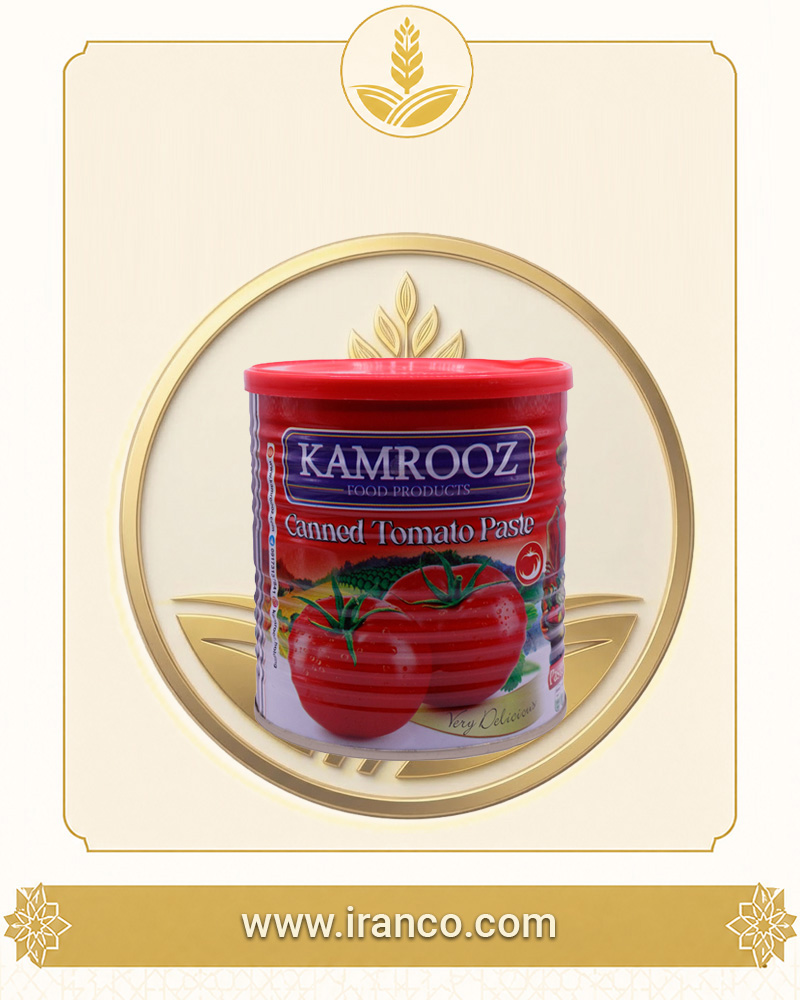
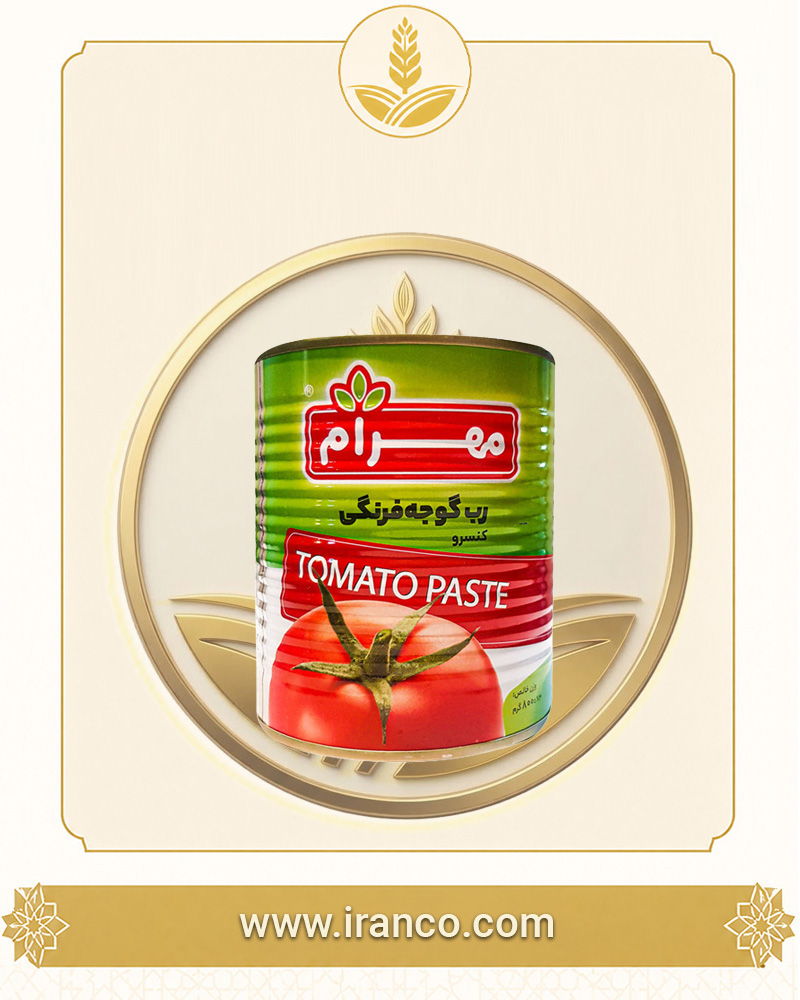
Metal cans are widely used in retail and food service. Weights of about 400 and 800 grams are common in the consumer market, and multi-kilogram packages are used for restaurants and industrial kitchens.
The following points should be considered in can control:
- Seam quality and sealing
- Internal coating resistance against acidic product
- Absence of severe indentation in the seam area
- No rust
- Actual net weight
- Print and label safety
- Proper arrangement inside the mother carton
Damage to the can during the export process can reduce the saleability of the shipment even without damage to the product. For this reason, the quality of the mother carton and the way of palletizing are very important in road export.
glass
Glass is suitable for parts of the retail market where the appearance of the product is more important, but the high weight and risk of breakage increase the cost of transportation and logistics control. The color of the paste can also be seen directly in the glass, and the uniformity of the color becomes more important.
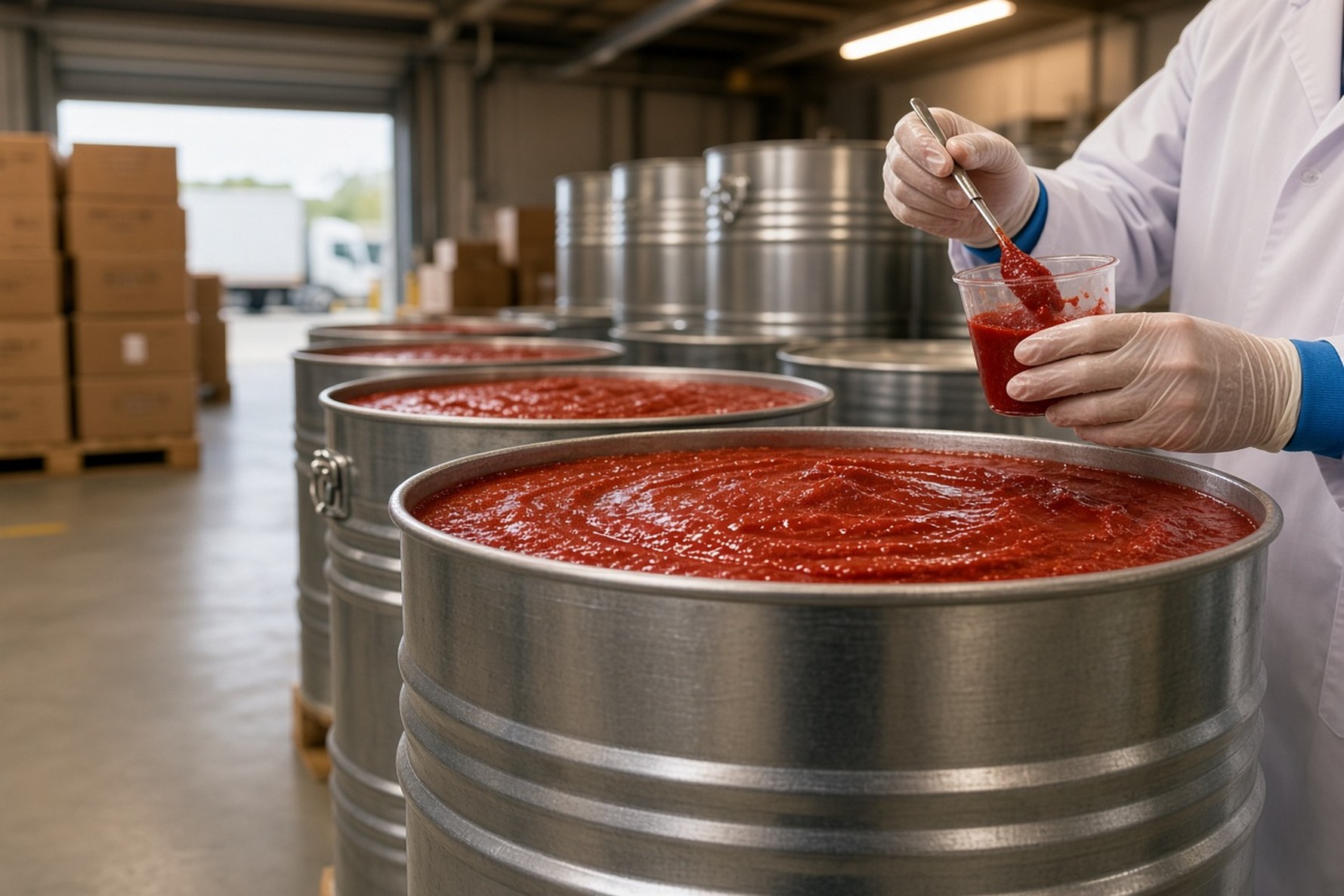
Aseptic bag in drum
For industrial trade, one of the most important formats is the multilayer aseptic bag inside the metal drum. The nominal capacity of the drums is usually in the range of 200 to 220 liters and the net weight of the product can be around 220 to 240 kg based on Brix, density and filling method.
The advantages of this package are:
- Reducing product contact with the environment
- The possibility of storage without a cold chain in a closed state
- Suitability for container shipping
- Reducing the cost of packaging per kilo of product
- Suitability for industrial lines and mechanized unloading
In an aseptic order, only the term "220 liter drum" is not enough. Guaranteed net weight, drum material, bag specifications, number of layers, sealing method, production date and pallet condition must be recorded in the order.
| packaging | The main customer | Advantage | control point |
|---|---|---|---|
| small can | retail | Ready for consumption and distribution | Seam, label, weight |
| A multi-kilogram can | Restaurant and food service | Major consumption | can resistance |
| glass | Retail market | Direct display of the product | Refraction and light |
| Aseptic in the drum | Food industry factory | Lower cost and high volume | Bag health and sterilization |
| Large industrial package | High consumption factories | Reducing the cost of internal transportation | Compatibility with evacuation equipment |
9. Transportation, storage and shelf life of export paste
Unlike fresh fruit, tomato paste does not generally depend on refrigerated containers. A properly canned or aseptic product can be shipped unopened at room temperature, but extreme heat, direct sunlight, and high humidity are not ideal for packaging.
For aseptic drums, the warehouse should be dry, clean, well ventilated and away from direct radiation. Prolonged contact of the drum with the wet surface increases metal corrosion. Mechanical damage to the rim or drum can also transfer pressure to the inner bag.
Shipping to Iraq and Afghanistan
Ground transportation is the main advantage of Iran in these two markets. In these routes, truck quality, load bracing, carton condition and pallet selection are very important. Retail packages must be resistant to continuous track vibration.
Shipping to Russia and the Caucasus
Land transportation and combined land-sea routes can be used for these markets. In the industrial order, the high weight of the paste makes the permissible weight limit of the vehicle and container very important in the load design.
Shipping to UAE and Oman
Sea export from the southern ports of Iran is a more logical route for container cargoes. In these markets, the time the container stays at the port, the ambient heat and the protection of the can or drum against moisture and sea salt should be considered.
The shelf life of the product should not be included in the contract as a general number. Production process, brix, packaging and storage conditions are decisive. Industrial aseptic paste and canned paste are usually designed for long storage periods, and many commercial products are available with a shelf life of about 18 to 24 months; The guaranteed shelf life must be exactly as specified by the manufacturer and the final label.
10. How should the price of export paste be compared?
The price of tomato paste depends on the price of industrial tomatoes, the amount of solid matter, the season of production and the conditions of the export market more than any other factor. A price comparison without technical specifications almost always produces an incorrect result.
The most important price factors are:
| agent | Effect on price |
|---|---|
| brix | Increasing the concentration changes the amount of tomato consumed and processing energy |
| Tomato quality | It affects the color, aroma and final quality |
| Processing method | Changes viscosity and application characteristics |
| packaging | Aseptic, can and glass have different cost structures |
| order weight | It affects the cost of production and logistics |
| Dedicated tests | It increases the cost of testing and control |
| Exclusive brand | Changes printing, format, label and minimum production |
| destination | Shipping costs, documentation and market requirements change |
| time of purchase | It depends on the production season and factory inventory |
For industrial purchase, it is better to check the price per "usable solid material" as well. Suppose two offers are close in terms of price per ton, but one is 28 to 30 brix and the other is 36 to 38 brix. The second product carries less water and provides more solids per ton to the plant. On the other hand, if the final formulation requires a high-viscosity thermal break product, simply purchasing a thicker concentrate does not provide a technical advantage.
The actual purchase cost is equal to the price of the product plus packaging, shipping, testing, possible damage, rejects, reprocessing costs and risk of non-conformance. A cheaper offer is really cheaper when the specifications are equal.
11. Iran against rival suppliers of tomato paste
The global tomato concentrate market is competitive, with China, Italy, Spain, Portugal, the United States, Türkiye, and several other producers playing an important role in the business. Iran must compete with each of these different sources based on the target market.
| country or region | Business advantage | A competitive point for Iran |
|---|---|---|
| china | Mass production and industrial concentrate | Less distance from Iran to the Middle East and some Eurasian markets |
| Türkiye | Strong processing industry and regional access | Direct competition in Iraq, Caucasus and Central Asia |
| Italy | Developed industry and strong presence in branded products | Iran competes mostly in the raw material and regional market |
| Spain and Portugal | Industrial production and direct access to Europe | Iran's main market is mostly the East and the Middle East |
| United States | Standardized industrial production | Iran's geographic distance creates a logistical advantage for nearby markets |
| Iran | Access to several land markets and diverse production capacity | The need for greater stability of specifications and the development of long-term industrial contracts |
Iran's real advantage in the market of Iraq or Afghanistan is not the same as its advantage in Europe. In Iraq, distance and flexibility of packaging creates value. In Russia, regulatory compliance and technical stability are more important. In more distant industrial markets, competition comes down to price per unit of solids, color, viscosity, and shipping cost.
Importer's checklist before placing an order
Before finalizing the purchase of export tomato paste, these items must be written:
1. Determine the exact Brix of the product and acceptable tolerance.
2. Determine hot breaking or cold breaking.
3. The presence or absence of salt and its amount should be recorded.
4. Determine the method and conditions of Bostwick measurement.
5. The range of pH and acidity should be agreed.
6. The color criteria of the product should be numerical.
7. Determine the required microbial tests.
8. Determine the requirements of the remaining toxins and metals of the destination market.
9. Confirmed sample received before production or loading.
10. The net weight of each package or drum should be recorded in the contract.
11. Verify the specifications of the aseptic bag or can.
12. Request an analysis sheet for each batch.
13. Batch number and traceability should be included on the package.
14. Visual inspection of packaging before loading.
15. The criteria for accepting and rejecting the shipment should be written in the contract.
16. Specify the exact country, city or port of delivery.
17. Delivery conditions and responsibility for shipping should be clear.
18. The final version of the label must be approved before mass printing.
What information should be sent to receive an accurate price?
The request for a professional price of tomato paste should include at least the following information:
- Brix required
- Heat breaking or cold breaking
- Final use of the product
- pH range
- Viscosity profile or Bostwick
- Salted or unsalted
- Required color index
- Consumer or industrial packaging
- Net weight of each package
- Total order amount
- The need for a proprietary brand
- Required tests
- destination country
- Delivery city or port
- Desired delivery conditions
The phrase "the price of a container of export paste" is not enough to get a comparable offer. A 36-38 brix aseptic paste container and an 800g can container are completely different deals in terms of product, packaging cost, net weight and end customer.
Buyers can register the same specifications in Iranco's purchase request to check supply options based on technical needs and the destination market.
The way to supply tomato paste from Iranian producers
In the export purchase of paste, the selection of the supplier should be done after determining the product specifications, not before. First, it should be clarified whether the product is for direct sale or factory consumption. Then Brix, processing method, viscosity, color, salt, packaging and necessary tests are determined.
The next step is to receive the sample and specification sheet. For the industrial product, the sample should be evaluated under conditions that are close to the actual consumption of the factory. For example, if the buyer is a producer of ketchup, the behavior of the paste after dilution and entering the formulation is much more important than the appearance of the thick paste inside the container.
After the approval of the sample, the technical specifications should be attached to the contract. Downloading should also be controlled based on the same version. In aseptic shipment, besides the paste itself, the health of the drum and bag is important; In retail shipment, control of cans, printing, weight, mother carton and pallet is necessary.
Iranco allows buyers and importers to register a purchase request with details such as Brix, usage, order quantity, packaging and destination country so that available supply options in Iran can be reviewed on the same basis. The more detailed the purchase request, the more realistic the comparison of offers will be.
summary
The export of Iranian tomato paste creates the most commercial value when the product is defined based on the application and destination market. For an industrial buyer, the term "high Brix paste" is not a sufficient criterion. Brix, heat breaking or cold breaking, Bostwick consistency, pH, color, salt, microbial quality and packaging should be checked together.
Geographically, Iran has access to large markets such as Iraq, Afghanistan, the Caucasus, Russia, and the Persian Gulf countries, and in recent years, most of its exports have gone to the Middle East and Eurasia. This advantage is maintained when the manufacturer can repeat the quality from one batch to the next and provide reliable technical documentation.
In the industrial product, aseptic drum is one of the most important export formats, and Brix 28 to 30, 30 to 32, and 36 to 38 each have a different market and application. A Brix of 36 to 38 is attractive for reducing carry-over water and reprocessing, while a heat-breaking paste of 28 to 30 can be more valuable for the production of thick sauces.
In the retail product, in addition to the quality of the paste, the health of the can, inner coating, net weight, label, mother carton and the requirements of the destination country are decisive.
Therefore, the correct selection of export paste should start from the consumption formula, destination market and technical specifications. An importer who puts these criteria in writing before asking for a price will more accurately compare supplier offers, reduce quality variance, and have more control over the final outcome of the deal.