 Iranco 杂志团队
678亿英镑市场、6%增长、14种过敏原、黄曲霉毒素限值8/10 µg/kg、GB与NI差异、IPAFFS、开心果、藏红花、标签、质控、包装、运输及20步进口商清单
市场报告 · 出口 · 英国 · 食品标准
伊朗食品出口英国:机遇与标准
From product choice and market structure to aflatoxin control, labelling, import requirements, packaging, shipping and commercial risk management in the British market — a practical guide for exporters and professional importers.
分析性引言
Exporting Iranian food to the UK cannot be driven by “good product, competitive price and one foreign buyer” alone. Britain’s market is large, diverse and import-dependent, but it enforces precise rules on food safety, traceability, contaminants, consumer information and importer responsibility. A product sold regionally on a health certificate and invoice may need extra testing, relabelling, pre-notification, designated border entry or additional documents for the UK.
Iran’s opportunity lies mainly in lines with distinct Iranian identity and value (saffron, pistachios), supply strength (dates, raisins, dried fruit) or industrial use (bulk nuts, saffron, raisins for confectionery, ice cream, bakery, ready meals and food manufacturing). Products are not regulated equally — Iranian pistachios illustrate strict aflatoxin control in Great Britain.
In 2025 the UK imported about £67.8 billion of food, animal feed and drink — roughly 6% higher in current prices than 2024. Fresh fruit and vegetables totalled about £8.2 billion; coffee, tea, cocoa, spices and related groups about £7.6 billion. The market is deep, but Iranian presence must grow product-by-product and channel-by-channel.
1. 英国食品市场为伊朗带来哪些机会?
Britain relies heavily on international trade for a large share of its food basket. The gap between market size and narrower Iranian presence means export development must be product-led, not based on a vague “general market for Iranian food”.
At least three commercial channels matter: ethnic and specialist retail (Iranian and Middle Eastern shops and wholesalers — saffron, raisins, dates, pomegranate paste, pickles, dried herbs); premium non-ethnic (premium pistachios, packed saffron, origin-story dried fruit — fine food stores and e-commerce); and industrial and foodservice (kernels, pistachio paste, bulk saffron, raisins for factories and restaurants).
Channel choice should precede packaging design: a 1 kg foodservice pack, a 200 g specialist retail unit and a factory bulk carton are three different commercial offers.
Ethnic-channel buyers often prioritise familiar taste and brand; premium buyers weigh packaging, batch traceability and consistency alongside price; industrial buyers focus on technical specs, regular delivery and warehouse landed cost.
2. 哪些伊朗食品在英国出口潜力更大?
Real opportunity appears when Iranian product advantage aligns with import demand, chain margin and regulatory feasibility. Cheaper is not automatically better for export.
| Product | Suitable channel | Iran advantage | Main barrier |
|---|---|---|---|
| Pistachios & derivatives | Wholesale, bakery, ice cream, premium | Range, export track record, industrial use | Aflatoxin & border control |
| Saffron | Premium retail, restaurants, industry | High value per kg | Authenticity, residues, consistency |
| Dates | Retail, wholesale, bakery | Variety and packing options | Competition and uniformity |
| Raisins & dried fruit | Bakery, confectionery, wholesale | Industrial and consumer supply | Residues, moisture, appearance |
| Fruit pastes & sauces | Specialist stores, foodservice | Persian cuisine differentiation | Flavour, recipe, labelling |
| Spices & dried herbs | Specialist, restaurants, industry | Ingredient range | Microbiology, residues, authenticity |
| Traditional confectionery | Ethnic retail | Cultural differentiation | Allergens, recipe, shelf life |
Pistachios — large opportunity, high compliance cost
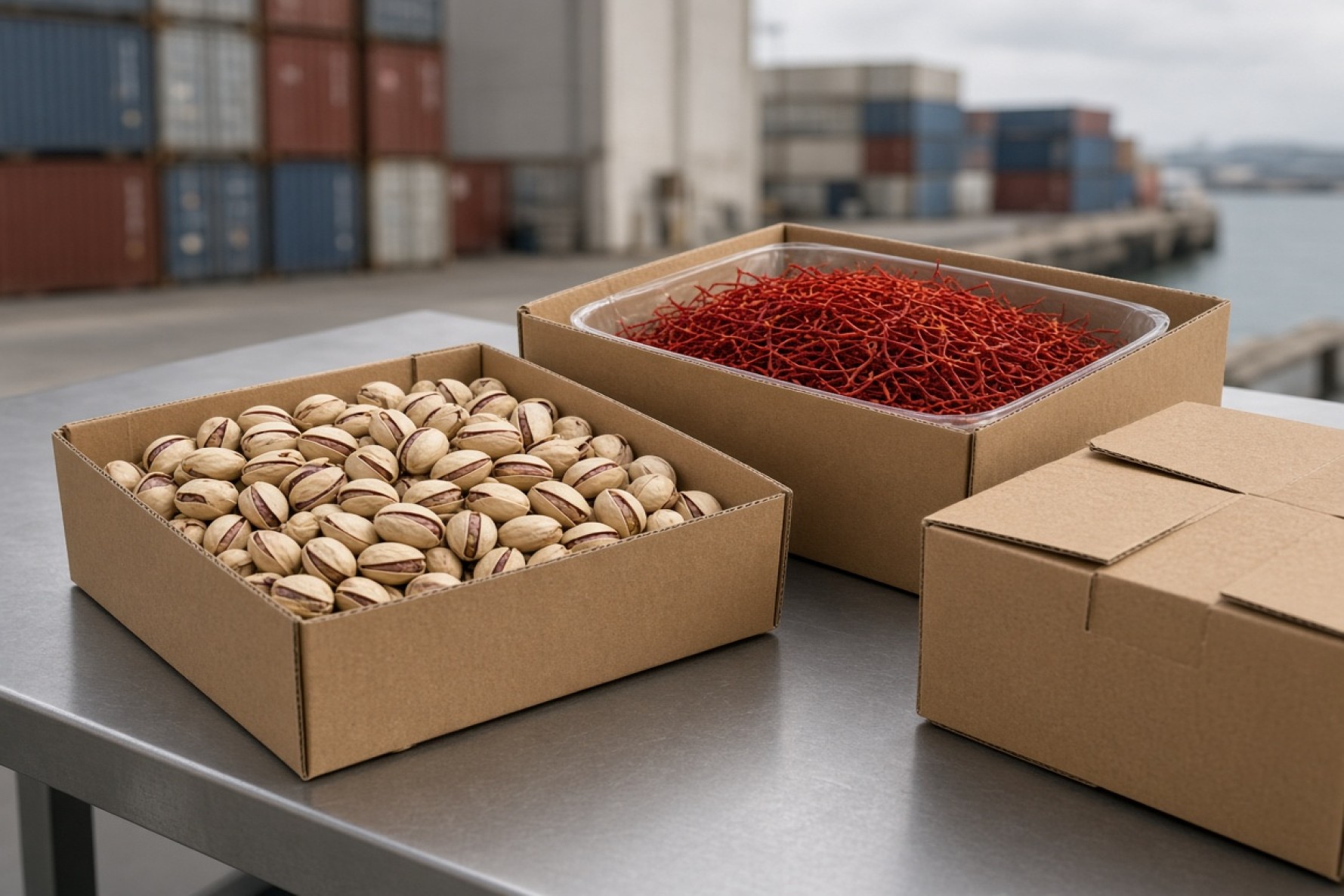
Pistachios can be sold in shell, shelled, as paste, powder or food ingredients. Aflatoxin control from orchard and drying through storage, sorting, testing and loading must be part of the sales system. Main codes: CN 08025100 (in shell) and 08025200 (shelled).
Saffron, dates, raisins and processed lines
Saffron’s value per shipping kg reduces freight pressure on UK pricing; buyers focus on authenticity, moisture, colour strength, aroma and residues. Dates and raisins need measurable grade, moisture and uniformity more than origin alone. Pastes, pickles, sauces and shelf-stable foods suit specialist channels; complex formulas increase scrutiny of additives, allergens and nutrition panels.
3. 大不列颠与北爱尔兰并非同一监管市场
A common mistake is treating “England’s rules” as applying to the whole United Kingdom. Distinguish Great Britain (England, Scotland, Wales) from Northern Ireland. Much GB food law derives from EU rules retained after Brexit; in NI EU rules still apply directly in many areas.
Final destination must be fixed before shipment preparation: England, Scotland, Wales or Northern Ireland. A label or document accepted in London is not automatically valid for Belfast without review.
Compliance is not only the foreign producer’s duty — the importer and UK food business operator placing product on the market is responsible. Professional buyers review specifications, full ingredient lists, lab reports, label artwork, producer data and samples before final order — that is import risk assessment, not an “extra request”.
4. How is each product’s regulatory path determined?
Initial classification decides the route: standard or high-risk non-animal food; fresh produce under plant health; animal-origin products; composite foods; or organic claims. That choice changes the entire import path.
| Group | Example | Control focus |
|---|---|---|
| Standard non-animal food | Sauces, pickles, processed plant foods | Safety, composition, additives, labelling |
| High-risk non-animal food | Iranian pistachios | BCP, testing, extra formalities |
| Fresh produce | Some fruit and vegetables | Plant health and certificates |
| Animal origin | Dairy, meat, honey | Market access, approved establishments, BCP |
| Composite | Processed plant + animal mix | Recipe and group-specific rules |
| Organic | Organic claim | Organic certificate and control body |
Animal products: many imports require market access for the exporting country for that exact product and, where applicable, listing of the production site. An Iranian domestic licence alone does not guarantee UK export of meat or dairy.
IPAFFS
Importers must use IPAFFS before arrival for high-risk non-animal food, animal products, some composite foods and medium/high-risk plants. Shipment documents must reach the importer before goods move; late or incomplete data causes pre-notification or border delays.
5. 伊朗开心果 — 英国标准的最清晰案例
Iranian pistachios face intensified GB controls for aflatoxin risk. Official lists cover in-shell and shelled pistachios, mixed nuts containing pistachios, paste, processed pistachios and flour/powder of Iranian origin. Rules can extend to composite foods with more than 20% listed high-risk material — pistachio confectionery, sweets and creams do not automatically escape origin rules through processing.
For pistachios sold for direct human consumption in England and Wales, maximum aflatoxin B1 is 8 µg/kg and total aflatoxins 10 µg/kg. Professional buyers expect control from harvest and drying through storage: segregation of damaged nuts, moisture control, representative sampling, competent laboratories and batch numbers tied to the physical shipment.
| Parameter | Define in contract | Why it matters |
|---|---|---|
| Product form | In shell, kernel, slivers, powder, paste | Regulatory path and use |
| Size & open shell | Agreed sizing method | Commercial value |
| Closed shell & damage | Contractual limits | Quality and appearance |
| Moisture | Agreed level | Storage stability |
| Aflatoxin | Results aligned with destination | Safety requirement |
| Foreign matter | Acceptable limit | Cleanliness |
| Pack type | Bulk or consumer | Quality retention |
6. 英国市场食品标签
Export labels are not simple translations of Persian artwork. Prepacked foods generally need food name, date marking, warnings, net quantity, ingredients in descending weight order, origin where required, batch code, storage conditions, instructions where needed, and business name/address of the responsible operator or importer.
14 major allergen groups must be emphasised in the ingredient list — including tree nuts (pistachio, almond, walnut), peanuts, sesame, milk, eggs, gluten cereals, soy, mustard and sulphites where applicable. Critical for gaz, sohan, sweets and mixed nuts.
If an ingredient is emphasised in the name or image, percentage declaration rules may apply — a “pistachio biscuit” cannot assume pistachio presence alone satisfies quantitative ingredient rules.
Nutrition information is mandatory for most consumer packs. In England and Wales mandatory information must be in English; Persian may appear alongside if mandatory details remain clear. Origin labelling is mandatory for some groups and required elsewhere if omission would mislead consumers.
7. 伊朗食品出口的重要检测
| Group | Important tests |
|---|---|
| Pistachios & nuts | Aflatoxin, moisture, microbiology where relevant |
| Saffron | Authenticity, moisture, quality indices, residues |
| Raisins & dried fruit | Moisture, pesticides, sulphites, microbiology |
| Spices | Salmonella, residues, mycotoxins as applicable |
| Pastes & sauces | pH, solids, microbiology, additives |
| Confectionery | Allergens, microbiology, nutrition, shelf life |
Imported food must meet UK pesticide maximum residue levels. Pesticide approval in Iran does not imply UK acceptance — orchard spray records must be traceable. Authenticity testing matters for saffron, spices, honey and high-value oils.
8. 包装 — 从保护到零售准入
Successful UK packaging must protect safety and quality, survive international transport, carry legal information and fit the sales channel. For nuts: moisture and oxygen barriers; vacuum or modified atmosphere only with validated shelf life. Good packaging does not remove existing aflatoxin.
Saffron needs light, moisture and tamper protection. Pastes and sauces need seal integrity and food-contact materials. Industrial buyers need net weight, units per case, dimensions, pallet pattern, barcodes, private label, label language, batch and date coding defined before production.
9. 从伊朗到英国的食品运输
| Mode | Best for | Advantage | Limitation |
|---|---|---|---|
| Air | Saffron, samples, small high-value lots | Speed | Higher cost |
| Sea | Nuts, cans, pastes, shelf-stable | Economical volume | Lead time and inventory planning |
| Refrigerated | Temperature-sensitive lines | Cold chain | Cost and technical control |
| Multimodal | Specific trade lanes | Flexibility | Handover coordination risk |
In dry containers, day–night temperature swings can cause condensation on walls and cartons — check cleanliness, dry floors, door seals, cargo spacing, pallet quality and load securing before stuffing. For saffron, insurance and cargo security matter. Fresh produce needs remaining commercial life and plant-health rules assessed before export.
10. 关税、到岸成本与制裁
Landed cost includes product price, export packing, testing, certificates, inland Iran haulage, port/airport, international freight, insurance, customs broker, import duty, border control, sampling, UK inland haulage, warehousing, label correction and finance. The UK has no general preferential trade agreement tariff with Iran — rates depend on the precise commodity code and import date.
Do not guess HS/CN codes from marketing names: sweet pistachio cream, pistachio biscuits or “Iranian ready meal” may classify differently. Sanctions: food trade is not a blanket ban, but importers must screen parties, banks, ownership and transport/insurance services; payment routes should be clear before production starts.
下单前20项进口商核对清单
- Exact product definition: processing form, composition and intended use
- Quality grade: size, colour, moisture, defect percentages
- Representative sample matching expected shipment quality
- Versioned specification sheet referenced in the contract
- Test programme aligned with product and UK risk
- Allergen and cross-contamination review
- Pesticide programme and residue testing for UK limits
- Additives checked against UK rules
- English label artwork approved before bulk print
- Net weight, outer cartons and pallet pattern
- Rejection criteria and defect tolerances
- Verified repeatable supply capacity
- Minimum remaining shelf life on arrival
- Import route and BCP requirement
- IPAFFS responsibility and document timing
- Market access for animal/composite products
- Sanctions screening of parties and services
- Incoterms and risk/cost transfer point
- Pre-shipment sampling linked to tested batch
- Document retention matched to batch codes
RFQ fields for accurate pricing
- Exact product name, processing form, grade, size, specs and defect limits
- Required tests, pack weight, bulk vs consumer, total order weight/count
- Outer carton, pallet needs, brand, label language, destination city/port
- Preferred shipping mode, Incoterms, pre-order sample, delivery timing
- Pistachios: in shell/shelled, sizing, open shell, aflatoxin, pack — Saffron: form, grade, QC, pack weight — Pastes/sauces: recipe, Brix/solids, container
Sourcing Iranian food for the UK market
International food buying is not only price per kg — one quote may include valid testing, export-grade packing, private label and batch stability while another shows only a lower unit price. Sound sourcing starts with defined specifications, then samples and documents, then pre-shipment controls.
Iranco can receive structured purchase requests and match them to Iranian supply options. The more numeric the brief — especially for pistachios, saffron, dates and industrial inputs — the more meaningful supplier comparison becomes.
总结
Iranian food export to the UK has commercial room, but the market punishes vague specifications. Pistachios, saffron, dates, raisins, spices and shelf-stable Persian lines can work in specialist, foodservice or industrial channels when designed for that channel.
Choose products with repeatable quality control, documents ready before shipment and importers who can prove compliance. Pistachios exemplify the logic: aflatoxin risk and BCP make sampling part of the business model. GB vs NI differences and correct classification of animal, composite, high-risk and organic goods are essential before dispatch.
常见问题
Is exporting food from Iran to the UK possible?
Yes — many foods can enter when product-specific rules are met. The path depends on animal or plant origin, processing, risk level and final destination. Iranian pistachios face special controls; some animal products need market access.
Which Iranian foods suit the UK best?
Pistachios, saffron, dates, raisins, spices, pomegranate paste and traditional shelf-stable lines for specialist, industrial or ethnic channels. Fit depends on quality stability, documents, packaging, allergens and entry cost — not price alone.
Do Iranian pistachios need aflatoxin testing for the UK?
Iranian pistachios and several processed forms are on intensified aflatoxin control lists. For direct consumption in England and Wales, B1 limit is 8 µg/kg and total 10 µg/kg. Agree sampling and batch linkage before ordering.
Is a Persian-only label enough for UK retail?
No. Mandatory information must meet destination rules and, in practice for England and Wales, be in English. Persian may appear alongside if mandatory details stay clear.
Must all Iranian products enter through a BCP?
No — it depends on product group and risk. High-risk non-animal foods, many animal products and some other lines need border control. Iranian pistachios are intensified; check the exact code and origin.
What information is needed for pricing from Iran?
Exact name, grade, volume, pack weight, cartons, tests, brand, destination and Incoterms. On Iranco, enter the same fields in a purchase request for like-for-like supplier review.
Do organic Iranian products have separate UK rules?
Yes. Organic claims require certificate and control-body rules for imports from outside the EU/EEA/Switzerland into GB — inspection certificates per shipment framework.
Do UK sanctions ban all Iranian food imports?
No — not a blanket food ban. Importers must screen parties, banks, ownership and related services; payment, haulage and insurance must be feasible before production.
What is the best way to ship saffron from Iran to the UK?
Air freight is often commercially sensible for small or medium high-value lots given low weight; confirm volume, insurance, speed and inventory plans. Packaging must protect against moisture, light and tampering.















