 Iranco 杂志团队
目标市场分析、技术规格、卫生与标准、包装、物流与竞争策略
Export Guide · Regional Markets
Practical Strategies to Grow Iran's Food Exports to Neighbouring Countries
From market selection and product adaptation to standards, packaging, cold chain, distribution channels and repeatable export contracts.
Neighbouring countries absorb a large share of Iran's food and agricultural exports, but sustainable growth requires more than geographic proximity. This guide covers practical steps for market choice, export product design, quality control, regulatory alignment, packaging, logistics, pricing and turning one-off sales into recurring trade relationships.
Analytical Introduction
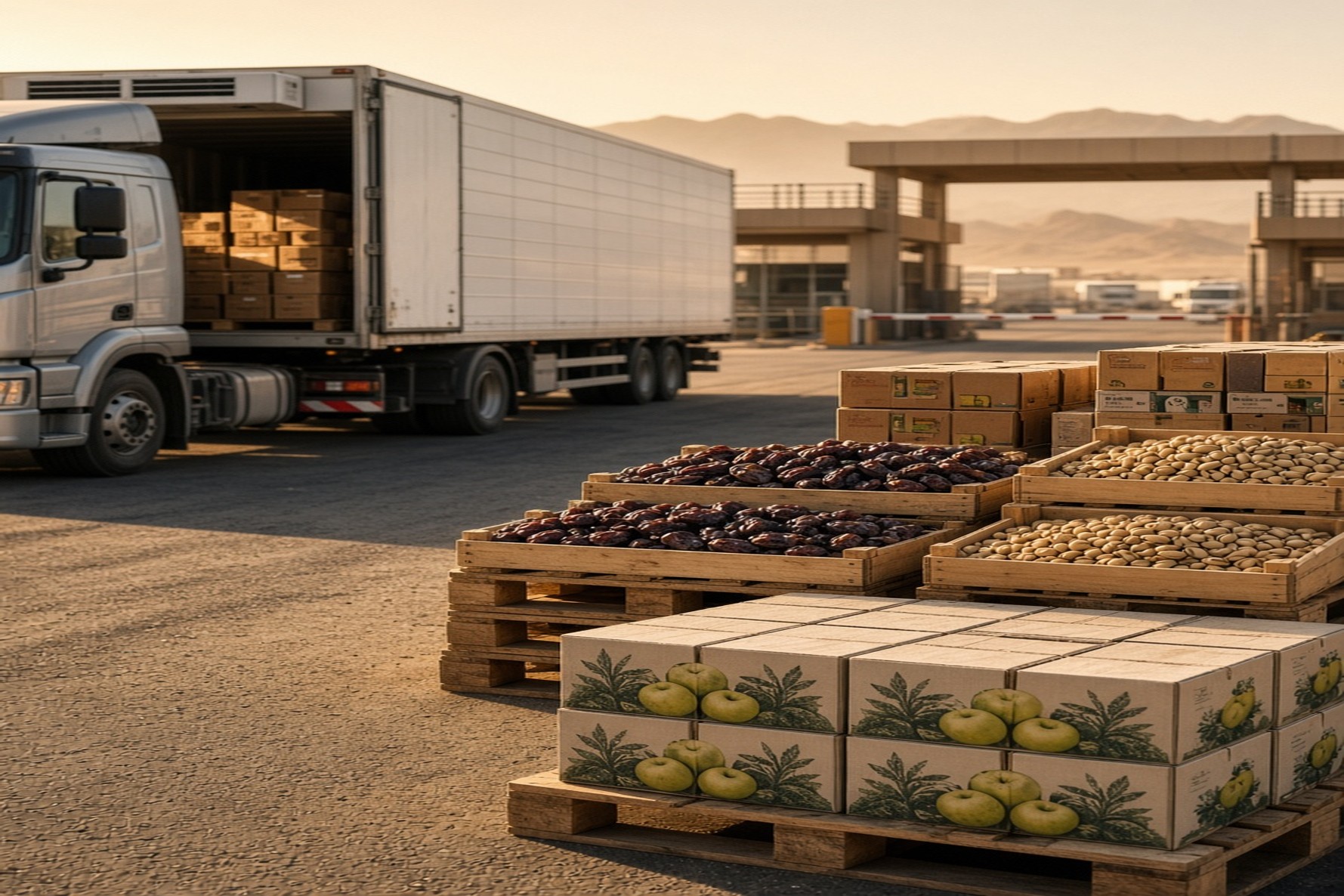
Iran's advantage in food exports to neighbouring countries is not distance alone. Climate diversity, broad fruit and vegetable production, dairy, nuts, dates, saffron, confectionery and chocolate, grain-based products, tomato paste and a large portfolio of raw and processed goods allow Iran to meet regional food demand with shorter transit times than many distant competitors.
Statistics underline the role of neighbours. In the year to March 2024 more than 8.8 million tonnes of livestock, fishery, agricultural, greenhouse, dairy and food products were exported at over $6 billion in value, and about 80% of that value went to 15 neighbouring countries. Iraq, the UAE, Russia, Pakistan and Afghanistan were the top five destinations in that period.
These figures also reveal a structural weakness: much trade still follows short-term opportunities, price gaps, temporary shortages in the destination country and broker-led orders. Such exports can create volume but do not necessarily build a durable Iranian brand or producer presence on foreign shelves.
Real export growth happens when the exporter analyses markets by product, knows the buyer's technical requirements, designs the item for the sales channel, completes entry documents before final production and turns reliable delivery into a competitive advantage.
Effective strategy for neighbouring markets must shift from "What can we sell?" to "What exact product, packaging, price, documents and delivery schedule does this buyer want?"
Customs data show Iran's agricultural exports reached about $5.2 billion and 7.6 million tonnes in the year to 20 March 2025, with value up 29%. Pistachios, tomatoes and dates were among leading items. The Iran–EAEU free trade agreement took effect on 15 May 2025, liberalising tariffs on nearly 90% of tariff lines covering over 95% of bilateral trade.
1. Neighbouring Markets Are Not One Market
A common mistake is using one product, one pack and one sales method for every country around Iran. Short distance does not mean similar market structure.
Iraq is not the UAE. Russia is not Afghanistan. Kazakhstan and Armenia sit under the EAEU framework, while Gulf Arab states follow another set of labelling, registration, quality and distribution rules. Even within one country, a chain retailer, a traditional wholesaler and a food-service buyer need different pack weights, design, shelf life, price points and commercial terms.
| Market / cluster | Main advantage for Iran | Commercial priorities | Main challenge |
|---|---|---|---|
| Iraq | Short land routes, familiarity with Iranian goods | Dairy, processed foods, fruit & veg, confectionery | Price competition, QC, strong distributor |
| Afghanistan | Land access, repeat supply | Packaged staples, daily foods, inputs | Price sensitivity, inland freight |
| UAE | Import hub, modern distribution | Nuts, saffron, dates, fruit, niche brands | High standards, global competition |
| Oman & Qatar | Food import dependence | Quality fresh, processed, retail packs | Importer selection, supply stability |
| Russia | Large market, Caspian & land routes | Fruit, veg, nuts, tariff-favoured foods | EAEU technical rules, label language |
| Armenia & Kazakhstan | EAEU trade framework | Processed foods, nuts, fruit | Market scale, channel choice |
| Pakistan | Land border, large population | Complementary goods, border trade | Price competition, logistics limits |
| Turkey | Large market | Differentiated nuts, inputs | Strong domestic food industry |
| Turkmenistan & Central Asia | Land & rail corridors | Shelf-stable foods | Transit formalities, capacity |
The goal is not to pick a single "best country" but the best product–market–channel combination. Economy confectionery may fit Iraq and Afghanistan; the same SKU without formula, design and consumer price adjustment may fail in UAE retail. Traceable packed saffron or nuts can offer more upside in Gulf markets.
2. Export Growth Starts with the Right Product
Successful export does not mean shipping everything the factory makes. Many SKUs are designed for the domestic market and should not enter abroad unchanged in formula, pack size, shelf life or label.
Before market entry, define the end buyer:
- Household retail consumer
- Wholesaler
- Restaurant and hotel
- Confectionery and bakery
- Food manufacturer
- Modern retail chain
- Economy distributor
- Premium specialty store
Industrial tomato paste is not the same pack as household paste. Dates for confectionery differ from premium retail dates. In-shell pistachios for snacking differ commercially from industrial kernels.
| Group | Examples | Advantage | Suitable strategy |
|---|---|---|---|
| Fresh & perishable | Fruit, veg, some dairy | Proximity | Speed, pre-cooling, cold chain |
| Medium / long shelf life | Dates, nuts, sweets, biscuits, cans | Easier inventory | Regional distribution, periodic contracts |
| Food industry inputs | Paste, concentrate, puree, industrial nuts, saffron | Larger, repeat industrial orders | Tight specs, supply contracts |
Moving gradually from bulk raw sales toward processing matched to the market raises export value. Bulk remains valid for industrial buyers; the exporter should choose consciously where to sit on the value chain. In the year to March 2025 pistachio exports were about $1.5 billion, tomatoes about $233 million and dates about $205 million — high unit-value and high-volume perishables need different operating models.
3. Sell Specifications, Not Generic Product Names
Professional buyers do not order "export dates", "grade-one pistachios" or "quality paste". Measurable attributes must appear in the purchase request, proforma, specification sheet and contract to avoid sample–shipment disputes.
| Parameter | Example | Why it matters |
|---|---|---|
| Exact product name | Form and use | Avoids order misinterpretation |
| Grade | Commercial, industrial, agreed spec | Sets quality and price |
| Size | Weight, diameter, count per kg | Lot uniformity |
| Moisture | Product-specific | Shelf life & spoilage |
| Solids (Brix) | Where applicable | Input quality control |
| Visual defects | % or limit | Accept/reject criteria |
| Composition | Fat, protein, salt, sugar | Formula alignment |
| Microbiology | Market-appropriate tests | Food safety |
| Contaminants | Aflatoxin, heavy metals, residues | Legal compliance |
| Net weight | Unit and carton | Commercial control |
| Shelf life | Duration & storage | Distribution planning |
| Packaging | Material, count, master carton | Logistics & retail |
| Labelling | Language & legal data | Customs clearance |
| Delivery terms | Agreed Incoterms | Cost & risk split |
Price comparison becomes meaningful only on identical specs. Buyers seeking Iranian food supply can register requests on Iranco with product, packaging, quantity and destination so suppliers are compared on one specification set.
4. Real Advantage: Compliance Before Loading
Producing and packing first, then asking about entry rules, is one of the costliest export mistakes. Professional sequence: entry requirements first, then product design and production.
Iraq
Iraq's Central Organisation for Standardisation and Quality Control sets and enforces standards for imported goods. General marking rules updated in 2023 require Arabic or bilingual Arabic–English labels. Domestic-market packs must not enter the Iraq export line without label review.
UAE
Food label information must be clear and accurate; Arabic language and country-of-origin rules are embedded in UAE food regulations. Weak packs or incomplete data face low tolerance in a market with international brands and modern retail.
Gulf Arab states
In Saudi Arabia food importers register on the relevant authority platform and products are registered before entry. Certificates of origin, health, halal or slaughter may apply by product. GSO 9 is a key base for packaged food labelling; Arabic on the label is mandatory in many cases. Even if Saudi Arabia is not your direct market, GCC structures often share regional standards — national registration still differs by country.
Russia, Armenia, Kazakhstan (EAEU)
EAEU technical regulations govern food safety, labelling, dairy, meat, fish, bottled water, additives and specialised groups. TR CU 022/2011 defines mandatory label fields — product name, quantity, dates, storage, manufacturer ID and transport unit data — with mandatory text in Russian and, where required, the member state's official language. Approve the export artwork before mass print.
5. Turn Trade Agreements into Selling Advantage
Tariff cuts matter only when sales teams know which SKUs qualify, origin rules are met and the benefit appears in the final price.
The Iran–EAEU free trade agreement entered force on 15 May 2025, covering preferential trade with Russia, Armenia, Kazakhstan, Belarus and Kyrgyzstan. Tariffs on nearly 90% of lines were eliminated, covering over 95% of bilateral trade volume.
- Exhibiting in Russia is not enough — verify HS code, preferential rate and proof-of-origin documents.
- Lower duty creates price room but does not replace standards, quality or distribution.
- Armenia and Kazakhstan belong in the portfolio, not Russia alone, when a regional compliance and label structure exists.
- Quota lines need separate volume checks; HS classification must be confirmed by a customs specialist before quoting.
6. Export Packaging Is Product Engineering
Packaging protects the product, carries legal information, eases logistics and creates value at the shelf — not merely a domestic pack plus a sticker.
Industrial packs focus on strength, handling, accurate net weight and quality protection (multi-wall bags, cartons, drums, aseptic, vacuum as appropriate).
Retail adds: destination language, affordable unit size, readable product name, nutrition panel, dates, storage, origin, importer details if required, barcode, traceability and print/durability in transit.
Smaller packs are not always less economic — in price-sensitive markets they lower the cash outlay per unit and ease listing. Food service and factories often prefer multi-kilo packs for lower pack cost per kilo.
| Channel | Pack type | Priority |
|---|---|---|
| Modern retail | Consumer unit | Design, label, uniformity |
| Wholesale | Carton / bulk | Price & strength |
| Food service | HORECA pack | Ease of use, unit economics |
| Factory | Industrial pack | Specs & cost per kg |
| Premium | Small, high presentation | Appearance, traceability |
| Border economy trade | Simple durable pack | Price & transit survival |
7. Logistics Must Match Product Life
Iran borders seven countries by land and connects to others by sea. Geographic proximity alone does not guarantee cheap freight — border queues, reloads, customs checks and weak cold chain can erase the distance advantage.
Iraq
Western crossings such as Shalamcheh, Chazabeh, Mehran, Khosravi, Parvizkhan and Bashmaq serve different destinations. Choose border by buyer city — Basra, Baghdad, Kurdistan or central Iraq — not only by factory proximity.
Afghanistan
Dogharoun–Islam Qala, Milak–Zaranj and Mahiroud are main land axes; perishables need aligned arrival time, border formalities and onward transport.
Pakistan
Mirjaveh–Taftan is a primary official route; Rimdan–Gabed supports southern border trade.
Turkmenistan & Central Asia
Sarakhs, Lotfabad and Incheh Borun link Iran to Turkmenistan and beyond; Turkmen customs confirmed active crossings including Sarakhs, Artik, Hudan and Altin Asr on the Iranian border in 2026.
Persian Gulf
Southern ports serve UAE, Oman, Qatar, Kuwait and other sea destinations; for short-life goods compare real door-to-door time, not sea freight alone.
Russia & Kazakhstan
North-west land corridors, rail, Caspian ports and multimodal routes reach EAEU buyers — choice depends on product, season, capacity, delivery point and cold-chain need.
8. Cold Chain Preserves or Destroys the Distance Advantage
For fresh and chilled goods, quality at loading is insufficient — the buyer judges at destination. Fruit harvested well but not pre-cooled, or trucks opened repeatedly at borders, may arrive soft, spoiled or with shortened shelf life.
A sound export cold chain links: harvest timing, fast packing centre transfer, pre-cooling where needed, ventilated humidity-appropriate packs, controlled storage, correct loading, in-transit temperature and delivery without breaks.
One temperature does not fit all foods — even fresh fruits differ in cold and humidity tolerance. Use a product-specific transport instruction covering target and acceptable range, stacking, ventilation, frost sensitivity and temperature logging. Data loggers help resolve disputes between exporter, carrier and buyer.
9. From Anonymous Brokers to Channel Management
Export growth does not end when one foreign buyer appears. Two buyers ordering one container can have very different value if one only resells to wholesalers while the other reaches hundreds of stores.
- Licensed importer or broker?
- Which cities does their network cover?
- Which competing brands do they carry?
- Wholesale only or reach to retail?
- Adequate warehouse for the product?
- Prior import experience in this food group?
- Inventory levels and reorder frequency?
- Promotion and listing plan?
- Does exclusivity match their volume?
Country exclusivity for a small buyer can cap exports; tie exclusivity to performance, geography, channel, minimum purchase and term. Iraq illustrates channel importance: in nine months to March 2026 Iraq took about 39% of Iran's agricultural exports and about 50% of food-industry exports — retaining share requires distribution power, stable quality, packaging and agile response, not volume alone.
10. Price from Destination Backward
Internal costing (production + margin + freight) helps planning but does not replace market price. The exporter must know the sellable price in the destination and work backward through the cost stack.
| Cost element | Effect on price |
|---|---|
| Ex-factory price | Calculation base |
| Export packaging | Material, print, order size |
| Testing & certificates | Product & destination driven |
| Domestic haul to border/port | Factory location |
| Export formalities | Commodity type |
| International freight | Mode & route |
| Insurance | Contract terms |
| Destination entry | Duty, inspection, clearance |
| Warehouse & distribution | Market structure |
| Importer margin | Services & power |
| Wholesale / retail margin | Channel |
| Discounts & returns | Especially in retail |
If the landed price exceeds what the market accepts, options are real cost reduction, pack/channel change or a different market segment — not sustained quality cuts. Define Incoterms precisely; misapplied terms can erase contract margin.
11. Consistent Quality Beats One Perfect Sample
A frequent problem is the approved sample differing from the commercial lot in size, colour, breakage, viscosity, moisture or pack quality. Professional buyers set lot acceptance criteria, not sample approval alone.
Pre-shipment checks may include appearance, sizing, net weight, moisture, Brix, pH, salt/sugar/fat, microbiology, aflatoxin, residues, heavy metals, pack integrity, batch code, dates, remaining shelf life, label match, pallet and carton condition — as relevant to the product.
Keep a reference sample; agree test methods and accepted laboratories.
Importer checklist before ordering
- Define exact product name and processing form.
- State use: retail, food service or industrial.
- Put grade and technical specs in writing.
- Set defect acceptance limits.
- Approve a pre-order sample.
- Fix tests required for the destination market.
- Approve final label artwork before print.
- Specify unit weight, units per carton and net weight.
- Define minimum remaining shelf life at delivery.
- Verify supplier capacity and lead time.
- Confirm transport mode and cold-chain need.
- Check export documents and certificates before loading.
- State Incoterms on the proforma.
- Fix payment method and timing before production.
- Define lot accept/reject in the contract.
- For repeat orders, define batch-to-batch stability controls.
- Agree handling of weight shortage, damage or non-conformance.
- For fresh goods, align delivery schedule and maximum transit time with the carrier.
12. Execution Steps for Sustainable Export Growth
- Product–market focus:Target "packaged cheese to Baghdad wholesalers" or "industrial pistachio kernel to Russian confectioners", not vague "Iraq market".
- Export SKU version:May differ in weight, formula, shelf life, carton, label language or units per pack.
- Reduce seasonal-only dependence:Develop processed, longer-life lines alongside fresh seasonal peaks.
- Sell to foreign food factories:Paste, concentrate, puree, industrial nuts and botanical inputs can yield repeat contracts when specs match the buyer formula.
- Export technical file:Specs, tests, pack photos, carton dimensions, pallet count, storage, shelf life and documents per SKU.
- Monitor competitors:Rivals change by product — regional date suppliers, pistachio structure, Turkish or local processed foods.
- Trial shipments:Small orders surface label, transport, pack size and consumer acceptance issues before large contracts.
- Repeat contracts:Reorder rate in 6–12 months matters more than customer count alone.
- Market diversification:Avoid over-dependence on one country or one buyer.
- Use data:Log volume, margin, claims, payment time, freight cost, reorder rate and waste per market.
What to send for a meaningful price quote
"What is the export price of Iranian food?" has no single answer without purchase specs. Include:
- Exact product and processing form, grade, size or appearance specs
- Required tests and quality limits
- Unit weight, pack type, units per carton, total quantity
- Private label yes/no, label language
- Destination country, city/port/border, transport mode, Incoterms
- Repeat order plan if any
On Iranco, buyers can submit purchase requests on this basis so suppliers are compared on identical requirements — especially when no single producer is pre-selected.
Summary
Growing Iran's food exports to neighbours depends more on process quality than on shipment count alone. Proximity is a starting advantage only when it becomes short delivery, competitive logistics, controlled cold chain and responsive order fulfilment.
Sustainable share requires product design for a defined customer and channel, measurable specifications, packaging aligned with regulations and consumer behaviour, and entry documents completed before final production. In Iraq the challenge is retaining share through distribution and consistent quality; in the UAE and competitive Gulf markets, presentation and importer choice weigh heavily; in Russia, Armenia and Kazakhstan, EAEU FTA benefits require correct HS codes, origin rules and technical compliance.
The strategic shift is from opportunistic selling to market management — measuring reorders, margin, delivery cost and distributor performance turns export from a periodic activity into a durable business model.
Frequently Asked Questions
Which neighbouring markets matter most for Iranian food?
It depends on the product, but Iraq, the UAE, Russia, Pakistan and Afghanistan have been leading destinations. Iraq is critical for many staples and fresh goods; the UAE is an import and re-export hub; Russia is important for agri and food under the EAEU framework.
What matters most for growing exports to Iraq?
After competitive pricing, stable quality and distributor choice dominate. Products must meet Iraqi marking and standards; commercial lots must match approved samples. Evaluate the buyer's reach in Baghdad, Basra, Kurdistan or other regions before granting agency.
Has the Iran–EAEU FTA made food export easier?
Since 15 May 2025 the agreement eliminated tariffs on a large share of lines, which can improve competitiveness, but benefits require correct classification, rules of origin and EAEU technical compliance.
Is a Persian label enough for Arab markets?
Often no. UAE rules require proper Arabic label information; Saudi Arabia and GCC markets rely heavily on GSO 9 for packaged foods. Final artwork must be checked against the destination country before printing.
How do I compare two Iranian suppliers on price?
Match grade, size, moisture or other specs, net weight, packaging, tests, delivery point and Incoterms. Otherwise price per kilo misleads because quality or service scope differs.
Which products are lower-risk to start exporting?
Risk is not product-only, but shelf-stable items usually face less time and cold-chain pressure than fresh produce. Nuts, dates, some confectionery, biscuits, canned goods and stable inputs are logistically simpler — each still has its own quality and market rules.
How can I source food directly from Iran?
Define product, specs, volume, packaging, destination and delivery terms; then review samples, datasheets and tests and set lot criteria in the contract. International buyers can send the same data via Iranco as a purchase request.
What best prevents disputes with foreign buyers?
Written measurable specifications — convert vague "grade one" or "export quality" into size, moisture, defects, composition, net weight, tests and pack standards. Reference samples and pre-shipment inspection cut disagreement sharply.
Is cutting price the best way to grow exports?
Not if quality is sacrificed. Price cuts from efficiency, freight or pack design can help; quality cuts usually erode repeat orders. Compare landed price with competitors and choose the right market segment.
Regional food export advisory and supplier matching from Iran
Contact Irancoinfo@iranco.com · WhatsApp: +98 913 104 4182 · Telegram: @irancofood







