 Iranco 杂志团队
出口用伊朗鲜樱桃的市场选择、质量控制、预冷、包装与运输专业指南
出口指南 · 樱桃 · 冷链 · FFV-13
伊朗樱桃出口:高利润市场与冷链管理
出口用伊朗鲜樱桃的市场选择、质量控制、预冷、包装与运输专业指南
Introduction: why cherry export differs from most fruit exports
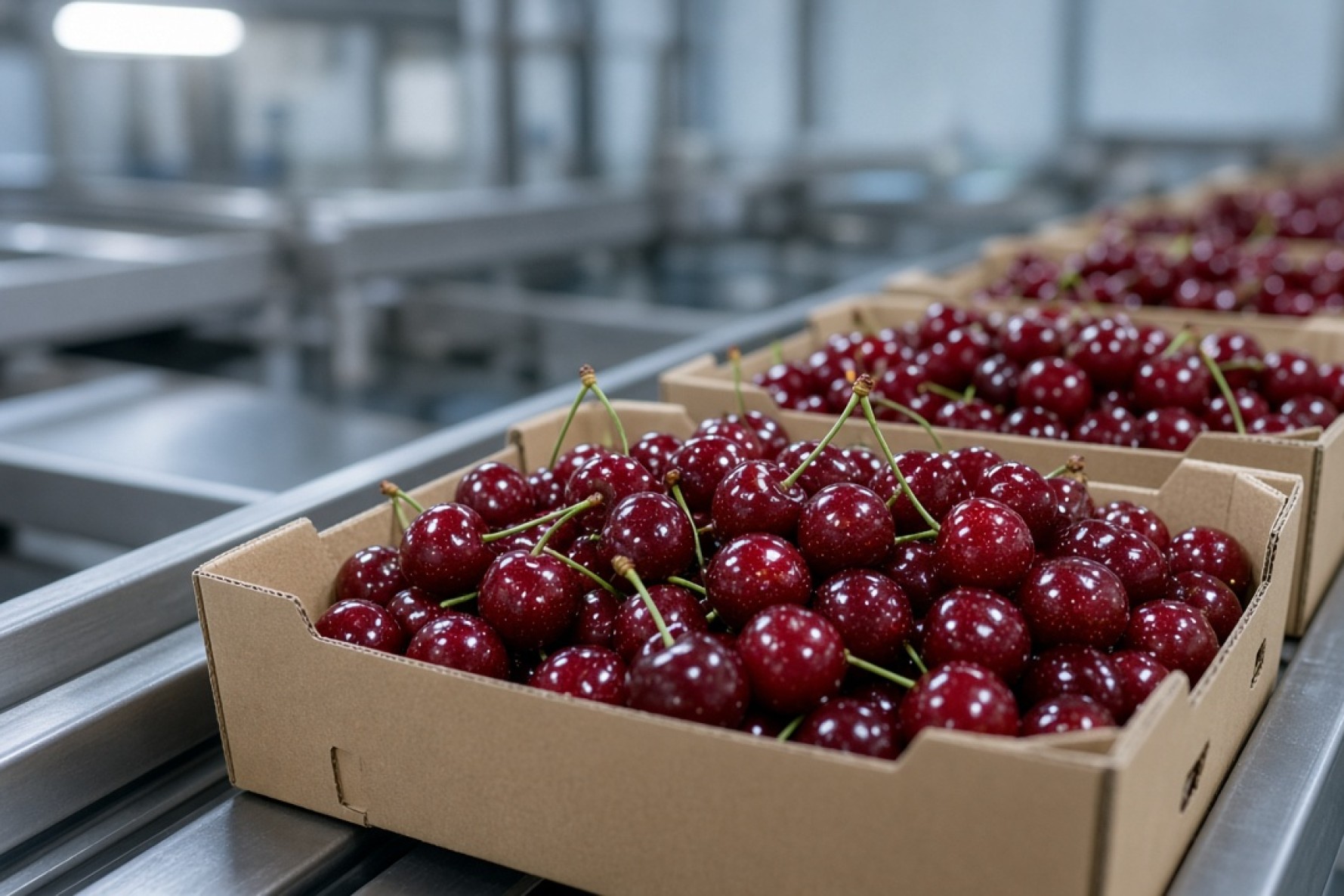
Sweet cherry is among Iran’s most sensitive export fruits. Commercial value depends not only on orchard quality but on harvest speed, pre-cooling, sorting, packaging and maintaining the cold chain through to destination. Russia, Iraq, the UAE, Oman, India and parts of Eurasia matter for Iranian cherries, but success in each market hinges on different requirements for size, colour, firmness, pack style and transport mode.
Under the international HS classification, fresh cherries other than sour cherries are coded080929; sour cherries use080921. Post-harvest references recommend holding cherries at about −0.5 °C within a range close to 0 °C and 90–95% relative humidity to preserve quality. Sweet cherries should reach below 5 °C within roughly four hours of harvest.
In fresh fruit trade, time always matters; for cherries, time converts directly into load value. A few hours’ delay in field shading, transfer to the packhouse or pre-cooling can cause damage that attractive packaging or late chilling cannot reverse.
After harvest, cherries continue to respire, lose moisture and are highly sensitive to pressure, impact and temperature rise. A premium orchard lot under weak post-harvest handling can arrive with brown stems, shrivelled skin, soft texture or high reject rates.
Iran’s mountain climate, elevation spread across growing areas and ability to supply varied colour and size profiles support regional trade. Proximity to Iraq, Russia, Gulf states and Central Asian markets is a major logistics advantage.
Geographic closeness alone does not guarantee margin. In cherry export, the stronger producer harvests to buyer specifications from the start; the stronger exporter treatsfruit temperatureas a measurable commercial metric alongside weight and carton count.
Trade statistics show a real export track record for Iranian cherries. In 2022, under the legacy statistical code 080920 for fresh cherries, more than 13.4 million kg of exports from Iran were recorded, with Russia taking the largest share and Iraq, the UAE, Azerbaijan and India among registered destinations.
The core challenge for Iranian cherry export is therefore not finding a market from zero, but matching each quality tier to the right destination, growing the premium share, cutting in-transit losses and delivering loads buyers can place into wholesale or retail without severe quality collapse.
1. Commercial position of Iranian cherries and how margin really works
Export cherry value rests on four factors: initial product quality, load uniformity, supply-chain speed and achievable destination price. Weakness in any one factor does not automatically yield higher profit even when nominal retail prices at destination look attractive.
For example, Gulf retail may show higher shelf prices than Iraqi wholesale, but premium packs, fast transit, tighter sorting and rejection risk also rise. Iraq, with shorter distance and a history of imports from Iran, can offer a simpler route for some trading groups.
Russia has been very important by historical volume, but high tonnage there does not mean acceptance of weak fruit; firmness, green stems, uniform colour and sound fruit remain decisive.
A “profitable market” in practice is one where available product specs align with that buyer’s standard. Large, dark, firm, uniform cherries with green stems can enter premium channels. Sound fruit of medium size usually belongs in a different commercial lane. Mixing both in one shipment tends to price the entire load at the lower tier.
For Iranco, analysing a cherry order starts here: destination alone does not define opportunity. Destination, required size, colour stage, pack type, transit time and buyer quality limits must be fixed together.
2. What overseas wholesale buyers scrutinise in export cherries
In bulk cherry buying, growing region or local variety names may help in first contact, but the commercial decision rests on measurable attributes. Fruit diameter is the primary index, followed by colour, uniformity, firmness, stem condition, cracking, bruising, decay and soluble solids.
UNECE standard FFV-13 classifies cherries into commercial quality groups. In the Extra class, minimum diameter for most cherry types is 22 mm; for Class I and II, minimum diameter is 17 mm. The same standard stresses soundness, cleanliness, apparent freshness, adequate firmness, absence of abnormal external moisture and ability to withstand transport to destination.
| Attribute | Professional buyer expectation | Effect on price and sale |
|---|---|---|
| Fruit diameter | Uniformity within each pack and match to order | One of the main drivers of premium grade |
| Colour | Uniform and aligned with agreed ripeness stage | Uneven colour reduces perceived load value |
| Firmness | Texture that resists handling and stacking | Excess softness shortens commercial life |
| Stem | Green, fresh, without severe dryness | Key freshness signal in the market |
| Cracking | Minimal and within contract tolerance | Cracks are entry points for decay |
| Bruising and indentation | Minimal | Quickly destroys commercial appearance |
| Decay | Affected fruit removed at sorting | Even a few rotten cherries can taint a pack |
| Soluble solids | Suited to variety and buyer spec | Directly linked to taste and ripeness |
| Uniformity | Similar size and colour within a pack | Critical for premium retail |
Skin colour and soluble solids are common ripeness indicators; green, fleshy stems are widely read as a freshness cue.
A common export mistake is to pick from the orchard first and search for a customer afterward. Professional trade runs in reverse: order specifications are set first, then orchards or orchard groups capable of delivering those specs are selected.
3. Grading — where load profit is created or destroyed
Cherry sorting is not merely separating sound from rotten fruit. Effective sorting converts product into sellable commercial groups. Two cartons both labelled “export cherry” can carry entirely different market value.
On the sorting line, foreign material, leaves and damaged fruit are removed first. Fruit is then separated by diameter, colour and, where possible, other quality indices. The less size variation inside a pack, the more professional the presentation. Chain retailers and premium distributors do not want very large cherries packed beside very small ones in the same carton.
Cracked cherries, serious skin damage, bruising, mould, abnormal softness or decay signs must be culled before packing — not for appearance alone. Damaged tissue accelerates decay and can compromise fruit still in the pack.
Indentation and bruising are major quality killers. Hard contact with equipment, drops, pressure in harvest bins and rough unloading all cause damage; the product path from orchard bin to packing line should minimise free fall and impact.
| Defect | Common cause | Control action |
|---|---|---|
| Skin cracking | Rain near harvest, over-ripeness or mechanical damage | Complete removal at sorting |
| Brown stem | Low humidity and heat after harvest | Rapid cooling and adequate humidity |
| Softness | Late harvest or cold-chain break | Harvest-stage control and temperature monitoring |
| Indentation | Impact during harvest, sorting or packing | Reduce drop height and hard contact |
| Shrivelling | Moisture loss | High humidity and appropriate packs |
| Grey mould | Fungal contamination and poor conditions | Line hygiene, cull infected fruit, low temperature |
| Soft rot | Temperature rise and tissue damage | Fast pre-cooling and refrigerated transport |
Cherry quality should be controlled lot by lot. Blending loads from several orchards without tight control can place fruit of different firmness, size or ripeness stage in the same pack — a problem that shows most on long hauls, when the riper portion fails first.
4. Main markets and export opportunities for Iranian cherries
Suitable markets for Iranian cherries fall into three groups: high-volume established markets such as Russia and Iraq; regional premium markets such as the UAE and Oman; and developing markets such as India and parts of Central Asia.
Trade data show Russia has carried heavy weight in Iran’s cherry export history. In 2022, more than 10.4 million kg of registered fresh cherry exports from Iran under legacy code 080920 went to Russia.
Iraq imported more than 551,000 kg of fresh cherries from Iran in 2024, with Iran the largest registered origin that year. India and Oman also recorded measurable imports from Iran in 2024.
| Market | Commercial status for Iran | Main demand profile | Suitable strategy |
|---|---|---|---|
| Russia | Established, high-volume market | Uniformity, soundness, firmness, transit tolerance | Standard loads, strong pre-cooling, refrigerated haul |
| Iraq | Near, active market | Mix of wholesale and quality-focused demand | Grade separation and fast road transport |
| UAE | Premium, competitive market | Strong appearance, professional packs, large fruit | Focus on Extra grade and retail channels |
| Oman | Smaller but expandable market | Visual quality and appropriate packaging | Selected loads and regular programmes |
| India | Large import market with Iranian presence | Premium product and tight transport control | Named buyers and controlled logistics |
| Kazakhstan & Eurasia | Complementary market | Stable quality and road or multimodal haul | Distribution development and quarantine compliance |
Russia
Russia offers Iranian exporters trade history and refrigerated road options. Every unnecessary hour stopped at border or en route cuts remaining shelf life. Exports to Russia become more economical when loads are chosen from the outset for a relatively long journey — firmer, sounder, more uniform fruit assigned to that lane.
Russia is a member of the Eurasian Economic Union (EAEU). High-risk plant products entering the union must carry phytosanitary certificates issued by the authorised body of the exporting country, and consignments are subject to quarantine control.
Iraq
Iraq is one of the most practical regional destinations by distance and market structure. 2024 statistics show Iraq imported about 1.05 million kg of fresh cherries in the relevant statistical class, with roughly 552,000 kg registered from Iran.
Proximity allows part of the crop unsuited to very long routes to be directed to a nearer market when quality is sufficient — not as an excuse to ship weak fruit. Professional Iraqi buyers still price uniform loads above mixed quality.
UAE and Oman
In Gulf markets, visual appeal weighs heavily. Large cherries with attractive colour, green stems and tidy retail packs have more room in premium stores.
Registered fresh cherry imports from Iran to Oman in 2024 were about 116,000 kg.
Pack design, net weight, layout, ventilation and product appearance must align with the sales channel from the start. A pack suited to border wholesale is not necessarily suited to a premium supermarket shelf.
India
India is a larger import market; in 2024 it imported more than 2.1 million kg of fresh cherries. Over 121,000 kg from Iran was registered that year. Chile, Afghanistan, the United States and Turkey also had significant presence.
Entry into India should rest on supply-window advantage, product quality and freight cost control. Shipping without a firm buyer and without defined quality specs creates high commercial risk.
5. Standards, documents and destination entry requirements
Fresh cherry export at the border is not only a commercial transaction; it is also a plant-health and product-safety process. Exporters must know required documents and destination acceptance rules before harvest.
The primary HS code for fresh sweet cherries is080929; fresh sour cherries use080921.
Typical trade documents include invoice, packing list, certificate of origin, transport documents, export declaration and phytosanitary certificate. Depending on destination and contract, residue test results, quality inspection reports or supplementary certificates may form part of the shipment file.
For Russia and other EAEU members, phytosanitary certificate alignment with the consignment is essential. Fresh fruit entering Gulf countries is also inspected at entry.
In the UAE, official agricultural clearance services for fresh fruit and vegetables include inspection on arrival and laboratory testing when required.
Pesticide residues must be managed in the orchard, not on loading day. Use without respect for pre-harvest intervals or selection of actives with stricter limits at destination can jeopardise the entire consignment commercially.
Export orchards should maintain spray records, last application dates and harvest timing. In professional orders, product samples or specifications are approved before the deal is fixed. Size, colour, pack type, net weight, defect tolerances and even stacking method should be explicit — phrases like “first-grade cherry” alone are not adequate contract language.
6. Cold chain management — the decisive part of cherry export
The cherry cold chain does not start in the cold store; it starts the moment fruit leaves the tree.
After harvest, cherries must be moved out of direct sun quickly. Harvest bins should not sit hot in the orchard for long periods. Transfer to the packhouse should be short and organised, and cooling should begin immediately.
Post-harvest references recommend bringing sweet cherries below 5 °C within about four hours of harvest. Hydrocooling, forced-air cooling and room cooling are common methods; hydrocooling is generally the fastest among them.
After pre-cooling, the main goal is to prevent heat regain. If cooled fruit sits hours in a warm hall, or warm cartons enter a container, part of the pre-cooling benefit is lost.
A refrigerated container is not a tool to “quick-chill hot product”; its job is to hold temperature for fruit already at target before loading.
| Stage | Control point | Correct action |
|---|---|---|
| Harvest | Ambient temperature and harvest timing | Pick in cooler hours; move quickly to shade |
| Field collection | Bin pressure and drop height | Avoid overfilling and impact |
| Orchard to packhouse | Time to packing centre | Minimise transit time; cover load appropriately |
| Pre-cooling | Pulp temperature | Rapid pull-down below 5 °C |
| Sorting | Time in warm environment | Keep area cool; maintain line speed |
| Packing | Product temperature at close | Pack already-cooled fruit |
| Cold store | Near-zero temperature and high humidity | Continuous temperature and RH control |
| Loading | Carton and vehicle temperature | Pre-cooled vehicle; avoid delays |
| Transport | Temperature logging | Use temperature recorders |
| Delivery | Product temperature on arrival | Log temperature; inspect before full unload |
Recommended holding temperature for cherries is about −0.5 °C within a range close to 0 °C; 90–95% relative humidity helps preserve freshness and green stems.
Temperature control should follow actual product temperature, not only the cold-store or container display reading. If container air is at 0 °C but pulp at loading is still warm, fruit inside packs generates heat and uniform temperature takes longer to achieve.
For Iranco export deals, recording pre-cooling-stage temperature and using in-transit loggers on long hauls is an important tool to resolve disputes between seller and buyer. Temperature data shows whether a cold-chain break occurred at origin, in transit or at delivery.
7. Packaging for export cherries
Cherry packs must simultaneously provide mechanical protection, air flow, moisture retention and customer-ready appearance. A pack that looks good but lacks ventilation is unsuitable for refrigerated transport.
Export cartons need enough strength for cold-store humidity and stacking pressure. Vent holes must be designed so they are not blocked when cartons are palletised.
If cold air cannot pass through the stack, temperature differences between the centre and edges of a pallet increase.
For wholesale, robust cartons with suitable inner packs are standard. For premium and retail markets, small consumer packs inside master cartons add appeal. Final pack choice should be agreed with the buyer before buying packaging materials.
Liners and modified-atmosphere packaging can help on long routes. Fruit respiration and film permeability change the gas mix compared with normal air.
Post-harvest sources indicate controlled atmospheres with lower oxygen and higher carbon dioxide can benefit cherries, but pack design must match temperature, product weight, respiration rate and film properties.
This technology does not replace pre-cooling. Warm cherries sealed in MAP raise respiration and create an unstable gas balance.
The correct sequence is appropriate harvest, fast pre-cooling, sorting, packing, then cold-chain holding.
Palletisation belongs in pack design. Cartons should not overhang the pallet, ventilation paths should not be blocked by stretch wrap, and upper-layer weight should not crush lower cartons.
8. Disease, quality loss and in-transit risk control
The three main post-harvest enemies of cherry are heat, moisture loss and mechanical damage. Besides direct quality loss, they increase conditions for decay.
Brown rot, grey mould and opportunistic soft rots are known cherry post-harvest problems. Low temperature is one of the most effective tools to slow decay development.
Low temperature alone is not enough. If the initial load is contaminated or cracked fruit remains in the pack, cooling only slows the problem.
Hygiene of harvest bins, water used, sorting lines, tables, belts, cold stores and packing areas should be part of the quality programme.
Stem browning is another major commercial defect. Consumers judge cherries heavily by green, fresh stems. Even when flesh is sound, dry brown stems make product look old. High cold-store humidity and short harvest-to-cooling time are critical for stem quality.
Pre-loading quality records are essential: dated photos, sorting results, pulp temperature, net weight, pack specifications and lot numbers. On large deals, retained witness samples from each lot help trace disputes.
9. Choosing transport: road, sea or air?
Cherry transport mode should follow market distance, product value, remaining commercial life and achievable destination price.
For Iraq and much of the Russia and Eurasia trade, refrigerated road transport is the main option. Road haul can mean more direct movement and fewer unload/reload cycles. The sensitive points are border stops and transit-time variability — documents should be complete before departure and receiver/broker coordination arranged in advance.
Air freight suits premium product and time-critical markets. Cost is higher, so it makes sense only when premium destination pricing covers freight.
In such deals, pack weight and net-to-gross ratio should be optimised.
Sea freight can be economical on some lanes, but cherries have shorter commercial life than many fruits. Sea use demands precise pre-cooling, suitable packs, predictable schedules and continuous temperature monitoring. Extra port dwell consumes selling life.
Exporters should not plan only on “vehicle transit time.” Real chain time includes harvest-to-pack interval, waiting to load, movement to border or port, export formalities, main carriage, import formalities, transfer to buyer warehouse and time until product reaches market.
Loading five days before product fails is not a sound rule. Cherries at delivery must still have enough commercial life for wholesaler, distributor and retailer.
10. How export cherry prices are set
There is no single fixed export cherry price. Even on one day in one growing area, two loads can price very differently because physical specs and deal terms differ.
Main price drivers include dominant fruit diameter, size uniformity, colour, firmness, stem freshness, defect percentage, pack condition, order volume, delivery point, transport mode, cold-store cost and season timing. Loads with a higher share of large, uniform fruit usually access premium channels more easily.
Another key factor isexport sorting yield. If one tonne is bought from an orchard but only part meets the target export grade, true cost per exportable kilogram rises. Orchard purchase price alone is not full landed cost.
| Factor | Effect on cost or price |
|---|---|
| Larger diameter and uniformity | Higher premium-channel potential |
| High sorting waste | Raises true cost of exportable product |
| Retail-oriented packs | Higher pack and labour cost |
| Long route | Higher freight and quality-loss risk |
| Professional pre-cooling and cold store | Higher operating cost but lower waste |
| Air freight | High cost; suited to higher unit-value product |
| Buying at peak supply | Better volume access with daily market volatility |
| Late-season harvest | Depends on remaining quality and market conditions |
| Destination lab requirements | Adds QC cost |
| Large, uniform orders | Requires professional aggregation across orchards |
What information is needed for an accurate quote?
A professional enquiry should include at minimum destination country and city, order quantity, required size, target colour, pack format, net weight per unit, delivery terms, intended loading window and buyer quality standards. Reference photos or buyer spec sheets speed pricing significantly.
At Iranco, a request such as “price for one container of cherries” lacks enough detail. The gap between medium fruit for regional wholesale and large, uniform cherries for premium retail can change the entire cost and pack structure.
11. Checklist for importers and wholesale buyers of Iranian cherries
This checklist reduces commercial disputes. The more precise the purchase spec, the less room for arguments over vague terms like “export quality” or “first grade.”
- State required diameter in millimetres; do not rely on “large” or “medium” alone.
- Confirm colour stage and expected darkness with reference images or approved samples.
- Define whether stems must be fully green and how dry stems are tolerated.
- Write allowable cracking, bruising, softness and surface defects into the purchase spec.
- Approve pack type, net weight, carton format and inner pack before production.
- For long routes, request pulp temperature after pre-cooling.
- Specify use of in-transit temperature recorders in the contract.
- Align phytosanitary certificate, certificate of origin and destination testing before loading.
- Plan transit on real orchard-to-warehouse time, not truck or vessel transit alone.
- On large orders, require proof the seller can supply the same grade across full volume.
- Maintain lot numbers or traceability for each shipment segment.
- Define arrival inspection criteria before signing so delivery quality is judged against a shared standard.
12. Sourcing and export planning for cherries at Iranco
In cherry trade, finding product is only the first step. Supply must match required volume, season window, repeatable specifications and aligned cold-store and packing infrastructure.
Supplier evaluation must cover both orchard and post-harvest operations.
Under Iranco’s commercial review process, a professional cherry request is defined by destination, quantity, required diameter, colour stage, packaging, loading date and delivery terms. Capability to supply product matching those specs is then verified.
That approach avoids buying volume that later fails to match destination market needs.
Overseas buyers should know from the outset what share of supply will meet their target grade. On repeat programmes, consistency between first and subsequent shipments matters more than a one-off exceptional sample.
Export cherry sourcing should focus on four pillars: suitable orchard selection, controlled sorting, fast pre-cooling and logistics tied to the cold chain. Any plan that skips one link transfers quality risk to destination.
Summary
Iranian cherry export has strong value-creation potential, but cherries cannot be managed like long-shelf-life fruit. Time from harvest to pre-cooling, actual fruit temperature, humidity, size, firmness, stem condition, defect rate and pack quality directly affect achievable destination price.
Russia remains one of the most important markets by trade history. Iraq is critical for proximity, real Iranian presence and fast road options. The UAE and Oman reward premium product and professional packs; India is a larger market where Iran already trades. Market choice should follow real load quality, not destination retail price alone.
Technically, the priority is rapid pull-down and uninterrupted cold holding through delivery. Fruit that stays warm in the first hours after harvest consumes commercial life before it leaves the country — packaging or a refrigerated container cannot recover that lost time.
Sustainable trade requires exporters to sell on measurable specs and buyers to define orders by diameter, colour, firmness, pack type and delivery temperature. Together with lot traceability, professional pre-cooling and transport temperature records, that approach turns Iranian cherries from a high-risk seasonal item into a plannable product for regional and premium markets.
Frequently asked questions about Iranian cherry export
Which export market matters most for Iranian cherries?
Russia has been among the most important markets by registered export volume. Iraq is also a major near market; in 2024 Iran supplied more than 551,000 kg of Iraq’s registered fresh cherry imports. The UAE, Oman, India and Eurasian markets remain important for growth.
What is the best holding temperature for export cherries?
Near 0 °C is appropriate for holding cherries. Post-harvest references cite about −0.5 °C within a half-degree range and 90–95% relative humidity. Continuous temperature matters more than intermittent chilling.
How soon after harvest should cherries be cooled?
Sweet cherries must enter cooling very quickly. Expert guidance is to reach below 5 °C within about four hours of harvest. That speed is central to firmness, green stems and slower quality decline.
What minimum size applies to export cherries?
Acceptable size depends on market and contract. Under UNECE FFV-13, minimum diameter for most types is 22 mm in Extra class and 17 mm in Class I and II. Premium buyers often require larger sizes and tighter uniformity.
Why do green stems matter in export cherries?
Green stems are a primary visual freshness cue. High temperature and low humidity dry stems quickly. Fast pre-cooling and high relative humidity during holding directly protect commercial appearance.
Is road transport suitable for cherry export?
Yes. For markets such as Iraq, Russia and parts of Eurasia, refrigerated road haul is a main option. Product must be fully pre-cooled before loading, temperature maintained en route and border or operational stops minimised.
Can modified-atmosphere packaging replace cold storage?
No. MAP complements the cold chain. Cherries must be cooled quickly first, then packed appropriately. Packaging cannot fix quality lost from staying warm after harvest. Performance depends on temperature, film permeability, pack weight and respiration rate.
What factors move export cherry prices most?
Diameter, uniformity, colour, firmness, stem condition, sorting waste, pack type, order size, freight cost and season timing are the main drivers. Orchard price is only part of final cost; export sorting yield strongly affects cost per sellable kilogram.
Which HS code applies to cherry export?
Fresh cherries other than sour cherries are classified under HS 080929. Fresh sour cherries use 080921. Export documents should match the code to the precise product description and destination customs classification.
Submit an export cherry purchase request
Iranco’s B2B platform (iranco.com) supports international importers and buyers with:
- Purchase requests by diameter, FFV-13 grade, colour, pack type and destination
- Coordination of fresh cherry supply from Iranian growing regions
- Advice on cold chain, refrigerated transport, EAEU phytosanitary requirements and Gulf market entry
In international fresh fruit buying, choosing a supplier on price alone rarely delivers the best outcome. Two offers can differ on pre-cooling, sorting, packs, harvest timing and ability to repeat supply.
Importers planning fresh cherries from Iran should define technical specs before enquiry — including diameter (22 mm or 17 mm targets), colour, firmness, pack weight, delivery temperature and destination.