 Iranco 杂志团队
卡塔尔食品产业市场的战略分析、Watheq 要求、税号、海湾标准、分销网络与冷链管理
Export Guide · Qatar · Watheq · Deir Port · Cold Chain
Iran Food Exports to Qatar: Sales Opportunities for Iranian Producers
Strategic analysis of Qatar’s food industry market, Watheq requirements, tariff codes, GCC standards, distribution networks and cold-supply-chain management
This report reviews demand structure, trade flows, Watheq health rules, tariff codes and the container transit advantage from southern Iranian ports to Al Ruwais and Hamad. Producers and traders will find a roadmap for entering Qatar, quality compliance and contract patterns that reduce risk.
Introduction
Climate limits, scarce fertile soil and limited freshwater keep Qatar’s farm output below ten percent of consumption. High per-capita income and a large expatriate population make Qatar structurally dependent on steady food imports; Doha’s market brings in more than three billion dollars of food, beverages and processed goods each year.
Iran’s climatic diversity and surplus in greenhouse produce, fruit, nuts, dairy, canned foods and aquaculture create strong bilateral trade potential. Non-oil trade is rising and the balance favours Iran, yet much Iranian product still reaches Qatar indirectly via Oman and the UAE under third-country labels.
Sustainable margins require moving beyond traditional trading, understanding GCC standards, Watheq registration and professional cold-chain execution.
1. Macro market and food trade balance
Food import dependence is a stable feature of Qatar’s economy. Progress in dairy and broiler self-sufficiency has not removed imports of vegetables, fresh fruit, tree nuts, red meat, seafood and grain-based products.
Official flows show about 34% growth in Iran’s exports to Qatar and a surplus near USD 11 million for Iranian exporters. The export basket is dominated by crops, greenhouse lines, nuts, eggs and processed foods.
Industry estimates put indirect flows of roughly USD 200 million through Oman and the UAE—real demand for Iranian origin that is often intermediated because of banking or lack of direct marketing.
Iran’s core edge is short sea distance: perishables from southern ports can reach Qatari berths in under half a day, preserving freshness and vitamin value.
Qatar’s consumers split between affluent nationals and Western managers seeking organic and premium packs, and Asian workers driving value and bulk buying. Exporters should align assortments with one segment, not mix incompatible loads.
2. High-potential product groups
Iranian agriculture and food manufacturing map into five advantaged groups for Qatar.
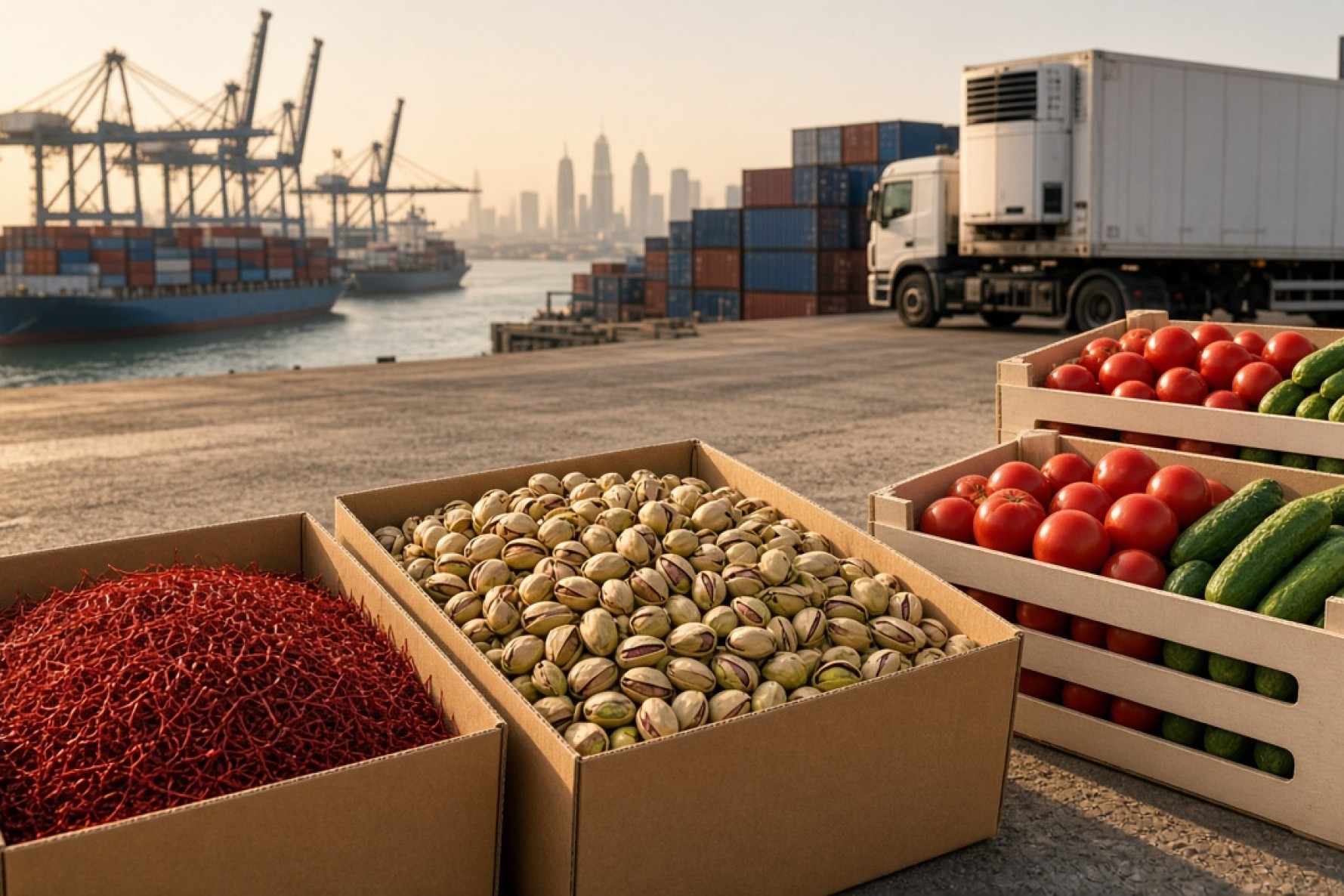
Greenhouse produce: hydroponic tomato, cucumber, bell pepper, broccoli and lettuce from Bushehr, Fars, Hormozgan and Khuzestan in winter months.
Nuts and saffron: Akbari and Ahmad Aghaei pistachios, raisins, Estahban fig, dates and super-negin saffron for hotels and gift retail.
Dairy: demand shifts to skim milk powder, butter, processed white cheese, mozzarella and pastry cream; strained yoghurt and still doogh are popular locally.
Seafood: vannamei shrimp from Bushehr and Chabahar and Gulf fish (shari, zubaidi, hammour) via fast freeze or chilled delivery to Al Ruwais.
Canned and processed: canned tomato paste, tuna, pulses, pickles and packaged biscuits fill hypermarket shelves.
| Category | HS | Quality | Channel |
|---|---|---|---|
| Greenhouse veg | 0702, 0707 | Freshness, uniformity | Hypermarkets, Al Sailiya |
| Fresh fruit | 0807, 0808 | Brix, 5-ply cartons | Catering, retail |
| Pistachio | 0802.51 | Open shell >95%, aflatoxin <10 ppb | Premium nuts |
| Saffron | 0910.20 | Crocin >250, moisture <10% | Hotels, gifts |
| Seafood | 0306, 0302 | −18°C freeze | HORECA |
| Canned | 2002.90 | Standard Brix | Household, catering |
3. Technical specs and quality gates
Qatari buyers enforce mechanical sorting, uniform weight and colour and absence of physical defects; mixed cartons are downgraded or rejected at port inspection.
Key limits include 5% size tolerance per carton, MRL per GSO 382, pistachio open shell ≥95%, total aflatoxin ≤10 ppb, paste Brix 28–30 (cans) and 36–38 (aseptic), firmness 6–8 kg/cm², nut moisture 5–6%, receiving temperature −18°C frozen and +2 to +4°C for fresh produce.
Unauthorized starch, thickeners or colours in processed goods void health approvals and breach contract.
4. MoPH, GCC standards and Watheq
Qatar applies GCC food standards; the Ministry of Public Health monitors imports through the Watheq electronic portal.
Before loading, the Qatari importer needs an active Watheq account and a technical dossier (factory data, formulation, lab results, label images). Shipping without a registered product ID leads to detention, costly sampling or re-export.
Meat, dairy, eggs, seafood, honey and fresh produce require conformity certificates from recognized bodies in Iran.
GCC labelling mandates Arabic; product name, ingredients, allergens, net weight, “Made in Iran”, batch, dates and importer must be industrial print—hand stickers are not allowed on industrial packs.
At clearance at least 50% of total shelf life must remain; otherwise return or destruction at the berth.
5. Tariffs, exemptions and seasonal duties
The GCC unified tariff is typically 5% CIF; payments run through the Al Nadeeb digital customs system.
Zero-duty lines cover live animals, fresh fruit and vegetables, fresh and frozen fish, grains, rice, flour, seed and industrial milk powder.
Seasonal protective duties during local greenhouse harvest can raise some vegetable lines from 0% or 5% to 15%—export calendars must match official windows.
| Product | HS | General | Seasonal |
|---|---|---|---|
| Fresh tomato | 070200 | Exempt | 15% (Jan–May) |
| Eggplant | 070930 | Exempt | 15% (seasonal) |
| Pistachio | 080251 | 5% | Flat |
| Canned paste | 200290 | 5% | Flat |
6. Distribution and consumer behaviour
Three main channels: Al Sailiya central wholesale and morning auctions; modern chains (Al Meera, Lulu, Carrefour, Monoprix); and HORECA plus industrial catering (Huwala in Ras Laffan and Mesaieed).
Modern retail entry needs Watheq product codes, supply continuity, listing fees and flawless packaging.
7. Competitive position vs global suppliers
Turkey leads dairy and canned with branding but longer routes; India competes on onions and rice with 5–7 day sea transit; Saudi Arabia on road logistics; Oman on fish and re-exports with smoother banking; Europe on luxury at high cost.
Iran wins on flavour and horticultural quality; common gaps are carton uniformity, barcodes and cool-chain breaks at loading—fixable with technical management.
| Country | Focus | Rival edge | Iran response |
|---|---|---|---|
| Turkey | Dairy, canned | Brand, pack | Shorter freight |
| India | Onion, rice | Low cost | Fresher, faster |
| Oman | Fish, re-export | Banking | Volume, price |
8. Export packaging for Gulf climate
Humidity and heat require 5-ply moisture-resistant cartons, standard vent holes and MAP films for delicate vegetables.
Pallets 100×120 or 80×120 with ISPM 15, corner boards, strapping and breathable stretch wrap are mandatory.
Nuts and saffron use glass jars, nitrogen-flushed tins or metallized zip pouches.
9. Sea, air and reefer logistics
Deir to Al Ruwais is about 160 km and 8–12 hours on refrigerated dhows—the main fresh-produce corridor.
FCL from Bushehr or Bandar Abbas to Hamad (36–60 hours) suits paste, cans, milk powder and dry goods.
Ultra-frozen −18 to −22°C for shrimp and fillets; air from Shiraz or Tehran to Hamad under three hours for saffron and luxury samples.
Temperature data loggers inside reefers are mandatory; MoPH reviews transit charts on arrival.
| Route | Time | Temp | Cargo |
|---|---|---|---|
| Deir → Al Ruwais | 8–12 h | +2 to +6°C | Fresh produce |
| Bushehr/Abbas → Hamad FCL | 36–60 h | Dry/reefer | Paste, nuts |
| Ultra-frozen | 18–48 h | −18°C | Shrimp, fillet |
| Air Shiraz/Tehran | 2–6 h | Dry ice | Saffron |
10. Pricing, settlement and risk control
Consignment sales at Al Sailiya without fixed prices expose exporters to spoilage and broker pressure; use formal contracts with fixed terms.
FOB southern ports for new exporters; CFR Al Ruwais/Hamad; CIF for major hypermarkets.
Without direct SWIFT, settlement uses licensed exchangers in Doha or Dubai with 30–50% prepayment, CAD or trust accounts in Oman/UAE.
11. Pre-order checklist for importers
- Active Watheq account and complete product registration
- PRN/QFR before loading
- Conformity certificate from accredited Iranian body
- Arabic GCC label match
- MRL and aflatoxin tests (ISO 17025)
- 50% shelf-life check at clearance
- Seasonal 15% duty calendar review
- ISPM 15 pallets
- Reefer data loggers
- Invoice, origin, packing list and health certificates
- Incoterms and exchanger channel agreed
12. Information needed for accurate pricing
Commercial and scientific name, grade, sizing, physicochemical indices, retail and master pack, FCL volume, Incoterms (FOB Deir or CIF Hamad), certificates and discharge port Al Ruwais or Hamad.
Buyers can submit these details on the Iranco platform for structured quotes.
Conclusion
Qatar’s import dependence and proximity to Iran offer tangible opportunity. Long-term presence depends on Watheq compliance, MRL discipline, cold chain and transparent contracts—avoid unsecured consignment sales.
FAQ
Why is Watheq registration required before loading?
Watheq is MoPH’s official portal; without a product ID, clearance stops, costly sampling or return is likely.
Why use Deir Port for fresh produce?
About 160 km to Al Ruwais and 8–12 hours transit preserves perishable quality.
Shelf-life rule at Qatari customs?
At least 50% of total shelf life must remain at clearance.
What must export labels include?
Arabic (English optional), ingredients, allergens, weight, industrial print dates, storage and Qatari importer.
Which products face seasonal duties?
Tomatoes Jan–May and eggplant/courgette in set windows can rise from zero to 15%.
Safe FX settlement?
Licensed Doha/Dubai exchangers, prepayment or CAD; QAR is pegged to USD.
Pistachio aflatoxin limit?
Max 10 µg/kg total and 8 ppb B1 under GCC standards.
Ordering from Iranian producers?
Register specs and volume on Iranco for sourcing and Watheq alignment.
RFQ data for pricing?
Grade, pack, FCL volume, Incoterms and discharge port in the Iranco form.
Iran food supply through Iranco
Importers and procurement managers can register orders by grade, packaging, Qatar MoPH standards and volume on Iranco.
Contact Irancoinfo@iranco.com · WhatsApp: +98 913 104 4182 · Telegram: @irancofood













