 Iranco 杂志团队
Brix、热/冷破碎、霍华德霉菌、220升桶与工业采购分析
采购指南 · 无菌酱 · 工业 B2B
无菌番茄酱:工业采购指南
面向工业买家与国际进口商的技术指标、质量控制、Hot Break 与 Cold Break 工艺、220 升铁桶包装及商务管理的完整指南
Aseptic tomato paste is a strategic raw material in global food manufacturing and the base for sauces, condiments, and repacking operations worldwide. This guide examines laboratory indices such as Brix, Bostwick, color, and the Howard mold test alongside economic analysis of origin and destination markets, giving procurement managers and international importers a clear, rigorous path to precise, low-risk sourcing decisions.
Rising demand from repacking units and downstream processors for consistent, stable, contamination-free supply has made aseptic tomato paste one of the most dynamic items in international trade. Aseptic processing removes the need for continuous cold-chain storage, structurally changing supply-chain management and sharply cutting logistics cost. Industrial purchasing, however, is not limited to unit price per weight: it requires deep understanding of biochemical variables, thermal process engineering, color stability, and rheological behaviour.
Iran combines exceptional climatic advantages, extensive industrial tomato cultivation in high-sunshine plains, and modern continuous concentration and sterilization lines, securing a strong position in regional and global markets. Sharp differences between Hot Break and Cold Break paste, Brix variation, and alignment of quality certificates with strict customs and health rules in destination countries remain core challenges for plant buyers. Minor discrepancies in Howard mold count or burnt particles can expose a full container load to non-release, return, or heavy penalties at destination ports. This guide resolves those ambiguities and builds a technical–commercial view for transparent, durable, reliable contracts.
1. Iran’s commercial and geopolitical role in global tomato paste supply
Annual production of more than 6 to 7 million tonnes of tomatoes places Iran among the world’s top seven producers of this crop. A significant share of the harvest is industrial fruit with high field Brix (typically 4.8 to 5.5%) and suitable dry matter, routed to more than 140 active units producing concentrate and tomato paste.
Geographic spread and climatic diversity create a strategic advantage: for much of the year, processors can access fresh tomatoes reliably.
Main industrial production hubs in Iran
Industrial tomato harvesting and processing follow a clear regional pattern:
- Southern basin (Fars, Bushehr, Hormozgan, Khuzestan): Fars is the heart of tomato processing, with modern vacuum evaporation delivering much of the high-quality concentrate. Autumn and winter cultivation in the south keeps plants running with fresh fruit in cold months.
- Northeast (Razavi and North Khorasan): Long-established processing centres with strong aseptic packing capacity, focused on Central Asia, Russia, and Afghanistan.
- Northwest and west (Qazvin plain, Zanjan, West Azerbaijan, Kermanshah): Contract farming on fertile soils yields paste with excellent colour and high Brix.
- North (Golestan): Summer and autumn production with modern plant density and Caspian Sea ports for direct maritime export.
Iran’s climatic edge is not only volume: long sunny days, favourable day–night temperature swings in Shiraz and Mashhad plains, and industrial hybrid seed use increase effective lycopene in fruit tissue and support natural red colour without additives. Customs data indicate annual exports of more than 110 to 135 thousand tonnes of tomato paste worth over USD 76 to 140 million to more than 50 international destinations. The main shift is gradual movement from small consumer cans toward industrial 220-liter aseptic drums, with growing demand in Russia, the Persian Gulf, Turkey, and Eastern Europe.
2. Core process engineering: Hot Break vs. Cold Break
Choosing the correct thermal break on the production line is the most fundamental step a plant buyer must take based on the finished product. Raw tomatoes contain pectin-degrading enzymes such as polygalacturonase and pectin methylesterase. If not inactivated, they break natural pectin chains and sharply reduce final viscosity. How these enzymes are handled divides paste into two fundamental categories.
Hot Break process characteristics
In high thermal break, crushed tomatoes are heated immediately to 85–95°C (up to 98°C in some systems). This thermal shock rapidly stops pectin-degrading enzyme activity. Natural pectin preserves texture structure; the paste is thick, dense, and rheologically stable. On a Bostwick viscometer it shows very low flow (typically 3–6 cm in 30 seconds). For ketchup, thick pizza sauce, and canned products with meat or vegetables where uniform sauce suspension without syneresis is critical, Hot Break is the definitive choice.
Cold Break process characteristics
In low thermal break, crushed pulp is preheated at lower temperature, usually 60–70°C. Enzymes remain active briefly and partially hydrolyse pectin. The result is lower body and higher Bostwick flow (7–11 cm in 30 seconds). The unique advantage is retention of fresh tomato aroma, limited thermal oxidation of sugars, and bright natural red colour (higher HunterLab a/b). Plants that dilute paste into tomato juice, mixed vegetable nectars, or thinner home-style canned paste consistently prefer Cold Break.
| Evaluation parameter | Hot Break | Cold Break |
|---|---|---|
| Pulp preheater temperature | 85–98°C | 60–70°C |
| Pectic enzyme status | Rapid, complete inactivation | Partial activity and bond cleavage |
| Natural pectin stability | Very high (gel-like body) | Medium to low |
| Bostwick index (viscosity) | 3.0–6.0 cm / 30 s | 7.0–11.0 cm / 30 s |
| Colour brilliance and fresh flavour | Cooked note; deeper red | Very fresh tomato; bright red |
| Primary end use | Ketchup, thick sauce, ready meals | Tomato juice, nectar, can repacking |
Industrial buyers who understand this distinction can choose which type creates more value for their line technology. Buyers planning supply around Hot Break or Cold Break lines can align orders with Iranian plants equipped for dual thermal systems through Iranco.
3. Standards and Brix grades: double vs. triple concentrate
Brix expresses the percentage of total natural soluble solids (NTSS) in concentrate without added salt. In international aseptic tomato paste trade, no salt is added and the product is 100% pure tomato solids. Brix therefore directly reflects commercial value and dry matter yield per kilogram purchased.
Brix 28–30% (double concentrate)
Suited to plants with low-pressure pumping or formulations needing quick dissolution without heavy colloid mills. A large share of shipments to the Middle East and consumer can repacking plants loads at 28–30% base Brix.
Brix 30–32% (standard industrial grade)
The balanced food-industry grade, widely used in Hot Break sauce lines and general Cold Break processing. Evaporation at this Brix limits damage to natural sugars such as fructose and glucose and minimizes caramelization risk on double- or triple-effect evaporators.
Brix 36–38% (triple concentrate)
Strategic for distant export markets and high-volume container moves. Financially and logistically, importing 36–38% paste is often the most efficient form: the buyer pays freight on less water and receives more active dry matter per container. Russian and Eastern European plants dilute this concentrate to lower line Brix. Reaching 38% Brix requires advanced vacuum systems (rising and falling film evaporators) to avoid thermal quality loss and particle scorching.
4. Technical dossier and certificate of analysis (COA): mandatory parameters
For a QC manager or food-plant buyer, a valid COA is the essential document before physical opening and acceptance. Vague terms such as “good paste” have no legal weight; numeric limits for every parameter must be fixed in the international purchase contract. Key COA elements include natural concentration and dry matter, total acidity and pH, optical colour, Bostwick viscosity at standard dilution, microbiological spoilage and Howard mold, and counts of burnt particles and structural defects.
HunterLab colour index (a/b)
One of the main quality pricing drivers for aseptic paste is the redness (a) to yellowness (b) ratio on HunterLab or Gardner instruments. Acceptable colour trends deep red without yellow or brown cast. Global standards often define a minimum a/b of 2.1, with premium grades above 2.2. Values below 2.0 suggest immature tomatoes or excessive heat during cooking and concentration, with partial sugar burn.
Acidity and pH
Acidity is usually expressed as citric acid on reconstituted Brix, typically 1.5–2.5%. Natural pH for tomato and standard paste should sit in 4.0–4.4. Iranian national standard ISIRI 761 sets a maximum pH of 4.3. pH above 4.4 raises risk of incomplete thermal sterilization and, in can repacking, spores of Clostridium botulinum.
Concentration and Bostwick
Bostwick viscosity is measured after dilution to standard Brix (usually 12.0 or 12.5%) at 20°C over 30 seconds in a Bostwick trough. Shorter flow distance means higher structural viscosity and better pulp integrity.
| Parameter | International acceptance | ISIRI 761 (Iran) | Eurasia (TR CU 021/2011) |
|---|---|---|---|
| Brix (NTSS) double | 28–30 or 30–32% | Min. 25% | Per declaration (usually 28–30) |
| Brix (NTSS) triple | 36–38% | — | 36–38% |
| HunterLab a/b | Min. 2.1 | Up to 2.0 (grade bands) | Up to 2.2 |
| pH | 4.0–4.4 | Max. 4.3 | Max. 4.4 |
| Total acidity (as citric) | 1.5–2.5% | Max. 2.8% | 1.5–2.5% |
| Bostwick at 12 Brix (Hot Break) | 3.0–6.0 cm / 30 s | Process-dependent | 4.0–6.0 cm / 30 s |
| Bostwick at 12 Brix (Cold Break) | 7.0–10.0 cm / 30 s | Process-dependent | 6.0–9.0 cm / 30 s |
| Pure lycopene | Min. 50 mg / 100 g dry matter | Min. 45 mg | Min. 55–65 mg |
| Added salt | Zero | Allowed if declared | Zero |
5. Biological safety tests: Howard Mold Count, microbial load, and pesticide residues
Agricultural raw-material quality appears in microbiological and cellular tests. Among the most common reasons for returned tomato paste in import markets are elevated Howard mold indices or pesticide residues above legal limits.
Howard Mold Count (HMC) method
The Howard test is a standard microscopic method counting dead or live fungal hyphae on a Howard slide. It reveals whether incoming tomatoes were sound and fresh or whether a significant share of mouldy fruit passed sorting.
- Global acceptance ceiling: Under U.S. FDA rules, Codex CXS 57-1981, and Eurasian sanitary protocols, positive Howard mold fields in paste diluted to 8.5 Brix must not exceed 40%.
- Reports above 40–50% from reference laboratories classify the product as substandard and the batch as unfit for human food use.
Black specks and structural defects
Dark spots from scorched tomato skin in evaporators or foreign matter are major quality defects. After wash and filtration on standard filter paper, dark particles larger than 0.5 mm should be zero or within a contractually agreed microscopic count; they cause severe consumer rejection in white sauce or clear ketchup.
Heavy metals and pesticide MRLs
International food standards enforce residue limits for organophosphorus, chlorinated, and fungicide actives (e.g. mancozeb, dimethoate, chlorpyrifos) by GC-MS and LC-MS at destination customs. For EU and Eurasia imports, heavy metals are also tested at strict thresholds:
- Lead: max. 0.05–0.1 mg/kg
- Cadmium: max. 0.05 mg/kg
- Arsenic: max. 0.1 mg/kg
- Tin: max. 50–100 mg/kg (in aseptic bag-in-drum, tin contamination is effectively nil)
6. Aseptic packaging technology: multilayer bags and 220-liter steel drums
Aseptic technology means separate high-temperature short-time (UHT) sterilization of the food, simultaneous sterilization of the packaging chamber, and filling in a microbiologically controlled atmosphere with inert gas or steam. The outcome is commercial sterility and ambient storage without chemical preservatives. Components include new impact-resistant steel drums (0.8–1.0 mm sheet), protective polyethylene drum liners, 4-layer metallized or foil aseptic bags with minimal oxygen transmission, steel closing rings with security seals, and heat-treated wooden pallets per international rules.
Aseptic bag structure
- Multilayer laminates typically combine metallized PET or high-purity aluminium foil with LLDPE flex layers and sometimes EVOH oxygen barriers.
- Oxygen transmission rate (OTR): should be below 0.05–0.1 cm³/m²/24 h. Higher OTR causes non-enzymatic browning and lycopene loss.
- Fitment and valve: moulded inlets connect to aseptic fillers; after product injection without air ingress, ports are sealed and locked.
220-liter steel drums
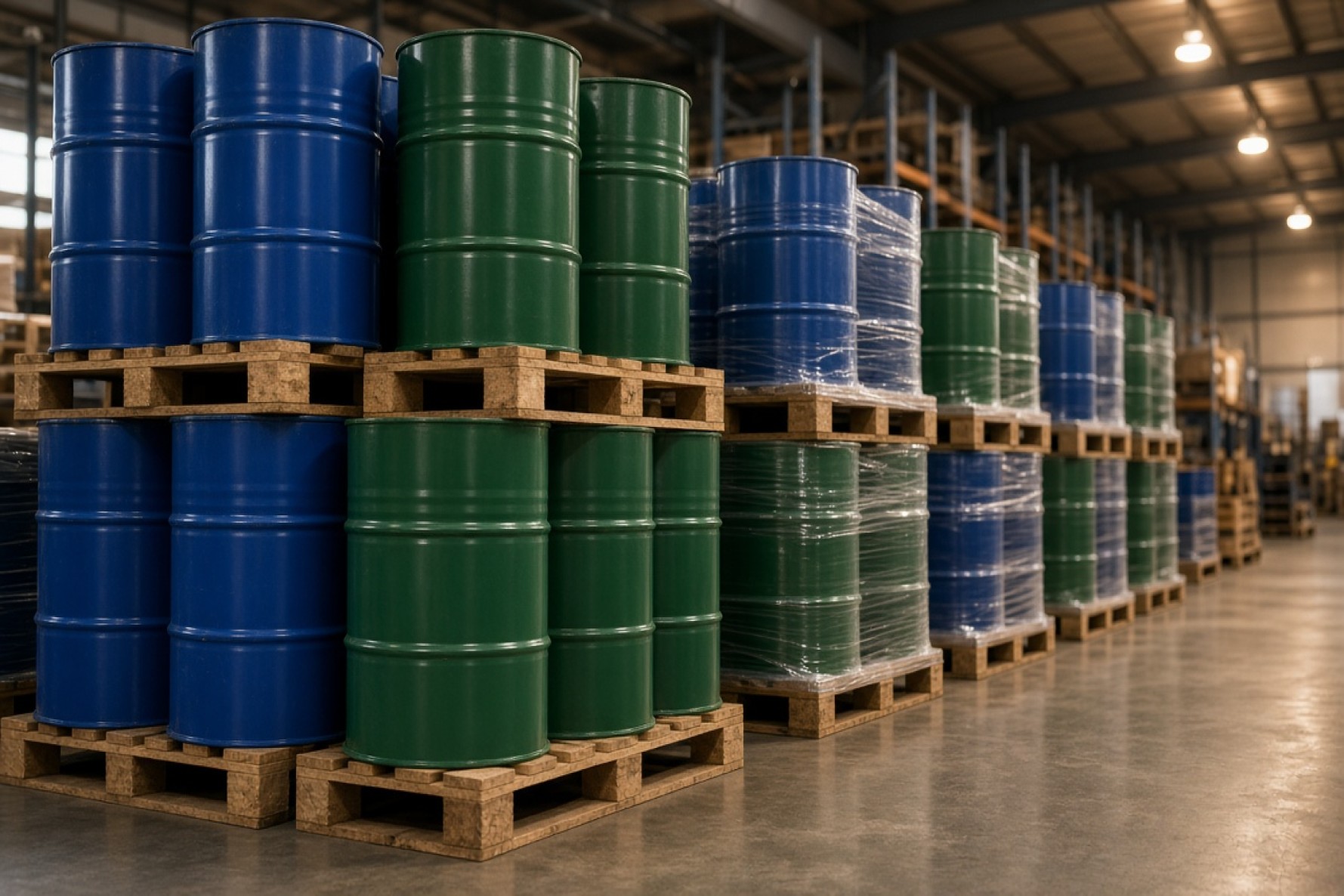
- New steel drums with external anti-rust coating (often blue, green, or white) and internal protective lacquer.
- The aseptic bag is first placed in a thick outer polyethylene liner, then inserted in the drum to prevent abrasion.
- Drum lids are closed with steel rings and screw or lever closures for watertight sealing under transit vibration.
Large aseptic bins / totes
Very large plants may use 1,000-liter wooden or metal bins (~300 US gallons), requiring heavy forklifts and dedicated pressure discharge lines at the destination factory.
| Pack feature | 220 L steel aseptic drum | 1,000 L bin (wood / metal) |
|---|---|---|
| Net product weight | 230–240 kg | 1,250–1,350 kg |
| Gross weight with pack | 248–258 kg | 1,320–1,450 kg |
| Outer body | Coated steel with internal lacquer | Compressed wood pallet box or galvanized frame |
| Aseptic bag layers | 3–5 layers, barrier film | Reinforced films for high tonnage |
| Discharge fitting | 1″ or 2″ sterilized | 2″ or 3″ industrial |
| Logistics role | Standard sea and road containers | Direct plant-to-plant transfer |
7. Logistics, containerization, and dry vs. cold chain
Moving aseptic tomato paste is one of the costliest supply-chain links because of high density and weight. Container damage or pallet overturn can apply multi-tonne pressure on bottom bags and risk bag seam rupture and total batch spoilage.
Loading a standard 20-foot FCL
- A standard 20-foot container typically holds 80 × 220-liter drums.
- Drums are stacked four-high on 20 wooden pallets (100 × 120 cm), strapped and stretch-wrapped.
- Total net paste weight per 20-foot box is about 18.4–19.2 tonnes; gross weight with pallets and container is about 20–21 tonnes.
General vs. refrigerated containers
Aseptic packing allows ambient storage and transport. Specialist buyers still consider route climate:
- On temperate or cool transit routes (e.g. Iran to Russia and Kazakhstan in spring and autumn), standard dry vans perform without quality loss.
- On Persian Gulf sea lanes in summer, when ambient air exceeds 45°C and metal container interiors can pass 60°C, sugars react with amino acids (Maillard) and HunterLab colour drops within weeks. Premium producers then book reefer containers at 10–15°C for stable colour.
Container rain and drum sweating
When containers move from warm to cold zones (southern ports to Russia and the Caucasus), trapped humidity condenses on the ceiling and drips onto drums. Industrial desiccant bags and full pallet hoods help prevent rim rust and pallet damage.
8. Comparative analysis of export destination markets
Industrial buyer requirements differ by country. Each market has national standards and customs structures; exporters must align formulation and documentation accordingly.
Russia and the Eurasian Economic Union (EAEU)
- TR CU 021/2011: baseline food safety including toxins, metals, and microbiological indices.
- TR CU 022/2011: labeling in Russian with producer, net weight, production and expiry dates.
- GOST: emphasis on 36–38% Brix, no preservatives or added starch, Howard mold below 40%.
Turkey and inward processing
Turkey is a major tomato processor yet imports significant Iranian aseptic paste as raw material under inward processing regimes, blending or reprocessing for re-export to Europe. Turkish buyers stress HunterLab a/b above 2.1 and non-GMO declarations.
Persian Gulf (GCC)
- Valid international halal conformity certificates.
- Dates in Gregorian and Hijri calendars; Arabic and English drum marking.
- Acceptance of 28–30% and 36–38% Brix depending on repacking infrastructure.
| Destination | Preferred Brix | Health basis | Drum label language | Special sensitivity |
|---|---|---|---|---|
| Russia & Eurasia | 36–38% | TR CU 021/2011, GOST | Russian (+ English if needed) | Howard <40%, exact Brix |
| Turkey | 36–38%, 30–32% | Turkish Food Codex (TGK) | English / Turkish | a/b >2.1, viscosity stability |
| Persian Gulf | 28–30%, 36–38% | GSO regional standards | Arabic & English | Health cert., halal, metals |
| Iraq & Afghanistan | 28–30%, 30–32% | Border inspection standards | Arabic, English, or Persian | Road speed, drum integrity |
9. Customs tariff structure (HS codes) and commercial declaration
Accurate tariff codes on proforma invoices and customs documents prevent classification disputes at borders. Prepared or preserved tomatoes without vinegar or acetic acid fall in Chapter 20 of the Harmonized System:
- HS 2002.90: global heading for paste, purée, and concentrate.
- HS 2002.90.10: widely used in Iran and the region for tomato paste in various packs.
- HS 2002.90.90: purée, concentrate, and other industrial grades without added sugar.
- Eight- and ten-digit splits often follow natural dry matter: roughly 12–20% (lighter concentrate/purée), 20–30% (double), above 30–34% (triple, often >1 kg net per pack).
International orders should state clearly: “Tomatoes prepared without vinegar or acetic acid, natural dry matter, no added sugar or salt” to avoid misclassification of pure aseptic paste.
10. Competitive assessment: Iran vs. China and Turkey
In tomato products across the Middle East, Central Asia, and wider Asia, three major origins compete closely: Iran, China, and Turkey. Long-term buyers weigh cost, quality, and commercial risk before signing contracts.
China
Xinjiang and national scale make China the world’s largest tomato paste exporter, with automated lines and stable 36–38% Brix. High container freight to Middle Eastern and West Asian ports, geopolitical import restrictions in some Western markets on Xinjiang-origin goods, and 30–45-day sea transit push regional buyers toward nearer suppliers.
Turkey
European-aligned technology yields very uniform, high-standard paste with tariff advantages into the Mediterranean and EU. Higher raw tomato, inflation, and energy costs keep Turkish aseptic paste noticeably above Iranian and Chinese price floors.
Iran
Iran offers structurally low energy, labour, and field tomato costs. Proximity to Russia, the Caucasus, and Gulf ports cuts logistics spend. Historical FX volatility and payment friction have eased somewhat through bilateral settlement in neighbouring markets.
| Origin | Main competitive edge | Constraints | Typical price band | Physicochemical profile | Core export markets |
|---|---|---|---|---|---|
| Iran | Low cost, short transit, strong natural colour | Banking, periodic FX swings | Competitive / economical | Excellent colour, good viscosity | Russia, Iraq, Turkey, Gulf, Kazakhstan |
| China | Huge scale, large-batch uniformity | Long freight, origin perception | Global floor to mid | Industrial standard, mid colour | Europe, Africa, Middle East, East Asia |
| Turkey | EU alignment, modern lines | Higher tomato and energy cost | Mid to premium | Uniform quality, strong Hot Break body | EU, UK, Middle East |
11. Downstream uses and in-plant behaviour
Aseptic tomato paste is a base intermediate in food engineering. Understanding its behaviour downstream prevents heavy losses at user plants. Industrial chains include ketchup and BBQ sauce plants, can/glass/sachet repacking, fish/legume/ready-meal canneries, and industrial tomato juice and nectar producers.
Ketchup and condiment plants
Ketchup combines paste with vinegar, sugar, glucose syrup, salt, and spices. Hot Break paste with low Bostwick is essential: natural pectin acts as a gum and limits costly hydrocolloids and modified starch. Using Cold Break paste for ketchup causes phase separation and a clear aqueous layer on the bottle shoulder.
Can, glass, and sachet repacking
Many countries operate industrial repacking zones: 36–38% aseptic drums are diluted with purified water to home-style Brix (e.g. 27%), salted, pasteurized, and filled into 400 or 800 g cans—minimizing duty on finished goods and metal can imports. Cold Break with high a/b is preferred for a fresh, vibrant retail appearance.
Stew, fish, and legume canning
In tuna in tomato sauce or baked beans, paste carries flavour and provides a glossy coating. Thermal stability through retort (121°C under pressure) without scorch or metallic off-notes is a hallmark of well-controlled aseptic paste.
12. Pricing variables and international contract structure
The final price per tonne of aseptic tomato paste in international trade follows a moving set of variables. Professional buyers should not rely on lump-sum quotes without fixed technical specs.
Key price drivers
- Field tomato price per kg: the largest cost component; roughly 6.5–7.5 kg fresh fruit per kg of 36–38% paste. Weather and fresh-fruit competition move paste price directly.
- Cost per Brix unit: quoted price divided by Brix is the standard comparison; 36% tonne price must reflect dry matter versus 28% offers.
- Harvest vs. off-season contracting: peak Iranian harvest (mid-summer to early autumn) usually marks annual price lows; cold-season and pre-spring northern demand lifts prices.
- Packaging quality: new metallized drums with specified sheet thickness vs. reused drums or cheap high-OTR bags can differ USD 20–35 per drum.
- Incoterms: EXW at plant gate vs. FOB Bandar Abbas or Amirabad vs. CFR/CIF at buyer’s port changes freight and insurance allocation.
To compare market options and receive transparent quotes matched to Brix and thermal break type, Iranco connects importers with tier-one Iranian producers once technical requirements are submitted.
Twelve-point importer checklist before order confirmation
- Match required Brix to production target (e.g. 36–38% or 30–32% NTSS without salt).
- Fix Hot Break or Cold Break in the contract text based on ketchup vs. nectar/repack needs.
- Contractual Bostwick band at defined dilution Brix and temperature (e.g. 5 cm / 30 s at 12 Brix, 20°C).
- Require minimum HunterLab a/b of 2.1 for acceptable redness and no scorch.
- Cap Howard Mold Count at 40% maximum for destination health inspection.
- Mandate new steel drums, outer PE liner, and multilayer aseptic bags with standard OTR.
- Obtain a pre-shipment sample (1–2 kg sealed) with COA from the same production lot.
- Set tolerance for black specks and burnt skin particles per 100 g microscopic count.
- Confirm certificate of origin, phytosanitary/health certificates, and COA aligned with buyer country.
- Specify new pallets, four-drum strapping, and container desiccants against container rain.
- For large tonnage, require third-party inspection (SGS or equivalent) before loading at origin.
- Clarify production/load dates and reefer requirements if routing crosses peak summer heat.
What to send for an accurate price quote
Vague LOIs waste time and produce unrealistic prices. Professional RFQs should list:
- Process type: Hot Break or Cold Break
- Target Brix (e.g. 36–38% or 30–32% NTSS, salt-free)
- Expected HunterLab a/b (minimum 2.1 or higher)
- Maximum allowable HMC (40% or lower)
- Target Bostwick at 12 Brix (cm / 30 s)
- Pack: new 220 L steel drum with 4-layer aseptic bag
- Volume in tonnes or number of 20-foot FCLs
- Final destination country, POD port, or land border
- Incoterms (e.g. FOB Bandar Abbas, CIF Saint Petersburg, CPT Astara)
- Label language, halal, and any factory-specific marking rules
Clear parameters allow Iranco to route inquiries immediately to producers with the highest match to stated requirements.
Sourcing aseptic tomato paste from Iranian producers
Differences among commercial offers for aseptic tomato paste are never only headline price. Rheology, colour stability on reprocessing, Brix uniformity across drums in one shipment, and aseptic bag integrity determine plant profit or loss at destination.
Iranco is a reference B2B platform linking international procurement teams with leading Iranian aseptic tomato paste plants. Buyers register Hot or Cold Break, target Brix, Bostwick and colour bands, and tonnage; Iranco matches orders, prioritizes ISO and HACCP units, coordinates sealed samples with valid COAs, and supports pre-load conformity checks. Email info@iranco.com or use the contact form to start a structured supply review.
Analytical summary
Industrial procurement of aseptic tomato paste sits at the intersection of food biochemistry, thermal process engineering, and international trade law. Success requires moving beyond traditional spot deals toward enforceable industrial standards.
Conscious choice between Hot Break for viscous sauces and Cold Break for repacking and fresh flavour is the first foundation step. Continuous control of Brix, HunterLab a/b above 2.1, Howard mold below 40%, and verified aseptic bag integrity protects quality, legal acceptance, and financial outcome. With large-scale industrial agriculture and world-class product potential, Iran is a strong supplier for global downstream plants when the chain is transparent, technical, and contract-bound.
Frequently asked questions
Why is Howard Mold Count (HMC) critical when buying aseptic tomato paste?
Howard mold counting reveals use of rotten or mouldy tomatoes at the process inlet. Pasteurization kills live microbes but not the structural evidence of mould filaments; Codex and import health agencies treat paste above 40% Howard as a health risk and will not release the shipment.
What is the main functional difference between Hot Break and Cold Break on plant lines?
Hot Break heats pulp to 85–95°C, inactivates enzymes, preserves pectin, and yields thick paste with low Bostwick—ideal for stable ketchup. Cold Break at 60–70°C gives a thinner, brighter product with fresh flavour—ideal for juice and home-style repacking.
What advantage does 36–38% Brix have over 28–30%?
Higher Brix carries more dry matter per kilogram and per container, saving freight on water; the buyer dilutes at destination to a much larger commercial volume.
What is the shelf life of aseptic tomato paste and how should it be stored?
With intact bag seals, product typically keeps up to 24 months at ambient warehouse temperature (15–25°C). Cool, ventilated storage away from direct sun slows non-enzymatic colour darkening from sugar reactions.
How can buyers source aseptic paste directly from Iranian factories?
Define Hot/Cold Break, Brix, colour, Bostwick, drum type, and tonnage, then submit the package through Iranco so available industrial suppliers can be vetted and sealed samples with COAs provided.
What information is needed for an accurate aseptic paste price?
Price follows Brix, thermal break type, drum and bag quality, delivery season, and Incoterms. Iranco registers the same detail set so producer quotes compare on one technical specification sheet.
How many 220-liter aseptic drums fit in a 20-foot container?
Typically 80 drums on 20 four-drum pallets; net paste weight about 18.4–19.2 tonnes and gross load about 20–21 tonnes including pallets and container tare.
What does the HunterLab a/b ratio mean and what is the standard minimum?
a/b is redness divided by yellowness on a spectrophotometer. Quality aseptic paste should show at least 2.1–2.2, indicating natural deep red without immature fruit or vacuum-line scorch.





