 Iranco Dergisi Ekibi
Pazar yapısı, fizikokimyasal özellikler, hasat sonrası teknoloji, standartlar, soğuk zincir ve ihracat lojistiği
Sourcing guide · Thomson navel · Mazandaran · Export
Mazandaran Thomson Portakalı; Tüccarlar ve Toptancılar için Doğrudan Tedarik Rehberi
Market structure, physicochemical specifications, postharvest technology, standards, cold chain and export logistics — for procurement managers and international traders.
This specialist guide covers the technical and commercial dimensions of wholesale Mazandaran Thomson orange sourcing. It gives traders and procurement managers strategic data on quality assessment, sorting standards, postharvest operations, packaging requirements, cold-chain management and customs procedures. Using this analysis, buyers can manage risk, cut unnecessary intermediaries and execute large orders efficiently from northern Iran’s production hubs.
Mazandaran Province is the main production and trade centre for Caspian citrus. The coastal strip’s alluvial soils, regular rainfall and stable humidity support commercial-grade fruit. Thomson navel dominates Mazandaran orchards and a large share of Iran’s agricultural export basket — homogeneous flesh, seedless segments, easy peeling and a strong sugar–acid balance.
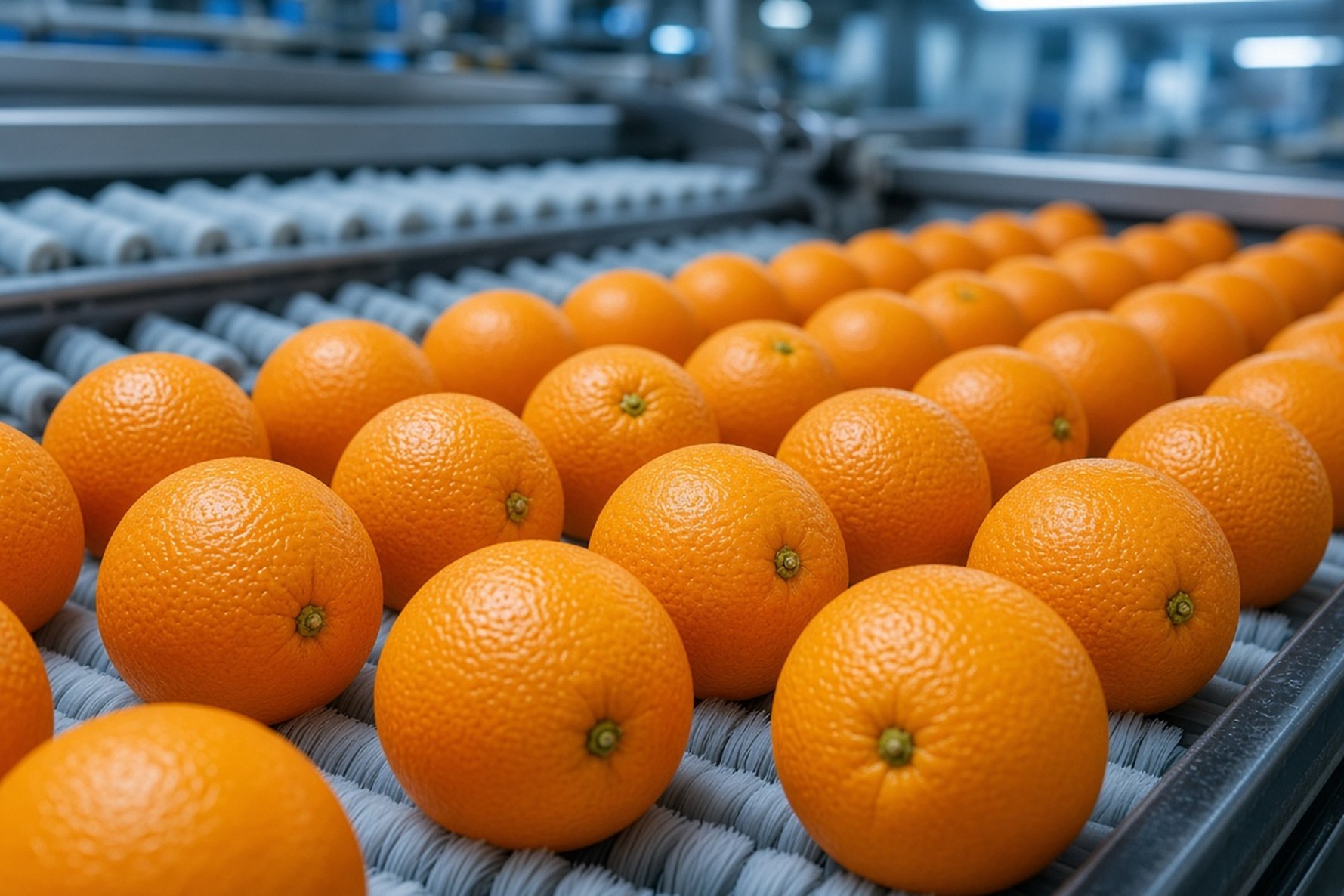
Scaling exports requires moving beyond traditional orchard purchases toward engineered supply chains. Buying in the field without humidity control leads to weight loss, calibre mismatch and biological waste. Meeting modern retail standards in Russia and the Gulf needs wash lines, approved food waxes, electronic sorting and reliable refrigerated equipment.
Direct contact between international buyers and packing houses and cold-store operators at origin stabilises quality, clarifies pricing and preserves shelf life on long transit lanes. This report examines the technical and economic trade in Mazandaran Thomson oranges and the criteria needed for sound bulk contracts.
1. Production geography, orchard structure and regional capacity
The Mazandaran plain and moderate Alborz foothills hold more than 88,000 hectares of citrus orchards, moving over 2.5 million tonnes to markets each year — of which roughly 1.8 million tonnes is orange. Micro-climate differences across the province produce noticeable variation in texture, peel thickness and sugar development between eastern, central and western zones.
Thomson density is highest in the central belt and fertile eastern plains: Qaemshahr, Sari, Miandorud, Babol, Neka and Joybar. Soils are mostly loam–clay with good depth and low electrical conductivity, supporting potassium and calcium exchange and tougher peel against mechanical damage. Traditional orchards yield about 25 t/ha; renovated and mechanised blocks reach 35–40 t/ha.
| Production zone | Soil & climate | Yield (t/ha) | Harvest window | Sorting hubs |
|---|---|---|---|---|
| Qaemshahr | Deep alluvial soil, moderate humidity | 25–35 | Mid-Aban to late Azar | Densest cluster of sort lines and cold stores |
| Sari & Miandorud | Light clay, high sunshine | 28–40 | Early Aban to mid-Dey | Mechanised export packing terminals |
| Babol | Fertile plain, groundwater | 24–32 | Mid-Aban to late Azar | Semi-automatic sort and pack |
| Neka & Behshahr | Semi-humid, day–night temperature swing | 22–30 | Late Aban to Dey | Technical stores and road loading |
| Tonekabon & Ramsar | Heavy rainfall, high humidity | 20–26 | Early Aban to Azar | Bulk and local fresh market flow |
Foothill blocks with sharp night–day swings convert chlorophyll to carotenoids faster, giving higher Brix and brighter colour; lowland orchards produce larger, juicier fruit suited to central wholesale markets. The Qaemshahr–Sari corridor is the north’s citrus processing logistics spine, with hundreds of sorting plants, modern stores and packing units able to aggregate and palletise high tonnage.
Tree structure: Dwarfing rootstocks such as citrange and citrumelo alongside traditional sour orange improve density and humidity stress tolerance and tighten size uniformity.
Plain vs foothill storage: Plain fruit has denser peel pores and needs precise waxing; foothill fruit with higher dry matter and sugar often holds better against winter chilling in extended storage.
2. Morphology and biochemistry of Thomson navel
Thomson navel is a Washington navel sport well adapted to Mazandaran’s humid subtropical climate. The hallmark is the navel-like opening at the stylar end. Flesh is fully seedless and segments separate cleanly from the albedo — a major advantage in fresh consumption markets.
Fruit shape is oblate to spherical. Export-grade equatorial diameter runs 65–95 mm and unit weight about 180–350 g. Peel thickness under balanced nutrition is 3.5–5.5 mm — flavedo (coloured peel) plus albedo (white spongy layer) that buffers mechanical shock.
Biochemically, the cultivar balances sugars, organic acids, vitamin C and flavonoids such as hesperidin. Vitamin C in fresh juice commonly reaches 45–60 mg per 100 ml. Citric acid is higher in early autumn and moderates as fruit matures on the tree.
Maturity index
Maturity Index = Brix ÷ Titratable Acidity (% citric acid)
An index below 7 tastes harsh and acidic; above 9 indicates aromatic development and the sweet profile wholesalers expect.
Granulation risk: From Bahman onward, crystallisation in juice vesicles rises — woody, dry flesh without obvious external peel signs. Professional buyers anchor cold-store contracts to fruit picked from mid-Aban through late Azar.
Albedo puffing: Heavy rain after drought inflates albedo and separates peel from flesh — cull before the wash line because carton strength and shelf life collapse.
3. Commercial calendar, harvest technology and storage behaviour
Non-climacteric citrus cannot accumulate sugar after detachment from the tree; postharvest change is limited to acid decline, moisture loss and texture breakdown. Pick timing is therefore contractual, not cosmetic.
- Phase 1 — early pick (Aban): Yellowing peel; higher acid and Brix 9–9.5. Suited to prompt sale, not long technical cold storage.
- Phase 2 — export peak (Azar to mid-Dey): Prime wholesale window; Brix above 10.5, full orange colour, maximum tolerance for international haul and cold store.
- Phase 3 — cold-store carry (Bahman to Farvardin): Supply from technical stores; full cost rises with power, weight loss and re-sorting.
Commercial degreening and ethylene risks: In early Aban some packers degreen in ethylene rooms at 1–5 ppm, 20–22°C and 90% RH for 24–72 hours. Degreened fruit shows softer stem ends and higher respiration — for destinations beyond about seven days’ transit, tree-ripened colour change is preferred.
4. Commercial classification, calibres 1–5 and quality grades
Physical uniformity drives base price. Modern Mazandaran lines use optical and mechanical weighing by equatorial diameter and gram weight — typically within ±1 g.
| Calibre | Diameter (mm) | Weight (g) | 10 kg carton | 15 kg carton | Target markets |
|---|---|---|---|---|---|
| 1 Super large | 88–100 | 330–420 | 24–28 count | 36–42 count | Premium domestic, specialty retail |
| 2 Export luxe | 81–88 | 280–330 | 30–32 count | 45–48 count | Russia, UAE, Kuwait |
| 3 Export standard | 75–82 | 230–280 | 36–40 count | 54–60 count | Iraq, Caucasus, regional hypermarkets |
| 4 Distribution medium | 69–75 | 180–230 | 44–48 count | 66–72 count | Wholesale chains, mesh bags |
| 5 Industrial small | 62–69 | 130–180 | 52–56 count | 80–88 count | Juice, food service, hotels |
- Superlux grade: Spherical form, full symmetry, small navel, uniform peel; surface defect tolerance under 2%.
- Grade 1 (commercial): Minimum 90% colour coverage, closed navel, up to 5–8% non-progressive surface blemish.
- Grade 2 (general): Minor shape variation, incomplete colour, up to 15% peel defect without impact on juice or flesh shelf life.
Calibres 2 and 3 form the backbone of standard export. On Iranco you can register a purchase request with product, pack and destination detail so supplier review follows the same brief.
5. Postharvest operational protocols
Destination quality depends more on pack-house discipline after picking than on orchard aesthetics alone.
- A) Dump and wash: Hydraulic dump into 36–40°C water with approved food-grade detergent; soft nylon brushes and clean rinse water to clear flavedo pores.
- B) Fungicide: Risk of Penicillium digitatum and P. italicum — imazalil 500–1,000 ppm or thiabendazole (TBZ) with destination MRL verification before treatment.
- C) Waxing: Natural wax is reduced by washing; food-grade carnauba or oxidised polyethylene applied by flood or rotary brush — engineered film thickness (too heavy: anaerobic off-flavour; too light: shrivelling).
- D) Dryer tunnel: 40–48°C air for under two minutes evaporates surface moisture and sets the glossy moisture barrier.
6. Laboratory tests, food safety and quarantine
Plant health and food-safety compliance underpin foreign customs release. Shortcuts at origin trigger rejection, destruction and heavy penalties.
Mediterranean fruit fly (Medfly): Among the most sensitive quarantine pests — Russian Federation protocols may treat a single egg or larva as container-wide contamination. Magnifying-glass inspection, orchard sampling and colour-spot segregation on the sort line are mandatory in export contracts.
| # | Parameter | Method | Acceptance |
|---|---|---|---|
| 1 | Brix | Refractometry at 20°C | Minimum 9; ideal 10.5–12.5 |
| 2 | Titratable acidity | NaOH 0.1 N titration | 0.7–1.2% citric acid |
| 3 | Brix : acid ratio | Maturity index | 8:1 to 12:1 |
| 4 | MRL | GC-MS/MS, LC-MS/MS | Per destination country |
| 5 | Heavy metals | Graphite furnace AAS | Pb < 0.1; Cd < 0.05 ppm |
| 6 | Quarantine pests | Cutting, microscopy | No Medfly |
| 7 | Active mould | Inspection and incubation | Zero at terminal exit |
| 8 | Juice percentage | Mechanical press | Minimum 35–40% of fruit weight |
Advanced terminal labs attach Brix and acidity certificates to each lot’s shipping documents.
7. Export packaging: cartons, trays, crates and pallets
Packaging must survive compression in stacked reefers and rough border handling — not only display printing. Mazandaran export Thomson is typically built around telescopic corrugated master cartons, internal cushioning and pallet discipline.
- 5-ply telescopic cartons: Common net weights 10 kg and 15 kg with die-cut vents; wet-strength board for wash-line moisture; lid/telescope design improves stack stability versus regular slotted containers on Russia and Iraq lanes.
- Cellulose trays: Moulded pulp or cellulose inserts separate fruit, cut point pressure and keep calibre rows uniform — required for Superlux and many Russian wholesale specs.
- PP crates: Reusable polypropylene crates suit short Gulf and domestic legs where return logistics exist; higher tare but better impact resistance than carton alone on Astara-type truck corridors.
- Heat-treated (HT) pallets: ISPM 15–compliant EUR or block pallets; specify HT stamp and maximum stack height (often 1.6–1.8 m fruit surface) in the contract.
- Net pallet wrap: Ventilated stretch net (not fully closed film) preserves lateral airflow between cartons while securing the load — critical when carton vents are designed for 15–20 m³/h pallet-level air exchange in the reefer.
Label each master carton with cultivar (Thomson navel), calibre, count, net weight, pack date, exporter and destination language where required. Private-label artwork should be approved before bulk packing starts.
8. Cold chain: precooling, storage and logistics routes
Warm fruit loaded into a reefer does not cool quickly — the unit maintains set-point but cannot substitute for precooling. Target a fruit core temperature near 5°C before sealing the container.
- Storage set-point: 4.5–6.5°C for Thomson navel in technical storage and most export reefers — inside the broader 4–7°C commercial band without chilling injury on sensitive lots.
- Relative humidity: 85–90% to limit weight loss; combine with wax and carton vents to avoid free moisture on peel.
- Airflow: Cold-store and reefer ventilation roughly 15–20 m³/h per tonne (or per pallet slot per packer spec) to remove respiration heat and ethylene.
- Monitoring: Data loggers at three heights in the load are inexpensive dispute evidence for Russia and Gulf buyers.
| Corridor | Mode | Transit note | Pack preference |
|---|---|---|---|
| Russia — road (Caucasus) | Reefer truck via Astara/Bazargan | 7–14 days; border dwell risk | 5-ply telescopic, calibre 2–3 |
| Russia — Caspian sea | Reefer vessel Amirabad/Anzali → Russian ports | Lower road stress; port scheduling | Ventilated cartons, logger per container |
| Iraq | Reefer or insulated truck | 2–5 days; fast turnover | 10–15 kg carton; price-sensitive Grade 1–2 |
| Gulf (UAE, Kuwait, Qatar, Oman) | Reefer truck + sea or direct road | Appearance-led; re-export hub UAE | Superlux/Grade 1, trays, strong print |
Never mix ethylene-producing fruit (apples, ripe bananas) with navel oranges in the same reefer. Degreening rooms and poorly ventilated holds are common ethylene sources — segregate lots accordingly.
9. Target markets: Russia, Iraq and GCC — comparison
Mazandaran Thomson is not one export product — Russia, Iraq and Gulf states differ on size, peel finish, documents and price elasticity. Contracts should name the lane before calibre and pack are fixed.
| Market | Preferred calibre | Quality focus | Documentation | Price sensitivity |
|---|---|---|---|---|
| Russia | 2–3 (81–82 mm common) | Firm fruit, wax finish, zero decay | Phytosanitary, Medfly-free, MRL, Russian language labels | Medium — competes with Egypt |
| Iraq | 3–4 | Volume, carton strength, quick sale | Commercial invoice, origin, truck manifest | High |
| GCC | 2 (luxe) and 3 | Colour, symmetry, retail pack | Halal market norms, MRL, re-export traceability | Lower on premium grade |
Russia rewards stable QC and documented cold chain; Iraq rewards short lead time and robust 5-ply cartons on border queues; GCC and UAE hubs reward Superlux presentation for retail-facing wholesalers.
10. Competitive position vs Turkey, Egypt and Spain
Iran does not win Thomson navel export on farm-gate price alone. Turkey, Egypt and Spain ship large calibrated volumes with established brand recognition in Russia, the Gulf and Europe.
- Egypt: Dominant in Russian and Iraqi orange trade by volume and marketing presence; Mazandaran must match calibre tables and MRL discipline to compete on the same shelf.
- Turkey: Strong logistics into Iraq and Caucasus; overlapping season with northern Iran — differentiation via seedless navel eating quality and direct Caspian sea options.
- Spain: Reference standard for EU retail appearance; Iran’s practical battleground is nearer markets where freight days favour Caspian and landbridge routes.
Mazandaran’s sustainable edge is traceable, sorted, waxed and cold-chain-managed fruit on shorter lanes — not undifferentiated bulk with mixed calibres.
11. Pricing and cost structure
Export price is built from orchard gate, field sorting loss, pack-house processing (wash, imazalil/TBZ, wax, dryer), calibre yield, carton and tray, cold storage days, inland haul to port or border, export documentation, insurance and destination market risk — not from a single farm quote per kilogram.
| Cost layer | What moves the needle | Buyer lever |
|---|---|---|
| Raw fruit | Season phase (Azar peak vs Bahman store) | Fix harvest window in contract |
| Sort-out | Superlux vs Grade 2 yield | Name grade and max defect % |
| Postharvest | Fungicide + wax + energy | Agree MRL-compliant treatment list |
| Packaging | 5-ply, trays, print | Approve spec sheet before run |
| Cold chain | Storage weeks, precool, logger | FOB vs CIF and dwell time |
| Logistics | Sea vs road, border queue | Incoterms and delivery point |
Comparing offers without calibre, net weight per carton and sort-out assumption leads to claims at destination. Request a line-item breakdown for calibre 2 and 3 in the Azar–Dey window for apples-to-apples bids.
12. Processing and byproducts
Not every Thomson orange ships fresh. Calibre 5, peel blemish within juice limits and post-sort culls feed Iran’s citrus processing chain — relevant for traders who bundle fresh export with industrial offtake.
- Concentrated orange juice (FCOJ / NFC lines): Brix targets and acid balance differ from fresh export; specify separate MRL and variety declaration.
- D-limonene: Peel oil recovery from press waste; industrial and fragrance markets.
- Dried peel and cattle feed: Pelletised peel and pulp after extraction; moisture and pesticide carry-over must be controlled.
- Pectin: Albedo-rich waste streams for food-grade pectin where extraction plants exist.
Fresh export and processing grades should never be commingled on the same sorting line without a defined divert — cross-contamination of wax or fungicide residues into juice streams creates audit failure.
13. Importer checklist (12 points)
- Devlet çeşidi Thomson navel ve Mazandaran üretim bölgesi (örn. Qaemshahr, Sari).
- Çapı mm cinsinden ve 10 kg veya 15 kg'lık karton başına adetini belirterek ticari kalibreyi (1-5) sabitleyin.
- Kalite derecesi belirtimi: Superlux, 1. veya 2. sınıf, yazılı hata toleranslarıyla birlikte.
- İhracat zirvesi için Brix 9-12.5 'e ve olgunluk endeksi ≥ 9' a bağlı bir sezon içi referans örneğini onaylayın.
- Bitki sağlığı sertifikası ve açık Medfly - free denetim protokolü gerektirir.
- Meyve bahçesi spreyleri kilitlenmeden önce sözleşme varış yeri MRL paneli (kullanılıyorsa imazalil/TBZ dahil).
- 5 katlı teleskopik karton spesifikasyonunu, havalandırma deliklerini, tepsi tipini ve net ağırlık toleransını onaylayın.
- Ön soğutma hedefini (~5° C çekirdek) tanımlayın ve % 85 -90 RH ile 4.5–6.5° C ayar noktasını soğutun.
- Yüklemede sıcaklık veri kaydedicilerini ve rastgele karton muayenesini zorunlu kılın.
- Confirm HS 080510 subheading and commercial invoice alignment for importing country.
- Incoterms, teslimat noktası (liman, sınır, şehir) ve sigorta sorumluluğunu belirleyin.
- Çürüme, kalıp ve kalibre karışımı için talep prosedürü, denetim makamı ve reddetme kurallarını kabul edin.
14. Doğru teklifler için RFQ alanları
Eksik RFQ'lar kullanılamayan fiyatlar üretir. Asgari olarak şunları dahil edin:
- Kültivar VE orijin ilçe
- Hedef hasat aşaması (Aban /Azar - Der/soğuk hava deposu)
- Kalibre, kalite, ana karton başına yaklaşık sayım, net ağırlık (10 kg veya 15 kg)
- Minimum Briks, olgunluk indeksi ve belirtilmişse % meyve suyu
- Hacim (ton), konteyner veya kamyon sayısı, sevkiyat programı
- Ambalaj: teleskopik karton, selüloz tepsisi, PP kasa; etiket dili ve özel etiket evet/hayır
- Gerekli laboratuvar testleri (MRL listesi, ağır metaller, Brix/asit sertifikası)
- Varış ülkesi, şehir veya sınır geçişi, tercih edilen koridor (deniz Hazar ve yol)
- Incoterms (EXW paketleme tesisi, FOB limanı, CIF varış yeri)
- Ödeme koşulları ve sevkiyat öncesi denetim ihtiyacı
Zayıf istek: “Thomson Orange FOB Iran'dan alıntı yapın." Profesyonel talep: "Kalibre 3, Derece 1, 15 kg teleskopik 5 katlı, 38 -40 adet, Azar pick, Brix min 10.5, MRL Rusya, Astara üzerinden Moskova'ya haftada 2 reefer kamyon, DAP muayeneyi kabul etti ."
15. Iranco aracılığıyla doğrudan kaynak sağlama
International wholesalers need Mazandaran Thomson that matches written calibre, postharvest treatment and delivery schedule — not mixed orchard lots relabelled at the border. Iranco is the B2B entry point to register purchase requests, align specifications with export packers and reduce unnecessary trading layers.
Submit cultivar, calibre, grade, volume, packaging, test requirements and destination in your request so supplier review starts from the same technical brief. Sample approval, wax and MRL confirmation, and logger rules should be settled before the first full truck or container loads.
16. Summary
Mazandaran Thomson orange export succeeds when orchard, pack-house and reefer behave as one managed chain: defined calibre 2–3 in the Azar–Dey window, Superlux/Grade 1 rules on peel, wash at 36–40°C with imazalil/TBZ and carnauba wax, precool to ~5°C core, hold at 4.5–6.5°C and 85–90% RH, and 5-ply telescopic cartons on HT pallets with ventilated wrap.
Russia, Iraq and the Gulf differ on size, documents and pack — Egypt, Turkey and Spain set the competitive bar. Price follows sort-out, postharvest, storage and lane, not farm gate alone. Laboratory proof (Brix, acidity, MRL, Medfly-free) and a 12-point importer checklist turn volume into repeatable wholesale business.
17. FAQ
What is the minimum Brix for export Thomson from Mazandaran?
Contract minimum is usually 9° Brix; export peak lots (Azar–Dey) should target 10.5–12.5° with maturity index above 9. Early Aban fruit at 9–9.5° is for fast sale, not long cold storage.
Which calibre do Russian wholesalers expect?
Calibre 2 (81–88 mm) and 3 (75–82 mm) dominate — specify count per 10 kg or 15 kg carton in the contract. “Large fruit” without millimetre bands causes claims.
What reefer temperature should be set for Thomson navel?
Precool fruit to about 5°C core, then run 4.5–6.5°C at 85–90% RH with adequate ventilation (roughly 15–20 m³/h per tonne). Do not load warm fruit expecting the reefer to cool it down in transit.
Carton or PP crate — which is better?
5-ply telescopic cartons with cellulose trays are standard for Russia and Gulf retail-facing loads. PP crates suit short Iraq/Gulf truck legs where return logistics exists and extra impact resistance is needed.
What does direct sourcing from Mazandaran mean in practice?
Buying from export packers and cold stores in Qaemshahr–Sari with defined sort, wax, test and load protocols — often facilitated via Iranco RFQ — rather than ungraded field fruit resorted abroad.
Is postharvest wax mandatory?
After hot wash, natural wax is depleted; food-grade carnauba (or approved equivalents) limits weight loss and shrivelling in 4–7°C storage. Wax type and maximum residue must match destination rules.
Which laboratory tests should the RFQ require?
At minimum: Brix, titratable acidity, Brix:acid ratio, destination MRL (GC/LC), heavy metals where required, Medfly inspection, mould check at dispatch, and juice % for dual fresh/processing deals.
What should a professional Thomson orange RFQ include?
Cultivar, Mazandaran zone, harvest phase, calibre 1–5, grade, net weight and count, volume and schedule, pack spec, test panel, corridor (Caspian sea vs road), Incoterms and payment — see section 14 for the full field list.
Öne Çıkan Ürünler










İlgili Yazılar



