 Iranco Dergisi Ekibi
Ürün seçimi, hasat zamanı, sorter, ambalaj, soğuk zincir ve İran kivisini ihracat pazarlarında satış için uzman rehber
Kivi ihracatı · Hedef pazarlar · Hasat · Soğuk zincir
İran Kivi İhracatı: Hedef Pazarlar, Hasat Zamanı ve Taşıma Koşulları
Hayward hasadından sorter ve ihracat ambalajına, ön soğutmadan Rusya, Hindistan, Körfez ve Orta Asya satışına — ithalatçı rehberi.
Key Iranian kiwi export indicators
| Indicator | Value / range | Buyer note |
|---|---|---|
| National output (1403) | ~294,659 tonnes | 5th global producer; bulk potential |
| Mazandaran exports | Main northern loading hub | Sorting & cold stores near ports/borders |
| India shipments | Growth with approved units | Phytosanitary cert. & packhouse codes |
| Store temperature | 0°C at 90–95% RH | Firmness and shelf life to destination |
İran kivisi ihracat için neden önemli?
Kuzey İran Hayward kivisi — özellikle Mazandaran ve Gilan — taze meyve ihracatının ana hatlarından biridir. Üretim hacmi, belirgin hasat penceresi, 0°C depolama ve karayolu erişimi Rusya, Kafkasya, Orta Asya, Irak ve Körfez için avantaj sağlar. Başarı; olgunluk, uniform sorter, MRL, ambalaj ve kesintisiz soğuk zincire bağlıdır.
1. Iran's place in kiwi production and export
With about 294,659 tonnes in FY 1403, Iran ranks fifth globally after China, New Zealand, Italy and Greece. Scale enables bulk programmes, but quality varies widely between packhouses and exporters.
First-half 1404 trade reports ~35,000 tonnes exported to 20+ destinations. Russia, India, Iraq, the UAE, Qatar, Oman, Azerbaijan, Georgia and Central Asia recur as destinations. Professional buyers pair Iran's volume with provable quality control.
Versus New Zealand and Chile, Iran gains overland distance to Russia, Iraq and parts of Central Asia — but on long sea lanes (some Indian or European ports) landed cost and transit days must match firmness and the destination ripening programme.
Gilan has reported around 174,000 tonnes production in recent seasons with a significant export share. Combining Mazandaran volume/sorting infrastructure with Gilan's earlier window supports multi-lot seasonal programmes.
Iraq's proximity enables fast road turns — often suited to medium firmness and less than two weeks to shelf. The UAE and Qatar retail channels stress pack appearance and size uniformity.
| Rank | Country | Approx. output | Competitive note |
|---|---|---|---|
| 1 | China | >2 million t | Mostly domestic |
| 2 | New Zealand | ~550–600k t | Brand & sea logistics |
| 3–4 | Italy / Greece | Top EU origins | EU market access |
| 5 | Iran | ~294,659 t | Overland to Russia & Gulf |
| — | Chile | Strong sea exports | Russia/Asia rival |
2. Main origins: Mazandaran, Gilan and Hayward
Mazandaran is the core export origin (Tonekabon, Ramsar, Neka, Behshahr and nearby districts). Gilan ( Talesh, Rezvanshahr, Rudsar, Astara) adds earlier complementary supply. Export grade is overwhelmingly green Hayward (Actinidia deliciosa cv. Hayward).
Climate and harvest dates differ between provinces, enabling staged buying if each lot is contracted with separate numeric specs (firmness, Brix, size).
Export requires farm/packhouse registration for destination rules (especially India) before harvest. Buyers should receive valid production or packhouse codes tied to the same picking district.
- Mazandaran: Tonekabon, Ramsar, Neka, Behshahr, Bandar Gaz — sorting and cold-store hub
- Gilan: Talesh, Rezvanshahr, Rudsar, Astara — earlier complementary supply
- Dominant variety: green Hayward; other cultivars only by explicit contract
| Parameter | Example | Export relevance |
|---|---|---|
| Province / district | Mazandaran, Gilan | Traceability & market rules |
| Variety | Hayward | Market recognition & ripening |
| Calibre | e.g. 90–110 g | Retail uniformity |
| UNECE class | I or Extra | Defect tolerance |
| Firmness | Agreed penetrometer method | Transit tolerance |
| Brix / DM | ≥6.2° / ~15% | Codex CXS 338 minimum maturity |
3. Harvest timing for export
Export picking concentrates from late Mehr through Aban, varying by elevation and province. Early pick sends firm but immature fruit on long lanes; late pick raises softening and ethylene risk.
Codex CXS 338-2020 and UNECE FFV-46 set minimum maturity at 6.2° Brix or 15% dry matter average. Link orchard sampling dates and lab averages to the cold-store batch actually loaded.
QC teams should record Brix, penetrometer firmness and agreed ripeness scores at several orchard points — fruit at 6.2° Brix but below loading firmness is unsuitable for 15–20 day lanes.
- Harvest index: Brix ≥6.2 or ~15% dry matter
- Firmness: numeric agreed range, not subjective wording
- Uniformity: avoid mixing multi-day picks in one carton
- Logging: date, orchard block, sorting operator
4. Sorting, grading and quality control
Sorting lines should grade by weight or diameter, uniformity, skin defects, decay, pests and firmness — each with contractual limits.
For sensitive markets (EU, India, Gulf), MRL panels must reflect sprays used on the same orchard or batch. Sampling must cover multiple pallets and carton depths, not display rows only.
CXS 338 splits kiwi into Extra, Class I and II; bulk export usually trades Extra or I — Class II only by explicit agreement and price.
| Defect | Risk | Export approach |
|---|---|---|
| Decay | Fast spread | Zero tolerance |
| Bruise / wound | Decay entry | Very strict limit |
| Marks & sunburn | Appearance | Agreed % cap |
| Size mismatch | Value gap | Re-sort |
| Soft fruit | Short life | Near market or downgrade |
5. Target export markets
Destination mix shifts with season, exchange rates, destination cold capacity and competition from New Zealand, Chile and Turkey. The table is a roadmap; regional notes follow.
| Market | Role | Practical note |
|---|---|---|
| Russia | High volume | Cold chain, CA, price competition |
| India | Growing demand | Approved units, PC, labels |
| Azerbaijan | Land border | Fast delivery, documents |
| Georgia | Transit / consumption | Uniform quality |
| Central Asia | Kazakhstan, Uzbekistan… | Reefer road |
| UAE | Regional hub | Appearance, packing |
| Qatar & Oman | Retail & wholesale | Temperature stability |
| Iraq | Proximity | Speed and price |
Russia
Rail and sea lanes from northern Iran; firmness and temperature logs matter. Compete on landed cost and repeatable quality vs Chile and Turkey.
India
Entry requires phytosanitary certificates, registered production/packhouse units and quarantine compliance. Align English label text and PC codes before printing.
Gulf (UAE, Qatar, Oman)
Fast turnover markets — premium packs and size uniformity count. Shorter sea legs than Europe but port breaks in the cold chain are common.
Caucasus & Central Asia
Reefer road dominates. Border coordination, container seals and data loggers are critical for disputes.
6. Export documents
Typical sets: commercial invoice, packing list, certificate of origin (if required), phytosanitary certificate (ISPM 12), bill of lading and sometimes quality or MRL reports. HS 081050 on the proforma must match the physical product (fresh kiwi).
Carton marks: product name, count, net weight, exporter, country of origin (Iran), traceability code and — for India — approved unit codes. Mismatches between labels and phytosanitary text can stop clearance.
- Invoice and packing list aligned on net weight and counts
- Phytosanitary certificate under ISPM 12
- Certificate of origin when tariff or preference rules require it
- Contract spec annex with Brix, firmness and defect limits
- MRL laboratory report for strict destinations
7. Packaging and palletisation
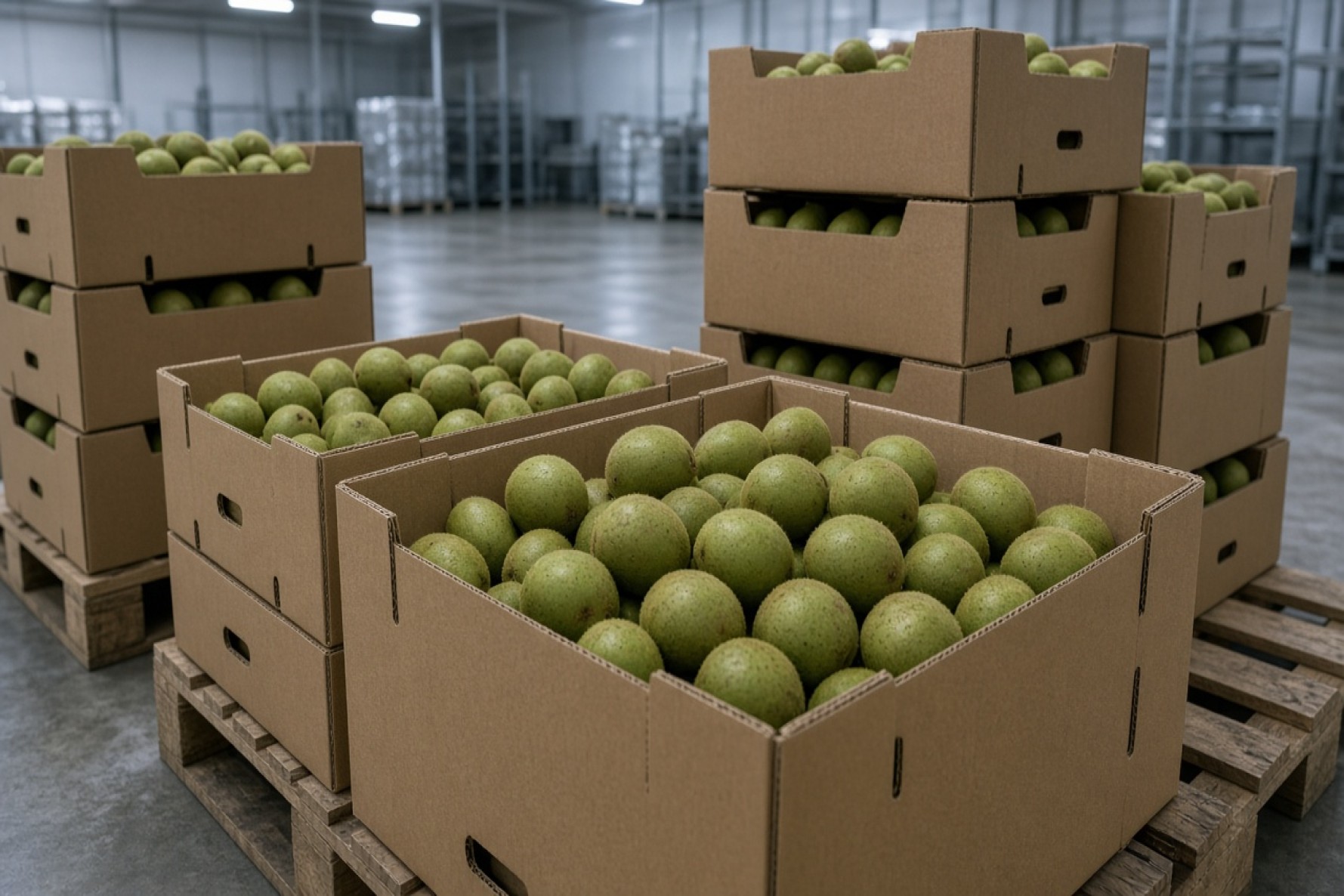
Common export packs: 3.5–10 kg cartons with trays or dividers, vent holes and moisture-resistant print.
EUR pallets with stretch wrap and corner boards; agree pallet weight and stack height with destination equipment. Sea freight needs cartons that tolerate high RH inside reefers.
| Type | Gross weight | Use |
|---|---|---|
| Single-wall carton + tray | 3.5–5 kg | Premium retail |
| Double-wall carton | 7–10 kg | Wholesale |
| Cell dividers | Variable | Long road haul |
| EUR pallet 80×120 | ~500–700 kg | Mechanised loading |
8. Cold chain and shipping
Pre-cool after sorting until pulp nears 0°C before loading. Kiwi is highly ethylene-sensitive — store separately from apples, tomatoes and bananas. Data loggers are recommended for Russia and India lanes.
Reefer road for Iraq and Central Asia; reefer sea for India and the Gulf. Long ambient stops raise pulp temperature and halve commercial life.
Road: 0°C reefer trucks to Iraq, Azerbaijan, Armenia and Central Asia — shorter door-to-door but border delay risk.
Sea: reefers from northern ports to JNPT, Jebel Ali and Russian ports — needs sound seals, airflow management and a destination ripening plan.
| Stage | Target temp | RH / note |
|---|---|---|
| Post-harvest | Shade, rapid move | Lower respiration |
| Pre-cool | 0°C | Pulp ready before load |
| Cold store | 0°C | 90–95% RH |
| Loading | Pulp ≤2°C | Check before seal |
| Transit | 0°C set point | Ethylene & CO₂ control |
| Delivery | No broken chain | Logger report |
9. Export pricing levels
Export kiwi price is not a single number — three common negotiation levels exist. State which level you quote so FOB, CFR and delivered offers compare fairly.
Other drivers: sort-out %, testing fees, carton type, real pre-cool, FX, season (peak pick vs late season) and Chile/New Zealand supply in the same destination window.
| Factor | Effect | Negotiation note |
|---|---|---|
| Larger calibre | Higher unit price | Softening risk on long haul |
| Extra class | Better margin | Higher sort cost |
| Pre-cool | Energy cost | Required for sea lanes |
| Full MRL panel | Lab cost | EU/India gate |
| Volume | Scale discount | Batch uniformity |
| Level | Includes | Buyer risk |
|---|---|---|
| FOB orchard / packhouse | Sorted on line | Domestic haul & export formalities |
| FOB cold store | Pre-cooled inventory | Loading & international leg |
| CFR/CPT destination | Freight + insurance per Incoterms | Import clearance & last mile |
10. Iranco supply approach
Iranco (ایرانکو / إيرانكو) is the B2B path to register structured purchase requests for Iranian agricultural products — not “Iran Ceramic”. Buyers submit measurable specs (variety, calibre, firmness, Brix, pack, volume, destination, Incoterms) so northern orchard, sorting and cold-store options can be matched.
For large programmes, visits, batch samples and export document alignment (especially India and Russia) can be coordinated within the purchase request workflow.
Use the correct trade name Iranco (ایرانکو / إيرانكو) — avoid misleading abbreviations in English correspondence.
- Register a purchase request with variety, calibre, firmness and destination
- Match cold-store inventory to your loading window
- Approve samples from the same batch before the main contract
- Align documents: HS 081050, phytosanitary certificate, labels
- Align cold-chain mode with road vs sea routing
İstatistik ve gümrük notları
The 294,659 t output figure anchors seasonal volume planning — confirm the lot matches the same harvest season and origin district.
Mazandaran is widely cited as the northern loading hub — align port/border loading with Incoterms on the proforma.
India shipments require approved unit lists and correct PC codes on the phytosanitary certificate — verify rule changes with the destination broker before loading.
HS 081050 applies to fresh kiwi; processed or mixed products may classify differently.
Before signing a seasonal contract, importers should audit packhouse and cold-store capacity at least once — carton photos or isolated samples are not enough.
On long lanes, subtract transit and retail distribution days from loading firmness so remaining sellable days are realistic. Structured Iranco purchase requests align suppliers on this math.
18 maddelik ithalatçı kontrol listesi
- State variety (Hayward) and country of origin on the proforma.
- Define average calibre or weight and uniformity tolerance numerically.
- Fix UNECE class or contractual equivalent (Extra / I).
- Write minimum 6.2° Brix or 15% dry matter in the contract.
- Agree firmness range and measurement method.
- Set skin defect limits and decay tolerance (prefer zero).
- Align harvest window and loading date.
- Record carton type, count per carton and net weight.
- Document pallet pattern and maximum stack height.
- Require real pre-cool and pulp temperature at loading.
- Specify data logger placement.
- Confirm separation from ethylene-producing fruit.
- Request MRL panel matching the destination.
- Verify phytosanitary certificate and unit codes (India).
- Approve English label text before printing.
- Clarify Incoterms (FOB, CFR, etc.) and delivery point.
- Define accept/reject criteria and optional third-party inspection.
- Document cold-chain responsibility after loading.
For an accurate quote, send at least: variety and calibre, quality class, volume (tonnes or pallets), pack type, destination port, Incoterms, MRL needs, loading window and allowed storage time at origin. Without this, comparing two “export kiwi price” lines is usually misleading.
Özet
İran kivi ihracatı, doğru olgunlukta hasat, uniform sorter, uygun belgeler ve 0°C zincirle sürdürülebilir; Rusya, Hindistan ve Körfez hacim sunar ancak sıcaklık kırılması ana risktir.
Sık sorulan sorular
When is the Iranian export kiwi harvest season?
Mostly late Mehr through Aban, varying between Gilan and Mazandaran; contracts should state harvest and load dates.
What are the main export markets for Iranian kiwi?
Russia, India, Iraq, UAE, Qatar, Oman, Azerbaijan, Georgia and Central Asian states are recurring destinations.
What transport and storage temperature is used?
About 0°C at 90–95% RH; fruit should be pre-cooled before loading.
What is minimum export maturity?
At least 6.2° Brix or 15% dry matter average under CXS 338 and UNECE FFV-46.
How ethylene-sensitive is kiwi?
Very sensitive — keep separate from ethylene-producing commodities in storage and transit.
What packaging is typical?
Ventilated cartons with trays/dividers on EUR pallets with proper securing.
Is sea freight suitable?
Yes with 0°C reefers, loggers and intact seals; transit time must match fruit firmness.
Which tests matter most?
MRLs, firmness, Brix/dry matter, decay inspection and size uniformity.
What is needed for bulk purchase?
Volume, calibre, class, destination, Incoterms, pack type, MRL and loading window.
What is the HS code for fresh kiwi?
081050 under HS; reconcile with destination customs classification.
Öne Çıkan Ürünler












İlgili Yazılar



